
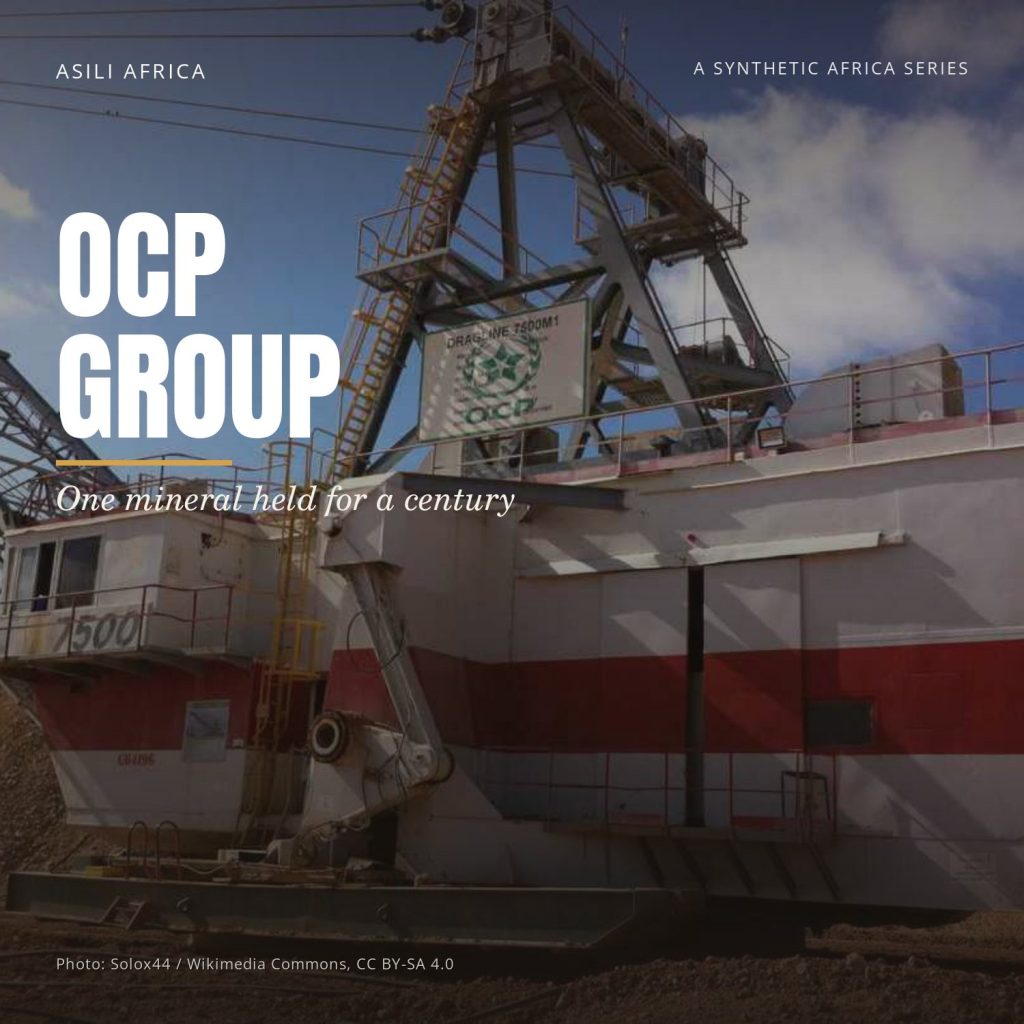
The OCP Group Story: One mineral held for a century
Most fertilizer is built around three nutrients. Nitrogen, potassium and phosphorus.
Nitrogen can be drawn out of the air. Factories do it every day. Phosphorus cannot.
It comes only from rock, dug out of the ground.
There is no synthetic version of it. There is no substitute for it.
Every farm on earth that uses fertilizer depends, in the end, on that rock.
About seventy per cent of the world’s known reserves of it lie under Morocco and Western Sahara.
Seven in every ten tonnes of the known supply of something nothing can replace.
In nineteen twenty, a decree handed Morocco’s phosphate to a single state body.
It became a company. It has been held by the same owner ever since.
A hundred and six years on, it has never been sold. The Moroccan state still owns it.
THE DECREE
On the twenty seventh of January, nineteen twenty, a decree declared a state monopoly over the working of Morocco’s phosphate.
Morocco was then a French protectorate. France ran the administration, and decrees were issued in the name of the Sultan.
A decree of that kind is called a dahir.
On the seventh of August that year, a second dahir created the body that would hold the monopoly. The Office Chérifien des Phosphates.
Chérifien refers to the Sultan. The name was his. The administration was France’s.
Today the body is known by its initials, OCP.
The purpose of the decree is on the record. The phosphate under Morocco was already suspected to be vast.
The monopoly was meant to keep it out of private hands and foreign concessions, and to send its revenue through the state.
There is no founder in this story. No engineer with a hunch, no trader with a borrowed stake. There is a decree.
Mining began at Boujniba, in Khouribga, on a plateau south east of Casablanca that sat on some of the richest phosphate deposits then known.
The first shaft opened on the first of March, nineteen twenty one. Khouribga was the first of the mining basins, and it is still the largest.
On the twenty seventh of July, the first cargo of phosphate left Morocco by sea.
Ten years later, in nineteen thirty one, a second mining basin opened at Youssoufia.
The people who dug it are missing. No miner, no foreman, no labourer from the company’s first three decades is named or quoted in any source we found.
The founding survives as decrees, dates and tonnage, and nothing else. The people who went down the shafts left no words in this record.
For four decades, the rock went out the way it came up. It was dug, loaded and shipped. Nothing was made from it at home.
Phosphate from Khouribga and Youssoufia went to fertilizer makers abroad, and the money came back through the state, as the decree intended.
In nineteen fifty six, Morocco became independent.
The monopoly that a colonial administration had created passed to the independent Moroccan state. It kept its name, and it kept its monopoly.
How that handover was made, we could not find. No source examined for this episode describes it, and we are not going to fill that gap with a guess.
What the record does show is enough. The flag over the building changed. The instrument inside it did not. The decree outlived the protectorate that wrote it.
In nineteen sixty five, at Safi, on the Atlantic coast, OCP began turning its own rock into phosphoric acid and fertilizer.
For the first time, some of the rock stayed home, and became something else before it left.
The ground had been the state’s since nineteen twenty. Now some of the value was as well.
THE CONVEYOR
In nineteen seventy five, Spain still administered Spanish Sahara, the stretch of Atlantic coast and desert now known as Western Sahara.
That year, in the Green March, about three hundred and fifty thousand Moroccans crossed into the territory.
On the fourteenth of November, nineteen seventy five, in the Madrid Accords, Spain agreed to transfer the administration of the territory to Morocco and Mauritania.
Inside the territory, Spain had been developing a phosphate deposit since the nineteen sixties. It was called Bou Craa.
On the first of January, nineteen seventy six, Spain’s state phosphate company sold OCP sixty five per cent of the Bou Craa mine.
Who held the other thirty five per cent until then, the sources we used do not say.
A handover of about sixteen months followed. By May nineteen seventy seven, the Spanish technical staff had gone.
In two thousand and two, OCP became the mine’s sole owner.
The march and the accords were acts of governments. The purchase was OCP’s.
Those are the facts the record gives, in sequence. The words people put on top of them belong to the people who use them, and when we use those words, we will say whose they are.
Bou Craa is an open pit in pale desert, about a hundred kilometres from El Aaiún.
Its rock is carried to the coast on a conveyor belt about a hundred kilometres long.
One belt, running straight across empty ground, from the pit to the port.
Most of what is documented about this trade comes from one organisation, Western Sahara Resource Watch, a monitoring and advocacy group that has tracked it for two decades.
We name it every time we use it, because it matters how much of the record rests on one source.
According to the group, about two million tonnes of rock were extracted at Bou Craa in twenty twenty five.
Figures it cites put the mine at about eight per cent of what OCP extracts, and about a fifth of OCP’s phosphate rock exports.
Two numbers, and we will leave them as two numbers. A small share of the digging. A large share of the rock OCP ships abroad.
It is not where OCP’s hold began, and it is not a footnote to it. It is the one part of OCP’s ground that other people dispute.
The United Nations lists Western Sahara as a Non-Self-Governing Territory.
The United Nations keeps that list for territories whose peoples have not yet attained a full measure of self government.
The Polisario Front fought Morocco from nineteen seventy five until a ceasefire in nineteen ninety one, a ceasefire that has since come under strain.
It claims the territory as an independent state.
Morocco calls the territory its Southern Provinces. Since two thousand and seven, it has proposed autonomy for them under Moroccan sovereignty.
Those three positions cannot all be right. Each has its supporters among governments. Each is given here in its holders’ own words.
The question of whose ground this is has never been settled, and this episode is not going to settle it.
One party’s own account is missing, and it is the company’s. We looked for what OCP, or Phosboucraa, the subsidiary that runs the mine, has said in public about its right to Bou Craa, and about what the mine gives the territory.
We did not find it in the record examined. We are not going to write it for them.
The belt runs on, across the desert, towards the sea.
The people whose territory this is, the Sahrawi, do not speak in this record.
Not one first person account from a worker, a refugee or a resident is in any source we found. A monitoring group’s voice is not theirs.
The record argues about who owns this ground. It says nothing about who lived on the ground the mine now covers.
THE FACTORY
In nineteen eighty four, the Jorf Lasfar chemical complex opened on the Atlantic coast.
By the company’s own description, it is now the largest integrated phosphate processing site in the world.
Four years before it opened, a third mining basin had started work, at Benguerir.
Safi had begun turning the rock into fertilizer at home. Jorf Lasfar made that the centre of what OCP does.
In two thousand and six, Mostafa Terrab became chief executive. He was born in Fez, in nineteen fifty five.
He had trained in engineering and operations research at the Massachusetts Institute of Technology.
He had worked as an adviser in the Royal Cabinet, as head of Morocco’s telecoms regulator, and as a specialist at the World Bank.
In two thousand and eight, OCP became a public limited company. The Moroccan state kept ninety four point one two per cent. A Moroccan banking group, Banque Populaire, held the rest.
A company in form. The state’s in ownership. The paperwork changed, and the owner did not.
No shares went to the public, then or since.
Terrab has been chairman and chief executive ever since. By twenty twenty six, that is nearly twenty years in the role, a long run for the head of any state company.
In twenty nineteen, the International Fertilizer Association elected him its president.
Beneath him, the public record thins almost to nothing. No other senior executive has a documented role in any source we found.
That does not mean he runs everything himself. It means the record shows only one man.
In twenty twenty two, Koch, the American industrial group, bought half of one of the fertilizer plants at Jorf Lasfar.
In July twenty twenty six, the two companies signed a second venture of the same kind, on the same site. Together, the two ventures are expected to make about two and a half million tonnes a year.
The plants can be shared. The mines are not. Koch took a share of a factory. No one has taken a share of a mine.
In twenty sixteen, OCP set up OCP Africa, to sell fertilizer and farming advice across the continent. It now works in about sixteen African countries.
In twenty twenty two, the war in Ukraine drove fertilizer prices up around the world.
OCP committed four million tonnes of fertilizer, roughly double its usual allocation, for emergency access by African smallholder farmers.
It worked with the World Bank and with the United States Agency for International Development.
Whether it reached those farmers, and what it did for them, we could not establish.
We found no independent account from a farmer, in Africa or anywhere else, of whether OCP’s product, its prices or its programmes worked.
In twenty twenty four, according to its own statements, OCP exported twelve point three million tonnes of fertilizer.
A body created to hold rock and ship it out raw now sends the world its fertilizer.
THE SEA
On the seventh of August, twenty twenty three, OCP announced a programme worth thirteen billion dollars, to run from twenty twenty three to twenty twenty seven.
Five gigawatts of wind and solar power by twenty twenty seven.
Green ammonia, made with that power. One million tonnes a year by twenty twenty seven, and three million by twenty thirty two.
Ammonia supplies the nitrogen in most of OCP’s fertilizer. OCP has been importing between one and a half and two million tonnes of it a year. The stated aim is to stop buying it.
All the water its industrial plants use, drawn from the sea and desalinated, so that none of it comes from the country’s fresh water.
Part of the desalination is being built with backing from the World Bank’s private sector arm and from the European Bank for Reconstruction and Development.
And carbon neutrality by twenty forty.
The ammonia it used to buy, it now intends to make. The water it drew from the land, it intends to take from the sea.
It is the decree’s logic, turned on the company’s own supply. What the business cannot run without, it means to hold itself.
The programme is now mid way through its five years, and its twenty twenty seven targets are not yet due. It is a real commitment, on a real scale, and it is not finished.
Phosphate processing leaves behind a byproduct called phosphogypsum. It carries naturally occurring radioactive material.
According to reporting by the investigative outlet Follow the Money, OCP discharges about forty million tonnes of it into the Atlantic every year.
The same reporting describes Morocco as one of the few countries still permitting the practice, and describes OCP’s own sustainability reporting as vague on the subject.
Follow the Money’s reporting, published in twenty twenty four and twenty twenty five, went to the towns where the rock is mined and processed.
It describes Youssoufia and Safi as among the poorest regions in Morocco. It quotes a human rights association and a labour union on conditions for workers there.
It reports that OCP has not met its own target of restoring a thousand hectares of mined land a year.
It reports allegations that fluoride from mining and processing has contaminated drinking water, linked in the reporting to damaged teeth and to problems in people’s bones and joints.
It counts twelve hundred and forty five workplace accidents over five years, with two hundred and forty five serious injuries and fourteen deaths.
It describes a release of toxic gas that left workers temporarily blinded and paralysed. One of them died before reaching hospital.
It reports that subcontracted workers earned about one euro fifty an hour, and bought their own protective gear.
That contradicts OCP’s public statement that every worker receives safety equipment free.
OCP did not respond to specific questions, according to the reporting.
None of these claims has a second independent source in the record we examined, and each of them is given here as what it is. A report.
The record cannot agree on how many people work for OCP. Counts run from about eighteen thousand to about thirty two thousand, depending on who is counted.
In all of it, the only workers who appear are the injured, and one man, thirty six years old, with nerve damage from an accident, whom the reporting protects with a false name.
Not one employee, anywhere in the record, speaks about their own work.
THE CLAIMS
On the seventh of April, twenty twenty one, the United States imposed duties on phosphate fertilizer from Morocco. The case began with a petition from Mosaic, a fertilizer maker based in Florida.
American authorities found that the Moroccan government subsidises OCP, and set the duty at about twenty per cent.
Almost all of that rate, eighteen point four two points out of nineteen point nine seven, came from a single finding. That the state provides OCP with the right to mine its phosphate for less than adequate remuneration.
Put plainly, the finding was that the Moroccan state gives OCP the right to the country’s rock too cheaply.
This is a case about subsidy law. It is not about Western Sahara.
Since then, the rate has been cut sharply in the American courts, to about two per cent.
In April twenty twenty six, a group of United States senators introduced a bill to scrap the duties altogether.
In February twenty twenty six, OCP published its results for twenty twenty five. Revenue rose seventeen and a half per cent, to about a hundred and fourteen billion dirhams, roughly eleven point four billion dollars.
Net profit fell thirteen per cent, to seventeen point six five billion dirhams. The fall was reported as the result of higher taxes.
The state that collects those taxes also owns ninety four per cent of the company.
In law, those are two different roles. A tax authority, and an owner. At OCP, they are the same state.
How much money moves between OCP and the Moroccan treasury in a year, and in which direction, no public source sets out in one place.
The taxes it pays. The dividends it pays the state as owner. What the state charges for the mining rights. Any guarantees the state gives.
We looked, and we could not find the whole of it.
The record offers two glimpses instead. A finding in the United States that the state charges OCP too little for its rock.
And a year in which OCP’s profit fell on higher taxes paid to that same state.
We are not going to reconcile them. Without the full accounting, nobody outside can.
In March twenty twenty six, OCP issued its first international hybrid bond, for one and a half billion dollars.
The bond is subordinated and perpetual. Its lenders rank behind other creditors, and there is no fixed date by which it must be repaid.
It was four point six times oversubscribed, by a hundred and seventy six investors in twenty three countries. By the company’s description, it was the first bond of its kind from an African company.
The world lends to OCP.
It was borrowing. The state sold no shares.
In December twenty twenty, the United States recognised Moroccan sovereignty over Western Sahara. It was the first Western government to do so.
In October twenty twenty five, at the United Nations Security Council, it backed a resolution favouring negotiations on the basis of Morocco’s autonomy plan.
On the twenty eighth of July, twenty twenty six, the United States Trade and Development Agency granted five point seven million dollars for engineering studies.
The studies are for a green ammonia plant at El Aaiún, in the territory, a project valued at four and a half billion dollars.
Its developers are a group of American, Spanish and German companies. OCP is not one of them. In the record examined for this episode, there is no role for OCP in the project.
Western Sahara Resource Watch calls the grant the first direct United States government support for private investment in the territory.
No United Nations body has endorsed the American position on sovereignty. The United Nations listing is unchanged.
At Bou Craa, the belt still runs. The rock still goes to the sea.
A mineral nothing can replace, and seven tenths of the known supply of it under Morocco and Western Sahara.
In nineteen twenty, under the protectorate, a decree gave all of Morocco’s phosphate to one state body.
Independence changed the flag over it, and left the monopoly whole. The body became a company. The company borrowed from lenders in twenty three countries. The state never sold it.
In a hundred and six years, the hold has only widened. From the ground, into the factory. Onto ground whose status nobody has settled. Into its own ammonia, and its own water.
As of the twenty eighth of September, twenty twenty six, every edge of that hold is still argued over. Whose ground Bou Craa stands on. What the state takes from its own company, and what it gives. And what the sea is given.
None of it is settled. This is Asili Africa. Every empire has an origin. See you on the next one.
Key Takeaways
- THE DECREE. On the twenty seventh of January, nineteen twenty, a decree declared a state monopoly over the working of Morocco’s phosphate.
- THE FACTORY. In nineteen eighty four, the Jorf Lasfar chemical complex opened on the Atlantic coast.
- THE SEA. On the seventh of August, twenty twenty three, OCP announced a programme worth thirteen billion dollars, to run from twenty twenty three to twenty twenty seven.
- THE CLAIMS. On the seventh of April, twenty twenty one, the United States imposed duties on phosphate fertilizer from Morocco.
In this series: State Assets
What does a state do with a company it owns?
- Mumias Sugar
- Pan Paper
- Kenya Power
- KenGen
- New KCC
- KTDA
- Ethiopian Airlines
- Kenya Airways
- Precision Air
- Ethio Telecom
- OCP (this episode)
Also available on YouTube — search “Asili Africa” or subscribe to our channel.