
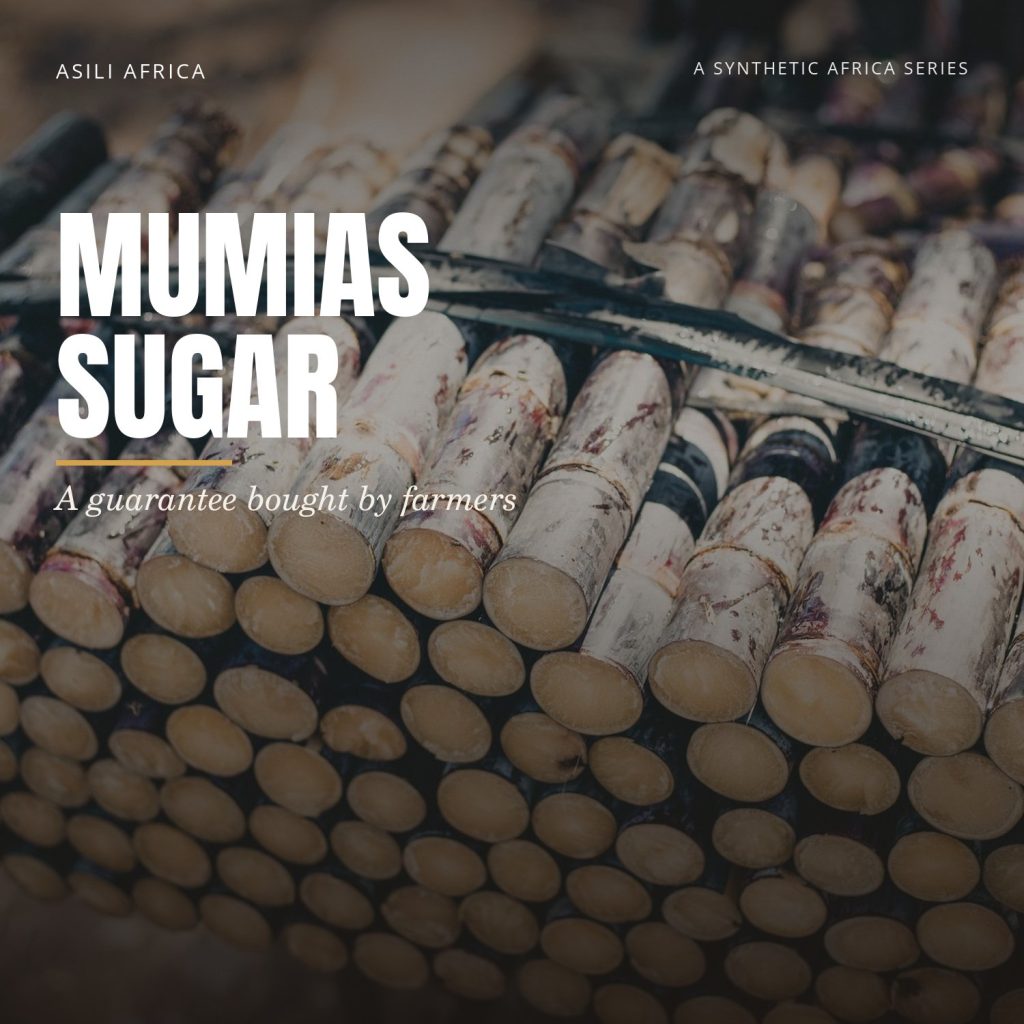
The Mumias Sugar Story: A guarantee bought by farmers
Somewhere near the town of Mumias, in Western Kenya, a farmer is being paid within seven days for a tonne of sugarcane, at six thousand and fifty shillings.
That is a small fact. It is also the only unambiguous fact about this company in the year twenty twenty six.
The mill this farmer is selling to is running under a twenty-year lease that the High Court cancelled in twenty twenty two. The distillery next to it, and the thirty four megawatt power plant beside that, are being operated separately, under a presidential directive, by a different company owned by the brother of the man who owns the mill. The two brothers do not speak. Neither operator has a clean legal basis. The company that owns all of it has been in receivership since twenty nineteen. Its shares have not traded since October of that year.
And the farmer is being paid within seven days.
THE BARGAIN OF 1971
On the first of July, nineteen seventy one, the Government of Kenya incorporated a company called Mumias Sugar Company Limited. The state held seventy one per cent. A British development-finance body, the Commonwealth Development Corporation, held seventeen. Booker McConnell of London held four per cent and, more importantly, the management contract — Booker’s engineers and agronomists were the world’s most experienced tropical sugar operators, and they were being paid to run this mill for the state.
That same year, Parliament passed Sessional Paper number five of nineteen seventy one, in which the state guaranteed the company’s purchase of factory plant from Booker. It was the first of many state guarantees in the company’s history, and the last one that worked as intended.
The site was chosen for a mix of reasons. The Kakamega belt had the rainfall for cane. The Kenyatta government wanted an industrial trophy in the West, a region economically detached from the Nairobi–Mombasa spine. And Mumias was poor. The area was, by Kenyan standards, one of the poorest in the country. The project was designed to change that.
The mill produced its first sugar in nineteen seventy three, and commercial operations began the year after. The rated capacity was a hundred and twenty five thousand tonnes a year — later expanded past two hundred and fifty thousand.
But the real architecture was not the factory. It was the farmers.
The Kenyan state built the plant, and the cane was to come almost entirely from smallholders in the surrounding counties. Booker had built out-grower schemes before, but Mumias took it further than any prior project. At peak, over a hundred thousand farmers were registered to supply cane on plots of one to five acres each. They received seed cane on credit, ploughing and fertiliser as services, and a guaranteed price and buyer.
They also received a legal restriction: they were prohibited from selling cane to any other mill. Zoning. That was the master switch. It converted a hundred thousand farmers into a captive supply, which meant that when the mill worked, it worked for everyone, and when it stopped paying, the same farmers could not legally sell elsewhere.
For a generation, it worked.
By the mid nineteen nineties, Mumias was the dominant sugar producer in Kenya. The town of Mumias, before the mill a market centre for the Wanga community, had been rebuilt around the factory — a company hospital, a company primary school, an airstrip, a golf course. In two thousand and one the company was floated on the Nairobi Stock Exchange; the state reduced its holding to twenty per cent, and a farmer share allocation was created inside the initial public offering.
And in two thousand and five, Mumias produced two hundred and sixty nine thousand, one hundred and eighty four tonnes of sugar — sixty per cent of Kenya’s national output that year, and the industry’s all-time peak. It has not been matched by any Kenyan mill since.
THE HANDOVER
On the thirtieth of June, two thousand and three, Booker Tate’s thirty-two year management contract expired. The last expatriate managing director, Dennis Driscoll, handed over. The company’s head of agriculture, Paul Mutanda, acted as chief executive for a matter of months, and then a new managing director was appointed.
His name was Evans Kidero. A Kenyan pharmacist and business executive, he was the first African to run the company.
Under Kidero, the company reported cumulative profits of approximately fourteen point eight billion shillings across nine years. In his last full year, two thousand and eleven, the reported net profit was two billion shillings. The ethanol distillery was commissioned in two thousand and nine. A thirty four megawatt bagasse-fired co-generation plant came fully online in two thousand and eleven; Mumias was the first Kenyan mill to sell power back to the national grid.
In twenty twelve, Kidero resigned. He ran for governor of Nairobi, and he won.
His successor, Peter Kebati, was appointed in twenty twelve. And in twenty fourteen, an internal audit commissioned by the company itself, and conducted by KPMG, described a shadow operation running under Kebati and the commercial director, Paul Murgor.
The scheme, as KPMG documented it, was this. Sugar was being imported cheaply from Sudan and Uganda, brought into Kenya, repackaged in Mumias-branded bags, and sold. A parallel account was operated at Dubai Bank in the name of a shell entity called Dantes Peak. The company’s own board had not authorised any of it.
In March twenty fourteen, a parliamentary agriculture committee raided a depot at Shimanzi in Mombasa and found more than seven tonnes of undocumented imported sugar being handled as Mumias product. Kebati and Murgor were sacked. Approximately fifty two other senior executives were dismissed in the clean-out that followed. The company sued Kebati and three colleagues for one point one billion shillings.
The KPMG audit also examined the Kidero years. It named specific transactions — a payment of sixty five point eight million shillings to a fertiliser distributor made without board tender committee approval, and others in a range that different reports variously put between three hundred million and six hundred and fifty million shillings. Kidero denied wrongdoing, and sued KPMG for defamation. A parliamentary report recommended he be barred from public office. He has not, as of twenty twenty six, been convicted of any offence connected to Mumias.
THE BAILOUTS
In twenty fifteen, the government announced a three billion shilling revival plan. President Uhuru Kenyatta personally handed over an initial five hundred million. Further tranches followed through twenty sixteen, twenty seventeen and twenty eighteen. The total government injection across those years is estimated at three point seven billion shillings.
The revival did not happen. Losses accelerated. Four point seven three billion for the financial year to June twenty sixteen. Six point eight billion for June twenty seventeen. Fifteen point one billion for June twenty eighteen.
Mumias itself commissioned an audit of one of the bailout tranches, three point two billion shillings, to establish how it had been used. Parliamentary reports asked the same question. No consolidated accounting has been published. Farmers, opposition politicians, and journalists asserted, then and since, that the money went on wages, on cane arrears, and on operating expenses — that it did not restore the plant and it did not restore the cane. Where the money went is the question. That the question has no public answer is the answer.
And then, in April twenty nineteen, a lawyer named Jackline Kimeto filed an insolvency petition against Mumias Sugar over an unpaid bill of seventy six million shillings.
She was not a household name. Her firm had done work for the company and had not been paid. Eighty other creditors joined her petition.
On the twentieth of September, twenty nineteen, KCB Bank Kenya placed Mumias Sugar under receivership. The trigger was defaulted debt of approximately twelve point five billion shillings owed to KCB. Total creditor obligations were around twenty billion. A receiver-manager was appointed — an insolvency practitioner named Ponangipalli Venkata Ramana Rao, the principal of a firm called Tact Consultancy Services.
Three weeks later, on the fifteenth of October, the Nairobi Stock Exchange suspended trading in the company’s shares.
Six weeks after that, on the sixth of November, Rao fired the entire workforce. Four hundred and thirty three permanent employees and three hundred and nineteen contract staff — seven hundred and thirty two people in total, sacked without notice, backdated to the day of the receivership. They were owed one point eight billion shillings in arrears.
What happened next to those seven hundred and thirty two workers is not in the record. Some cases are grinding through the labour courts. Former workers camped at the factory demanding dues in twenty twenty three, and again in twenty twenty five. Aggregate outcome data — how many were paid, how many are still owed, how many died before payment — has not been published.
THE LEASE
In August twenty twenty one, the receiver launched a tender to lease the Mumias assets for twenty years. Eight bidders came forward. The two that matter here are the first and the last.
The first was West Kenya Sugar Company, controlled by a Kenyan-Punjabi industrialist named Jaswant Singh Rai. West Kenya was, by twenty twenty one, the largest miller in Kenya, controlling something in the order of forty five to fifty per cent of national sugar production. Jaswant Rai bid thirty six billion shillings for the Mumias lease.
The last was the Sarrai Group, a Uganda-based conglomerate whose Kenyan cane assets include Kinyara Sugar. Sarrai is controlled by Jaswant’s younger brother, Sarbjit Singh Rai. The brothers had fallen out publicly some years earlier, after the death of their father, Tarlochan Singh Rai. Sarbjit bid substantially less than his brother. The pack carries the total value of the Sarrai bid as somewhere between six and eleven and a half billion shillings, depending on how the commitments are counted — the exact structure is disputed in litigation.
On the twenty second of December, twenty twenty one, the receiver awarded the lease to Sarrai. To the younger brother. To the lowest bidder. His stated reasons for doing so were not published.
The Treasury had separately opposed the West Kenya bid on concentration grounds — Jaswant’s group already had roughly half of Kenyan sugar, and adding Mumias would move it toward monopoly. That is on the public record. It is not clear that it was the reason.
On the fourteenth of April, twenty twenty two, Justice Alfred Mabeya of the High Court cancelled the lease. His ruling said, plainly, that the receiver had awarded the lease to the lowest bidder when higher bids existed, without giving any justifiable explanation. He removed Rao and appointed a new administrator, Kereto Marima.
Two months later, on the sixth of June, twenty twenty two, the Court of Appeal stayed Justice Mabeya’s ruling. Sarrai continued operating.
In December twenty twenty three, the commercial court ruled that operations could continue pending resolution. Resolution has not arrived. Sarrai runs the mill.
Two brothers, one father, opposite sides of a border, one plant. That is the operating structure of Kenya’s largest sugar asset in the year twenty twenty six.
THE DIRECTIVE
On the twentieth of January, twenty twenty five, President William Ruto launched what the government called Kenya’s first ever sugarcane bonus programme. A hundred and fifty million shillings was disbursed to Mumias farmers. The payment did not come from Mumias. It came from the state.
At the same event, the President directed that the ethanol distillery and the thirty four megawatt co-generation plant at Mumias be operated separately — by West Kenya Sugar. That is: by Jaswant Rai. The elder brother.
The mill would continue to be run by Sarrai. That is: by Sarbjit. The younger brother.
The same physical complex, divided operationally by presidential fiat, between two companies owned by two brothers who do not speak.
Local politicians and farmers reacted. The Kakamega governor and county elders vowed to block the West Kenya takeover of the ethanol assets. In one incident, farmers stormed the factory to prevent the transfer of the co-gen plant. The directive stood.
Later in twenty twenty five, Jaswant Rai withdrew all his outstanding Court of Appeal applications challenging his brother’s lease. It was read, by analysts, as a truce — the two brothers were now dividing the plant between them, rather than fighting over it.
That, on the current record, is the settlement. It has never been ratified in any court. It has never been put to a shareholder vote — the shareholders’ vote does not function. It has never been debated in Parliament. Its authority is a spoken directive from the President of Kenya, made ahead of the twenty twenty seven election in a province the President needs.
The receiver acted. The creditor blessed the act. The court cancelled the act. A higher court stayed the cancellation. The President directed the split. Both brothers are operating. It is working.
2026
In the twelve months before this episode was recorded, the mill has been crushing cane at three thousand tonnes a day, with a target of six thousand once upgrades are complete. The cane price to farmers has been six thousand and fifty shillings a tonne, paid within seven days.
At the national level, Kenya produced eight hundred and thirty two thousand tonnes of sugar in twenty twenty five, a record. National output rose about twenty two per cent in the first five months of twenty twenty six. The government has said the country will be a net sugar exporter by the end of the year, for the first time since the nineteen seventies.
And in January twenty twenty six, Kenya exited a regime it had lived under for twenty four years. Since two thousand and one, the country had operated under a COMESA safeguard that let it restrict cheap regional sugar imports. The safeguard expired. Cheap regional sugar — from Uganda, from Egypt, from Sudan — now enters Kenya without restriction. Mumias re-emerges into a market designed for it under different rules. The mill that spent the last decade being killed by imports of Ugandan sugar re-packaged in its own bags now competes with Ugandan sugar in the open.
The Kenya Revenue Authority assessed sixteen point one seven billion shillings in tax arrears against Mumias in twenty twenty three. Eleven billion of it has been waived, to support the revival. The rest is disputed. Farmers have asked, publicly and formally, how a company under receivership accumulated a further two point three two billion in tax liabilities under the receiver’s management. That question has also not been answered.
The company’s shares have now been suspended from the Nairobi Securities Exchange for very nearly seven years. Retail investors — including farmers who took shares in the two thousand and one flotation — have neither a market for their equity nor a dividend. In September twenty twenty six, at least one shareholder publicly asked the exchange to explain why the suspension still stood. There has been no answer.
The mill runs. The farmer is paid. The two brothers do not speak. The receivership has not ended. The share register is frozen. The lease is contested. The revival is being staked on the twenty twenty seven vote of a Western Kenyan electorate. Whether Sarrai and West Kenya are reviving an integrated enterprise or asset-stripping it as two feuding lessees under political cover, no one can tell you.
A rural development project succeeded so completely that it made a hundred thousand households dependent on a single mill. And when the mill failed, the same architecture that had lifted them held them in place. They could not legally sell to anyone else. They could not vote out the board. They could not force a receivership to end. They could not compel a court to publish the reasons the lease was awarded. They could not stop it being split between two brothers who do not speak. They could only wait, and replant, and be paid within seven days when a president decided.
Mumias Sugar is not dead. Mumias Sugar is not alive. It is a plant that turns cane into sugar under a legal fiction, on presidential directive, in the year before an election, for a farmer whose only durable protection is a payment cycle a politician has promised to keep. Whether that survives twenty twenty seven, nobody knows. This is Asili Africa. Every empire has an origin. See you on the next one.
Key Takeaways
- THE BARGAIN OF 1971. On the first of July, nineteen seventy one, the Government of Kenya incorporated a company called Mumias Sugar Company Limited.
- THE BAILOUTS. In twenty fifteen, the government announced a three billion shilling revival plan.
- THE LEASE. In August twenty twenty one, the receiver launched a tender to lease the Mumias assets for twenty years.
- 2026. In the twelve months before this episode was recorded, the mill has been crushing cane at three thousand tonnes a day, with a target of six thousand once upgrades are complete.
Also available on YouTube — search “Asili Africa” or subscribe to our channel.