
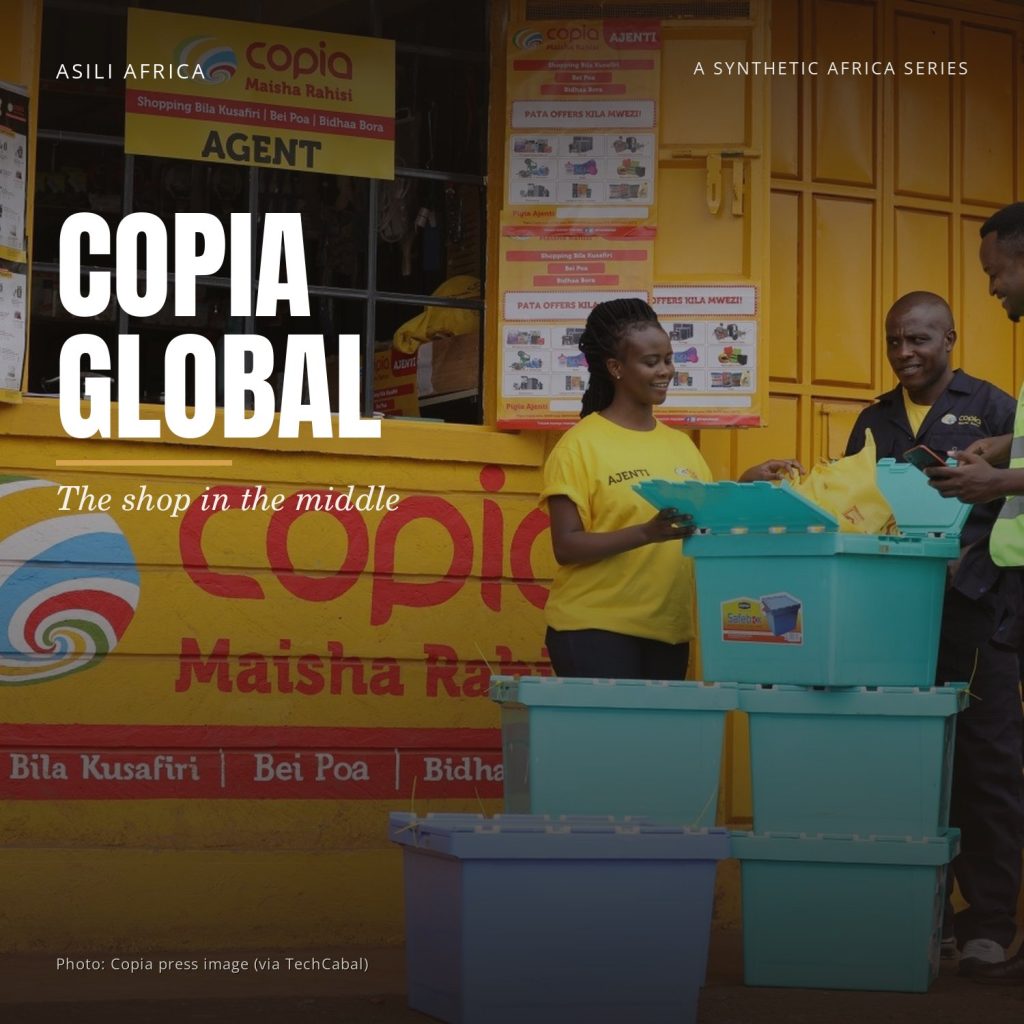
The Copia Global Story: The shop in the middle
In a small Kenyan town, a customer walks into a shop that sells a little of everything, and asks for something it does not stock.
The shopkeeper takes the order on an ordinary phone.
A few days later the goods arrive at the shop, in one van, with everyone else’s orders from that town.
The customer comes back, collects, and pays, right there at the counter.
No street address. No bank card. The shop is the address.
It is a way of selling online, built for people that online retail had not been built for.
A company built on that one idea, called Copia, grew in time to tens of thousands of shops like this one.
In September twenty twenty four, its administrators put what was left of it up for sale.
A brand. An app. Two million customers.
And a network of thirty thousand shops.
The shop was the whole idea. At the end, the shops were one line in a sale.
THE SHOP
In the mid nineteen nineties, an American student named Tracey Pettengill Turner spent time studying in Kenya.
She saw at first hand how hard it was for people in rural areas, and on low incomes, to get good quality household goods.
Years later, that problem would become the starting point for a company.
The company was worked out not in Nairobi but in San Francisco, where Turner and a friend, Jonathan Lewis, brainstormed it together.
Both were fintech entrepreneurs based in Silicon Valley, and both were American.
The key idea came from Lewis, who had a background in microfinance, and he has told the story himself. It goes back to the years before smartphones.
Lenders who made small loans in rural areas relied on loan officers. The officers travelled out, village by village, to collect repayments in person.
Lewis’s thought was that those loan officers were natural distribution points. A place where money was collected could also be a place where goods were delivered.
What he pictured was a catalogue of household goods, ordered and collected at that point.
The journey was already being made. The meeting point already existed.
They called the company Copia. It is Latin, and it means abundance.
It launched in Nairobi, in twenty twelve by its co-founder’s account.
By Lewis’s own account, early sales exceeded what the founders had expected.
Copia called what it did assisted e-commerce. Online shopping, with a person standing in the middle.
Its customers were households on low and middle incomes, in the countryside and on the edges of towns. Mainstream online retailers could not reach them at a cost that made sense.
Copia was designed around them from the first day.
In place of the loan officer, Copia put the shopkeeper.
Its agents were mostly small shopkeepers in towns and villages, each running an independent business of their own, who took orders for Copia alongside everything else they sold.
The agent earned a commission on the orders placed through the shop.
A customer chose from the catalogue: food, cleaning products, electronics, farm inputs, even building materials.
Customers placed their orders through the agent, a person at the counter who could do it with them. That was the assistance.
The order went in by USSD, the numbered text menus that work on any mobile phone, however basic. Or by SMS. Or through an app.
That choice decided who could use Copia. No smartphone. No data bundle. No bank card.
Orders were gathered at regional warehouses, packed, and sent out in batches, one van load serving many shops.
Within two to four days, the goods reached the agent’s shop.
The customer came in to collect them, and paid there, often in cash.
What the design avoided was the most expensive part of selling online anywhere: carrying one parcel to one door. In rural Kenya, many of those doors had no address a driver could find.
Copia did not go looking for the door. It let the shop stand in for the address.
One stop could serve many customers at once.
And no customer had to wait at home for a van that might never find the house.
Order at the shop. Delivery to the shop. Pay at the shop.
It was a simple answer to an expensive problem. And it was a good one.
THE NETWORK
In January twenty fifteen, Copia raised a seed round of four million dollars. It is the first funding round in the record.
A seed round is early money, raised to prove that an idea can work.
Copia’s model was physical. Before a single order could reach a single shop, there had to be a warehouse, stock on its shelves, and a van on the road.
Reaching a new region meant building that whole chain again, from the warehouse out to the counter.
The shops themselves were the one part Copia did not have to build. Each new agent brought a counter that already existed, in a place people already came to.
By March twenty seventeen, Tim Steel was Copia’s chief executive, the role he would hold until the end.
In January twenty nineteen, Copia raised two million dollars from Goodwell Investments.
In November of that year came a much larger round. A Series B of twenty six million dollars, led by LGT Lightstone, with Perivoli Innovations and Goodwell among the other investors.
A Series B is the round a company raises once it has shown that its idea works, and needs money to do much more of it. Twenty six million dollars was more than six times Copia’s seed round.
What Copia had shown by then was demand. People that mainstream online retail was not reaching were ordering household goods through a shop, and coming back days later to collect them.
In twenty twenty, the pandemic came, and movement was restricted in Kenya, as it was in almost every country.
As people shifted to having goods delivered rather than going out for them, demand for Copia’s service rose.
Its collection points were local shops, close to home, so customers did not have to travel far to reach one.
Copia moved its stock toward cleaning and antibacterial products.
Soap and disinfectant went out through the same shops as everything else.
That autumn, the United States International Development Finance Corporation, the American government’s development lender, invested five million dollars in Copia.
It was an equity investment, so the American government’s lender now held a stake in the company.
Through all of this, the design did not change. Order at the shop. Delivery to the shop. Pay at the shop. What changed, year after year, was the number of shops.
Every order still travelled the same route: a phone, a warehouse, a van, a shop.
By March twenty twenty one, according to a profile published that month by Pioneers Post, Copia had served a million different customers.
And it was working through about twenty five thousand agents.
Twenty five thousand counters across the country, each one standing in for an address.
FIFTY MILLION
In January twenty twenty two, Copia raised fifty million dollars.
It was a Series C, by a distance the largest round in the company’s history, and it was raised to fund expansion across Africa.
A Series C is growth money. By this stage, a company is expected to take what works at home and make it work somewhere new.
One trade publication read the round as proof that investors had found an interest in Africa’s rural consumer, a customer the industry had often ignored.
The rural consumer was the customer Copia had been built for.
The place Copia went was Uganda, next door. In twenty twenty two, it opened a logistics hub in Kampala.
What it took across the border was the model it had built in Kenya: a warehouse at the centre, vans going out, and shops at the end of the routes.
It was the first time the design had been tried outside Kenya.
There were plans to go further, into other countries in the region.
In April twenty twenty three, Copia suspended its operations in Uganda and left the country. The reason it gave was a downturn.
According to reports at the time, about three hundred and fifty people there lost their jobs. They left with severance.
The plans to go further were shelved.
Reports at the time described the Ugandan operation as recently established. That one word, downturn, is the reason on the record. We have not found another, and we are not going to supply one.
In July twenty twenty three, Copia cut again, this time at home. Reports put the number at about three hundred and fifty more people, in Kenya, and Copia confirmed the cuts.
Two rounds of cuts, three months apart.
By then, money for growing startups across Africa had become far harder to raise than it had been when the Series C closed.
In Kenya, the design carried on as before. The vans still went out to the shops, and the orders still came in through them.
In December twenty twenty three, Copia announced a twenty million dollar extension to its Series C.
An extension adds new money to a round that has already been raised.
Existing investors stayed in. Among them were Lightrock, Perivoli Innovations, and DEG, the German development finance institution.
And new investors joined: Zebu Investment Partners, Koa Labs, and the Development Finance Corporation, the American government’s development lender, back for a second time.
After a retreat from one country, two rounds of cuts, and in a harder market for money, investors still believed in the model. And more of them had come in.
ADMINISTRATION
In May twenty twenty four, between the sixteenth and the eighteenth, Copia warned more than a thousand of its employees that layoffs were coming, and that the company might have to shut down.
It had failed to secure new funding.
Neither Copia nor any of its investors has said on the record who was asked for that last money, who said no, or why.
On the twenty fourth of May, Copia’s board placed the company into administration.
Two partners from the accounting firm KPMG were appointed as its administrators.
In administration, outside administrators take control of a company, to rescue it if they can, and to sell what it owns for its creditors if they cannot.
In the United States, Copia’s American parent company filed for bankruptcy under Chapter seven, the part of American law that deals with liquidation.
The filing listed about forty five and a half million dollars in liabilities.
Against that, it listed about four hundred thousand dollars in assets.
And twenty thousand three hundred dollars in cash.
This was a company that had raised more than a hundred million dollars.
The remaining staff were laid off. Their May salaries were delayed.
Kenyan labour law entitled them to severance and to pay for their accrued leave. The administrators left the timeline for those payments unspecified.
We looked for what happened next. The record does not show whether those employees were ever paid what they were owed.
In those last weeks, according to Techpoint Africa, customers reported orders that never arrived, or arrived wrong, and suppliers complained on social media of unpaid bills.
Copia did not fall alone. In the same years, Twiga Foods and other Kenyan startups in commerce and logistics failed too.
In the Kenyan business press, Copia’s name now appears on lists of well funded startups that failed in that window.
They had a shape in common. They ran heavy physical operations: warehouses, vehicles and stock. They sold on thin margins. They were backed by some of the best known investors in the business.
And they needed fresh money just as money for growing startups dried up, after twenty twenty two.
None of that says that nobody at Copia made a wrong call. It says the fall had company, and a pattern.
One analysis, published by Money Myths Africa, goes further back, to the founding choice itself.
It starts from density. Online retail gets cheap when orders sit close together, so that each van carries more and travels less.
A van that makes many drops on one street costs less for each order than a van that drives a long way between two shops for a few.
The analysis sets Copia against Jumia, which built its business in the cities and treats smaller towns and the countryside as a secondary line.
Copia did the opposite. It led with the countryside and the edges of towns. On this argument, that choice meant it could never reach the density that makes deliveries cheap.
On the same argument, the money, large as it was, was not enough for long enough, against competitors with deeper pockets and more room to change course.
That is one analyst’s argument, written after the collapse. It is not a verdict, and this episode does not deliver one.
What the argument points at is in the design itself. The shop solved the address. It did not solve the distance between one shop and the next.
Copia proved the customers were there. A million of them by twenty twenty one. What the record never shows is that carrying their orders paid for itself. There is no audited figure that says so, either way.
In July twenty twenty four, less than two months in, the administrators gave up trying to revive the business, and moved to sell its assets to pay its creditors.
By September, Copia’s operations in Kenya and Uganda had been fully wound down.
The administrators put what was left up for sale.
The platform: the website, the app and the USSD service.
The brand, and the intellectual property.
Two million customers.
And an agent network of thirty thousand shops.
The shops themselves were not Copia’s to sell. What was on the list was the network, its tie to thirty thousand businesses that belonged to other people.
Beyond those complaints in the last weeks, the customers appear in the record as a number in a sale. None of them, that we found, was ever asked what the service had meant to them, or what losing it meant.
In twenty twenty one, that Pioneers Post profile described one agent. A pharmacy owner, called Jane.
After her shop became a Copia agent, the traffic through it doubled.
She is the only agent whose voice appears anywhere in the record. No agent has been quoted since the collapse.
What happened to her shop, and to the others, the record does not say.
THE ESTATE
In June twenty twenty four, a new e-commerce company called Stahili was registered.
Among its founders were Tim Steel, Copia’s former chief executive, and Michael King, Copia’s former chief technology officer, with Turner, Copia’s co-founder.
In July twenty twenty four, Turner said publicly that she was planning a new household goods delivery business in Nairobi.
A year later, in July twenty twenty five, reporting described Stahili as live in Kenya, selling on a cashback model.
Filings reported by TechCabal show that Stahili is wholly owned by a company registered in the United States called Copia Holding Company, which the same reporting links to Turner.
None of the three has spoken publicly about the timing of the new venture.
Once operations had stopped, what the administrators held was not much of a working business. No warehouses running, no vans on the road. There was a name, a platform, and a store of customer records.
At a date the record we examined does not give, the administrators sold Copia’s brand, its intellectual property and its transactional customer data to a buyer named Copia Holdings Limited.
Transactional data means the record of who bought what, and when.
The record examined for this episode does not establish whether Copia Holding Company and Copia Holdings Limited are the same company, related companies, or unconnected.
From twenty twenty five into twenty twenty six, two of Copia’s unsecured creditors challenged that sale.
Both were suppliers. One was Tuffsteel, owed about thirteen million shillings. The other was Jastan Traders, owed about seven hundred and ninety thousand shillings, around six thousand dollars.
They are the two creditors named in the court reporting, not the whole list of those Copia owed. Other suppliers had complained of unpaid bills. How many were owed, and how much, is not established.
Unsecured creditors hold no claim over any particular asset. They are paid from whatever is left, after the costs of the process and the creditors ahead of them.
So the price of that sale mattered to them. The lower it was, the less there would be to share.
They argued that the sale should be shown to have been made at fair market value. They alleged mismanagement. And they asked the court to order a forensic audit covering three years.
A forensic audit is an investigation of the accounts, meant to establish where the money went, and whether anything was done wrong.
In May twenty twenty six, the administrators themselves petitioned for Copia to be liquidated, telling the court that the company could not pay its debts. It said that efforts to revive the business had failed.
Liquidation is the end of a company. What it owns is sold, what is raised is paid out to those it owes in the order the law sets, and the company itself is closed.
On the seventeenth of September, twenty twenty six, Justice Rhoda Rutto of the High Court ordered Copia’s final liquidation.
She called the creditors’ claims of mismanagement speculative and unsupported by evidence.
She found that the sale of the brand and data had not been shown to be below market value.
She refused the forensic audit.
And she noted that the liquidators keep their statutory power to investigate, under Kenya’s Insolvency Act.
A week later, the two KPMG partners who had run the administration were formally appointed as Copia’s joint liquidators.
According to the reporting on the ruling, Copia’s unsecured creditors are expected to recover little or nothing.
Copia began with one idea: that a small shop could stand in for an address.
For people with no street address, often no smartphone and no bank card, it worked. They ordered at the shop, collected at the shop, and paid at the shop.
By the administrators’ count, it reached two million customers, through thirty thousand shops.
What it could not do was make the distance between those shops pay.
As of the twenty eighth of September, twenty twenty six, Copia is in final liquidation.
The record still does not show whether the people who worked there were ever paid what they were owed.
Or what became of the shops, and the people who kept them.
The whole idea was the shopkeeper. At the end, the shops were one line in a sale.
This is Asili Africa. Every empire has an origin. See you on the next one.
Key Takeaways
- THE SHOP. In the mid nineteen nineties, an American student named Tracey Pettengill Turner spent time studying in Kenya.
- FIFTY MILLION. In January twenty twenty two, Copia raised fifty million dollars.
- ADMINISTRATION. In May twenty twenty four, between the sixteenth and the eighteenth, Copia warned more than a thousand of its employees that layoffs were coming, and that the company might have to shut down.
- THE ESTATE. In June twenty twenty four, a new e-commerce company called Stahili was registered.
In this series: Failed Funded
- Sendy
- Twiga Foods
- MarketForce
- Copia (this episode)
Also available on YouTube — search “Asili Africa” or subscribe to our channel.