
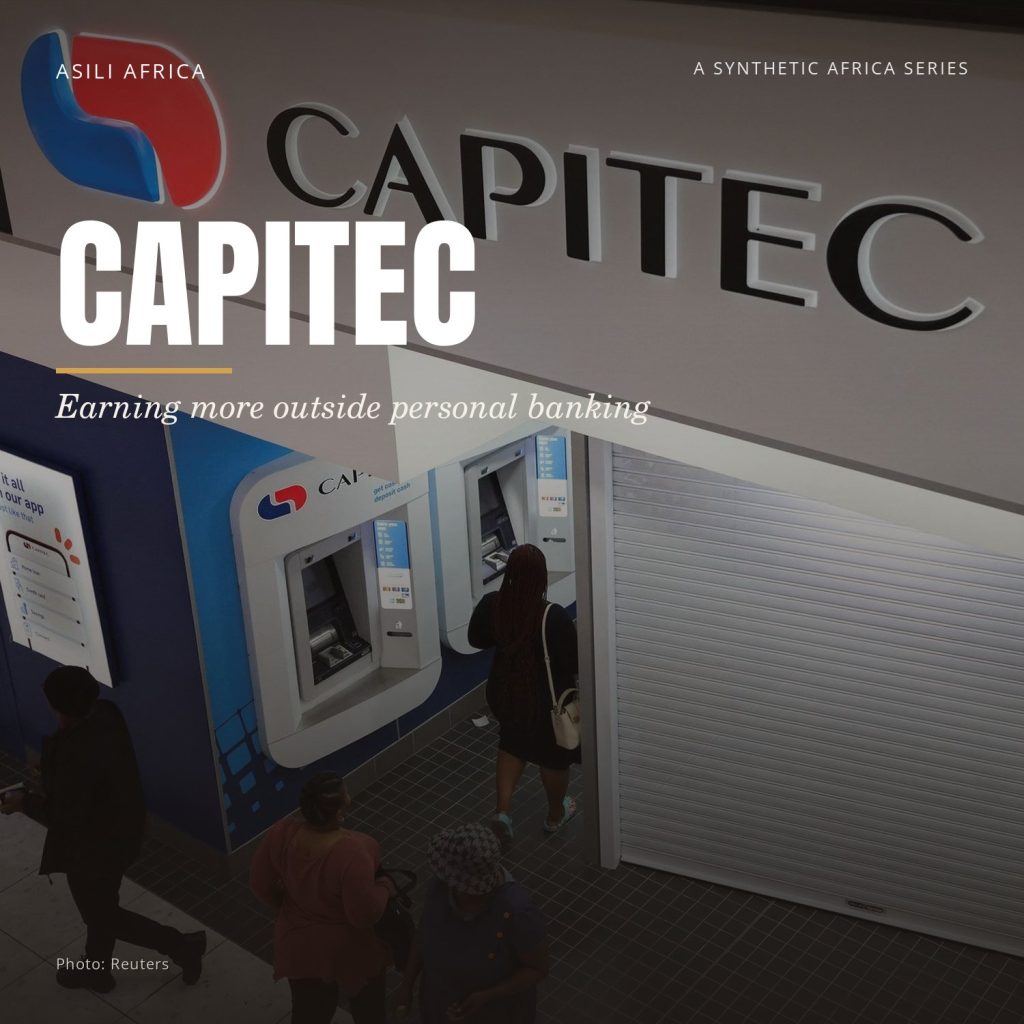
The Capitec Story: Earning more outside personal banking
In two thousand and one, a bank was founded in the Western Cape of South Africa.
Its roots were in microlending: small loans, to people the big banks did not lend to.
Twenty-five years later, it has twenty-six point six million active clients. That is its own count.
In the six months to the end of August, twenty twenty-six, it made nine point five billion rand in headline earnings.
Headline earnings is the profit measure South African companies report, with one-off gains and losses taken out.
In its latest half-year results, personal banking, meaning the everyday accounts and the lending together, earned thirty-seven per cent of those earnings.
Insurance earned more than a quarter.
Its phone and payments business, airtime, data and a mobile network of its own, earned more than a quarter again.
Together, those two earned more than half.
The microlender now earns more outside personal banking than inside it.
THE HOURS
“I thought banks closed at that time because of some kind of law.”
That is Michiel Le Roux, on the three-thirty closing time of the banks he knew.
He was born in Stellenbosch, a university town in the winelands of the Western Cape, and took a law degree and a master’s at the university there.
He never practised.
He went into banking instead, and came to head Boland Bank in the Cape.
“I discovered at Boland Bank,” he said later, “that banking was very archaic.”
Of the bank he went on to build, he said: “When we started at Capitec, there were no hours.”
In two thousand and one, South Africa was seven years past its first democratic election, and four big banks dominated its retail banking.
In the nineteen nineties, small loans had been exempted from the country’s old cap on interest rates, and a microlending industry had grown up below the big banks, around that exemption.
Capitec was founded as a bank on the first of March, two thousand and one.
Its founders were Michiel Le Roux and Riaan Stassen, senior men at Boland Bank, with money from Jannie Mouton’s PSG.
Mouton had founded PSG, an investment group, and his money backed the new bank from the start.
The founders built it after Boland merged with another bank, NBS, and Le Roux brought much of Boland’s senior management with him.
So this was not a garage. It was a breakaway of experienced bankers, with an investor behind them.
Its roots were in microlending, and it carried those roots into the new bank.
Stassen was a chartered accountant, and a former colleague of Le Roux’s from Distillers, a drinks company.
One profile describes him as casual, never in a tie, and analytically fierce.
The bank ran from what that profile calls a drab office park outside Stellenbosch, the same winelands town where Le Roux was born.
The reason it gives is Stassen’s view that shareholders’ money “should not be wasted on corporate fancy.”
Three names, then, and no single founder. Le Roux had the motive on the record, Mouton had the money, and Stassen, as it turned out, had the longest years running the place.
On the eighteenth of February, two thousand and two, less than a year after its founding, Capitec listed its shares on the Johannesburg Stock Exchange. From then on, anyone could own a piece of it.
Le Roux was its first chief executive, for about three years.
Riaan Stassen then ran it, as chief executive until twenty fourteen.
One account says the first five years were plagued with challenges that stagnated growth.
What those challenges were, the record does not say.
In two thousand and six, for the first time, people began to keep their money with Capitec in any real amount.
Five years after its founding, the bank with its roots in microlending had become a bank that people kept their money in.
THE LENDER
In the decade Riaan Stassen ran it, Capitec sold two things at once.
The first was a cheap transactional account: somewhere to be paid, to draw cash and to pay for things, at a low fee.
It came with long hours, the opposite of the three-thirty closing that Le Roux had once taken for a law. Its branches stayed open into the evenings and on Saturdays.
The second was credit, and specifically unsecured lending: loans with nothing pledged against them, no house and no car.
Without security, the lender’s protection is its own judgement of who can repay.
Years later, in twenty nineteen, Stassen would call unsecured lending Capitec’s original strength.
A profile of his years in charge credits him with taking Capitec into the big league. Its title says that, under him, everything had to be just so.
Both businesses ran through the same branches.
According to a competition study of Capitec’s entry into banking, an electronic platform took the paper out of them.
We have that study only in summary, so its findings are given here as its own.
In two thousand and eight came the Competition Commission’s enquiry into South African banking.
It looked at what the banks charged their customers, and at who could get into the payments system that moved money between them.
The same study credits the enquiry, partly put into effect, with making the field easier for a newcomer.
The four big banks were Standard Bank, Absa, FNB and Nedbank.
Each sold a low-cost account at the bottom of the market, for people on small incomes.
According to the same study, after Capitec entered, low-cost account fees fell at all four.
The big banks had moved.
By twenty fifteen, Capitec’s retail savings deposits had grown by about a third in a year, to nineteen point three billion rand.
Its assets were above fifty-three point nine billion, and its shareholders’ equity was eleven point six billion.
So the cheap bank and the lender were one company, in one decade, working out of the same branches.
The lending, meanwhile, ran under a new law. In two thousand and seven, the National Credit Act took effect, setting the rules for how lenders in South Africa could lend and collect.
Capitec describes its purpose in the language of financial inclusion.
Whether the credit it extended improved the lives of the people who took it is a question no study we found has tracked: not their incomes, not their assets, and not the weight of their debt over time.
We are not going to answer it for them, in either direction.
The record we found names one borrower from the lending years. It is one case, and he cannot stand for anyone else.
It concerns a garnishee order: a court order that deducts a debt directly from a person’s salary. It is a case in which Capitec is the bank defending the order.
A railway yard foreman in Soweto owed seventeen thousand two hundred and nineteen rand.
The garnishee order on his salary was for thirty-two thousand two hundred and thirty-eight.
Monthly deductions came off his pay until he had settled it, in January twenty fourteen.
THE CLIENTS
In twenty fourteen, Gerrie Fourie, described as a founding member of the bank, became chief executive. Riaan Stassen became chairman.
Fourie had been on the management team from the early years. He would run the bank for about eleven years.
That same year, Capitec took a forty per cent stake in AvaFin, an online lender abroad, a small offshore bet.
Under Fourie, Capitec’s clients went from about five million to about twenty-four million, as one news report put it. That is close to five times where he started.
By twenty nineteen, it had eleven point four million clients and a balance sheet of about a hundred billion rand.
Its market value that year was about a hundred and fifty-six billion rand, third largest by value in South Africa at the time.
It grew a branch network that today numbers about eight hundred and eighty branches.
In twenty twenty-five, it scored eighty-two point two on the South African Customer Satisfaction Index, a national survey of how customers rate their banks.
Every one of those client figures is the bank’s own count.
On the thirtieth of January, twenty eighteen, Viceroy Research published a report on Capitec.
Viceroy was a short seller: a firm that profits when a company’s share price falls. A short seller sells shares it has borrowed, and buys them back later, cheaper if it is right.
The report was titled: Capitec, a wolf in sheep’s clothing.
It called Capitec a loan shark.
It said the bank’s bad debts were understated, and that it faced more than eleven billion rand of impairments.
And it said Capitec should be placed under curatorship, which means taken out of its managers’ hands and run by a curator appointed by the authorities.
Within two days, Capitec’s shares fell by about a fifth.
The South African Reserve Bank called the report reckless.
The Reserve Bank and the National Treasury both backed the bank.
At the time, one newspaper’s headline noted that others, too, had raised the alarm about unsecured lending in South Africa.
The matter went to the conduct regulator, and its question was a narrow one: what Viceroy had published about Capitec, and whether it was true.
In September twenty twenty-one, three years after the report, the Financial Sector Conduct Authority found, under the Financial Markets Act, that Viceroy’s statements about Capitec were false, misleading or deceptive.
It found that Viceroy had shared profits with a client holding a short position.
And it fined Viceroy fifty million rand.
THE OTHER BUSINESS
In twenty nineteen, his last year as chairman, Riaan Stassen described unsecured lending, Capitec’s original strength, as actually shrinking as a share of the business.
He was describing a change already under way. No document we found records a single decision to make it.
Part of what grew around the lending was insurance.
Capitec sells funeral cover, insurance that pays for a funeral.
It now holds three point eight million funeral policies, covering seventeen million lives. On average, each policy covers more than four people.
Seventeen million is more than a quarter of everyone in South Africa.
The total its life policies would pay out, the sum assured, rose by three quarters in a year, to a hundred and twenty-six billion rand.
It also holds two point two million credit life policies.
Credit life is sold alongside a loan. It covers the debt if the borrower dies or can no longer pay.
So part of the insurance business rides on the lending itself.
In the latest half-year, insurance made two point five billion rand in headline earnings, up twenty-two per cent.
In twenty twenty-two, Capitec launched Capitec Connect: its own mobile network, running on Cell C’s infrastructure. At launch, it promised data that does not expire.
Capitec Connect now has one point eight million active clients, up from one point one million a year before.
Through the network and the banking app, Capitec sells airtime, data and prepaid electricity.
Its clients bought twice as much data in the half-year as they had a year earlier.
Its income from selling airtime, data and electricity alone was three and a half billion rand, up thirty per cent.
Sixteen and a half million people use its app every month.
Its clients made six hundred and sixty-two million digital transactions in the six months, up about a quarter.
Its digital wallets, paying with a phone instead of a card, are used by two point four million clients, up by more than two thirds. Spending through them nearly doubled, to fifty-two point one billion rand.
The business Capitec calls fintech made net income of two point seven billion rand, up thirty per cent.
Business clients more than doubled in a year, to six hundred and eighty-six thousand.
Its lending to businesses rose by more than a third, and it now holds a hundred and forty-one thousand merchant accounts.
Business banking earned six hundred and nine million rand, about six per cent of the group’s headline earnings.
None of this came from leaving lending. In the same half-year, Capitec’s loan book passed a hundred billion rand for the first time.
Its income from lending rose nine per cent, to eleven point four billion.
The lending is still growing. The rest is growing faster.
Net interest income, broadly what the bank earns from lending its money out, was twelve point seven billion rand, up seven per cent.
Net non-interest income, everything else, was sixteen point one billion, up twenty-one per cent.
Capitec’s non-interest income is now larger than its interest income.
For a bank, that is a change in what kind of business it is. Interest is the margin on money lent. Non-interest income is fees, insurance, and the things it sells: here, airtime, data and electricity.
In its latest half-year results, personal banking earned thirty-seven per cent of the group’s headline earnings.
Insurance earned twenty-seven per cent.
Its fintech business, meaning airtime, data, prepaid and its own mobile network, earned twenty-nine.
Insurance and fintech together: fifty-six. Personal banking: thirty-seven.
FULLY BANKED
In July twenty twenty-five, Gerrie Fourie retired, after about eleven years as chief executive and some twenty-five on the management team.
Graham Lee, who joined Capitec in two thousand and three, became chief executive. He was fifty.
He is the first chief executive from outside the founding generation.
His career had taken him into investment banking in Zimbabwe, to Morgan Stanley in London, into software and data analytics in Australia, and as far as running a microfinance bank in Nigeria.
Inside Capitec, he had worked in credit, in technology and data, and in running the retail bank, and he had sat on its executive committee since twenty twenty-two. Twenty-two years inside, by the time he took the top job.
In August twenty twenty-six, the holding company changed its name, from Capitec Bank Holdings to Capitec Limited.
On the thirtieth of September, twenty twenty-six, it reported record half-year results: nine point five billion rand in headline earnings, up nineteen per cent.
Its interim dividend rose by the same nineteen per cent, to thirty-one rand and ten cents a share. Its return on equity was thirty-one per cent.
Lee said its fees had been held unchanged for the second year in a row.
He has said he wants Capitec to become, in his words, the leading payments provider, and to expand what it calls embedded finance: banking built into other companies’ products.
Since March twenty twenty-six, two hundred and forty-eight of its branches have taken more than five hundred and ninety-four thousand applications for the government’s smart identity card.
It has launched an account for stokvels, South Africa’s savings clubs, of which there are an estimated eight hundred thousand.
Its cost to income ratio, the share of its income spent on running itself, fell to thirty-six per cent, from forty.
About seventeen thousand people work for Capitec. Behind that ratio are the people who run the branches and answer the phones.
The record we found says almost nothing about them: not what the model asks of them, and not how their pay compares with other banks.
Capitec has twenty-six point six million active clients, by its own count.
Ten point four million of them are what Capitec calls fully banked.
Both are the bank’s own definitions. Fully banked is a measure it reports, not a line it has crossed.
In a year, the fully banked number grew by eleven per cent, faster than the seven per cent growth in active clients.
What the others use Capitec for, no independent source we found says.
Whether they bank somewhere else as well, or whether active means a grant paid in, an airtime purchase or a single transaction, we could not find out.
On press counts, Capitec has about twice as many clients as Absa or Standard Bank each report.
TymeBank, a younger digital bank, reports about nine million customers, which one report describes as not necessarily all active.
Every count in this market carries the same question. The gap between active and fully banked is where Capitec’s contest with the big banks now sits.
The largest shareholder is the Public Investment Corporation, which manages the pensions of public servants, with about fifteen and a half per cent.
Michiel Le Roux is the largest individual shareholder, with about eleven per cent.
PSG later handed its Capitec holding to its own shareholders, and the Mouton family now holds its shares directly.
In July twenty twenty-six, a company belonging to Le Roux pledged shares worth about six and a half billion rand to secure a loan of six point five billion.
The shares were pledged, not sold. What the money is for has not been disclosed.
Pledged, not sold, and the purpose not disclosed. That is what the record holds, and we will not guess past it.
The lending years are still in court.
The railway yard foreman in Soweto says the consent form behind his garnishee order was fraudulent.
He says the order was obtained at a magistrates’ court in Kempton Park, though he lived in Soweto.
The order included legal fees of four thousand two hundred and ninety-two rand. He says the lawful figure was two hundred and forty-one.
Capitec is the bank defending the order. Its position is that more than a decade has passed, that he admitted the debt, and that it will pursue claims of unjustified enrichment against debtors who succeed.
In late June, twenty twenty-four, a magistrate found anomalies in the original order, and postponed the case.
The finding of twenty twenty-one settled what Viceroy had said about Capitec. It did not settle this.
This is a different question, about what the lending cost the people who took it, and it does not make Viceroy right.
It is one case. We did not find how it ended.
Nor does the record say how many Capitec borrowers had their wages garnished, or for how much.
In two thousand and one, bankers from Boland founded a bank outside Stellenbosch. One of them had once thought banks closed at three-thirty because of some kind of law.
For its first decade and more, it was a lender, and its own chairman called that lending its original strength.
Today it earns more from insurance, airtime and data than from personal banking, and its loan book is bigger than it has ever been. It has a new chief executive, and a new name for its holding company.
Twenty-six point six million active clients. Ten point four million fully banked. Both by its own count.
Airtime, data and funeral cover are things a person can buy without making Capitec their main bank.
Whether that is what the others are doing, nobody we found can say.
That is where this story stands, as of the end of September, twenty twenty-six.
This is Asili Africa. Every empire has an origin. See you on the next one.
Key Takeaways
- THE HOURS. “I thought banks closed at that time because of some kind of law.”
- THE CLIENTS. In twenty fourteen, Gerrie Fourie, described as a founding member of the bank, became chief executive.
- THE OTHER BUSINESS. In twenty nineteen, his last year as chairman, Riaan Stassen described unsecured lending, Capitec’s original strength, as actually shrinking as a share of the business.
- FULLY BANKED. In July twenty twenty-five, Gerrie Fourie retired, after about eleven years as chief executive and some twenty-five on the management team.
Also available on YouTube — search “Asili Africa” or subscribe to our channel.