
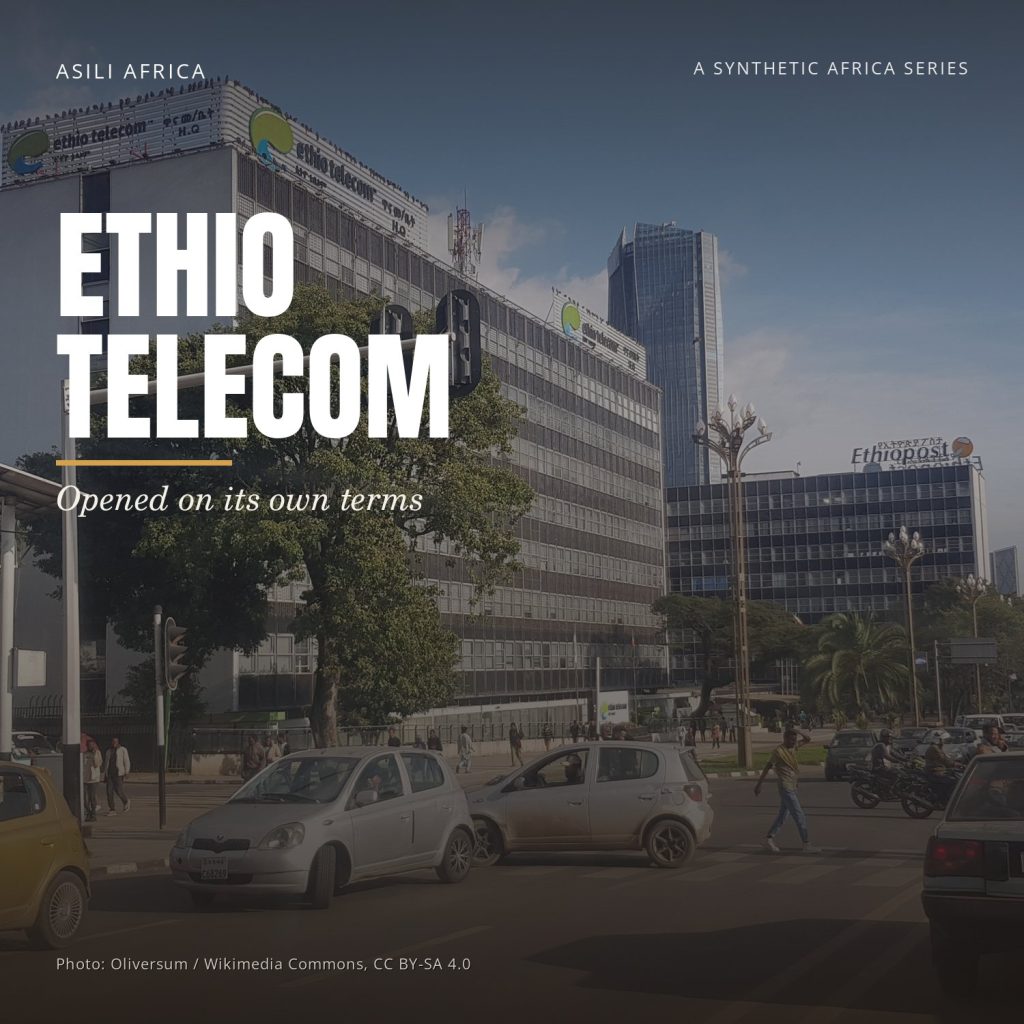
The Ethio Telecom Story: Opened on its own terms
In October twenty twenty four, for the first time, the Ethiopian state offered its own citizens shares in Ethio Telecom.
For a hundred and thirty years, from its first telephone line, the country’s network had belonged to the state alone. Now a piece of it was for sale.
A hundred million shares were put on offer. A tenth of the company.
Three hundred birr a share, and only for buyers inside Ethiopia.
If every share was taken, thirty billion birr would come in.
The offer stayed open through the turn of the year, into February twenty twenty five.
When it closed, about ten point seven million shares had been sold.
About a tenth of what was offered.
Roughly three point two billion birr, against the thirty billion on the table.
The state offered a tenth of the company. It sold about a tenth of what it offered.
A tenth of a tenth.
THE WIRE
In eighteen ninety four, Emperor Menelik the Second commissioned Ethiopia’s first telephone line.
It ran from Harar, in the east, to Addis Ababa.
Menelik commissioned a line. He did not found a company.
In most episodes of this show, this is where a founder would appear. A person with a reason, a first office, a first customer.
This story has none. No one person started this company, and the record offers nobody to stand in for one. We are not going to invent one.
What it has instead is an owner. For more than a century, that owner was the Ethiopian state, and only the Ethiopian state.
By nineteen fifty two, telephones had been in Ethiopia for nearly sixty years. The network had come through war and the Italian occupation, and it was in disrepair.
On the fifteenth of October, nineteen fifty two, the government of Emperor Haile Selassie issued a proclamation.
It created the Imperial Board of Telecommunications of Ethiopia, a body of the state, set up to run the country’s telecommunications.
A proclamation is a law issued by the government. No shareholder voted on it, because there were none.
The proclamation said what the Board was for. To rehabilitate, extend, repair and maintain the telecommunication facilities of Ethiopia.
And to engage in the business of telecommunication for profit.
For profit. A monopoly owned by the state, told in the document that created it to make money.
It is the closest thing this company has to a founding moment. And it was not a venture. It was a proclamation.
In nineteen seventy four, a revolution ended the empire, and the emperor’s government with it.
The Derg, the military committee that took power, reorganised the Board in nineteen seventy five, as the Ethiopian Telecommunications Service.
Under a Marxist military government, the state’s hold on the network deepened.
In nineteen eighty one, under the same government, it was reorganised again, as the Ethiopian Telecommunications Authority.
Governments changed again. In nineteen ninety six, the network became the Ethiopian Telecommunications Corporation.
The word corporation was new. The owner was not. The corporation was still wholly owned by the state.
A corporation is a word for a business. This one had been told to act like one since nineteen fifty two.
The sources for this episode do not show, regime by regime, what each government did with its network. What they show is who held it.
An emperor’s government chartered it to make a profit. A military government tightened its grip. A later government gave it a corporation’s name.
Each time, the network passed from one state to the next, whole.
By nineteen ninety six, it had outlived an emperor, a revolution and a change of government.
It had carried four names. A fifth was still to come.
Its owner never changed.
BORROWED HANDS
By the middle of the two thousands, the Ethiopian Telecommunications Corporation was about to build a much larger network.
The state did not sell any part of the company to pay for it. It borrowed.
Across two thousand and six and two thousand and seven, at the Forum on China Africa Cooperation, a summit between China and African governments, the corporation signed a framework agreement with the Chinese equipment maker ZTE.
ZTE would be the single supplier. Two other Chinese contractors would work alongside it.
The framework was reported at between one point five and one point nine billion dollars.
It was not an investment in the company. It was supplier credit. The equipment came first, and was to be paid for over time.
The supplier would be owed money. It would own nothing.
That is the difference between a lender and an owner. A lender is repaid and leaves. An owner stays.
The deal was criticised by the World Bank, and by former managers of the corporation itself.
Their objection was to its structure. It bypassed competitive procurement. And it tied the country’s network to a single supplier for years, with the risk of dependence that brings.
None of the sources for this episode show bribery in this deal. What was criticised was the choice to buy from one company without a contest.
And the credit built things. It was a major source of the network Ethiopia expanded through the two thousands and into the twenty tens.
Outside money had come in. No outside owner had come with it. And the corporation still had no competitor. There was one network in Ethiopia, and the state owned it.
On the twenty ninth of November, twenty ten, the Ethiopian Telecommunications Corporation became Ethio Telecom.
It was the fifth name, and the one it still carries.
On the same day, France Télécom took over the running of the company, under a management contract.
For the first time, the people managing Ethiopia’s network had been brought in from abroad.
Bloomberg reported in December twenty ten that France Télécom had taken over the management of Ethiopia’s monopoly.
A management contract is a hire. The managers are paid to run the business for a term. The owner keeps everything else.
France Télécom ran the company. It did not own it. No share in Ethio Telecom changed hands.
The state had rented competence, and kept the company.
Credit from China, then managers from France. Each time, something came in from outside. Each time, ownership stayed exactly where it had been since eighteen ninety four.
The contract ran from twenty ten to twenty thirteen, about three years.
In twenty thirteen, it ended. It has been reported that it ended somewhat acrimoniously.
Why, is not in any source found for this episode.
Nor are the names of the managers who came to run it.
What went wrong between the company and its French managers, and what they left behind, the record does not say. We are not going to guess.
THE SWITCH
In June twenty eighteen, the government of Ethiopia’s new prime minister, Abiy Ahmed, announced that the telecom sector would be opened, and that the state monopoly would end.
No rival had forced its way in. No market had broken it open. The decision to open was the owner’s.
The government would set the terms and the timetable.
The owner would also, in time, offer part of Ethio Telecom itself for sale. That part would take much longer.
The next month, on the twenty fifth of July, twenty eighteen, the prime minister appointed a new chief executive of Ethio Telecom. It was part of a wider change of leadership across the state’s enterprises.
Her name is Frehiwot Tamiru. She replaced Andualem Admassie.
Of his years in charge, the sources for this episode say almost nothing, and we will not fill them in.
She had started at the same company, years before, as a programmer, after a degree in information systems.
Over about seven years, she rose to deputy manager.
Then she left, and for about seven years ran an information technology company of her own.
She worked in the regional government of Afar, in its bureau for construction, transport and communication.
She took a master’s degree in business administration, from the Open University in Britain. She sat on Ethio Telecom’s board. And then she came back to run it.
Programmer, to chief executive, of the same company. It is the nearest thing to a personal arc this record holds. It is a career, not a founding.
She has led it through every opening since: a rival’s arrival, its own mobile money service, and the sale of shares.
When the owner is the state and the chief executive is appointed by the prime minister, the ordinary questions about a company’s leadership are hard to answer from public sources. Whether a given decision was commercial or political, the record for this episode cannot say.
In her first four years, by the company’s own reporting, it added about twenty seven point six million subscribers.
By the year to June twenty twenty two, it reported about sixty six point six million.
Teledensity, the number of phone subscriptions for every hundred people, went from about fifty one to about sixty three in a single year, again by the company’s own figures.
In May twenty twenty two, it launched a fifth generation mobile network.
Opening the market took time. Between the announcement and the licence that would end the monopoly, nearly three years passed.
In those same years, in November twenty twenty, war broke out in Tigray, in the north of the country.
Phone and internet service across the region was cut.
Across the region, calls stopped connecting and the internet went dark.
It would stay cut for more than two years.
Those were months of war, and of conditions close to famine. The blackout cut people off from emergency services, and made it harder to report on what was happening.
It was not the first time. Ethiopia has routinely shut down internet and phone access during periods of unrest. Freedom House and the OpenNet Initiative have documented politically motivated filtering and blocking of websites, over years.
A law passed in twenty twelve allows prison sentences of up to fifteen years for getting around state censorship.
In May twenty twenty one, the licence that ended the monopoly was awarded.
It went to a consortium led by Kenya’s Safaricom, for eight hundred and fifty million dollars. Ethiopia’s second full service telecom licence.
A hundred and twenty seven years after the first line, a second company would run a network in Ethiopia.
It was one licence. One rival. The owner had opened the market by exactly one company.
When that licence was awarded, the network in Tigray had been cut for six months.
In February twenty twenty three, service in Tigray began to come back.
In the record examined for this episode, no one who lived through those months appears in their own words.
What is known of them comes from outside the region, from wire reports and analysis written elsewhere.
What it meant to reach a clinic, to move money, or to find family, is not in any source found.
Nor is any account from Ethio Telecom, or from the Ethiopian or Tigrayan authorities.
THE RIVAL
In May twenty twenty one, the same month the rival’s licence was awarded, Ethio Telecom launched a mobile money service of its own. It called it Telebirr.
Telebirr was the incumbent’s own product, on its own network. It let customers hold money on their phones, send it, and pay with it.
It grew into a super app, with other services built inside it.
In its twenty twenty three financial year, it reported twenty one point eight million users.
By twenty twenty five, it reported about fifty five million.
As Telebirr grew, fraud cases followed.
Employees of Ethio Telecom and of partner banks were investigated and detained over mobile money fraud. Some transfers made in another person’s name were suspended, because accounts were being impersonated.
Security analysts describe mobile money fraud, including SIM swapping and social engineering, as the main kind of fraud that ordinary customers in Ethiopia face.
No source found for this episode contains a single account from someone who lost money. What happened to them is not in the record.
In October twenty twenty two, the rival switched on. Safaricom’s Ethiopian company began commercial service in Addis Ababa and ten other cities.
For the first time, people in Ethiopia could choose between two mobile networks.
It had paid eight hundred and fifty million dollars to be there, and it started with no customers, against an incumbent that reported more than sixty six million.
It brought M-Pesa, the mobile money service that defined its parent in Kenya.
In twenty twenty three, M-Pesa in Ethiopia had about three point one million subscribers.
Telebirr, that same year, had twenty one point eight million. About seven times as many.
Two numbers, from the same year.
The Business Daily reported the rival’s market share at five point five per cent, twenty two months after launch.
By September twenty twenty six, nearly four years after switching on, and five years after its licence, the rival had about fifteen million subscribers.
It is the only other licensed operator in the country.
Ethio Telecom reported about ninety million customers, about seventy two million of them active mobile subscribers.
It runs more than ten thousand mobile towers. Its fourth generation network reaches about seventy one per cent of the population, by its own figures.
Every one of those figures is the company’s own.
The rival is still not profitable. In its twenty twenty six financial year, its losses were narrowing.
Its stated target is seventy million subscribers by twenty thirty. That would be more than four times where it stands now.
One licence had been issued, to one rival. After nearly four years, it had one customer for every six of the incumbent’s.
It had not changed who was largest. It had not changed who led in mobile money.
In December twenty twenty two, two months after the rival switched on, and under what reporting at the time described as pressure from the new competition, Ethio Telecom cut the price of mobile data by up to seventy per cent.
THE OFFER
In February twenty twenty three, the Ministry of Finance, the owner, issued a formal request for proposals.
It set out to sell up to forty five per cent of Ethio Telecom, to investors from outside the country.
It was the largest stake the owner had ever put on offer. Selling it would have brought in the first outside owner in the company’s history.
The trade press later reported the process on hold.
In October twenty twenty four, a smaller offer came instead. A tenth of the company, a hundred million shares, at three hundred birr each, to buyers inside Ethiopia only.
It was not open to foreign buyers. The larger, foreign stake was the one on hold.
It stayed open for about four months. When it closed in February twenty twenty five, about a tenth of what was offered had been sold.
Why so few bought is not explained in any source found for this episode, and we will not supply a reason.
The shares were sold in the offer. The listing, fifteen months later, was when they could first be traded on an exchange.
On the twenty sixth of May, twenty twenty six, Ethio Telecom was listed on the Ethiopian Securities Exchange.
It was the first state enterprise to list there. It arrived with more than forty five thousand shareholders.
A hundred and thirty two years after the first telephone line, part of Ethio Telecom could be bought and sold by the public. The company had owners who were not the state.
The people who work there are harder to count. Sources for this episode give figures from about thirteen thousand to about forty thousand.
In the year to June twenty twenty five, by the company’s own reporting, they built one thousand six hundred and eighty three new mobile sites.
About half were in rural areas. The company says they brought coverage to about five point nine million more people in the countryside.
Not one of the people who built them appears in any source found for this episode. Not an engineer, not a technician, not anyone from a call centre or a shop.
The mobile sites are counted. The people are not.
That absence comes at the moment the company is being partly sold, when those who work there have the most at stake. The record does not say whether any restructuring is planned.
In the year to June twenty twenty five, the company reported eighty three point two million subscribers. A year later, it reported about ninety million customers.
By its own reporting, its network now covers about eighty six and a half per cent of the country’s land.
In twenty twenty five, it opened a marketplace inside Telebirr. Some independent e-commerce entrepreneurs and investors have said they worry it could crowd out smaller platforms.
A third telecom licence has been anticipated. None had been awarded in the sources for this episode.
The forty five per cent is still waiting. No sale of it has been reported as completed. What will happen to it, and when, the sources for this episode do not say.
In September twenty twenty six, fighting resumed in Tigray.
Al Jazeera reported that the fighting had raised fears of a blackout and a blockade.
Service in the region was reported disrupted, with reports that the regional authority itself had ordered both operators to cut it.
Shares have been offered. A rival has been admitted.
And the network in Tigray can still go dark. This time, reportedly, on both networks.
In eighteen ninety four, a wire ran from Harar to Addis Ababa, and the state owned it.
It has grown into a network with about ninety million customers. A hundred and thirty two years on, the state still owns almost all of it.
It was never founded. It was proclaimed, borrowed against, managed from abroad, given a rival, and offered for sale.
No single person built it, and no single decision opened it. It was opened one measured dose at a time. Credit from China, with no outside owner. Managers from France, with no outside owner. One rival. And a tenth of the shares, offered to its own citizens, who bought about a tenth of that.
Each dose was the owner’s decision. The switch was never part of any of them.
Competition moved the price of data. None of those doses changed whether a region’s network could be switched off.
As of the twenty eighth of September, twenty twenty six, the larger stake has not been sold. And in Tigray, service is reported disrupted again.
Both are open. This is Asili Africa. Every empire has an origin. See you on the next one.
Key Takeaways
- THE WIRE. In eighteen ninety four, Emperor Menelik the Second commissioned Ethiopia’s first telephone line.
- THE SWITCH. In June twenty eighteen, the government of Ethiopia’s new prime minister, Abiy Ahmed, announced that the telecom sector would be opened, and that the state monopoly would end.
- THE RIVAL. In May twenty twenty one, the same month the rival’s licence was awarded, Ethio Telecom launched a mobile money service of its own.
- THE OFFER. In February twenty twenty three, the Ministry of Finance, the owner, issued a formal request for proposals.
In this series: State Assets
What does a state do with a company it owns?
- Mumias Sugar
- Pan Paper
- Kenya Power
- KenGen
- New KCC
- KTDA
- Ethiopian Airlines
- Kenya Airways
- Precision Air
- Ethio Telecom (this episode)
Also available on YouTube — search “Asili Africa” or subscribe to our channel.
Pingback: OCP Group - Synthetic Africa
Pingback: Debswana - Synthetic Africa