
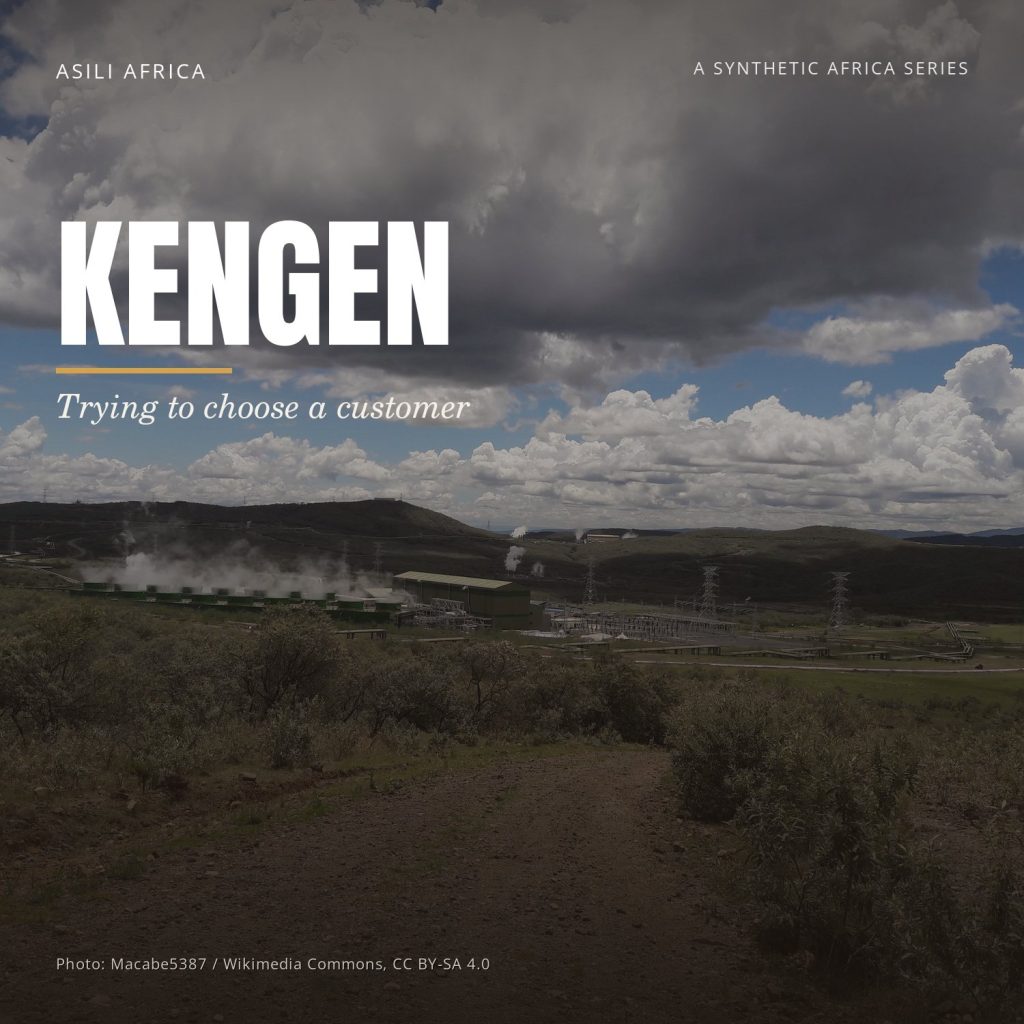
The KenGen Story: Trying to choose a customer
In the year to June twenty twenty five, one company produced more of the electricity bought by Kenya Power than every other supplier put together.
That company was KenGen. By its own reporting, fifty nine per cent of what Kenya Power bought came from it.
And every unit of electricity KenGen sells goes to one buyer. Kenya Power.
Most of the buyer’s power, from one seller. All of the seller’s power, to one buyer.
On average, KenGen sells that power for about nine point seven eight shillings a unit.
Private producers sell to the same buyer for an average of twenty one point one six shillings.
That makes KenGen the cheapest major supplier Kenya Power has.
And in the middle of twenty twenty five, Kenya Power owed it about seventeen billion shillings.
On the twenty sixth of May, twenty twenty six, KenGen said it would apply for a licence to sell power directly to customers at its Green Energy Park.
Around its only buyer.
THE LINE
On the first of February, nineteen fifty four, under the colonial Companies Act, a company was incorporated in Kenya to build a transmission line.
It was called the Kenya Power Company. Its line was to run from Nairobi to Tororo, on the border with Uganda.
On the far side of that border was the Owen Falls Dam. The line was built to carry that dam’s hydropower into Kenya.
Kenya was a British colony. Uganda, across the border, was a British protectorate. The wire ran between them.
The company was also to develop generating stations at home. But the first job it was given was a wire, carrying another country’s power.
The company that would one day be KenGen was born to import electricity.
And it did not run itself. Its shareholders contracted another company to manage it, the East Africa Power and Lighting Company.
In nineteen eighty three, that manager was renamed Kenya Power and Lighting. The generating company stayed inside it.
For about forty years, it had no independent life. It had a name and a mandate. Another company ran it, as a department of a single state power monopoly that made the electricity, carried it and sold it.
There is no founder in this story. No one person decided to build this company, and the record offers nobody to stand in for one.
We are not going to invent one.
Meanwhile, on the floor of the Rift Valley, at a place called Olkaria, steam was coming out of the ground.
Geothermal exploration there began in the nineteen fifties and sixties.
From nineteen sixty seven, surveys backed by the United Nations Development Programme, the Kenyan government and the East Africa Power and Lighting Company went looking at what lay underneath.
What lay underneath was heat.
In June nineteen eighty one, a power station called Olkaria One began generating electricity from that steam.
It was the first geothermal power station in Africa.
It was built in three phases. The second came in November nineteen eighty two, and the third in March nineteen eighty five, bringing it to forty five megawatts.
It was a first, and a real one. It was running seventeen years before there was any company called KenGen.
The capability came before the company. The steam field and the company that would own it belong to two different ages.
So by the time KenGen came into being, geothermal was not new to Kenya. It was already in the ground, and already feeding the grid.
In nineteen ninety six, Kenya reached a reform agreement with the International Monetary Fund and the World Bank.
World Bank funding was made conditional on separating the generation of electricity from Kenya Power and Lighting.
In nineteen ninety seven, the Electric Power Act put all of the state’s generating assets into the company from nineteen fifty four, and took it out from under Kenya Power and Lighting’s management.
The same reform created a regulator for the sector, the Electricity Regulatory Board. It began work in nineteen ninety eight.
Before this company had its name, three things had been settled by other people. What it was for. Who ran it. And when it would stand alone.
Its independence was a condition, attached by a lender.
THE RAINS
On the nineteenth of January, nineteen ninety eight, the Kenya Power Company was renamed.
It became the Kenya Electricity Generating Company. KenGen.
It inherited ageing power stations. And it had to prove, almost at once, that it could stand on its own as a business.
It also inherited a national grid that depended on hydropower for about seventy three per cent of its electricity.
About three quarters of the country’s power rested on its rivers. When the rivers ran low, so did the grid.
That same year, the long rains failed.
They failed again in nineteen ninety nine. And again in the year two thousand.
In November nineteen ninety nine, partial power rationing began.
By two thousand, the country faced a power shortfall of about forty per cent.
Major towns were put on rationing programmes, with cuts of twelve hours a day.
The same drought brought a food crisis with it.
The government chartered emergency diesel generators, about ninety nine megawatts of them, around Nairobi.
The reported cost was about thirty million dollars, to bridge the gap.
This was the country’s crisis. Nothing in the record says the new company’s survival was in question. It was the customers who were sitting in the dark.
And the company itself had never had to be a company.
It had no commercial culture of its own. No investor relations. Its governance and reporting had always been someone else’s.
It had to build those from almost nothing. It had eight years before the public was invited in.
In two thousand and three, Eddy Njoroge became managing director.
Under him, KenGen was taken to the stock exchange.
He would lead the company for ten years. In twenty thirteen, he stepped down before his third term was out, telling shareholders that ten years was sufficient time for one to make a difference in an institution.
In the offer, about six hundred and fifty nine million shares were put on sale at eleven shillings ninety each.
The public queued for them.
The offer was oversubscribed by three hundred and thirty seven per cent.
About twenty six billion shillings was put forward, for a sale of about eight billion.
About two thirds of that money had to be refunded.
After the sale, the public held about thirty per cent of KenGen. The state kept about seventy.
On the seventeenth of May, two thousand and six, the shares began trading on the Nairobi Securities Exchange.
There were bids above sixty shillings. The first trade was struck at forty five.
It was the largest public share offer Kenya had seen.
Six years after its towns were rationed twelve hours a day, the country was queuing to own a piece of KenGen.
THE WELLS
A geothermal well at Olkaria goes down more than two kilometres into the Rift Valley.
At the bottom is rock hot enough to turn water into steam.
The steam is brought to the surface, piped to a turbine, and turned into electricity.
KenGen has drilled dozens of these wells at Olkaria.
It is capital hungry, technically difficult work. For years, KenGen did it while still running the old fleet of hydro stations it had inherited.
Someone drills them.
The crews who work these rigs are the people the whole geothermal record rests on. They do not appear in any source for this episode.
Not who they are. Not how the work is staffed. Not its safety record.
KenGen reported about two thousand six hundred employees in twenty twenty three. Some of its drilling has been done by contractors. How many people have worked the rigs at Olkaria, in either group, the sources do not say.
The megawatts are documented. The people who produce them are not.
Under Eddy Njoroge, the company commissioned the geothermal plants that began to move it off its dependence on rivers. The managing directors after him kept building.
In twenty thirteen and twenty fourteen, a plant called Olkaria Four was commissioned. Two hundred and eighty megawatts.
It was built under the Kenya Electricity Expansion Project, with financing from the World Bank.
Olkaria One had been forty five.
By twenty twenty five, KenGen’s geothermal capacity stood at about seven hundred and thirteen megawatts, across five major stations and a set of smaller wellhead units.
Its rivers still account for a little more capacity. Its hydro fleet is about eight hundred and twenty six megawatts.
Add about thirty hydro plants, four thermal plants and a wind station, and the whole company runs to about eighteen hundred megawatts.
When KenGen got its name, about three quarters of Kenya’s power came from rivers. By twenty twenty five, KenGen had about seven hundred and thirteen megawatts of steam.
Olkaria One had been generating since nineteen eighty one. The company did not turn to geothermal. It had it before it had a name, and it kept drilling.
The skill travelled.
In twenty nineteen, KenGen won a contract to drill geothermal wells in Ethiopia, for the country’s state power company.
In twenty twenty one, it won another, to drill three wells in Djibouti.
The expertise had become an export.
KenGen could sell its drilling to other governments. Its electricity still went to one buyer.
The contracts to drill and lease these wells have been disputed, again and again, across the time of three different chief executives.
In twenty eleven, it was alleged that a two thousand and six contract with Great Wall Drilling, to drill six wells at Olkaria, had been varied to add fifteen more without a fresh tender, at a reported price increase of eleven point two per cent.
The Director of Public Prosecutions ordered further investigation. The Ethics and Anti-Corruption Commission found no irregularities that warranted criminal charges.
Around twenty nineteen, KenGen cancelled a disputed contract to lease wellheads, worth about fifty two billion shillings, roughly four hundred and ninety two million dollars, after a legal challenge.
From twenty twenty three, a tender to sell about six point three eight million carbon credits, worth about two and a half billion shillings, drew three bidders, and went through at least two procurement cycles.
Then it went into the courts.
The Court of Appeal ordered a fresh review. It ruled that an organisation running a tender cannot introduce new rules for judging the bids part way through.
The carbon credits tender is still unresolved.
Disputed. Cancelled. Cleared. Still in court. That is what the record establishes. What it does not hold is an extended account from KenGen’s own leadership, of any of the three, in its own words.
In the year to June twenty twenty five, ninety five per cent of the electricity KenGen supplied came from water, wind, and the heat of the Rift.
THE LAND
In twenty thirteen, Olkaria Four was coming into service. The steam field it draws on runs inside and beside Hell’s Gate National Park.
It is a park of red cliffs and a deep gorge. It is also where the steam is. The park and the field sit on the same ground.
KenGen has drilled more than ninety wells in or beside the park, each more than two kilometres deep.
About thirty two square kilometres of park land have been turned over to geothermal development.
The wells bring noise, light and vibration into a place set aside for wildlife.
On one cliff there was a colony of Rüppell’s vultures.
KenGen drilled a well directly in front of it.
For years afterwards, the birds’ breeding was disrupted.
Visitors reportedly asked for their money back. They said the park felt more like an industrial site than a national park.
Conservationists’ own assessment is that, in the trade-off between Kenya’s need for power and the habitat, the energy side has prevailed.
It is not a scandal with an ending. It is unresolved, and it is likely to stay that way.
Olkaria Four needed land. Maasai communities living on it were moved.
The project behind the plant, the Kenya Electricity Expansion Project, cost about one point three nine billion dollars. About three hundred and thirty million of that came from the World Bank.
The plant was built by KenGen. Part of the money was the World Bank’s.
In September twenty thirteen, the World Bank itself issued a statement on what happened at Olkaria. It used the word evictions in its title.
The resettlement is one of the more thoroughly documented episodes in KenGen’s history, by outsiders: the Bretton Woods Project, Cultural Survival, and others. In the company’s own public account of itself, it barely appears.
The communities say they were resettled onto land less than half the size of what they had held before.
The new ground, they say, is cut by steep ravines, where herding, their main livelihood, is largely unviable.
In October twenty fourteen, their leaders took a confidential request to the World Bank’s Inspection Panel.
They alleged impoverishment, disputes within the community, and concerns about their health.
The Inspection Panel is part of the World Bank’s own structure. Its finding was about the World Bank.
The Panel found that the World Bank had breached its own safeguard policies. It had failed to apply its own Indigenous Peoples Policy to the project.
An institution, found by its own panel to have broken its own rule.
KenGen’s part is just as specific. The company committed to build a hundred and sixty four resettlement houses. It built a hundred and fifty.
Fourteen were not built.
Fourteen families were left without one. The record describes them as the poor, orphans and widows.
No source for this episode confirms that this has been put right.
And nothing in the record is in their own words. Everything known about them comes through the Panel, advocacy groups and legal summaries. It is a fact reported about them. Not by them.
THE CUSTOMER
Since nineteen ninety eight, KenGen has had one buyer. In nearly thirty years, it has never had to choose a customer, and it has never been able to.
Every unit of electricity it sells goes to Kenya Power, which carries it the rest of the way and sends the bill.
In the year to June twenty twenty five, by its own reporting, KenGen sold eight thousand four hundred and eighty two gigawatt hours, out of fourteen thousand four hundred and seventy two that Kenya Power bought. Fifty nine per cent.
So the dependence runs both ways. KenGen has one customer. That customer gets most of its power from KenGen.
For a company of this size, a single customer for nearly thirty years is an unusual concentration. Everything it earns from electricity depends on one counterparty paying.
The owner is the state, with about seventy per cent. The Treasury has floated selling more of its stake, but had not committed to doing so.
And it gets it cheaply: about nine point seven eight shillings a unit on average, against twenty one point one six from private producers.
In June twenty twenty five, Kenya Power owed KenGen about seventeen billion shillings.
Kenya Power’s own finances are strained, partly by what it owes private producers in dollars, at a time when dollars have been scarce.
That is its own story, and it has its own episode.
The cheapest major power Kenya Power buys is also power it has been slow to pay for.
By February twenty twenty six, the business press was reporting that the debt was pushing KenGen to consider selling power directly to customers.
On the eighth of May, twenty twenty six, the Energy and Petroleum Regulatory Authority, successor to the board set up in nineteen ninety eight, gazetted new open access rules.
They ended Kenya Power’s monopoly on supplying large consumers. Large consumers could now buy their electricity from suppliers other than Kenya Power.
Eighteen days later, on the twenty sixth of May, KenGen said it would apply for a licence to sell power directly to customers at its Green Energy Park.
The application was planned for June. No decision on it appears in the sources for this episode.
If it is granted, it would be the first time since nineteen ninety eight that KenGen’s electricity reached a customer without passing through Kenya Power.
KenGen’s managing director since twenty twenty three is Peter Njenga.
He is an electrical engineer with more than thirty years in the energy sector. Before KenGen, he ran infrastructure development at Kenya Power. He came to the seller from the buyer’s side.
Whether any of this makes electricity cheaper for the households and businesses who pay the bills is not established. They were not examined in any source for this episode. The gap between KenGen’s price and the private producers’ price is in the record. What it means on anyone’s bill is not.
The licence KenGen wants is for one place. The Green Energy Park is at Olkaria, on the same ground where Olkaria One started generating in nineteen eighty one.
It covers about three thousand three hundred and fifty six hectares. In twenty twenty five, the government declared it a Special Economic Zone.
Tenants are offered steam, brine and electricity directly from the field, along with the tax incentives of a special economic zone.
Its promoters describe it as Africa’s first fully integrated, geothermal powered industrial ecosystem.
In November twenty twenty five, its first anchor tenant, a fertiliser plant, broke ground.
The park is planned in four phases, running to twenty forty five.
In July twenty twenty six, Kenya signed a work plan for its nuclear power programme.
KenGen was confirmed as the owner and operator of the country’s first nuclear power plant.
It is a planned plant in Siaya, with construction targeted for twenty twenty seven and power for twenty thirty four.
KenGen will work on it alongside the state’s Nuclear Power and Energy Agency, and a separate new nuclear regulator.
For a company built on rivers and steam, it is new territory.
The job came from the state, as the first one did in nineteen fifty four. A large task, set somewhere else, and given to this company to carry.
Within the same two months, KenGen asked for one new job, and was handed another. One bet it chose. One it was given.
Both are open.
For forty five years, the ground at Olkaria has been turned into power.
Owners changed. Lenders came and went. So did managing directors. The rains failed, and returned. The public bought in. The steam field stayed.
KenGen became very good at one hard thing, in one place. It found its steam before it had its name. It drilled wells that other countries now hire it to drill. It supplies most of the power its only buyer purchases, at the lowest price that buyer pays any major supplier.
And it did not choose how it was born, who owned it, or who bought its power.
As of the twenty eighth of September, twenty twenty six, it is trying, for the first time, to choose a customer. No outcome to that application has been published in the sources for this episode.
And the plant it was handed is eight years from its first power.
Neither is decided. This is Asili Africa. Every empire has an origin. See you on the next one.
Key Takeaways
- THE LINE. On the first of February, nineteen fifty four, under the colonial Companies Act, a company was incorporated in Kenya to build a transmission line.
- THE WELLS. A geothermal well at Olkaria goes down more than two kilometres into the Rift Valley.
- THE LAND. In twenty thirteen, Olkaria Four was coming into service.
- THE CUSTOMER. Since nineteen ninety eight, KenGen has had one buyer.
In this series: State Assets
What does a state do with a company it owns?
- Mumias Sugar
- Pan Paper
- Kenya Power
- KenGen (this episode)
- New KCC
- KTDA
- Ethiopian Airlines
- Kenya Airways
- Precision Air
Also available on YouTube — search “Asili Africa” or subscribe to our channel.