
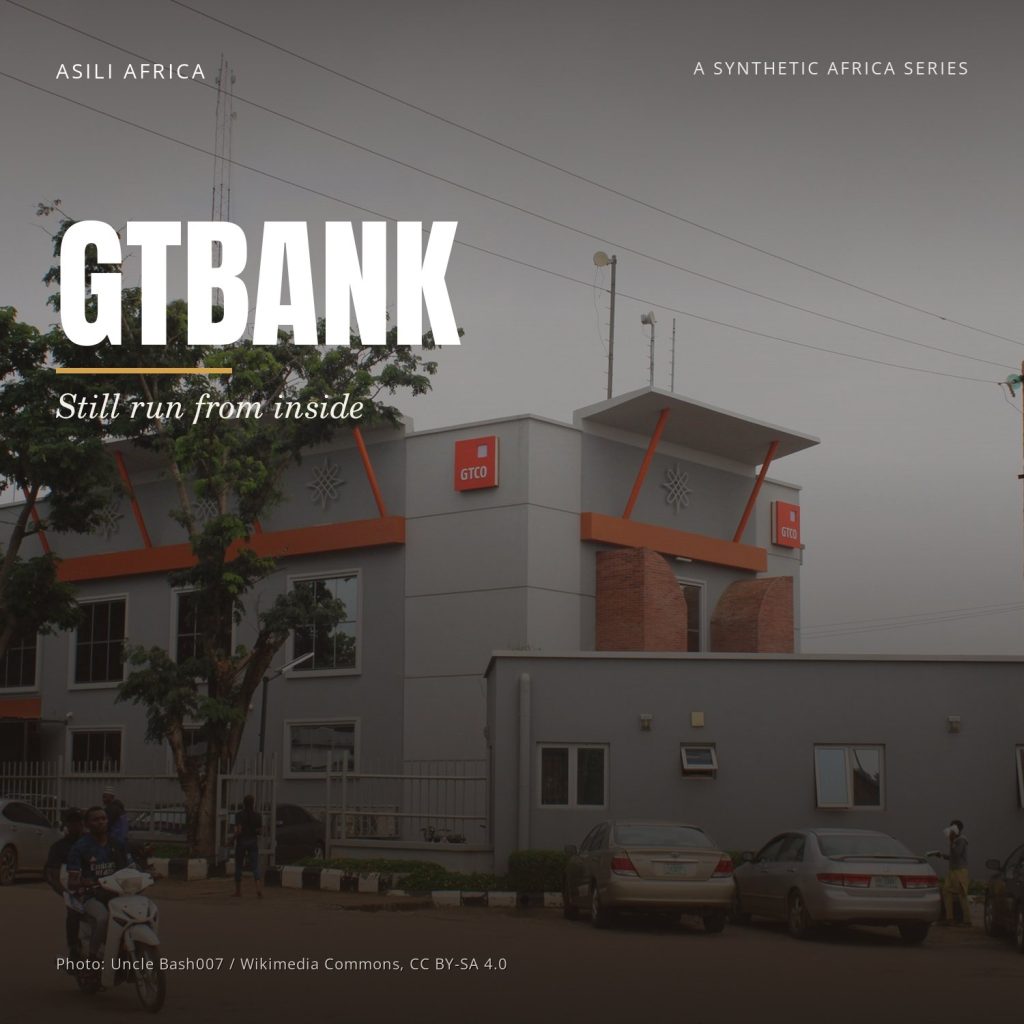
The GTBank Story: Still run from inside
In nineteen ninety, in Lagos, about thirty-five Nigerians, most of them in their thirties, were licensed to start a bank.
It was called Guaranty Trust Bank.
In twenty twenty-five, the group that bank grew into earned more than one point two trillion naira before tax.
No single shareholder controls it.
No founding family controls it. No government. No parent company abroad.
Neither of the two founders who first led it is there now.
Three times, the top job has changed hands. Each time, it went to someone who was already inside.
The man who runs the group today joined in nineteen ninety-one, the year its doors opened.
THE FOUNDERS
The bank’s first managing director was Fola Adeola. He was born in January nineteen fifty-four, which made him about thirty-six when the bank was licensed.
He was an accountant. He took a diploma at Yaba College of Technology in nineteen seventy-five, trained in practice, including at Deloitte, and qualified as a chartered accountant in nineteen eighty.
His deputy was Tayo Aderinokun. He was born in Kano, in May nineteen fifty-five, the year after Adeola.
He took a business degree at the University of Lagos, and in nineteen eighty-one an MBA from UCLA, in California.
One was trained in the ledgers, the other in business school. Both were in their thirties.
They were two of about thirty-five founders, most of them the same generation. Other founders’ names appear in the record. This episode follows the two who led.
Nigeria was under military rule at the time, and Lagos was still its capital.
How that group raised the capital to open a bank is not in the record our research found.
Nor is who backed them, or what share each founder kept, or what share any of them holds today.
So this is not going to be told as a story of a back room and borrowed savings. Nothing on record supports that version, and nothing on record supports any other.
On the eleventh of February, nineteen ninety-one, the bank’s first head office opened, on Adeyemo Alakija Street, on Victoria Island in Lagos.
The licence had come the year before. Now there was a building, a banking hall and a staff. Guaranty Trust Bank was open for business.
That same year, Segun Agbaje joined the bank.
He came from Ernst and Young, in San Francisco.
As the founding is told, by the bank and in friendly profiles of its founders, they had been disillusioned with the way Nigerian banking was done.
In that telling, they set out to build a bank on professionalism, transparency and integrity, one that put the customer first.
In the same telling, staff called each other by first names, including the people at the top. Office doors were left open.
There was a system through which staff could challenge decisions, all the way up to the leadership.
Later, the bank wrote its way of working down as eight principles. It called them the Orange Rules, after the colour it had taken as its own.
The research behind this episode found no independent account that tests any of that description, and no account from the people who worked there.
The description comes from the bank, and from writers friendly to it. It may be accurate. On the record we have, it cannot be checked.
In nineteen ninety-two, the bank opened branches at Ikeja and on Broad Street in Lagos.
It also opened its first branch outside the city, in Kano, far to the north.
The bank’s own history puts its profit that year at fifty-two million naira.
In nineteen ninety-three, it opened in Port Harcourt, in the oil country of the south.
By then, its balance sheet had passed two point three billion naira.
By nineteen ninety-seven, its shares were listed in Lagos.
A bank started by a group of people in their thirties now had public shareholders. Anyone with the money could buy a piece of it, and the bank now answered to them as well.
In January two thousand, Segun Agbaje became an executive director. He had been at the bank for nine years.
The bank’s first decade passed with both of its founding leaders still at the top.
THE DEPUTY
Two thousand and two. In February, Guaranty Trust Bank was granted a universal banking licence.
A universal licence let a bank work across more kinds of financial business than ordinary commercial banking, under one roof.
In July, Fola Adeola retired. He was forty-eight. He had run the bank for twelve years, since the beginning.
The record does not say why.
Not the bank’s own account, not the press, and not any profile of him that our research found.
A founder leaving the bank he led for twelve years is the kind of moment that usually comes with a story. Here, the record has a date and nothing else.
Tayo Aderinokun became managing director. He was forty-seven, and he had been the deputy for twelve years, from the first day.
In August, Segun Agbaje became his deputy.
The new managing director had been there since the founding. The new deputy had been there since the first year of business.
The bank had changed hands, and the hands were its own.
That same year, the bank opened its first subsidiaries outside Nigeria.
One was in the Gambia.
The other was in Sierra Leone. The first handover and the first move abroad came in the same year.
In two thousand and three, the Central Bank of Nigeria designated it a settlement bank.
That made it one of the banks through which money moving between Nigerian banks is settled. It is a role the regulator gives. A bank cannot take it for itself.
In two thousand and five, it opened in Ghana. It was the bank’s third country outside Nigeria.
That same year, it installed its first cash machine.
The bank was fifteen years old. For all of those years, it had served its customers without a cash machine of its own.
The ratings agency Fitch gave it a rating of double A minus. A rating is an outside opinion of how likely a borrower is to pay its debts.
How those banks abroad performed, one by one, is not separated out in anything our research found.
In two thousand and seven, the bank went to London.
Its shares began trading on the London Stock Exchange as global depositary receipts.
Those are certificates, each standing for a set number of a company’s shares, that let investors abroad hold them.
The same year, it sold three hundred and fifty million dollars of Eurobonds.
A Eurobond is a bond sold to investors around the world, in a currency other than the borrower’s own. Here, it was dollars.
Five years after the first handover, the bank was raising money from investors abroad, in dollars, in its own name.
By the end of the decade, the deputy of twelve years had been managing director for eight, and the hire from nineteen ninety-one had been his deputy just as long.
In twenty ten, the Central Bank of Nigeria brought in a rule.
It barred banks from owning non-lending businesses, businesses other than lending itself. Under it, a bank could no longer hold other kinds of business beneath it.
THE INSIDER
Twenty eleven. On the fourteenth of June, Tayo Aderinokun died in the United Kingdom. He was fifty-six.
He was still the managing director. He had been with the bank for all of its twenty-one years, twelve as deputy and nine at the top.
The record keeps the date and the place.
It does not keep how the bank took the news, what its staff were told, or anything his fellow founders said.
Our research found none of it, and this episode will not supply it.
Of the two founders who had led the bank, neither was now inside it.
The man named managing director was Segun Agbaje, who joined in nineteen ninety-one, the bank’s first year of business.
He had been inside for twenty years: an executive director from two thousand, the deputy from two thousand and two, and now managing director.
The second change at the top, like the first, went to someone already there.
That year, the bank sold five hundred million dollars of Eurobonds, a larger issue than the one of two thousand and seven.
In twenty thirteen, the bank bought seventy per cent of Fina Bank, for about a hundred million dollars.
Fina had banks in Kenya, Rwanda and Uganda. With one purchase, a Lagos bank was operating on the other side of the continent.
The bank had grown up in West Africa. Fina took it into the East African Community, a trading bloc that includes all three of those countries.
Seventy per cent meant control. The rest stayed with other shareholders.
How Fina was brought into the group is not in the record our research found.
Nor is how it has performed since, or what its staff and customers went through in the change.
The deal appears in the bank’s timelines. What happened after it does not.
In twenty sixteen, the bank widened its short code service, seven three seven, into full banking.
A customer dials the code on any mobile phone, with no internet connection and no smartphone, and does their banking from the keypad. It needs no app and no data plan.
The bank also had a subsidiary in Britain, Guaranty Trust Bank UK.
The Financial Conduct Authority is Britain’s financial regulator. It supervises the banks that operate there, including the British arms of foreign banks.
In August twenty thirteen, the Financial Conduct Authority fined that subsidiary five hundred and twenty-five thousand pounds.
It found what it called serious and systemic failings in the subsidiary’s anti money laundering controls.
Those are the checks a bank runs on who its customers are and where their money comes from.
From October twenty fourteen, a year after that first fine, to July twenty nineteen, the subsidiary’s controls fell short again. That is almost five years.
In January twenty twenty-three, the Financial Conduct Authority fined it again.
This time the fine was seven point six seven million pounds, after a settlement discount of thirty per cent. Without the discount, it would have been about eleven million.
A firm that settles with the regulator, rather than contesting the case, receives a discount on its penalty.
The regulator said the bank had failed to fix problems that had been repeatedly flagged to it.
In the regulator’s account, this was not a bank that had never been warned. It had been warned, and fined, and the weaknesses had stayed.
Against a group that would soon earn more than a trillion naira a year, the money was small. The finding was not.
The founders’ promise of integrity comes to us in the bank’s own words.
The only independent judgement on that promise in the record our research found is this one, a regulator’s, and it found the subsidiary’s controls wanting twice.
It is a judgement on one subsidiary, in one country. It is not a verdict on the whole group.
Ten years after his death, the training centre in Abeokuta where the bank’s new staff are taught was named after Tayo Aderinokun.
Tayo’s Plaza.
THE HOLDING COMPANY
Twenty twenty-one. Guaranty Trust Bank became part of a new holding company, Guaranty Trust Holding Company, known as GTCO.
The reason given was the Central Bank’s rule of twenty ten, the one that barred banks from owning non-lending businesses.
Eleven years after the rule, the bank’s structure followed from it.
For the first time in its history, the bank had a parent company. It was now a subsidiary of its own holding company.
A holding company is a parent company that owns other companies.
Under the rule, a bank could not hold other kinds of business itself. A holding company could hold the bank and those other businesses side by side.
So under GTCO, the bank became one company among several. Payments, pensions and asset management sat beside it, not beneath it.
Pensions and asset management look after other people’s savings. Payments move money for customers. None of them is lending.
The structure was not a free choice. It was how a group with businesses beyond lending could stay within the rule.
In August twenty twenty-one, Segun Agbaje moved up to become group chief executive of GTCO. He had joined the bank thirty years earlier, in its first year.
He had been managing director of the bank for ten years. Now he ran the group, and the bank had a managing director of its own.
Miriam Olusanya became managing director of the bank.
She is the bank’s first woman managing director.
It was the third change at the top. In thirty-one years, the bank had had four managing directors.
Today the group’s banks operate in ten African countries, from the Gambia and Côte d’Ivoire to Kenya and Tanzania, and in the United Kingdom. It has more than fourteen subsidiaries in all.
In twenty twenty-five, the payments arm’s transaction volume nearly tripled, and the fund manager’s assets roughly doubled, both from a small base.
In March twenty twenty-four, the Central Bank raised the minimum capital for banks with international licences.
Minimum capital is the least a bank must hold of its own money, its buffer against losses, to keep operating under that licence.
The floor went from fifty billion naira to five hundred billion. Every Nigerian bank with an international licence faced the same bar.
The deadline was March twenty twenty-six.
That was ten times the old floor, with two years to reach it.
On the ninth of July, twenty twenty-five, GTCO listed on the main market of the London Stock Exchange.
It came after an offering of about two point two nine billion new shares, which raised a hundred and five million dollars.
Eighteen years after the bank’s receipts first traded in London, the holding company had a listing on London’s main market, alongside its home market in Lagos.
Its shares now traded in two cities, and a listing on the main market brings that exchange’s full listing rules with it.
The London listing was partly how the new capital bar was met.
In August twenty twenty-five, the holding company put new capital into the bank.
Before the deadline in March twenty twenty-six, the bank was recapitalised past the five hundred billion naira threshold.
The deadline was met.
THE CLEARANCE
Twenty twenty-five. The group earned more than one point two trillion naira before tax.
That was less than the year before, because the year before had included about five hundred and seventeen point five billion naira in fair value gains, and those did not come again in twenty twenty-five.
Fair value gains come from changes in the value of assets a bank holds, not from its lending or its fees.
Interest income and fee income each grew by more than a fifth. The fall came from a gain that did not recur. The business underneath it grew.
Deposits rose by almost a quarter, to twelve point eight seven trillion naira. Total assets rose by a fifth, to seventeen point eight trillion.
Shareholders’ funds, the part of the balance sheet that belongs to its owners, stood at three point four trillion naira. For every hundred naira it earned, it spent less than twenty-eight.
And it has no single controlling shareholder.
What has carried this bank forward is not an owner. It is a line of managers, each already inside before taking the chair.
The man at the top of the group has been inside it for thirty-five years.
In the first half of twenty twenty-six, profit before tax was six hundred and three billion naira. That was flat, up by less than half of one per cent, after a fair value loss of forty-six point two billion.
Deposits grew by about a tenth in those six months, faster than profit. By the end of June, total assets had reached eighteen point six trillion naira.
GTCO’s board approved those half-year accounts on the twenty-eighth of July.
Half-year results usually come out by the end of August.
These were published on the twenty-ninth of September, after the Central Bank of Nigeria signed off. Until it did, the accounts the board had approved could not be published.
The Central Bank supervises Nigeria’s banks, and its sign-off on their accounts comes before they are made public.
Neither the bank nor the regulator has said why it took two months.
We have not found an explanation, and we are not going to supply one.
For two months, the shareholders of a group listed in Lagos and in London waited on the regulator to see figures its own board had already approved.
Two other matters are open.
In December twenty twenty-four, the Federal Competition and Consumer Protection Commission, the FCCPC, opened an inquiry into customer complaints against the bank, with hearings from the third of December.
The same inquiry also covered a telecoms operator and an airline.
Among the complaints against the bank were repeated stamp duty deductions, debits customers could not explain, and losses from transactions they say they did not authorise.
The inquiry’s outcome is not in the record our research found. Neither is the number of customers affected.
Then there is Innoson, a vehicle maker whose dispute with the bank over a loan and its charges has been in the courts since twenty eleven.
An award went against the bank in twenty thirteen. In twenty nineteen, the Supreme Court dismissed the bank’s appeal.
In twenty twenty-two, the Supreme Court set that ruling aside, saying its registry had misled it about a brief that had been filed, and relisted the appeal.
We did not find a final outcome.
In nineteen ninety, about thirty-five people in their thirties were licensed to start a bank in Lagos.
In two thousand and two, the founder who ran it retired, and his deputy of twelve years took the chair.
In twenty eleven, that deputy died in office, and the man who had joined in the bank’s first year took it.
In twenty twenty-one, he moved up to the holding company, and the bank passed to its first woman managing director.
No single shareholder controls it. Four managing directors since its doors opened, and the chain of hands is what has held it.
Its two biggest changes of structure in the twenty twenties were not free choices. The holding company followed from one Central Bank rule, and the London listing was partly how it met another.
And in twenty twenty-six, the regulator decided when its results could be seen.
Thirty-six years after the licence, it is a group with banks in eleven countries, still run from inside.
What comes next is open: the next set of results, the consumer inquiry, and the Innoson appeal.
That is where this story stands, as of the end of September, twenty twenty-six.
This is Asili Africa. Every empire has an origin. See you on the next one.
Key Takeaways
- THE FOUNDERS. The bank’s first managing director was Fola Adeola.
- THE INSIDER. Twenty eleven.
- THE HOLDING COMPANY. Twenty twenty-one.
- THE CLEARANCE. Twenty twenty-five.
Also available on YouTube — search “Asili Africa” or subscribe to our channel.