
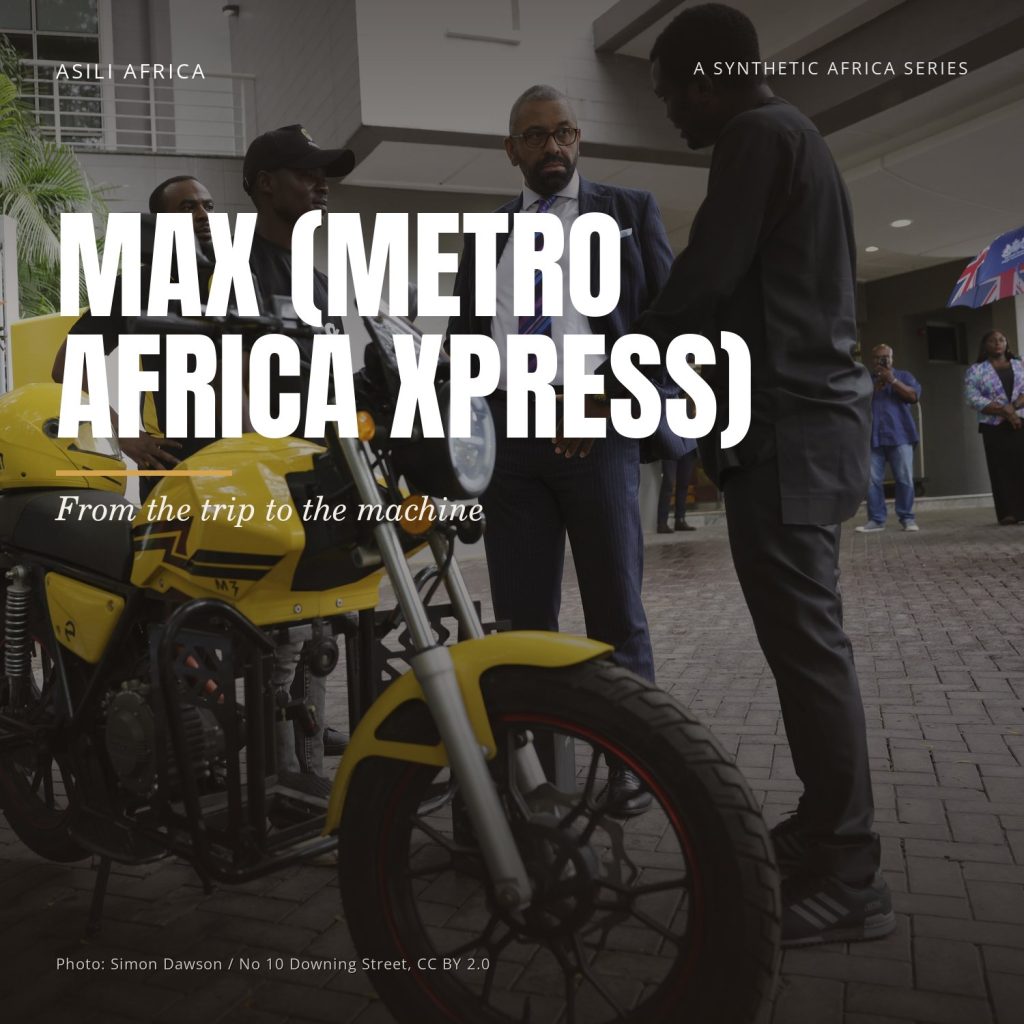
The MAX (Metro Africa Xpress) Story: From the trip to the machine
In June twenty twenty six, a Nigerian newspaper reported that taskforce operatives in Lagos had impounded two hundred and seventy eight motorcycles.
They were commercial motorcycle taxis. In Lagos they are called okada.
The rule those operatives were enforcing is not new. It rests on a state transport law of twenty eighteen, and in January twenty twenty the state announced that from the first of February it would cover major areas of the city.
More than six years later, it is still being enforced.
Ten years before that report, a young company started out on those same streets with twenty motorcycles.
It was a delivery business, and the motorcycle was the whole idea.
In June twenty twenty six, that company’s assembly plant is in Ibadan, another city in Nigeria’s south west.
It builds electric motorcycles and tricycles there, and it finances them to the people who ride them for a living.
That same month, the company’s chief executive gave an interview about electric vehicles, and reached for a comparison.
The business, the chief executive said, is like building a toll road.
A motorcycle restriction, still being enforced in Lagos. A company born on Lagos motorcycles, describing itself in the language of highways.
The company is MAX, Metro Africa Xpress. The restriction is still standing. MAX went around it, not through it.
TWENTY MOTORCYCLES
In twenty fifteen, two Nigerian students were finishing their degrees at MIT Sloan, the business school of the Massachusetts Institute of Technology.
Adetayo Bamiduro was in the MBA programme, and was a fellow at the university’s Legatum Center.
Chinedu Azodoh was taking a master’s in finance.
They did not build their company on the side. They built it in class, in a course called New Enterprises.
From there it went through the machinery the university keeps for student founders. The IDEAS Global Challenge. The one hundred K entrepreneurship competition. The Venture Mentoring Service. The Martin Trust Center.
Both founders are Nigerian, and they were building for home, from a classroom on another continent.
The idea was delivery. Motorcycles, carrying parcels across Lagos, for the companies that had started selling online.
Before the two of them graduated, they had commitments from three e-commerce companies. One of them was Jumia.
Two founders, one class, and three committed customers. That was the company on paper.
So there were customers waiting before the company had carried a single parcel.
An online shop that sells a phone to a customer on the other side of Lagos has made a promise it cannot keep on its own. Somebody has to carry the box. That was the gap MAX was built to fill.
MAX went live in Lagos at the turn of twenty sixteen. The sources disagree on the exact date. They put it somewhere between December twenty fifteen and the first week of January.
The founders have told the story of the first week themselves. They had twenty motorcycles on the road. They made two deliveries.
Two deliveries, from twenty machines, in seven days.
For a company with retailers already committed, that was not a slow start. It was a sign that something between the order and the doorstep did not work the way the plan had assumed.
In their own telling, that week forced them to throw out assumptions they had brought with them about the market.
One of those assumptions was about the riders. MAX needed people to ride its motorcycles, and it went looking for them the way a young technology company looks for anyone. It advertised online.
It did not work. Many of the riders the company was trying to reach did not have bank accounts, and a digital advert did not reach them.
What worked was street agents. People who went to the roadside, to where the riders already were, and stood beside the motorcycle, and talked.
It is a small detail. For this business, the hardest customer to reach was not the retailer with the parcels. It was the rider.
In March twenty sixteen, MAX reportedly raised a seed round of nine hundred and sixty thousand dollars.
The university’s own news office later profiled the company. That profile, and the founders’ own interviews, are most of what the record holds about these early years.
After that, the work was the ordinary work of a delivery company. Parcels collected from warehouses.
Parcels carried across the city.
Riders found, one roadside conversation at a time.
Parcels handed over at the other end.
By the summer of twenty seventeen, MAX was making about five hundred deliveries a day across Lagos.
In its first week, it had made two.
FINANCING THE BIKE
Around the summer of twenty seventeen, MAX began to pilot a second service. Passengers.
In Lagos, the okada was already everywhere: a motorcycle taxi you flagged down at the roadside. MAX offered the ride booked through a phone.
It also tried delivering food, and dropped it, reportedly because it performed poorly.
Parcels and passengers had one thing in common. MAX was selling what a motorcycle does. A delivery. A trip.
The motorcycle was the tool, and the rider was the one who used it.
In twenty eighteen, MAX started offering something else. It began financing vehicles for the riders themselves.
The rider would pay for the motorcycle over time, out of what riding it earned.
Many of these riders had no bank account, and no credit history a bank would lend against. MAX would lend anyway, against the machine and the work it did.
That changed who stood where. Until then, a rider was someone who worked through MAX. Now a rider was also a borrower, someone who owed the company for the machine underneath them.
And MAX was no longer only selling the trip. Its money was in the machine the trip happened on.
Why would a working delivery company start lending motorcycles to its riders? The record does not keep the founders’ reasoning from the moment they chose. What it keeps is the result, and the company’s own account of it.
The rider now carried a debt, paid back out of what the machine earned. MAX carried money sunk into machines that were out on the road, in other people’s hands.
If the machine stopped earning, both of them would feel it.
In December twenty twenty one, the company’s finance chief told TechCrunch what financing had done. Churn, the rate at which drivers leave, had fallen close to zero after vehicle financing began in twenty eighteen.
By the company’s account, riders who were paying for their own motorcycles stopped leaving.
In a business where the rider is the hardest customer to find, a rider who stays is worth a great deal. The company was saying that financing had solved the other half of the problem the street agents were sent out to solve. Once found, riders stayed.
In the first week, the rider had been the hardest person to reach. Now the rider was the customer.
In June twenty nineteen, MAX raised about seven million dollars. About six million of it was equity, and about a million came as grants.
The round was led by Novastar, an investor that would still be backing the company in twenty twenty six.
By November twenty nineteen, MAX had fifteen hundred drivers. Four years after twenty motorcycles and two deliveries, it counted its riders in the thousands.
And it had a target. Twenty thousand drivers, across three or four countries, by the end of twenty twenty.
The end of twenty twenty was about a year away. The end of January was closer.
FIVE DAYS
On the twenty seventh of January, twenty twenty, the Lagos State government announced a restriction on okada and keke, the motorcycle taxis and the three wheeled tricycles that carry passengers across the city.
It would take effect on the first of February, across major areas of Lagos.
It was not a ban on every road in Lagos State. It covered the major areas of the city.
Motorcycle taxis and tricycles were everywhere in Lagos, and MAX was one of several companies that had built a business on top of them.
The restriction covered both kinds of machine, the two wheelers and the three wheelers. Years later, those are exactly the two kinds MAX would build.
The announcement came on a Monday. The restriction began on the Saturday.
Five days.
Five days to decide what to do with a fleet of motorcycles, and with the people who rode them.
The government’s stated reasons were safety, security and congestion.
MAX disputed the reasoning. It pointed to what it called a zero passenger fatality record. That is the company’s own figure, and nothing in the record checks it.
The dispute did not move the date.
On the first of February, MAX was holding machines. For two years it had been financing motorcycles to its riders, and its money was in them.
Rest of World, looking back a year later on how the Lagos motorcycle rideshare boom went bust, reported what the restriction cost. MAX was left with six point seven million dollars of motorcycles that could no longer be used there.
And nearly two thousand riders were laid off.
The riders are harder to follow than the money. No source in the record follows what became of those two thousand people, where they went, or whether any came back. The record stops at the number.
Six point seven million dollars of machines, and much of the city closed to them.
Before twenty eighteen, a bad week had been a bad week of trips. Then the rider became a borrower. Now a third party had moved, the state, and the position with the most to lose when it moved was the one holding the machine.
MAX was not the only company caught. Its rival Gokada cut about eighty per cent of its staff two days after the ban.
Years later, in late twenty twenty four, Gokada reportedly filed for Chapter Eleven bankruptcy protection in an American court.
Chinedu Azodoh later described the posture MAX had held before the ban. We tried to stay under the radar, the co-founder said, to get things right.
It is a description of a strategy: build quietly, and fix the model before drawing attention. The ban did not wait for the model to be right.
It is tempting to tell this as the moment MAX was forced into financing. The dates do not allow it. Financing began in twenty eighteen, two years before the ban.
If the ban had come first and the financing second, this would be the story of a company pushed into a new model. It is the other way round. The model was already there. The ban put a price on it.
The ban did not push MAX into owning machines. It showed MAX what owning them costs. Six point seven million dollars of motorcycles is only a loss to a company whose money is in them.
And the lesson MAX drew was not to get out of owning machines. Everything it did afterwards went deeper in.
The record does not say what became of those particular motorcycles.
Gokada cut four in five of its people in two days.
MAX did not close.
BEYOND LAGOS
In twenty twenty, MAX was reported to be running in Ibadan, Akure, Osogbo and Kano, and in other Nigerian cities beyond Lagos.
None of those cities is under the Lagos restriction. One of them, Ibadan, is where MAX would later assemble its own machines.
The company that had just watched six point seven million dollars of machines lose their right to work did not stop putting machines on the road. It went looking for more roads.
And it borrowed to do it. In twenty twenty one, MAX reportedly raised twenty two million dollars in debt.
In December twenty twenty one, MAX announced a Series B of thirty one million dollars.
It was co-led by Lightrock and Global Ventures, both new to the company. Two earlier investors came back: Novastar, which had led the Series A two years before, and Proparco.
Proparco is a French development finance institution.
That is the kind of money that now began to sit under MAX’s machines. Development finance: money from institutions set up to invest in development.
The rider owed MAX for the machine. MAX now owed its lenders for the money behind it. Every repayment a rider made was also, one step up, part of a repayment MAX needed to make.
Alongside the Series B, MAX made promises. Ghana and Egypt, by the first quarter of twenty twenty two.
A hundred thousand drivers financed within two years. In November twenty nineteen, it had fifteen hundred.
Two years earlier the promise had been twenty thousand. Now it was five times that.
Francophone Africa, East Africa and Southern Africa, by the end of twenty twenty two.
It was a plan for half a continent, built on borrowed money and development money.
Some of it arrived. MAX went into Ghana, and later into Cameroon.
Riders in new countries, on machines MAX had paid for.
The money came in. The new markets were real. And in Lagos, the restriction was still in force.
ELECTRIC ONLY
By January twenty twenty five, MAX had narrowed what it would finance. Electric vehicles only.
Two wheelers and three wheelers. Motorcycles and tricycles, running on batteries instead of petrol.
And MAX was no longer only financing machines that someone else had made. It was assembling them, at a plant in Ibadan.
The plant has capacity for up to three thousand six hundred two wheelers and three wheelers a month.
The machines MAX lends are now machines MAX has put together itself.
That is capacity, not output. No published figure says how many vehicles the plant actually makes.
MAX also powers them. Drivers swap spent batteries for charged ones at stations on MAX’s own network.
Instead of plugging in and waiting, a rider pulls in with a spent battery and rides out with a charged one.
With each vehicle comes a bundle: insurance, health cover, maintenance, licensing, a digital wallet, and access to the swap stations.
A company that began by selling a delivery now assembles the machine, lends it, insures it, services it, and supplies the energy that moves it.
Each step has taken MAX further down, from the trip, to the thing the trip happens on, and then to the things that thing needs to run.
A driver paying off a petrol motorcycle could buy fuel at any pump.
A driver on an electric one gets energy from one company’s stations.
MAX is not the only company building this. Spiro, a far larger rival, runs its own swap network across several African countries. Its network is closed too.
And the two do not fit each other. A battery from one will not go into the other’s station.
So a driver financed by one company is tied to that company’s network for as long as they ride that machine.
Is that a protection or a trap? One operator answerable for the battery, the bike and the service. Or one operator the driver cannot leave.
The sources raise the question. None of them answers it, and we will not answer it for them.
In January twenty twenty five, as it moved to financing electric vehicles only, MAX laid off about a hundred and fifty people. They were described as thirty per cent of its workforce.
The layoffs took effect immediately. There was no cash severance.
MAX offered health insurance and help finding new work. Some of the people let go called the decision abrupt.
The company said: This decision was not made lightly.
One former member of staff has described the email that ended their job. It cited performance reviews.
At first, they thought it was about them alone.
It was not. They were one of about a hundred and fifty.
Beyond that one account and the company’s own statement, the record has nothing from the people who were let go. And nothing from the people who stayed.
THE TOLL ROAD
In August twenty twenty five, MAX marked ten years. The company said it had onboarded more than fifty five thousand riders since it was founded, across three countries.
That is the company’s figure, and it counts everyone who ever signed on. How many drive for MAX today has not been published.
In January twenty twenty six, MAX announced a round of twenty four million dollars, part equity and part debt. It did not say how much was which.
Novastar was among the investors again, and the debt came from development finance lenders.
Alongside the round, Adetayo Bamiduro said the company was profitable in Nigeria.
In the chief executive’s words: Profitability in Nigeria proves that electric mobility in Africa is not a future concept. It is viable, scalable, and investable today.
No revenue, margin or profit figure has been published. The claim is the company’s, and the numbers behind it have not been shown.
A year before that claim, MAX let go a hundred and fifty people. Both things are true, and nothing in the record connects them.
The cuts are a fact without a demonstrated consequence. The profit is a claim without a figure. We are not going to join them with a guess.
In June twenty twenty six, Bamiduro set out what kind of business this now is. It is like building a toll road, the chief executive said. You don’t make your money back in five years. You make it back in thirty or forty years.
It is the company’s clearest statement of what it has become. Not a delivery company. Not an app. The owner of a road that other people pay to use.
The company says its repayment rate is above ninety per cent. It has not said how that rate is measured.
Nor has it published the terms drivers repay on. The price of a vehicle. The interest. How long the contract runs. What happens when a driver cannot pay.
Without those terms, a repayment rate tells you one thing. It tells you whether MAX is getting paid.
It does not tell you what paying costs the driver. A high rate is a measure of MAX’s health. It could sit beside drivers who are comfortable, or drivers who are stretched, and the record cannot say which.
In May twenty twenty six, MAX borrowed another eight million dollars, from Triple Jump. The debt is in United States dollars. The record does not say how dollar debt is matched against drivers who earn in naira.
In twenty nineteen, the promise was twenty thousand drivers by the end of twenty twenty. In twenty twenty one, it was a hundred thousand drivers financed within two years.
What has been reported is fifty five thousand riders onboarded, in all, by August twenty twenty five. The measures are not identical: the promises counted drivers financed, the anniversary figure counts riders onboarded.
Egypt, promised for early twenty twenty two, does not appear again anywhere in the record.
The new target is two hundred and fifty thousand drivers by twenty twenty seven.
Spiro is far larger. And in April twenty twenty six, the federal government announced its own leasing scheme for okada and tricycle riders. No source says how either one affects MAX.
The company calls its drivers Champions. Almost everything known about them comes from the company.
What they earn after repayments. How many fall behind. How many lose their machines. None of it has been published. There is no independent account of the people paying the toll.
In the first week, the founders learned that a rider could not be reached by an advert. A rider was reached by someone standing beside the motorcycle, at the roadside, talking.
Ten years later, the whole business rests on those riders, on the repayments they make out of what the machine earns, one instalment at a time.
The street agents were the first people at the company to learn where the business was. Ten years on, the person beside the motorcycle is still the one it has to reach.
MAX began by selling what a motorcycle does. It ended up owning the motorcycle, building it, powering it, and lending it to the person who rides it, and each step changed who carries the risk of the machine. This is Asili Africa. Every empire has an origin. See you on the next one.
Key Takeaways
- TWENTY MOTORCYCLES. In twenty fifteen, two Nigerian students were finishing their degrees at MIT Sloan, the business school of the Massachusetts Institute of Technology.
- FIVE DAYS. On the twenty seventh of January, twenty twenty, the Lagos State government announced a restriction on okada and keke, the motorcycle taxis and the three wheeled tricycles that carry passengers across the city.
- BEYOND LAGOS. In twenty twenty, MAX was reported to be running in Ibadan, Akure, Osogbo and Kano, and in other Nigerian cities beyond Lagos.
- THE TOLL ROAD. In August twenty twenty five, MAX marked ten years.
Also available on YouTube — search “Asili Africa” or subscribe to our channel.