
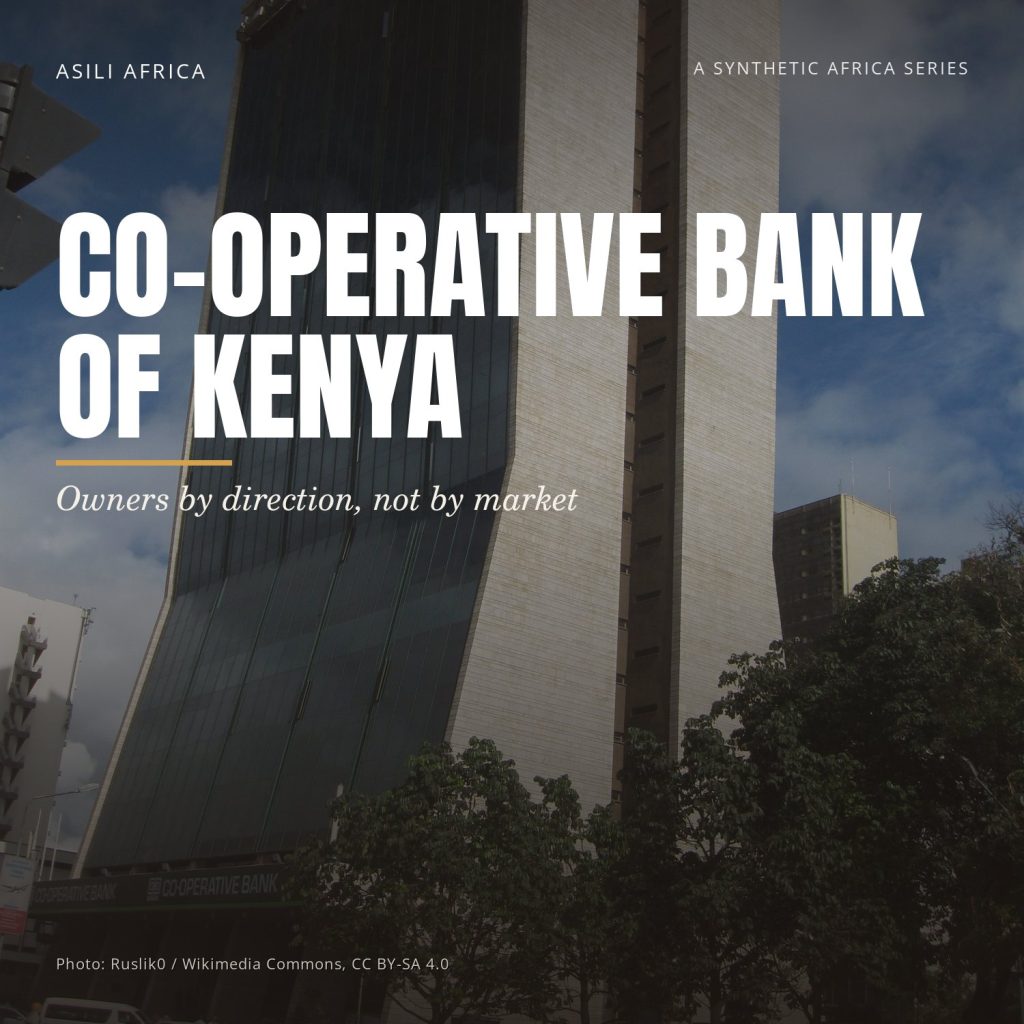
The Co-operative Bank of Kenya Story: Owners by direction, not by market
In the years after Kenya’s independence, the government gave every cooperative society in the country the same direction.
Put your deposits in one bank. And buy its shares.
Until the nineteen fifties, Africans in Kenya had been barred from cooperatives altogether. Now their societies were being given a bank of their own, and told to use it.
That bank was Co-operative Bank of Kenya. It did not win its first customers in a market, and it did not win its first owners there either. The government directed them to it.
It opened its doors on the tenth of January, nineteen sixty-eight, with two hundred and fifty-five thousand shillings of capital and a loan from the government.
In twenty twenty-five, the same bank reported a profit before tax of forty point three billion shillings.
Fifty-eight years after its doors opened, its largest owner, holding about two thirds of it, is a single society.
That society holds the stake of Kenya’s cooperative movement.
THE DIRECTIVE
In nineteen thirty-one, Kenya’s colonial government brought in the Co-operative Societies Ordinance, the law under which the colony’s cooperatives were registered and run.
A cooperative is how farmers pool what they grow and sell it together. The society is owned by its members, and what it earns goes back to them.
Under that ordinance, Africans were excluded from cooperatives.
They were admitted only in the nineteen fifties, about two decades later.
Kenya became independent in December nineteen sixty-three. By then, about a thousand cooperatives were registered in the country.
Their members grew coffee.
They grew cotton.
They kept dairy cattle and sold their milk together.
And they grew pyrethrum, a white flower that is dried and sold to make insecticide.
Societies like these needed credit, to carry their members from one harvest to the next. They needed a bank of their own.
And the new government wanted finance in African hands.
On the nineteenth of June, nineteen sixty-five, a new cooperative society was registered. It was to be a bank.
Registration gave the society a legal existence. It did not yet have a banking licence.
No source our research found names a founder. There is no founding chairman on the record, and no first manager.
The bank was created by the cooperative societies and unions themselves, with the government behind them. A union, in this movement, is a society of societies, gathering the produce of many local cooperatives.
And the government directed cooperative societies to do two things. To move their deposits to the new bank. And to buy its shares.
A bank lends out the money deposited with it. The first half of the direction gave this one something to lend from the start.
The second half gave it its owners. Its shareholders were to be cooperative societies and unions, and behind each society stood its members.
The sources say the government directed. None of them cites a law behind that direction, or says what happened to a society that did not follow it.
On the tenth of January, nineteen sixty-eight, two and a half years after it was registered, Co-operative Bank of Kenya opened its doors, with a banking licence.
Its capital was two hundred and fifty-five thousand shillings, and the government added a loan. The size of that loan is not on the record.
It was thin capital for a bank meant to serve a whole movement.
Thirty-seven years after a colonial ordinance had shut Africans out of cooperatives, their movement had a bank. Its doors were open.
Of the bank’s first two decades, the record keeps almost nothing. Who ran it, who borrowed from it, how it performed: no source our research found says.
Nor does any source say how long the government’s direction lasted.
And none examines what it meant for the societies that followed it: what they gave up, and what they gained.
So the record of this bank’s beginning comes down to two dates, a sum of money, a loan and a direction. After that, it goes quiet.
By the middle of the nineteen nineties, Co-operative Bank was a full commercial bank. The sources disagree on exactly when it got there.
THE DROUGHT
From about nineteen ninety-six, Co-operative Bank paid its owners no dividend.
A dividend is the share of profit a company pays to the people who own it. For this bank, those people were the cooperative societies and unions that held its shares.
The bank’s shares were not traded on any exchange in those years. They sat with the societies that held them, and they paid nothing.
It went on for seven years. The bank’s own history calls the period a seven year dividend drought.
For the owners, that is how the trouble of those years is measured. The bank’s deposits, loans and profits in the late nineteen nineties are not in our research. The missing dividend is.
In nineteen ninety-six, Gideon Muriuki joined the bank as a senior corporate manager.
In nineteen ninety-eight, a bomb attack aimed at the neighbouring United States Embassy in Nairobi damaged Co-operative Bank’s head office.
The attack killed and wounded many people in the city. Their story is their own, and this episode does not borrow it.
The bank moved its head office out of the building while it was repaired.
In two thousand, Co-operative Bank lost more than two billion shillings in a single year.
The loss is on the record. Its cause is not. The bombing is often mentioned beside it, and no source our research found connects the two.
The record holds an order of events. The dividend drought began around nineteen ninety-six, the attack came in nineteen ninety-eight, and the loss came in two thousand.
An order of events is not an explanation, and we will not make it into one.
On the first of March, two thousand and one, Gideon Muriuki became managing director. He had joined the bank five years earlier, and had run its corporate and institutional banking since nineteen ninety-nine.
By the bank’s own account, it then had twenty-seven branches and three cash machines. Its loans stood at about fifteen billion shillings.
That year, the loss was cut by about sixty per cent. A loss cut by sixty per cent is still a loss. On those figures, the bank lost something under a billion shillings in two thousand and one.
In two thousand and two, Co-operative Bank made a profit of one hundred and three million shillings. Two years after losing more than two billion, it was back in profit.
The same year, its head office moved back into the renovated building it had left four years before.
For the owners, nothing had changed yet. Six years in, there was a profit, and still no dividend.
What changed inside the bank to produce those figures is told almost entirely by the bank itself, in its own history, and by magazine and industry profiles that admire its chief executive.
Our research found no independent account of what was done. The figures are on the record. The reasons for them are not.
That is not a reason to doubt the recovery. A profit is a reported figure, and a dividend is either paid or it is not. What the record lacks is an account of how the bank got from the loss to the profit, told by anyone other than the bank and its admirers.
In two thousand and three, for the first time in seven years, Co-operative Bank paid its owners a dividend. Three per cent.
THE LISTING
In two thousand and eight, on the twenty-seventh of June, Co-operative Bank was incorporated as a company, so that its shares could be listed on the stock exchange in Nairobi.
For forty-three years it had been registered as a cooperative society. As a company, it could sell its shares to anyone.
Until then, its shares had been held by three thousand eight hundred and five cooperative societies and unions.
Those holdings were ring fenced, placed together in one society: CoopHoldings Co-operative Society. Three thousand eight hundred and five holders became one.
CoopHoldings held about sixty-five per cent of the bank. That is the cooperative movement’s stake, held as a single block.
In December two thousand and eight, the bank offered seven hundred and one million new shares to the public, at nine shillings and fifty cents each. They were due to begin trading on the twenty-second of December.
An initial public offering is the first sale of a company’s shares to the public. Because these were new shares, the money raised went to the bank, not to the societies.
At that price, the offer came to about six point seven billion shillings. How much demand there was for it is not in our research.
The public came in. The bank was listed, and the cooperative movement still held the majority.
Listing meant that anyone could now buy into Co-operative Bank, institutions and members of the public alike, and trade its shares every day the exchange was open.
The bank now answered to two kinds of owner: a single society speaking for the movement, and a public that could buy and sell.
In two thousand and nine, it joined the exchange’s index of twenty leading shares. That year, the bank added twenty-two branches.
From twenty-seven branches in two thousand and one, the network grew, by the bank’s own account, to one hundred and fifty-eight in Kenya by about twenty twenty-one.
Over the same years, its loans grew from about fifteen billion shillings to more than three hundred billion.
It became one of the largest banks in Kenya.
In twenty thirteen, the bank hired eight hundred and ten people and opened twenty branches. Its wage bill rose by two billion shillings, and reached about eight billion.
In December twenty fourteen, after a review by the management consultancy McKinsey, Co-operative Bank let go one hundred and sixty employees, most of them mid-level managers.
They were offered a month and a half’s pay for every year of service, and forty per cent of their staff loans was offset. Ten years of service meant fifteen months’ pay.
That month, the bank reported that its profit for the first nine months of the year was down nine per cent. It was the first decline since two thousand and one.
In one year the bank hired eight hundred and ten people. In the next, it let one hundred and sixty go.
What happened to the one hundred and sixty is not in the record. It is the only round of job cuts our research found.
Neither is the experience of the staff who worked through the bombing, the losses and the recovery. This bank’s story, as the record keeps it, is told from the top.
THE DIVIDEND
In twenty twenty and twenty twenty-one, as the pandemic disrupted Kenya’s economy, Co-operative Bank restructured forty-nine billion shillings of loans.
Restructuring a loan changes its terms, usually giving the borrower longer to pay, so that a loan in difficulty does not simply go bad.
In the middle of twenty twenty-five, seventeen point two per cent of the bank’s loans, by value, were not performing. A year later, the figure was thirteen point nine per cent.
A non-performing loan is one whose borrower has stopped paying as agreed. At thirteen point nine per cent, that is about one shilling in every seven the bank has lent.
Over the same year, the bank set aside more against them. Its cover for those loans rose from about seventy per cent to about eighty-one.
Our research found no comparison with other Kenyan banks, so we will not call that figure high, or low.
Who the borrowers behind those loans are, what they do, and what became of them, no source our research found says.
For twenty twenty-five, Co-operative Bank reported a profit before tax of forty point three billion shillings. It was a record.
Profit before tax was up nearly sixteen per cent on the year before. After tax, the bank made twenty-nine point seven five billion shillings.
Its total assets stood at eight hundred and twenty-seven billion shillings, its customer deposits at five hundred and seventy-six billion, and its net loans at four hundred and twenty-one billion.
Most of its income came from the gap between what it earns on loans and what it pays on deposits. That was sixty-two point eight five billion shillings of net interest income.
For every hundred shillings of its shareholders’ money, the bank earned about nineteen in a year. Bankers call that its return on equity.
In the first half of twenty twenty-six, profit before tax rose again, to twenty-three point one billion shillings.
A record profit, and about one shilling in every seven of its lending not performing: both are true of this bank at the same time.
Its largest owner was still CoopHoldings, with about sixty-five per cent.
The rest of the shares, about a third, were held by institutions and members of the public.
Its second-largest shareholder was one person: Gideon Muriuki, managing director since two thousand and one and now group managing director and chief executive, with about two per cent.
He bought more shares in twenty twenty-five. By twenty twenty-six, he had led the bank for twenty-five years.
In December twenty twenty-five, the bank paid its first ever interim dividend. An interim dividend is paid part way through the year, before the final accounts are in. This one was a shilling a share.
With the final dividend of one shilling and fifty cents, the total for the year came to two shillings and fifty cents a share. In all, the bank paid out fourteen point six seven billion shillings.
Twenty-two years earlier, after seven years of nothing, its owners had been paid three per cent.
The cooperative movement’s share, through CoopHoldings, was about nine and a half billion shillings.
That money is recorded as received. No account our research found follows it down: to a society, or to a member.
Even the number of members is uncertain: ten million or fifteen million, depending on the source.
THE HOLDING COMPANY
In April twenty twenty-six, the board of Co-operative Bank approved a plan to place the bank beneath a new parent company: Co-opbank Group PLC.
The parent would do no banking of its own. It would hold the businesses beneath it.
Beneath it would sit the Kenyan bank, its stockbroking and asset management arms, its bancassurance business, which sells insurance through the bank, and its bank in South Sudan.
So would minority stakes in an insurance group and a leasing company.
Co-opbank Group PLC is not CoopHoldings. CoopHoldings is the society that holds the cooperative movement’s stake. Co-opbank Group would be the company that holds the bank.
The stated aim of the change is regional expansion.
Outside Kenya, the record so far shows one operation: a bank in South Sudan, opened in twenty thirteen, fifty-one per cent owned by Co-operative Bank.
Our research found no figure for its size, its profit or its risks. That is the whole of the regional record the plan starts from.
On the fifteenth of May, twenty twenty-six, the plan was put to shareholders at the annual general meeting.
Besides the shareholders, it needs the approval of the Central Bank of Kenya, the Capital Markets Authority and the Registrar.
The result of that vote, and the regulators’ decisions, are not in the record our research found.
In August twenty twenty-six, Kenya’s public prosecutor moved to charge the chief executives of three banks, KCB, NCBA and Co-operative Bank, in a case over an alleged loss of three hundred and sixty-three point three million shillings at First Assurance Investment.
The money was allegedly taken by one of that company’s directors between twenty eighteen and twenty twenty-four, through accounts held at the three banks.
The three chief executives were summoned to answer the case before a magistrates’ court in Nairobi.
Reports differ on what the chief executives face. Our research has not seen the charge sheet, so this episode does not describe it.
The record names the chief executives, not the compliance officers inside the banks.
One of the other banks has argued that the reporting duty at issue sits with the institution and its designated officers, not with its chief executive personally.
Co-operative Bank’s own position was not found in the record. No court has made any finding against the bank, or against its chief executive.
On the seventh of August, twenty twenty-six, the High Court issued conservatory orders. For now, they stop the arrest, charging or prosecution of the bank and of Gideon Muriuki.
Conservatory orders hold a position in place while a court considers a case. They are not a verdict.
Days later, an activist, Francis Awino, petitioned to bar Muriuki from exercising his powers as chief executive while the case runs.
The petition argues that the integrity chapter of Kenya’s constitution applies whatever a criminal court finds. It has not yet been decided.
The next mention before the High Court is on the twelfth of October, twenty twenty-six. A mention is a short hearing at which a court sets the next steps in a case.
In the years after independence, Kenya’s cooperative societies were directed to put their deposits in one bank, and to buy its shares.
How long that direction lasted, and what it cost them, is not on the record.
More than half a century later, the cooperative movement still holds about two thirds of that bank, through a single society.
Its owners have been through seven years without a dividend, a listing that let the public in, and a record year.
Now the bank’s shareholders, the movement the largest among them, have been asked to approve what they will own next: a parent company with its sights on the region.
The result of that vote is not on the record our research found. The High Court’s orders stand for now, and the case returns on the twelfth of October.
That is where this story stands, as of the first of October, twenty twenty-six.
This is Asili Africa. Every empire has an origin. See you on the next one.
Key Takeaways
- THE DIRECTIVE. In nineteen thirty-one, Kenya’s colonial government brought in the Co-operative Societies Ordinance, the law under which the colony’s cooperatives were registered and run.
- THE LISTING. In two thousand and eight, on the twenty-seventh of June, Co-operative Bank was incorporated as a company, so that its shares could be listed on the stock exchange in Nairobi.
- THE DIVIDEND. In twenty twenty and twenty twenty-one, as the pandemic disrupted Kenya’s economy, Co-operative Bank restructured forty-nine billion shillings of loans.
- THE HOLDING COMPANY. In April twenty twenty-six, the board of Co-operative Bank approved a plan to place the bank beneath a new parent company: Co-opbank Group PLC.
Also available on YouTube — search “Asili Africa” or subscribe to our channel.