
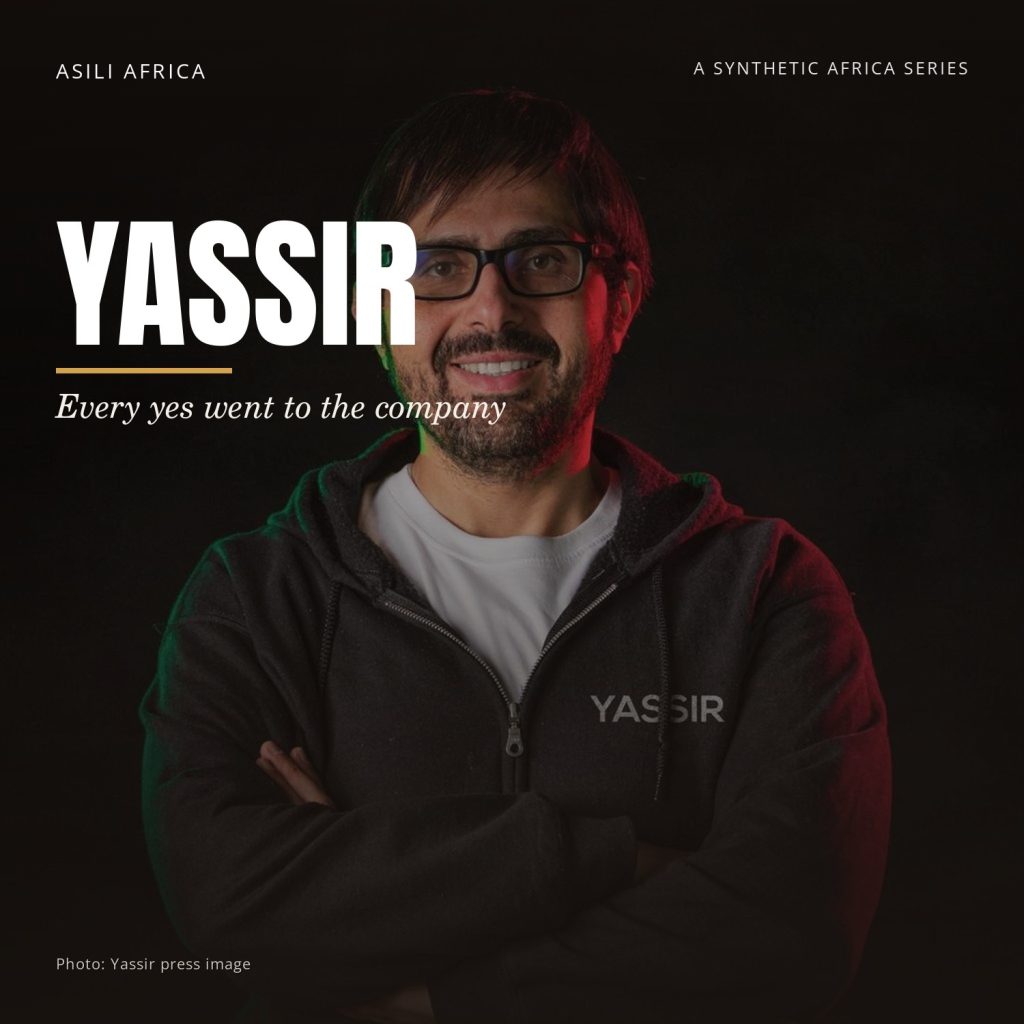
The Yassir Story: Every yes went to the company
On the twelfth of September, twenty twenty three, a commercial court in Paris chose new owners for a failing company.
The company was Flink France. It delivered groceries to people’s doors, and since June it had been in receivership, which meant a court was deciding what would become of it.
The court chose an offer from three buyers. One was the former head of Flink France. One was the Flink group itself.
The third was an app from Algiers. It is called Yassir.
It had started out as a way to book a car across the Algerian capital.
Six years later, a French court had chosen it as one of three buyers of a French business.
Three months after that, in December, the same company was in front of another institution. This one was in Algiers, the city where it had started.
A taxi union had gone to court.
It filed a complaint alleging that Yassir’s drivers carry passengers clandestinely.
BANKING AS A PLATFORM
Noureddine Tayebi was born in Algiers in nineteen seventy seven, into a family of doctors.
In nineteen ninety eight he left Algeria for the United States.
He studied electrical engineering at Stanford, and he came out of it with a doctorate. It was the kind of training that leads to research labs, and that is where he went.
In two thousand and six he moved to Silicon Valley and joined Intel, in research and development. He stayed about eight years, on the research side of one of the biggest chip makers in the world.
In twenty fourteen he founded a company of his own, InSense, which made motion sensors at a very small scale.
In twenty eighteen another company, Mojo Vision, bought it. One account of the founders calls that sale a springboard for what came next.
In the same year that Tayebi left for America, nineteen ninety eight, another Algerian engineer left for Canada. His name is Mahdi Yettou.
Yettou had trained at the École Nationale Polytechnique in Algiers, and then in Toulouse, in France. He is Yassir’s co-founder.
His title depends on who is writing. The Algerian press quoted him as chief executive in twenty nineteen. Later profiles call him managing director. The record on him is thin.
In twenty seventeen, the two of them launched Yassir. The name means easy, in Arabic. It began as ride hailing: you ask for a car on your phone, and a driver comes to you.
Ride hailing was the first service. Deliveries, groceries and payments would follow.
Its operations are run from Algiers. That is where the drivers are, and where most of this story happens.
How the first drivers were found, and what the first year looked like, is not in any source we have. Neither is the founders’ own account of why they chose that year, or that city, to begin.
What the record does hold is the idea. Tayebi laid it out to TechCrunch in twenty twenty one, and it did not start with cars. It started with money.
Most people in French speaking Africa, he said, are unbanked, with no bank account at all. The reason he gave was a lack of trust in incumbents, and banking solutions that did not work well.
Yassir’s own markets sit inside that picture: Algeria first, and later Morocco and Tunisia.
In a market where so much still moves as cash, that is a hard problem to solve from the top. A new bank asks for trust before it has earned any.
His answer ran the other way. Start with something people use every day, a ride or a delivery. Do it reliably, many times over. Let the trust build up there.
Then, once people trust the service, let the service carry their money. On demand services, he argued, could be the gateway to financial services.
It is an unusual way to describe a ride hailing company. In his telling, the ride is not the product. The ride is how the trust gets earned.
So the founder came to it from chips and sensors, not from cars or from banks, and what he built first was a service for booking rides.
It also meant that, sooner or later, the company would need more than its customers’ trust. A business that carries people’s money needs someone’s permission to do it.
He had a name for the idea. Banking as a platform.
THE PLATFORM TAX
On the first of January, twenty nineteen, a platform tax came into force in Algeria. It was created by Financial Law eighteen eighteen, and it reached the kind of business Yassir was.
Yassir says its drivers have paid that tax from the start. The tax is a matter of law. That the drivers pay it is the company’s statement.
So the state did not ban the service. It did not ignore it either. It taxed it.
For a company whose founding idea was trust, a tax bill is an odd kind of recognition, but it is recognition all the same. The state had counted the platform, and taken a share of what it did.
In November twenty nineteen, the company gave an account of itself to the Algerian press, in a statement that quoted Yettou.
It said Yassir had more than eleven thousand partner drivers, in twelve wilayas. A wilaya is one of the provinces Algeria is divided into.
Twelve wilayas meant the service had spread well beyond the capital, two years after it launched.
The company called them partners. They were people with their own cars, taking rides the app sent them.
The company also said that many traditional taxi drivers had converted to its service.
None of those drivers speaks anywhere in the record. We know they moved only because the company says they did, and no source asks them why.
On the company’s own account, then, the service worked. People signed up to drive for it, and some of them came from the taxi trade.
Eleven thousand drivers is the company’s number, not an audited one. But it is the number Yassir chose to give while it was asking for rules, and that is part of the story too.
The same statement said something else. Yassir said it favours regulation of its drivers’ activity, and that it was working with the authorities on a legal framework for them.
The Algerian press put that position in its headline. Yassir, it said, was in favour of a framework for its partner drivers.
A company asking to be regulated is worth holding on to. It means the gap in this story is not one Yassir said it wanted to keep. In public, it said it wanted the gap closed.
There was no framework. Algeria had no legal status for VTC drivers.
The letters are French shorthand for a private car with a driver, booked in advance rather than hailed in the street. It is the category Yassir’s drivers lacked.
A driver working through Yassir did not hold a taxi permit, so was not a taxi driver. In law, there was no other thing for that driver to be.
Taxi drivers had permits. Yassir’s drivers had an app, and a tax the company says they paid.
This is not a story of a company hiding from a regulator, and it is not a story of a regulator chasing a company. The state was collecting. The company was asking.
The tax came first. The status did not come with it. The platform had been recognised by the state as something to tax. The work had not been recognised as anything at all.
So by the end of twenty nineteen, two things were true at the same time. The Algerian state taxed the platform. And the drivers who did the platform’s work had no legal status.
$150 MILLION
In March twenty twenty, Yassir came through Y Combinator, the Silicon Valley startup programme. It was the first Algerian startup the programme had ever admitted.
Y Combinator takes in young companies in batches, and puts a small amount of money into each.
For a company built on the idea of earning trust, it was an outside vote of confidence, and it came from the place where Tayebi had spent his career.
In November twenty twenty one, Yassir raised a thirty million dollar Series A, usually the first big institutional round a startup takes. The company said it had around three million users by then, and forty thousand partners.
The money was for what it called a super app: rides, food delivery, groceries and payments, all from one phone.
A year later, on the seventh of November, twenty twenty two, five years after launch, Yassir announced its Series B. That is the round a company raises once it has shown the thing works, and wants money to make it bigger.
It said what the money was for. Triple the engineering and product teams. Launch new services. Grow in the markets it already had, and expand into new ones, including through acquisitions.
The company gave its numbers. Eight million users, it said, two and a half times as many as a year before. A hundred thousand partners, which in its counting meant drivers, couriers, merchants and suppliers.
At the Series A, a year earlier, the figure it gave had been three million.
Forty five cities, in six countries, with offices in Algeria, Morocco, Tunisia, France and Canada.
Tayebi told TechCrunch that three out of five on demand activities in Algeria went through the platform, and that the business had outstanding unit economics.
Unit economics means whether each ride or each delivery makes money on its own, before the cost of running the whole company.
Every number there is the company’s own, and none of them is audited. They are what Yassir said about itself on the day it raised.
The investors in the round included DN Capital, Dorsal Capital, Quiet Capital and Stanford Alumni Ventures. One of those names points back to the university where Tayebi took his doctorate.
Y Combinator’s own continuity fund invested too, so the programme that had admitted Yassir two years earlier was now backing it again.
The company said its total funding had now reached about a hundred and ninety three million dollars.
What it did not give was a valuation. It was not disclosed, and none has been disclosed since.
In the years since, Yassir has been described as a unicorn, a startup worth a billion dollars or more. It has not confirmed that figure, and it has never published audited accounts that would let anyone check.
That is the difference between a label and a number. The label is not documented. The round is.
The Series B itself was a hundred and fifty million dollars, five times the round before it. It was led by Mary Meeker’s firm, Bond.
It was the largest Series B any North African startup had reported.
THE PARADOX
Drivers working through Yassir were being asked for taxi permits they did not have. The result was fines, and cars impounded.
That is how the Algerian news site TSA Algérie described their situation, in a piece published on the ninth of November, twenty twenty two, the week of the Series B.
It is one outlet’s description. It gives no count of fines or impounded cars, and no other source we have gives one either. It is also the closest the record comes to what the gap cost the drivers themselves.
The piece was not an attack. Its headline called Yassir a success story, one that showed what it called the Algerian paradox.
It said Yassir itself operated legally and paid its taxes. The company, in other words, had a place in the law. The people doing its work did not.
TSA had a phrase for that. It called it the entire paradox of the Algerian market.
And it said that regulation should have been at the origin of the success, not a result of it.
In other words, the law should have come first, and the company after it. In Algeria it had happened the other way round.
Set that beside twenty nineteen, and it is the same gap, three years older. The platform was taxed. The company was inside the law. Its drivers were still being asked for a document they did not hold.
The Series B had named acquisitions among its uses. The next year, Yassir made one in France.
Flink France was the French arm of a larger grocery delivery group. It had gone into receivership in June twenty twenty three.
It was a quick commerce company: groceries ordered on a phone and delivered fast, from sites spread across France. It had nineteen of them.
In a French receivership, the court does not simply take the highest bid. It weighs what each offer would keep.
On the twelfth of September, the commercial court in Paris chose the offer that would take the business over. It came from three buyers together.
One was the former head of Flink France, who had co-founded another French grocery delivery company before it. One was the Flink group itself. The third was Yassir.
Yassir was one of three buyers. It put more than five million euros into the deal, as reported in the French press.
The offer kept two hundred and seventy of Flink France’s four hundred and eighty employees, and fourteen of its nineteen sites.
For those two hundred and seventy people, a company in receivership had owners again. One of the owners was an app that had started out booking rides in Algiers. It had taken six years to get from one to the other.
Two hundred and ten people were not kept, and no source we have follows what happened to them, or to the two hundred and seventy who stayed.
It is the first time the Series B’s promise of acquisitions shows up in the record, and it showed up outside Africa.
On the eighteenth of December, twenty twenty three, an Algerian taxi union wrote to the minister of transport.
Two days later it announced that it had filed a complaint against Yassir, in a court in Algiers.
The complaint alleged that Yassir’s drivers carry passengers clandestinely. The word is the union’s. In plain terms, it alleged they were carrying paying passengers without the right to.
It named the company, but the allegation was about the drivers.
The outcome of that complaint is not known. The record we have contains no ruling, and we are not going to supply one.
The union was asking the state for something as well. It wanted taxi fares raised.
Taxi fares, the union said, had not changed since twenty twelve. Its members’ costs had kept rising.
They, too, were waiting on the state.
THE BUYER
In June twenty twenty four, Yassir bought KooL, a delivery startup in Tunisia, founded in twenty twenty one. The terms were not disclosed, and the brand was kept.
It gave Yassir a delivery business in a second north African market, run under its own name.
Earlier that year, Yassir had applied to Bank Al-Maghrib, Morocco’s central bank, for status as a payment institution. That would let it handle payments in Morocco under its own licence. A payment institution can hold and move its customers’ money without being a bank.
By the last reporting we have, two years on, there was still no approval in the record.
In Algeria, its wallet runs through a partnership with a bank. Whether Yassir holds its own authorisation there is not established in anything we have.
Banking as a platform needs a regulator to say yes. In Morocco and in Algeria, neither yes is on the record. That is the idea from twenty seventeen, meeting the state.
And the trust at the centre of the idea has never been tested from the customer’s side. No source we have asks the people who ride with Yassir, or pay with it, whether they trust it.
In February twenty twenty six, Jumia ended its operations in Algeria.
The online retailer gave its reasons: restrictive trade policy and import controls, and a retail market that runs heavily on cash.
Algeria was about two per cent of Jumia’s business, measured by the value of goods sold through it in twenty twenty five. For Jumia, leaving was a small cut. For Yassir, Algeria is where it began.
In March twenty twenty six, Yassir bought Uno, a chain of hypermarkets, from the Algerian conglomerate Cevital. The terms were not disclosed.
The first store to carry Yassir’s name was planned for Bab Ezzouar, in Algiers, in time for Ramadan, twenty twenty six.
A company that began as a way to call a car in Algiers now owns hypermarkets. Shelves, stockrooms and checkout lines.
It is the plan the Series B set out in twenty twenty two: new services, and growth through acquisitions.
Nothing has been published about Uno’s staff, how many people work in its stores, or its suppliers, or what the sale means for any of them.
Trade policy decides what a hypermarket can bring in to put on its shelves. A cash heavy market decides how its customers pay. Both of Jumia’s reasons reach a hypermarket too.
Jumia left because of those conditions. Yassir has bought into them, with physical stores. It may have reasons to expect a different result. No source we have sets them out.
On the law itself, the minister responsible for transport has described a bill to give these drivers a legal status as finalised. As of the last reporting we have, from March twenty twenty six, it had not been confirmed in force.
No source explains the delay, or says how officials see Yassir. The state’s side of this story is not in the record.
Neither are Yassir’s own accounts. The company has never published audited numbers.
And the people this story has been about from the start are the least recorded of all. No Yassir driver is quoted anywhere in the record.
What they earn, what share the company takes, what the fines and the impounded cars have cost them: none of it is published. The drivers are counted. They are not heard.
Yassir began with a claim about trust: that a service people use every day could earn the trust the banks had not. Banking as a platform.
It was a theory about being recognised, first by the people who use a service, and then by everyone else a company like that needs.
Since then, the state has taxed it. Y Combinator admitted it. Investors put a hundred and fifty million dollars into a single round. A court in Paris chose it as one of three buyers, and a conglomerate sold it a chain of hypermarkets.
Every one of those was a yes to the company. None of them was the one its drivers are waiting for, a law that says what they are. This is Asili Africa. Every empire has an origin. See you on the next one.
Key Takeaways
- BANKING AS A PLATFORM. Noureddine Tayebi was born in Algiers in nineteen seventy seven, into a family of doctors.
- $150 MILLION. In March twenty twenty, Yassir came through Y Combinator, the Silicon Valley startup programme.
- THE PARADOX. Drivers working through Yassir were being asked for taxi permits they did not have.
- THE BUYER. In June twenty twenty four, Yassir bought KooL, a delivery startup in Tunisia, founded in twenty twenty one.
Also available on YouTube — search “Asili Africa” or subscribe to our channel.