
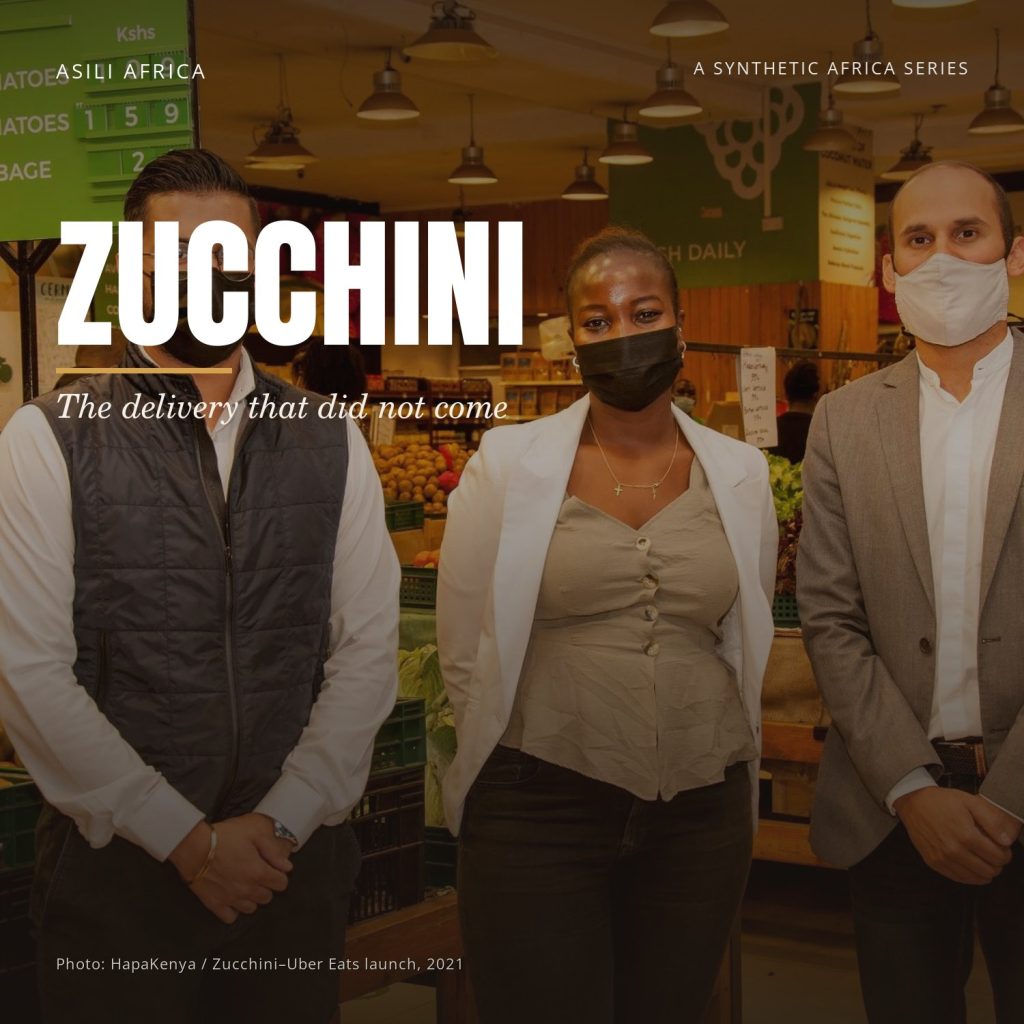
The Zucchini Story: The delivery that did not come
In nineteen ninety one, at a shopping centre called ABC Place in Westlands, Nairobi, a butcher named Gilani made a suggestion to a young man just out of university.
The centre had meat. It had groceries. It had no vegetables.
What it needed, the butcher suggested, was a vegetable shop.
The young man opened one. It is called Zucchini, and thirty five years later it has nine branches in Nairobi.
It sells fruit and vegetables, and cheese and bread and coffee, to some of the best off shoppers in the city.
Ask what makes Zucchini different, and the company’s own answer comes down to one thing.
It says it buys directly from farmers, with no one in between. It says it visits those farmers every week.
In every account of this company we could find, across thirty five years, not one of those farmers has been named.
The record can give you the surname of the butcher who suggested the shop.
It cannot give you the name of one farmer who grows what the shop sells, or tell you what any of them is paid.
THE CORNER
The young man was Sukhwinder Jandu. He was fresh out of university and a biochemist by training, and he was working for a company that imported goods.
One of the businesses that company supplied was Gilani’s butcher shop at ABC Place. So the idea that started Zucchini came from one of his employer’s customers.
He was on the supply side of somebody else’s shop before he had a shop of his own.
A biochemist selling vegetables is not an obvious path. The record offers one reason for it, and the reason is the butcher.
Almost everything known about what happened next comes from one person. Jandu told the story to the website How We Made It In Africa in twenty sixteen, and to the Business Daily newspaper in May twenty seventeen.
We found no other account of it, and nothing in it has been independently checked. It is told here as he told it.
Gilani’s idea was an observation about a building. A shopping centre that sold meat and groceries was sending its customers somewhere else for anything green.
Jandu took the suggestion to the supermarket at ABC Place, Continental Supermarket, and asked for space. Continental gave him a corner.
Into that corner he put thirty five thousand shillings of savings. The business had one employee.
Thirty five thousand shillings, one corner, one employee. As far as anyone has written it down, that is the whole of the company on its first day. No investor appears in the story, and no other money is described.
The company’s registered name today is Zucchini Greengrocers Limited. The word that matters in it is the plain one. Greengrocers.
A corner is not a shop. It is a patch of floor inside somebody else’s business, under somebody else’s roof, with somebody else’s customers walking past on the way to somebody else’s shelves.
Whatever Zucchini was in nineteen ninety one, it was a guest.
It is also a sensible way to begin. The customers are already walking in.
ABC Place itself is still there, and it is still where Zucchini keeps its head office.
The corner needed stock, and the stock came from Wakulima Market.
A greengrocer depends on the morning delivery more than most shops do. A supermarket’s tins and packets can sit on a shelf for months. Tomatoes, greens and fruit start to spoil from the moment they are picked. The shelves have to be filled again and again, so the shop is only ever as good as its last delivery.
For a shop in a corner, a trader who delivers saves somebody a trip to the market every morning.
At Wakulima, that is what the team was offered. In Jandu’s words, “a gentleman at the market convinced us that he would deliver the produce to the shop at ABC.”
He did not deliver.
The next day, Jandu was at the market himself, at four in the morning, with his old pickup truck.
It did not stay a single morning. His account speaks of four in the morning runs, plural.
For a while, the way to be sure the corner had something to sell was to go and fetch it yourself, before dawn, in your own truck.
It is the least glamorous way to solve a supply problem, and the most certain. A delivery cannot fail to turn up when the person delivering it is you.
That is the whole of the hardship in the recorded history of this company, and it is worth being exact about its size.
It was not a near collapse. No one lost the business. A man promised a delivery and did not make it, and the next morning the founder drove to the market himself.
It is a small scene. It is also the only scene the record contains, and the record tells it in a handful of sentences.
No account says what Continental Supermarket was paid for that corner, names the person who agreed to it, or records what became of either.
The lesson came in two parts. A promise of delivery is only as good as the person who makes it. And if somebody else controls the delivery, the shop has nothing to sell.
In nineteen ninety one, the answer was his own truck, and his own mornings.
DIRECT
Zucchini stayed in its corner of Continental Supermarket for four years, until nineteen ninety five. That year the arrangement ended, and Jandu changed how the company bought what it sold. He stopped buying through middlemen.
How the business moved from the corner into premises of its own is not in the record. The change of supplier is.
Nothing in the record says the shop was in trouble in nineteen ninety five. No losses are described, no near miss, no rescue. Zucchini went on selling vegetables in the same kind of shop. What changed was who it bought them from.
Between a farm and a Nairobi shelf, produce can pass through several pairs of hands. A trader. A transporter. A dealer at the wholesale market.
Each of them takes a share of the price, and each of them is one more place where a delivery can fail. A shop that buys through all of them depends on every one of them.
Twenty one years later, Jandu described the alternative to How We Made It In Africa.
“We don’t have dealings with middlemen,” he said. “Instead, we visit the farmers weekly and deal directly with them. We also support them in terms of access to seed supply and technology.”
Three commitments sit inside that statement. No one standing between the farm and the shop. A visit every week. And help for the farmers themselves, with seed and with technology.
A weekly visit is a standing commitment. For it to mean what he says it means, someone from the company has to be on those farms week after week.
According to the company, the buying is built so that no one farmer carries a product alone. Each product comes from several farmers.
And there are backup plans for gaps in stock. A daily plan. A weekly plan. A monthly plan.
Several growers behind every product, and a fallback for the day, the week and the month. Under that arrangement, one supplier who fails can no longer empty the shelf.
It is not a glamorous idea. It is redundancy, the same principle that puts a spare tyre in a car, applied to tomatoes.
It is built for the morning when something does not arrive.
The farm to shelf picture needs one qualification. The twenty sixteen profile also says Zucchini sources fresh produce from both local and international suppliers.
A year later, Jandu put the local share at about ninety per cent. Both can be true.
The promise of buying direct from farmers, in other words, covers most of the shelf, not all of it.
Every account of the relationship with those farmers comes from the buyer. What the support involves, what the farmers are paid, and on what terms, is in no source.
The man who promised that first delivery in nineteen ninety one was a trader at Wakulima Market.
In nineteen ninety five, Zucchini stopped buying through traders like him.
No source records what that meant for the traders at Wakulima.
MORE THAN ONE STORE
Java House was founded in nineteen ninety nine. It set up shop at ABC Place too, and according to Business Daily, it bought its fruit and vegetables from Zucchini.
Two businesses in one shopping centre, one buying its fruit and vegetables from the other.
When that supply began is not recorded.
“The owner of Java pushed me to open my first branch,” Jandu told the paper. “He said that you are not a brand unless you are more than one store.”
The profile does not name the owner of Java. Java’s side of the story has not been told in any account we could find.
So the sentence that turned a shop into a chain came from a customer, and a neighbour.
Jandu tells the story of his own expansion as somebody else’s idea.
It is a pointed piece of advice. One shop is a business. A second shop is a bet that what works at one address will work at another. For a greengrocer, that means the supply has to stretch to cover both.
The first branch opened at Junction Mall. The date is not recorded.
It came some time after nineteen ninety nine, because the advice came from a business founded that year, and before twenty sixteen. How the chain grew in between is not recorded.
What grew in those branches was more than a greengrocer.
The profiles of twenty sixteen and twenty seventeen describe cheese and a deli counter, a salad bar, a juice bar, a bakery, hot food, coffee, and imported Mediterranean lines.
On the twenty ninth of March, twenty sixteen, How We Made It In Africa ran its profile under a headline saying Zucchini had found its niche in fresh produce. By then the niche had a delicatessen attached.
Harveen Jandu, a director of the company, described the aim in twenty sixteen. “We are trying to be like a gourmet store, but one that is affordable.”
Gourmet and affordable pull in different directions, and the format sits between them.
Affordable gourmet across several branches is also a promise about supply. The same shelf has to be full in every store, every day.
Every new branch multiplies the number of shelves the backup plans have to cover.
George Osiko, a store manager, named three edges Zucchini had over the supermarkets in twenty sixteen.
Shorter queues. A wider variety of produce. And more consistent supply.
The first two are the ordinary strengths of a specialist. A smaller shop has fewer people at the till, and a food shop can give more of its floor to produce.
The third goes back to nineteen ninety one. The company began because a delivery did not come. Twenty five years later, its store manager was naming consistent supply as a reason to shop there.
The problem of the corner had become the thing the shop was selling.
Management described its customers as about seventy per cent local, with many expatriates, and on high incomes. No shopper is heard anywhere in the record.
In March twenty sixteen there were four stores, and a fifth was about to open.
Four shops, a deli counter, and a manager selling reliability. The corner had become a format.
400 TONNES
On the twenty second of May, twenty seventeen, Business Daily published a profile of the company by the reporter Doreen Wainainah.
The headline described a fresh produce store that had grown into a thriving chain.
It is the only time, in anything we could find, that the size of Zucchini’s supply has been put on the record. Every figure in it came from Jandu, speaking to the reporter. They are his numbers, and they are set out here as he gave them.
The same article is where most of the founding story comes from: the butcher, the corner, the savings, the pickup. For a company thirty five years old, it is close to a biography, told once.
There were five stores by then, among them branches at Garden City and at The Hub in Karen.
About two hundred people worked for the company. Twenty six years earlier it had one employee.
The profile also mentions a sister company, Tiramisu.
About ninety per cent of what the stores sold was sourced locally.
The stores went through about ten tonnes of watermelon a week.
Across all produce, the figure was four hundred tonnes a month.
Four hundred tonnes is four hundred thousand kilograms of fruit and vegetables, bought, moved and sold before it spoils, every month.
That works out, on our own arithmetic, at a little over thirteen tonnes a day.
In nineteen ninety one, the stock for one corner travelled in the back of one old pickup.
About a tonne of tomatoes, every day, through five stores.
THE QUIET YEARS
Nakumatt began closing stores in twenty seventeen. By January twenty twenty, its remaining six had shut. Its debts were reported at about thirty eight billion shillings, and some reports put them above three hundred million dollars.
Tuskys closed its last branch in March twenty twenty three. Its debts were reported at about nineteen point six billion shillings.
By June twenty twenty three, Uchumi was down to two branches, with debts of about three point two five billion shillings.
Reporting on the three collapses identifies a common factor. It was debt, including expansion paid for on credit from suppliers.
No source connects any of this to Zucchini. Zucchini’s own debts are unknown. It has no recorded outside investment, which is an absence in a database, not an account of how the company has paid its way.
Twenty twenty and the pandemic leave no trace in the record on Zucchini. No account describes its sales, its staffing or its supply during the lockdowns.
The next dated event is somebody else’s announcement. In June twenty twenty one, Uber Eats announced a partnership to deliver groceries from Zucchini, in about an hour.
Uber’s Nadeem Anjarwalla said the company wanted to be the operating system for your everyday life. That is Uber’s framing, not Zucchini’s.
Glovo lists Zucchini stores as well, and the company takes orders through its own website, by phone and on WhatsApp. The terms of the delivery platforms are not public.
The premium end of Nairobi grocery has larger players in it. By late twenty twenty five, Carrefour ran about twenty five outlets in Nairobi. Chandarana Foodplus has about twenty eight branches across the country.
Zucchini has nine. The edges its manager named in twenty sixteen, short queues, variety and consistent supply, have not been tested against either of them by any source.
The company’s own list gives nine branches: ABC Place, Rhapta Road, General Mathenge, Village Market, Langata, Valley Arcade, Lavington Mall, Junction Mall, and Kilimani.
Two of those names are already in this story. ABC Place is where the corner was. Junction Mall is where the first branch opened.
The shop the butcher suggested is still trading. No source explains how it lasted, and this episode will not supply a reason the record does not contain.
Across thirty five years, the public record on this company comes down to a handful of things. Two profiles, in twenty sixteen and twenty seventeen, built on interviews with its own management. A third interview we could not open. One news item, about a delivery deal. The company’s own website, and a few database listings.
Two stores named in twenty seventeen, Garden City and The Hub in Karen, are not on today’s list. No source says why.
Beyond one store manager in twenty sixteen, no one who works in a Zucchini store has been heard in any account.
The most recent coverage we could find describes Sukhwinder Jandu as managing director. He founded the company thirty five years ago. Who runs it after him? Nothing published says.
The company has never published a revenue figure, a margin, a profit or a debt, in anything we could find.
Which leaves the claim this story began with.
Zucchini’s identity rests on its farmers. It says it visits them every week, buys from several for every product, and supports them with seed and technology.
No farmer is named in any source we could find. None is counted. None is quoted. Nothing says what any of them is paid, or what happens when one of them cannot deliver.
Nothing suggests the claim is untrue. It is simply that everyone who has described it is on the buying side.
In nineteen ninety one, a trader at Wakulima Market promised a delivery, and it did not come. Zucchini was built on the answer to that morning.
Thirty five years and nine branches later, it still sells the same promise: that the produce will be there.
And the only person who has ever described how that promise is kept is the man who first made it. This is Asili Africa. Every empire has an origin. See you on the next one.
Key Takeaways
- THE CORNER. The young man was Sukhwinder Jandu.
- MORE THAN ONE STORE. Java House was founded in nineteen ninety nine.
- 400 TONNES. On the twenty second of May, twenty seventeen, Business Daily published a profile of the company by the reporter Doreen Wainainah.
- THE QUIET YEARS. Nakumatt began closing stores in twenty seventeen.
Also available on YouTube — search “Asili Africa” or subscribe to our channel.