
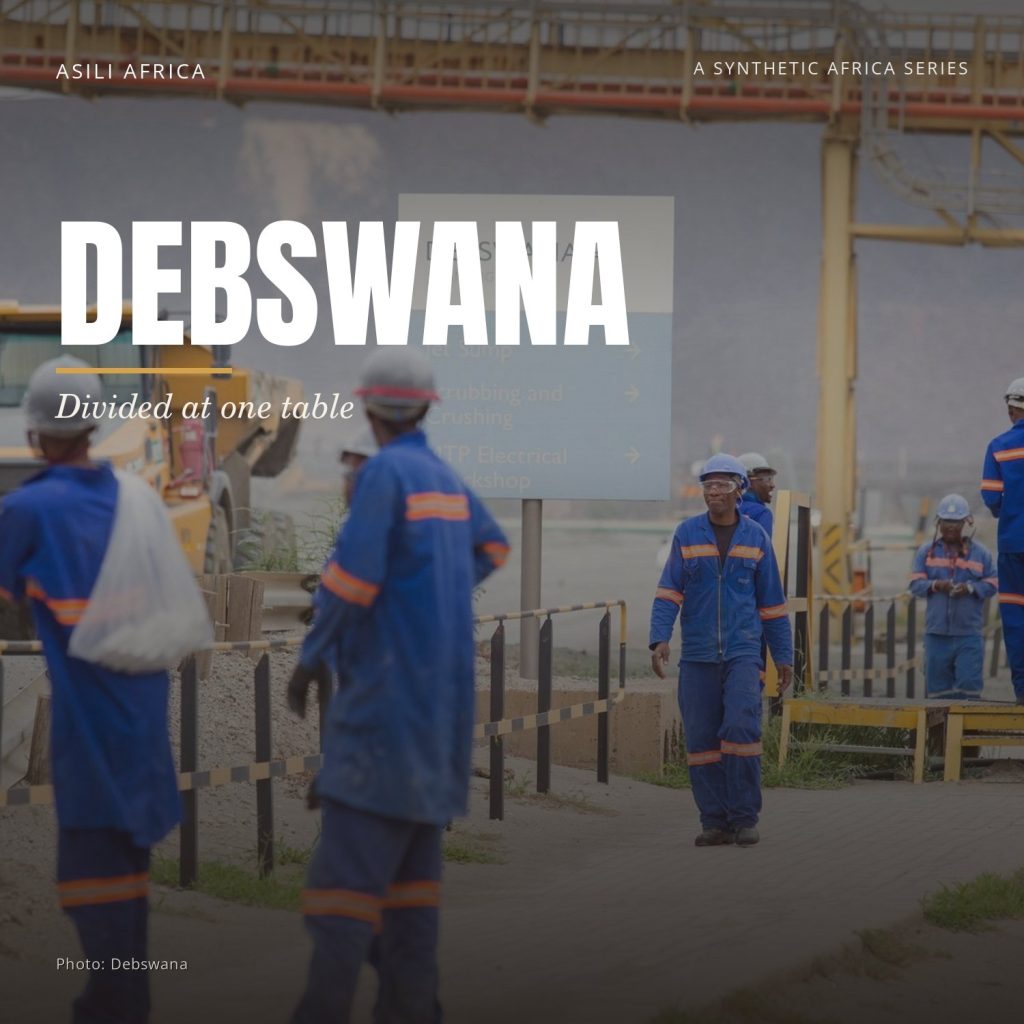
The Debswana Story: Divided at one table
In nineteen sixty six, Botswana became independent. By most accounts, it was one of the poorest countries in the world.
The next year, geologists working for De Beers found diamonds there.
In nineteen sixty nine, a company was formed to mine them.
De Beers took eighty five per cent of it. The new state took fifteen per cent.
Now it is twenty twenty six, and De Beers is for sale. Its majority owner, Anglo American, is selling the whole of it.
And Botswana, the partner that started with fifteen per cent, holds a right of first refusal over Anglo American’s shares in De Beers.
Fifteen per cent in nineteen sixty nine. A right of first refusal, fifty seven years later.
FIFTEEN PER CENT
On the thirtieth of September, nineteen sixty six, Botswana became independent from Britain.
By most accounts, the new country was among the poorest in the world. It was landlocked. Its economy ran on cattle, and it had next to no infrastructure.
Anything it sold abroad had to cross someone else’s territory to reach the sea.
Every account of what came next is written against that starting point, including this one. The hardship in it belonged to the country.
There was no company yet to struggle, and this story has no early corporate struggle to tell.
In nineteen sixty seven, less than a year after independence, a De Beers prospecting team was working in north central Botswana, not far from the salt pans of the Makgadikgadi.
Diamond prospecting went on across the country through the nineteen sixties, and it would go on for twenty years more.
The team was led by Gavin Lamont, with Manfred Marx and Jim Gibson.
What they found was a kimberlite pipe.
Kimberlite is the volcanic rock that carries diamonds up from deep inside the earth. Most of it carries none worth mining.
This one did. It covered more than a hundred hectares, at a place called Orapa.
The find was made by De Beers geologists, in a country that was not yet a year old.
There is no founder in this story. None of the men who signed what came next went on to run the company. What founded it was an agreement.
If this story has a protagonist, it is the bargaining position of the state of Botswana.
On the twenty third of June, nineteen sixty eight, the De Beers Botswana Mining Company was formally established. It was formed to develop the find at Orapa. Today it is called Debswana.
In nineteen sixty nine, the agreement to develop Orapa was signed.
Four men are recorded at the signing, in the company’s own history and elsewhere. Seretse Khama, the president of Botswana. Quett Masire, his vice president. Harry Oppenheimer, the chairman of De Beers. And J G Haskins, a minister in the government.
The signing is the one scene the record gives us from these years, and it gives us names and a date, not words. Nothing said at that table has come down to us in the sources for this episode.
De Beers held eighty five per cent of the company. The government of Botswana held fifteen per cent.
The partner whose geologists had made the find held nearly six times the state’s share. Fifteen per cent was where the state began.
Two years after the signing, in nineteen seventy one, Orapa opened. It is still being mined today.
Five years after independence, a country that had begun among the poorest in the world had a working diamond mine.
HALF
In nineteen seventy five, the agreement was renegotiated. The state’s share of the company went from fifteen per cent to half. Fifty fifty.
From then on, the state and De Beers each owned exactly half. It was the first rewrite of the bargain in the record, and it would not be the last.
How the talks went is not in the record examined for this episode. We have the outcome and the date. We do not have the negotiation.
The accounts put the change down to rising production, and to a government with more leverage, and more need of revenue, than it had in nineteen sixty nine.
When economists write about how Botswana handled its diamonds, this is the moment they usually point to, more than nineteen sixty nine, as evidence of disciplined, sustained bargaining by the state.
The same year, a second mine opened, at Letlhakane, not far from Orapa.
In nineteen eighty two, a third opened, in the south of the country. Jwaneng.
By value, it is the richest diamond mine in the world.
At its peak, the company produced between twenty and twenty four million carats a year. A carat is a fifth of a gram. By value, it was the world’s leading diamond producer.
By its own description, it became the largest employer in Botswana outside the government. More than nine in ten of its people are Batswana.
Diamonds came to make up about eighty per cent of what Botswana sells abroad.
Depending on the year and the source, they have been between a quarter and a third of the whole economy, and a similar share of government revenue.
That money paid for roads, for schools, and for a national safety net.
In the development literature, what followed is one of the most cited cases there is. A country that began among the poorest in the world became an upper middle income economy.
Economists have a name for what often happens to countries that depend on one valuable resource. They call it the resource curse. The wealth arrives, and weaker growth, weaker institutions or conflict arrive with it.
Botswana is cited again and again as a country that escaped it. The economists who make that case credit institutions, and negotiating discipline, more than luck.
In the same country, inequality has been measured among the highest in the world.
Inequality is often scored from nought to a hundred, where higher means more unequal. A figure from World Bank data put Botswana at about fifty five in twenty fifteen. The average across the world is around thirty seven.
The same year, about one in six Batswana lived below the national poverty line. The praise tends to leave those figures out.
Whether fifty years of diamond money reached Batswana living outside the diamond economy, none of the sources found for this episode says. The only voices in the record come from the mining towns.
Both things are true of the same country, and this episode is not going to choose between them.
In nineteen ninety one, the company appointed its first managing director, Louis Nchindo. That was twenty two years after the signing.
In nineteen ninety two, the company took the name it carries today. Debswana.
In May two thousand and one, Debswana set up a trust to provide free antiretroviral therapy to employees living with HIV, and to their spouses and their children.
Botswana was then one of the countries hardest hit by HIV anywhere in the world.
Debswana is reported as the first company anywhere in the world to do it.
THE COURTS
In nineteen ninety seven, the government of Botswana began moving Basarwa communities, also called San, out of the Central Kalahari Game Reserve.
The reserve covers a great stretch of the Kalahari, in the middle of the country. The Basarwa had lived on that land for generations.
The removals were the government’s. There were more of them, in two thousand and two and in two thousand and five.
Kimberlites had been found inside the reserve, at a place called Gope, in the early nineteen eighties.
Officials said repeatedly, as late as two thousand and five, that there was no mining in the reserve, and no plan for mining anywhere inside it.
In two thousand and six, the High Court ruled that the two thousand and two eviction had been unlawful, and affirmed a right to return.
The government read the ruling narrowly. It let back only the people who had brought the case, one hundred and eighty nine of them. Nobody else who had been moved was let back under the ruling.
It did not restore their access to water inside the reserve.
In September twenty fourteen, a diamond mine opened inside the Central Kalahari, at Gope. It is also known as Ghaghoo.
That mine was operated by Gem Diamonds, a different company. It was not Debswana’s mine.
The state that sat across the table from De Beers was the same state that told its own citizens there were no plans to mine. Those statements did not hold.
The mine that opened was not Debswana’s, and not the bargain’s. The statements were the government’s. It happened beside the bargain, not inside it, and it is part of the story of Botswana’s diamonds all the same.
In the record found for this episode, the Basarwa do not speak for themselves. Their case reaches us through courts, officials and the groups that campaign for them. A campaign’s voice is not theirs, and we will not use it as if it were.
In two thousand and six, the Directorate of Public Prosecutions began investigating Louis Nchindo.
He had run Debswana for thirteen years, and had also served as an adviser to the president. He retired as managing director in two thousand and four.
In two thousand and eight, he was charged with corruption.
During proceedings in his own case, Nchindo disclosed that he had arranged loans from De Beers to Quett Masire. That is according to reporting of those proceedings.
By then, Quett Masire was a former president of Botswana. He had held the office from nineteen eighty to nineteen ninety eight.
No source found for this episode connects that money to any term of any agreement between Botswana and De Beers.
The account economists give of this bargain is an account of discipline. The loans sat beside it. Both are on the record, and the record does not join them. Neither will we.
On the seventh of February, twenty ten, Louis Nchindo was last seen alive. He was found dead near Pandamatenga, in the north of the country.
His trial on thirty six charges had been set for April. He never answered them in court.
No official finding on how he died is in the record found for this episode. We looked for one, and we are not going to fill that gap with a guess.
On the twenty third of August, two thousand and four, the Botswana Mine Workers’ Union went on strike across all of Debswana’s mines.
The union asked for a sixteen per cent pay rise and a bonus of twenty five per cent of salary. Debswana offered ten per cent and ten per cent.
The strike lasted thirteen days.
It had been declared illegal. On that basis, Debswana dismissed four hundred and sixty one workers, some of them in essential services.
Among them were the union’s chairman, Chimbidzani Chimidza, and its general secretary, Jack Tlhagale.
Botswana’s Court of Appeal upheld the dismissals. Debswana’s employee relations manager said publicly that the company would not reverse them.
What became of the four hundred and sixty one afterwards is not in any public record we found.
THE PRICE
Diamonds can now be grown in a laboratory.
About ten years ago, lab-grown diamonds were roughly one per cent of the world’s diamond market. By twenty twenty five, they were about a fifth of it.
A lab-grown diamond is not a fake. Chemically, it is a diamond. It is made in a machine instead of mined, and it is structurally cheaper to make.
A slump in demand is something a miner can wait out. A cheaper way of making the same thing may not go away.
Whether the fall in demand for mined diamonds is a cycle, or something permanent, is an open question in the sources for this episode.
Demand for natural diamonds was also weak in the United States and in China.
And in twenty twenty five, American tariffs pressed on India’s polishing trade. India polishes an estimated nine in ten of the world’s diamonds.
Debswana cut its output. It produced about twenty four million carats in twenty twenty three, and about eighteen million in twenty twenty four, twenty seven per cent less.
For twenty twenty five it planned about fifteen million. Across those two years, output fell by about two fifths.
Its sales revenue fell by forty six per cent in twenty twenty four.
In the first three months of twenty twenty six, sales were down about forty eight per cent again, against the same months a year before.
None of this changed the terms between the state and De Beers. It changed the value of what they were dividing.
About five hundred jobs went, through voluntary separations. The company says that is how it is avoiding forced layoffs.
Fifteen contractor firms had their work cut back or ended. At points in twenty twenty five, plants stood idle.
Reporting from the mining towns, the Christian Science Monitor spoke to a mine worker who had lost their job and was planning to register as a taxi driver. That is one voice, and it comes from a mining town.
Diamonds carry between a quarter and a third of government revenue. In twenty twenty five, Botswana ran one of the widest fiscal deficits in sub-Saharan Africa, and its public debt rose sharply.
Jwaneng’s open pit is expected to run until about twenty thirty six.
Keeping the mine alive past twenty fifty means going underground. The full cost is put at about six billion dollars.
In January twenty twenty four, Debswana’s board approved the first phase, at about a billion dollars.
It is reported as a break with how Debswana has paid for its mines. It has built them from its own cash flow and from its shareholders. For this one, it is looking to outside money, from the capital markets, for the first time.
It needs that money in its worst revenue years in more than a decade.
Debswana is not insolvent. It is still mining. It is not failing. It is a company under pressure from several sides at once.
THE NEXT ROUND
In September twenty twenty three, Botswana’s government and De Beers signed heads of terms, the outline of a deal, for a new sales agreement and new mining licences for Debswana. The talks had begun under the Botswana Democratic Party.
The deal itself was not yet signed when, on the thirtieth of October, twenty twenty four, Botswana voted.
The Botswana Democratic Party had governed since independence. It had been the party of Seretse Khama. It was in government at the signing in nineteen sixty nine, and at every renegotiation since.
After fifty eight years, it lost power.
The outgoing president conceded. On the first of November, Duma Boko, of the Umbrella for Democratic Change, became president.
It was the first government since independence with no part for the Botswana Democratic Party.
On the twenty fifth of February, twenty twenty five, Duma Boko’s government signed the agreement.
It is a ten year sales agreement.
Under it, the state’s own diamond trader, the Okavango Diamond Company, takes thirty per cent of Debswana’s output for the first five years.
Then forty per cent. With an option to go to half. The rest of Debswana’s output goes on being sold through De Beers.
Debswana’s mining licences were extended by twenty five years, from twenty twenty nine to twenty fifty four.
The agreement one party began, the government that replaced it signed.
The party had gone. The state’s side of the bargain had not. And the terms had moved the state’s way again.
The agreement was signed in February twenty twenty five, after a year in which Debswana’s revenue had fallen by nearly half.
Fifteen per cent in nineteen sixty nine. Half in nineteen seventy five. A rising share of the sales in twenty twenty five.
In the record found for this episode, the state’s share has never gone down. And it has now come through the first change of government the country has had.
In September twenty twenty five, the government set up a sovereign wealth fund, to put diamond revenue into tourism, farming and processing, and renewable energy.
The new government has said it does not want to repeat a dependence on one commodity that it inherited. Whether the fund will change that, the record cannot yet say.
In twenty twenty six, a second fund was announced, the Diamonds for Development Fund, with money committed by De Beers. Its chair is Akinwumi Adesina, a former president of the African Development Bank.
In May twenty twenty four, Anglo American, the majority owner of De Beers, said it would sell De Beers entirely.
That sale and the sales agreement are separate processes. One is between Botswana and De Beers. The other is Anglo American’s.
Six bidders narrowed to two. Anglo American named a preferred bidder, the Global Diamond Consortium.
Its members reportedly include Angola, Namibia, a former De Beers chief executive, a Qatari investment fund and an Israeli businessman. Its full ownership is not settled in any source found for this episode.
The deal is expected to close in the last three months of twenty twenty six.
The state of Botswana owns fifteen per cent of De Beers itself.
And it holds a right of first refusal over Anglo American’s shares in De Beers. That stake and that right are separate from the state’s half of Debswana.
The government has said it keeps complete freedom. It can go in alongside the preferred bidder. It can go alone. Or it can bring in another partner.
It is working with financial advisers on what it calls the optimal structure. It has not said which way it will go.
In nineteen sixty nine, the state took fifteen per cent. The other half of Debswana still belongs to De Beers. Who will own De Beers once this sale closes is undecided.
For the first time since nineteen sixty nine, the partner across the table may not be De Beers as it has been.
One bargain, at one table, since nineteen sixty nine.
Fifteen per cent. Then half. Then a growing share of the sales. And now a right of first refusal over Anglo American’s shares in De Beers. It came through a change of government without losing ground.
In the same years, the thing on the table came to be worth about half what it was. The state kept winning better terms on something worth less each year.
As of the twenty eighth of September, twenty twenty six, the sale of De Beers has not closed. The underground mine at Jwaneng is not fully paid for. And whether lab-grown diamonds have changed the price for good is still an open question.
Who sits across that table next, and what a mined diamond will be worth when they do, nobody can yet say. This is Asili Africa. Every empire has an origin. See you on the next one.
Key Takeaways
- FIFTEEN PER CENT. On the thirtieth of September, nineteen sixty six, Botswana became independent from Britain.
- THE COURTS. In nineteen ninety seven, the government of Botswana began moving Basarwa communities, also called San, out of the Central Kalahari Game Reserve.
- THE PRICE. Diamonds can now be grown in a laboratory.
- THE NEXT ROUND. In September twenty twenty three, Botswana’s government and De Beers signed heads of terms, the outline of a deal, for a new sales agreement and new mining licences for Debswana.
In this series: State Assets
What does a state do with a company it owns?
- Mumias Sugar
- Pan Paper
- Kenya Power
- KenGen
- New KCC
- KTDA
- Ethiopian Airlines
- Kenya Airways
- Precision Air
- Ethio Telecom
- OCP
- Debswana (this episode)
Also available on YouTube — search “Asili Africa” or subscribe to our channel.