
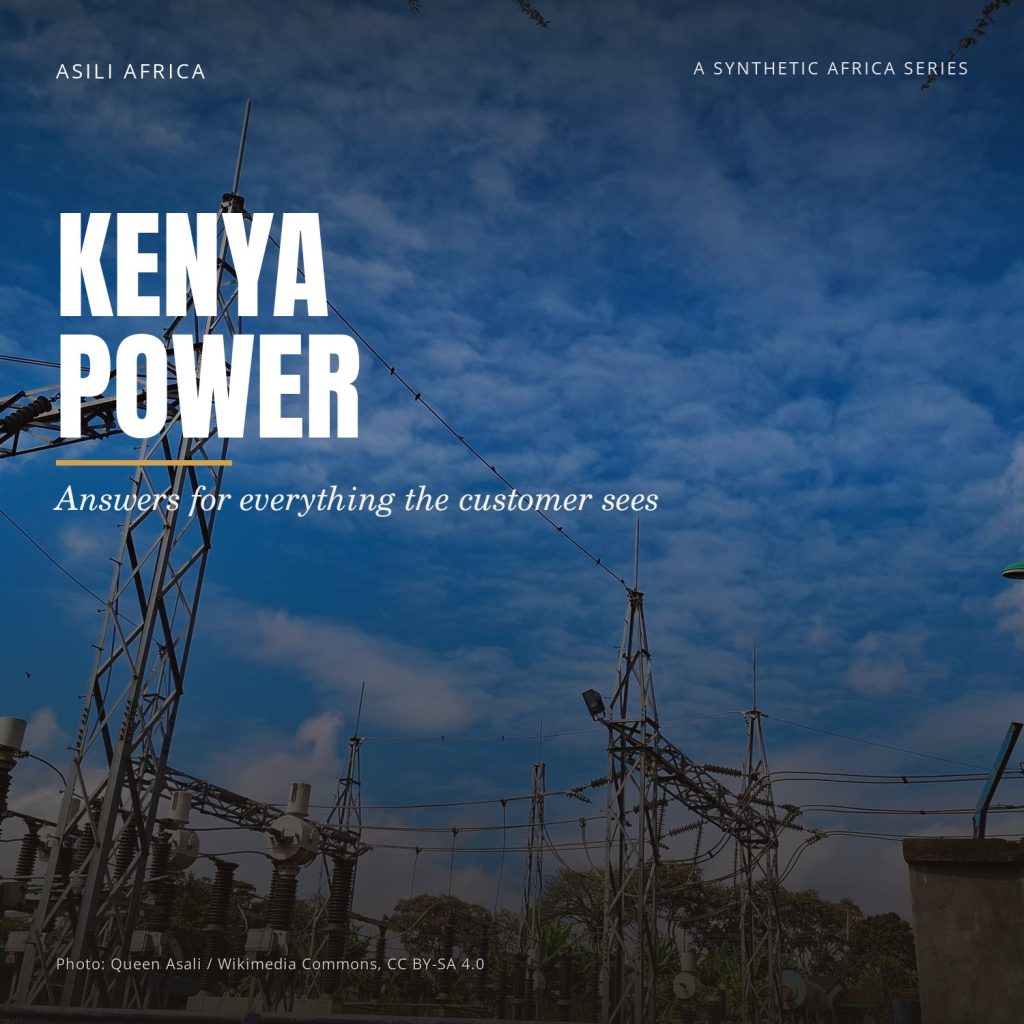
The Kenya Power Story: Answers for everything the customer sees
In the middle of twenty twenty four, a share in Kenya Power was trading for less than two shillings.
The company’s last reported year had ended in a loss. Three point two billion shillings.
This is the company that carries electricity the last stretch to more than ten million customers in Kenya, and sends every one of them the bill. It is a hundred and four years old.
Then the next set of results arrived. A record profit of thirty point one billion shillings.
With it came the first dividend since twenty seventeen.
And over the year that followed, the share price climbed past fifteen shillings.
One year, a loss of three point two billion. The next, a profit of thirty point one billion.
A large part of that swing was not something the company did.
It was foreign-exchange losses, reversing, as the Kenyan shilling recovered.
THE MIDDLE
In nineteen oh eight, the electricity business in what is now Kenya was two small franchises, in two towns.
In Mombasa, there was a lighting company associated with the merchant Harrali Esmailjee Jeevanjee.
In Nairobi, the colonial authority granted an engineer, Clement Hirtzel, the exclusive right to supply the town with electricity.
Two towns, two sets of wires, two small businesses selling light after dark.
On the sixth of January, nineteen twenty two, the two merged. Out of the merger came a single power and lighting company, with a reach across Kenya, Uganda and Tanganyika.
That merger is the only founding this company has. There is no founder in this story.
No one person set out to build it. Two franchise holders combined, and the record gives each of them a single line, and nothing after the merger. We are not going to give them more than the record does.
When Kenya became independent in nineteen sixty three, the company was already forty one years old.
In nineteen fifty four, it listed on the stock exchange in Nairobi, one of the exchange’s earliest listings.
Then it began to get smaller. In nineteen sixty four, it sold its operations in Tanzania to the Tanzanian government.
By nineteen eighty three, its operations in Uganda were gone as well. A company built for three territories now served one.
That year it took a new name, the Kenya Power and Lighting Company.
It was still a company that did everything. It made the electricity. It carried it across the country. And it sold it at the door.
In nineteen ninety seven, generation was taken out of it. The power stations went to a new company, the Kenya Electricity Generating Company, known as KenGen. The state holds a majority of that company as well.
For the first time, the company that sold electricity in Kenya was not the company that made it.
What happened on that side of the line became one of the real successes in this story.
Kenya’s electricity today is more than ninety per cent renewable. Geothermal power, heat drawn from deep under the Rift Valley, supplies the largest single share of it.
Hydro, wind and a growing amount of solar make up most of the rest.
By that measure, it is some of the cleanest electricity generated anywhere in the world.
Kenya Power makes almost none of it. It buys nearly all of the power it sells, and then it sells it to the people who pay the bills.
Most customers never deal with the companies that generate their power. The company they deal with is the one that sends the bill.
That success is real. It belongs to other companies.
In two thousand and three, the government converted fifteen point nine billion shillings of Kenya Power’s accumulated losses into preference shares, held by the state.
Losses on the books became the state’s stake in the company. For a time, that pushed the government’s share towards seventy per cent.
In two thousand and eight, the state created another separate company, KETRACO, to build and run the country’s new high voltage lines.
Kenya Power kept its own network of lower voltage lines, the ones that run along the roads and into the towns.
Twice in eleven years, a part of the chain had been lifted out and given to a new company. Neither was the company’s own decision.
In twenty ten, shareholders approved a rights issue, twenty new shares for every fifty one held, and the state’s preference shares were converted into ordinary equity.
The state did not take up all of the new shares it was offered. Its stake settled at fifty point one per cent, and it has stayed there ever since. That holding sits with the National Treasury.
By twenty ten, what was left was the wire to the house.
The meter on the wall.
The bill.
And an owner, holding just over half of it, which had also been its rescuer.
THE CHARGES
In twenty twelve, Kenya Power signed a contract worth about four hundred million shillings for hundreds of transformers, the drums on the poles that step power down for homes and businesses.
They turned out to be substandard. These were the faulty transformers, and the contract was the company’s own.
In twenty eighteen, the former managing director, Ben Chumo, his successor, Ken Tarus, and other senior managers were charged with abuse of office over that contract.
The whole management team was suspended, and an acting managing director was put in charge of the company.
How the case ended is not established in the sources found. There is no conviction on the record, and no acquittal. They were charged, and that is as far as the record goes.
The same year, a second failure came to light, and this one was inside the company’s own systems.
Kenya Power staff had given people from outside the company access to its billing system.
Customers’ bills were manipulated.
And prepaid tokens, the numbers a customer buys and keys into the meter to get power, were fabricated.
It went on for about a year before it was discovered.
This was fraud. It ran through the company’s own staff, on the company’s own systems.
A billing system is where a utility and its customer meet in numbers. For about a year, some of those numbers were false.
For months, customers had complained that their bills were wrong.
In January twenty eighteen, they answered in public, with a hashtag. Switch off K P L C.
It was aimed at the one company every one of them had to buy their electricity from.
Kenya Power has more than ten million customers. In the sources found, that hashtag is the only voice the record keeps from any of them.
No customer’s own account appears. Not a household that lost its power, and not a shopkeeper holding a wrong bill. We are not going to invent one.
None of this came from outside. The contract, the staff and the systems were Kenya Power’s own.
At the top, the job kept changing hands.
Between twenty seventeen and twenty twenty three, six different people held the post of managing director.
Some of them held it only in an acting capacity.
Six people, in about six years.
THE LAST MILE
In twenty thirteen, five years before those charges were brought, about thirty seven per cent of Kenyans had electricity.
Little more than a third of the country. Nearly two in three Kenyans lived beyond the end of the wire.
In the language of utilities, the final stretch between the network and a customer’s door is called the last mile. It is the stretch of wire this company exists to own.
By this point, that stretch was nearly all Kenya Power had left of the chain. Generation had gone to KenGen. New high voltage lines were KETRACO’s to build. The wire from the pole to the house was Kenya Power’s.
In twenty fifteen, the Last Mile Connectivity Project began. Its name was literal. It was financed by the World Bank, the African Development Bank and the government of Kenya.
It set out to reach households in thirty two of Kenya’s forty seven counties, in the countryside and on the edges of towns. It was aimed at the homes the network had not yet reached.
The money came from the lenders and from the state. Kenya Power did the connecting.
The work is the same at every house. A pole goes up near the homestead.
A service wire is run from the pole to the wall.
A meter is fixed beside the door.
The first token is keyed in.
And the house is on the grid.
Every one of those houses is also a new customer for the company in the middle. Another meter to read. Another bill to send.
Under the programme, more than one point three million households were connected, by the government’s own count. Much of the rise in access came through it.
More than a million times over, a crew did that same work. A pole, a wire, a meter, a door.
The clean electricity from the Rift Valley, the success that belongs to other companies, reached those homes along Kenya Power’s wire.
These are the same years as the charges and the hashtag. The failures were Kenya Power’s own. So was this.
It is a quiet kind of achievement. It does not show up on an exchange board.
In twenty thirteen, little more than a third of Kenyans had electricity. By twenty twenty three, about four in five did.
It is one of the most successful electrification records in sub-Saharan Africa.
The work has carried on. In the year to June twenty twenty six, Kenya Power added four hundred and eleven thousand, seven hundred and ten new customers.
A further two hundred and eighty thousand households were set as a target for connection by the end of twenty twenty five.
The stated goal is electricity for every Kenyan by twenty thirty.
THE CONTRACTS
In the year to June twenty twenty, Kenya Power posted the first net loss in its history. Two point nine eight billion shillings, after tax.
Before tax, the loss was about seven billion.
Foreign-exchange losses that year came to three point five three billion shillings.
In the same year, COVID nineteen cut demand for electricity.
In April twenty twenty one, the Treasury Cabinet Secretary told Cabinet that Kenya Power was unable to meet its obligations to suppliers, lenders and shareholders.
In the Treasury’s own words, the company faced imminent collapse.
Its commercial debt stood at about sixty five and a half billion shillings, around five hundred and fifty five million US dollars.
It was insolvency language, about the only company in Kenya that sells electricity to homes. And it came from the company’s own majority owner.
In the year to June twenty twenty one, the company scraped back to a small profit, one point four nine billion shillings, with its working capital still negative.
In March twenty twenty one, a month before that warning, amid public anger at the cost of electricity, which compared badly with neighbouring countries, a Presidential Taskforce chaired by John Ngumi had been appointed to examine the country’s Power Purchase Agreements.
These are the long term contracts under which Kenya Power buys its electricity, from KenGen and from a roster of independent power producers, private companies that build power plants and sell what they generate.
It was not a review of the company’s management. It was a review of the contracts the company buys its power under.
The taskforce reported in September twenty twenty one. It found that those contracts account for about fifty four per cent of Kenya Power’s cost of sales.
For every hundred shillings of its cost of sales, about fifty four go to the Power Purchase Agreements. It is the single largest cost the company carries.
Many of those agreements were signed a decade or more before the current management arrived. Kenya Power did not originate their terms. It is bound by them, and it cannot easily get out of them.
The customer never sees those contracts. The customer sees a bill, and the bill comes from Kenya Power.
The other side of those contracts is silent. No power producer’s own account of the terms appears in any source found.
Expensive is not the same as corrupt. The taskforce’s finding is about what the contracts cost and who is bound by them. Nothing in the record makes it a finding of wrongdoing by anyone.
New contracts with independent producers were frozen.
In August twenty twenty one, the managing director resigned.
In October, the government declared Kenya Power a special government project. It ordered an audit across ministries, and ordered the taskforce’s recommendations carried out.
In twenty twenty two, the board chair, Vivienne Yeda, the first woman to hold the post, was removed on the Treasury’s direction.
In January twenty twenty two, the government ordered a cut in electricity prices. The price of the only thing Kenya Power sells was cut by order.
The cut was estimated to cost Kenya Power about twenty six billion shillings in revenue.
The government allocated seven billion shillings to cover part of the gap. Then it allocated a further two point three five billion.
The state had set the price, and then it paid part of the difference.
By now, the National Treasury held the company’s largest stake, had written the warning of its collapse, and was paying towards its revenue.
Two thousand and three, losses converted into state shares.
Twenty ten, a rights issue.
Twenty twenty two, budget money after a price cut the government itself had ordered.
Each one repaired the balance sheet. The record shows none of them changing the contracts.
In twenty twenty three, the freeze on new contracts was lifted.
No renegotiation of the existing Power Purchase Agreements is documented in the sources found. As far as the record shows, the contracts stand as they were.
THE SHILLING
Since May twenty twenty three, the managing director has been an engineer, Joseph Siror.
In one year, Kenya Power reported a loss of three point two billion shillings.
The next, announced in twenty twenty four, it reported a record profit of thirty point one billion shillings.
A large part of that was the same foreign-exchange line that had helped push the company into its first ever loss, now running the other way as the shilling recovered.
For years, while the company was losing money or barely making any, there had been nothing to pay out.
Now the company paid its first dividend since twenty seventeen. Seventy cents a share, about one point three billion shillings in total.
With the state holding fifty point one per cent, just over half of every shilling paid out goes to the National Treasury.
The dividend has been raised twice since. To one shilling a share, and then to one shilling and fifty cents.
The following year, profit came down to twenty four point four seven billion shillings, as the currency gains faded. The year after, it was twenty four point nine nine billion.
In the year to June twenty twenty six, revenue was two hundred and thirty eight billion shillings, and the company sold about twelve per cent more electricity than the year before.
The company reports that its system losses fell to eighteen point five eight per cent in the year to June twenty twenty six. That is the share of electricity that enters its network and is lost, to the wires themselves or to theft, before it can be billed.
The regulator’s benchmark is seventeen point five per cent.
Its working capital, negative through the crisis years, has turned positive.
Those gains are the company’s own, and they are real. They came under a management that inherited both the contracts and the grid it runs.
In the middle of twenty twenty four, a Kenya Power share traded for under two shillings.
By twenty twenty five, it was trading above fifteen, more than seven times where it had been. To a shareholder, it looked like a different company.
In twenty twenty three, the national grid collapsed three times in three months. Each collapse was nationwide, and across the country the lights went out at once.
The longest came on the twenty fifth of August, twenty twenty three. It has been described as the longest blackout in the country’s history.
In August twenty twenty four, a nationwide blackout plunged Nairobi and six of the country’s eight grid regions into darkness. It came two months before the record profit was announced.
In December twenty twenty five, the grid went down again. That outage was traced to a disturbance on the regional network Kenya shares with Uganda.
Thin reserve margins are among the causes the sources cite. At points in early twenty twenty six, the country’s reserve margin, the spare capacity held back for the moment something fails, was about two per cent.
The record profits and the blackouts belong to the same years. Neither cancels the other. Both are true.
The Power Purchase Agreements, as far as the sources show, have not been renegotiated.
The state still holds just over half the company.
And when a privatisation law passed in twenty twenty five opened the way to selling state companies, Kenya Power was not on any list of those to be sold, in the sources found.
In twenty twenty five, by Kenya Power’s own count, a hundred and twenty two people died in connection with its network.
A hundred and fifteen were members of the public. Five were Kenya Power’s own employees. Two were contractors.
The year before, the count was a hundred and eighteen.
Kenya Power employs more than thirteen thousand people. Below the managing director, not one of them appears by name in any source found. Not the five employees and the two contractors who died. The people who keep the grid running are the least documented people in this story.
Kenya Power is the part of Kenya’s electricity system that every customer touches. The wire, the meter and the bill.
Almost everything that decides its fate is decided somewhere else. The power stations. The new high voltage lines. The contracts. The price. And in its record year, in large part, the currency.
What it does control is its own, the failures and the success alike. The transformers and the fraud were its own. So were the more than a million homes it connected.
It is older than the country it serves. It was made from two franchises and cut back to the middle. The state has repaired its balance sheet more than once, and the middle is where it still stands.
As of the twenty eighth of September, twenty twenty six, Kenya Power is financially stronger than it has been in a decade. It is still connecting homes. And its more than ten million customers are on a network that still goes dark.
This is Asili Africa. Every empire has an origin. See you on the next one.
Key Takeaways
- THE MIDDLE. In nineteen oh eight, the electricity business in what is now Kenya was two small franchises, in two towns.
- THE LAST MILE. In twenty thirteen, five years before those charges were brought, about thirty seven per cent of Kenyans had electricity.
- THE CONTRACTS. In the year to June twenty twenty, Kenya Power posted the first net loss in its history.
- THE SHILLING. Since May twenty twenty three, the managing director has been an engineer, Joseph Siror.
In this series: State Assets
What does a state do with a company it owns?
- Mumias Sugar
- Pan Paper
- Kenya Power (this episode)
- New KCC
- KTDA
- Ethiopian Airlines
- Kenya Airways
- Precision Air
Also available on YouTube — search “Asili Africa” or subscribe to our channel.