
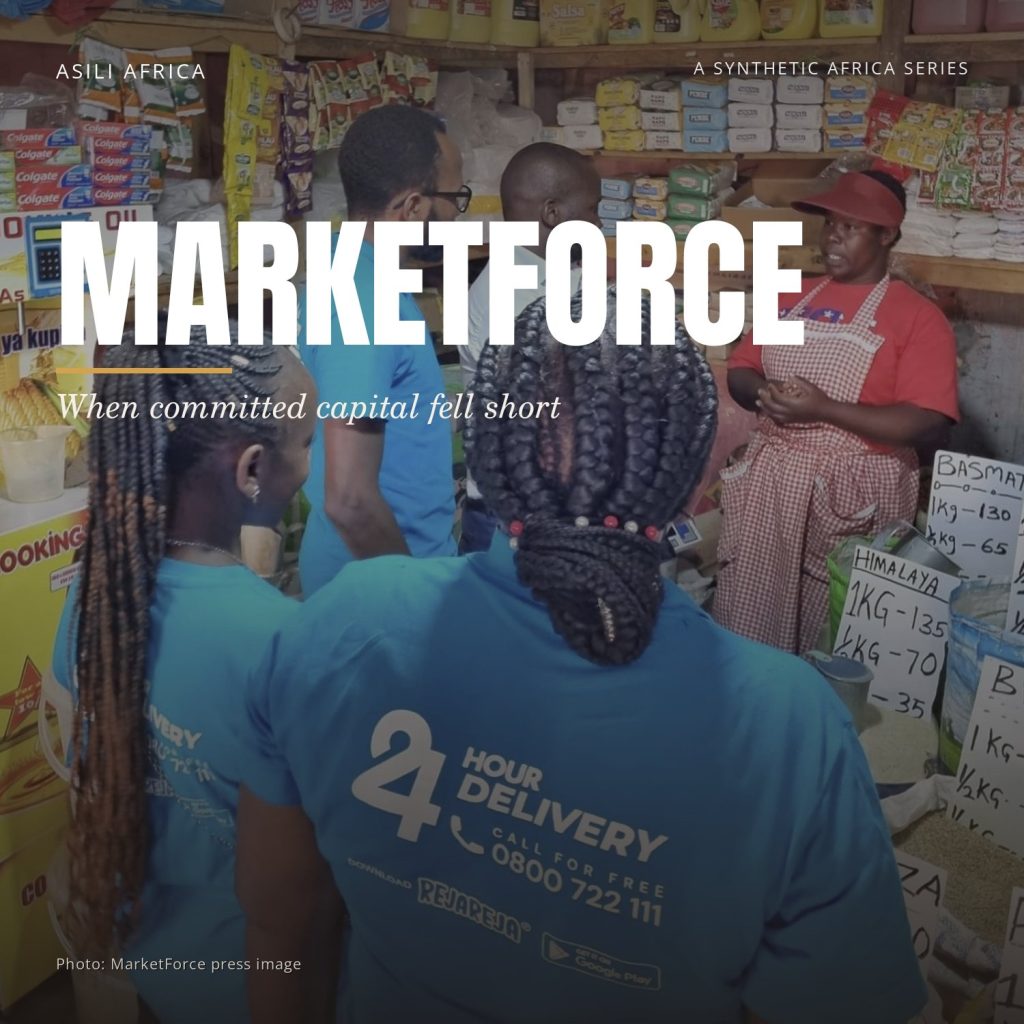
The MarketForce Story: Tesh Mbaabu built MarketForce into one of Kenya’s most-funded B2B startups
On the twenty-first of February, twenty twenty two, a Kenyan startup called MarketForce announced a forty million dollar Series A. It was, at that moment, one of the largest funding rounds ever raised by a business-to-business platform on the African continent. The round was led by a London and Lagos fund called V Eight Capital Partners. It valued the company at over one hundred million dollars. And on the new board, in the chair, sat Ken Njoroge — the co-founder of Cellulant, one of the most respected African fintech operators alive.
MarketForce, by then, had two hundred and seventy thousand corner-shop merchants on its platform. It had moved one hundred and sixty million dollars in goods. It had eight hundred employees across five countries.
Two years and two months later, on the seventeenth of April, twenty twenty four, the same founder, on the same Twitter account, posted a different kind of announcement.
“We got this completely wrong.”
RejaReja, the platform underneath the unicorn dream, was being permanently shut down. Eight million dollars of the original Series A had never arrived. Two hundred and fifty people had been laid off in waves. Three of the five countries had been abandoned.
This is the story of how Tesh Mbaabu spent six years building Africa’s most-funded business-to-business retail platform, watched it die, and walked out of the wreckage to build two new companies — including, against the odds of a man who had just publicly buried a unicorn, a bank.
The Software Boys from Mesozi
The story begins, as a surprising number of African tech stories do, inside a computer science classroom at the University of Nairobi.
The year was twenty thirteen. Two undergraduates were sitting in the same lecture hall. One was named Mutethia Mbaabu, but he went by Tesh. He had grown up in Nairobi. At eighteen, while still in school, he had started a graphic and web design agency called TeshTeq. And by the age of nineteen, by his own account and the reports of profile pieces written about him later, he had already made his first million dollars selling websites to Kenyan businesses.
The other student was named Mesongo Sibuti. Quieter. More technical. The kind of student who built credit-scoring engines in his spare time, for fun, before anyone had asked him to.
Tesh was the one with the customers. Mesongo was the one with the code. By the end of their second year, they had decided they wanted to build something together.
In twenty thirteen, while still students, they founded a consulting shop in Nairobi. They called it Mesozi Group. It sold websites and bespoke software to medium-sized African businesses. It was a hustle. They graduated in twenty fifteen with computer science degrees in one hand and a small portfolio of paying enterprise clients in the other.
Around the same time, they launched a second venture — a travel and leisure booking marketplace for Africans called Cloud Nine X P. By twenty eighteen, Cloud Nine X P had raised seventy-three thousand dollars, made it into Google Launchpad Africa, presented at DEMO Africa in Morocco, and shipped mobile apps. In twenty twenty, Cloud Nine X P would quietly be acquired by a Norwegian travel-tech company called HotelOnline. Their first exit.
But inside Mesozi, while Cloud Nine X P was running on the side, something more important was happening.
Their consulting clients kept asking for the same thing.
The clients were big consumer-goods companies. Unilever. PZ Cussons. Beverage distributors. Companies whose products eventually ended up on the shelves of small shops across Kenya and Uganda and Nigeria. And every one of those companies had the same problem.
They had no idea what was happening at the last mile.
Their field representatives were filling out paper forms. Their distributors were guessing inventory levels. Their managers were reading Excel spreadsheets that had been emailed three days after the sale. And the fifteen million independent corner shops, kiosks, and dukas scattered across the continent — which handled approximately ninety percent of all consumer transactions in Africa — were, from the perspective of head office, an invisible ocean.
This was a five hundred billion dollar retail market. Larger than the entire GDP of Nigeria. And the only reporting layer underneath it was Excel and text messages.
The first product Tesh and Mesongo built was very simple. They called it MarketForce three sixty. It was a mobile application that field representatives could use to log their visits in real time. Orders, inventories, deliveries, payments, competitor activity. All captured on a phone, all flowing back to head office instantly.
Enterprise customers paid per seat. The economics were ordinary software-as-a-service economics. The product worked.
In twenty eighteen, MarketForce Technologies Limited was officially spun out of Mesozi Group as its own company. The flagship product was MarketForce three sixty. The customers were consumer-goods companies, telecoms, and financial institutions.
By twenty twenty, MarketForce three sixty had ten thousand monthly active users. Three hundred thousand transactions processed. Five hundred million dollars in goods, in cumulative merchandise value, flowing through it. Twenty-five enterprise customers. Four thousand two hundred field agents. Forty-five thousand retail outlets indexed by their software.
The product had also caught the attention of a small Kenyan angel investor, who wrote a three hundred and fifty thousand dollar seed cheque in May twenty twenty.
Three months later, Tesh and Mesongo received an email from Y Combinator.
They had been accepted into the Summer twenty twenty batch.
Because of the pandemic, the batch ran entirely remotely. The two co-founders ran demo-day calls from their apartments in Nairobi. The Y Combinator cheque was the standard one hundred and fifty thousand dollars. The credential, in African venture capital terms, was worth far more than the money.
Two Products, One Team
Y Combinator changes a startup in two ways. The first is that it forces the founders to answer one question, again and again, in front of the most experienced startup people in the world. The question is — what are you really building.
Inside MarketForce, that question had a complicated answer. Because while MarketForce three sixty was working — paying enterprise customers, healthy margins, a real software business — Tesh and Mesongo had also started to notice something on the other side of their software.
The data was flowing back from the field. They could see, in real time, which corner shops were ordering, which were not, which products were moving, which were sitting on shelves. They could see the supply chain from above. And they could see something else — they could see that the shopkeepers themselves had no equivalent visibility into their own businesses.
The owner of a duka in Nairobi did not know which products were her best margin. She had no way to order more stock without calling a distributor and waiting two days. She had no way to take digital payments without paying a transaction fee that ate her profit. She had no way to borrow working capital, because no bank would lend to her.
So Tesh and Mesongo built her a second product.
In December twenty twenty, in the middle of the pandemic, they launched a business-to-business e-commerce platform called RejaReja. The name comes from a Swahili phrase used in retail — to buy in small quantities, the way a corner shop owner buys stock.
RejaReja was, on its surface, an Amazon for African corner shops. A shopkeeper could open the app on her phone, browse hundreds of fast-moving consumer goods, and place an order. The order would be fulfilled by the same manufacturers and distributors that MarketForce three sixty was already plugged into. Delivery in twenty-four hours. Payment by M-Pesa.
Underneath that, RejaReja was three more things stacked on top of each other. It was a digital payments terminal — letting the shopkeeper accept M-Pesa for things like airtime top-ups and utility bills, turning her duka into a mini banking agent. It was a working-capital line — extending overdraft credit to merchants based on their transaction history. And it was, eventually, a buy now pay later product, letting shopkeepers stock up on inventory and pay for it after they had sold it.
The MarketForce three sixty supply chain pointed at manufacturers. RejaReja flipped the same supply chain around and pointed it at the shopkeeper.
It worked. Faster than the founders expected.
Through twenty twenty one, RejaReja’s merchant count began to climb steeply. The early traction was strong enough that, in July twenty twenty one, MarketForce closed a two million dollar pre-Series A. The round was small but the list of investors was telling — Y Combinator, P One Ventures, Future Africa, Launch Africa, Greenhouse Capital, and V Eight Capital. Several of the most active African early-stage funds were now on the cap table.
But the same year that traction arrived, the founders also hit a wall they had not predicted.
They were running two completely different businesses inside the same company.
MarketForce three sixty was a per-seat enterprise software product, with a slow sales cycle, six-figure annual contracts, and the gross-margin economics any software business would recognise.
RejaReja was a retail commerce product, with razor-thin margins on cooking oil and sugar and soap and flour, a daily logistics burden, and unit economics that depended entirely on volume.
Different teams. Different sales motions. Different metrics. Different software stacks. And a single founding team trying to run both.
Worse — RejaReja was not the only platform doing this. By twenty twenty one, the African business-to-business e-commerce space was suddenly crowded. A Kenyan startup called Wasoko, then known as Sokowatch, was raising aggressively. Twiga Foods was scaling. In Nigeria, TradeDepot and Omnibiz were doing the same thing. In Egypt, a company called MaxAB. Every single one of them was selling the same products to the same shopkeepers in the same neighbourhoods.
Tesh would later describe this market with two phrases that became famous in African tech post-mortems. He called it perfect competition. He called it a race to the bottom. Every platform was discounting the same goods, eating the same losses, funded by the same global pool of cheap venture capital.
But in mid twenty twenty one, that race did not feel like a problem yet. It felt like the thing the next round of investors wanted to bet on.
Tesh would later put the pivot decision into a single sentence. We have run both models simultaneously, he said, and we have seen much faster traction on the e-commerce side.
MarketForce closed the year with a decision. Bet the company on RejaReja.
Forty Million Dollars
On the twenty-first of February, twenty twenty two, MarketForce closed the largest funding round in its history.
Forty million dollars. Twenty million in equity. Twenty million in debt. A reported valuation of over one hundred million dollars. The lead was V Eight Capital Partners, a London and Lagos fund. Around the table were Ten Thirteen V C, the S O S V Select Fund, V U Venture Partners, Uncovered Fund, Greenhouse Capital, and a list of other names long enough that the press release ran to multiple paragraphs.
But the biggest signal in the round was not in the press release. It was in the board appointment.
Ken Njoroge — the co-founder of Cellulant, one of Africa’s earliest and most respected pan-African fintech operators — joined the MarketForce board as its chair. Njoroge had built and scaled a company that operated in eighteen African countries. He understood, in his bones, what it took to run a platform business across multiple regulatory regimes, multiple currencies, multiple consumer behaviours.
When Ken Njoroge agrees to chair your board, you are no longer just a Kenyan startup. You are a continental bet.
The Series A formally repositioned MarketForce. The enterprise software product, MarketForce three sixty, was still alive — but it was no longer the headline. The headline was RejaReja. And RejaReja, with this much capital, was going to be everywhere.
The expansion plan was aggressive. Kenya was the home market. Uganda and Tanzania were already in motion. The Series A capital was going to fund full launches in Nigeria — the most coveted retail market on the continent — and Rwanda. Five countries. Twenty-one cities at peak. A merchant base that would grow from fifteen thousand toward fifty thousand, then a hundred thousand, then well past two hundred thousand.
At the same time, MarketForce introduced a buy now pay later product for merchants. Stock financing, underwritten on the transaction history flowing through RejaReja. This was the model that would, in theory, generate real margin — not on the cooking oil and the sugar and the soap, but on the credit underneath the cooking oil and the sugar and the soap.
The thesis was clean. MarketForce was not a retailer. It was a financial infrastructure company that happened to move physical goods, in order to teach itself who its merchants were, so that it could then lend to them.
Through twenty twenty two, MarketForce delivered on the early growth numbers. By the end of the year, it had signed a distribution deal with the Kenyan government to move household goods through its network. The fourth quarter of twenty twenty two was the company’s highest-ever quarterly revenue. The first quarter of twenty twenty three, by Tesh’s own later account, was the first quarter the company achieved gross-profitable contribution margins on a route-by-route basis. The model, for the first time, looked like it might actually work.
By early twenty twenty three, MarketForce had eight hundred employees. Seven hundred daily delivery routes across twenty towns. Two hundred and seventy thousand registered merchants. Around one million orders delivered cumulatively. And approximately one hundred and sixty million dollars in goods moved through the platform.
On paper, this was the African business-to-business retail story global venture capital had been waiting for.
But underneath the paper, a problem had already started to assemble itself.
Of the forty million dollars MarketForce had announced in February twenty twenty two, only thirty-two million had actually arrived in the bank.
Eight million dollars of the equity tranche had been committed, but never wired.
And the global venture capital market that had funded the announcement was, by mid twenty twenty two, no longer the same market.
The Eight Million That Never Came
The eight million dollars that did not arrive came at the worst possible moment.
Through the first half of twenty twenty two, the global venture capital market did something it had not done in a decade. It collapsed. The era of cheap capital ended almost overnight. Late-stage rounds across the world were either delayed, repriced down, or quietly cancelled. Tiger Global, the firm whose money had funded a long list of African startups through the boom years, retreated. So did almost every crossover fund that had been writing African cheques alongside it.
MarketForce had been built for the forty million dollars it had announced. The runway, the burn rate, the hiring plan, the country expansion — every operational decision had been calibrated against capital that the company had been told would arrive.
When the eight million did not come, the runway shortened by what Tesh would later say was more than eighteen months.
The first response, in early twenty twenty three, was to cut. The first round of layoffs. Then a second. By the time both waves were done, approximately two hundred and fifty people had lost their jobs. Daily delivery routes were trimmed from seven hundred down to four hundred. The fleet, the network, the geography — all began to contract.
In July twenty twenty three, a product manager named Tom Maina Chege was let go in the second wave. He would, in October that year, file a wrongful-termination case in the Employment and Labour Relations Court in Nairobi. MarketForce did not show up to defend the case.
In October twenty twenty three, the company made its hardest decision yet. It exited Nigeria. It exited Rwanda. It exited Tanzania. The five-country pan-African vision contracted back to two — Kenya and Uganda. Dennis Nyunyuzi, the Uganda country manager, was promoted to managing director of what was left of the regional business.
Through the first quarter of twenty twenty four, the company continued to try to fundraise into a market that did not want to write the cheque. The unit economics, by then, were the central question. African business-to-business retail had become a category that almost no global venture fund wanted exposure to. Wasoko had merged with Egypt’s MaxAB. TradeDepot had pivoted. Twiga Foods had laid off. The race to the bottom had ended. Almost everyone in the race was bleeding.
On the seventeenth of April, twenty twenty four, Tesh Mbaabu posted the announcement nobody in African tech wanted to read.
RejaReja was permanently shutting down.
The thread he wrote that day became, almost instantly, one of the most-quoted founder confessions in African startup history.
“Venture capital,” he wrote, “is not for good, or even great, companies. It is for companies that are so excellent that they produce outsized returns at the right time in the right market. We got this completely wrong. And it hurt us when the committed capital didn’t fully come through.”
The post-mortem was structurally important. He was not blaming only the investors who had walked. He was blaming MarketForce, for choosing to play a game in which only outliers survive. He used the phrase that would be quoted back to him for years afterward — that the entire business-to-business retail category had been perfect competition. A race to the bottom.
In March twenty twenty five, almost a year later, the Kenyan court ruled on the Chege case. Justice C N Baari, of the Employment and Labour Relations Court in Nairobi, ruled that MarketForce had laid Chege off in a manner that was procedurally and substantively unfair under Kenyan employment law. The award was two point one million Kenyan shillings, about sixteen thousand US dollars.
It was a small judgment, financially. But it was the first labour-law precedent against a high-profile, Y Combinator-backed Kenyan startup. The legal trade press treated it as the moment Kenyan employment law caught up with venture-backed redundancies.
Two hundred and fifty people. Three countries. One hundred and sixty million dollars in cumulative goods. A unicorn-adjacent valuation. Six years of work.
All of it, now, past tense.
Capital-Light
On the same day Tesh announced RejaReja was shutting down, he announced something else.
He and Mesongo had not been idle. While RejaReja was burning through its final months of runway, the founder pair had quietly been co-building a third company. A small one. A conversational commerce platform that lived inside WhatsApp and Instagram chats, letting small businesses sell, take orders, and collect payment without leaving the conversation. They had built it in twenty twenty two, with two other co-founders — Mark Kiarie and Kuria Kevin. They called it Chpter.
Chpter was the soft landing. In September twenty twenty four, Chpter raised one point two million dollars in pre-seed funding. The round was led by a new fund called Pani — set up, importantly, by the same Ken Njoroge who had chaired the MarketForce board.
Across all three ventures — MarketForce, Chpter, and what came next — Ken Njoroge remained the constant. The investor who kept writing the cheque.
In September twenty twenty five, Tesh and Mesongo stepped back from Chpter. They returned operational control of the company to Mark Kiarie, and turned their attention to a third act.
In October twenty twenty five, they announced it. A company called Cloud Nine Money. A digital bank for African Gen Z, Millennials, and what the marketing copy called Zillenials. Headquartered in Nairobi. Targeting, in Tesh’s own phrasing, Africa’s four hundred million young people.
The framing, given the previous six years, was striking. Tesh described Cloud Nine Money as a platform for, in his words, dignity, belonging, and opportunity. He said traditional African financial institutions had a long history of leaving young Africans underserved, excluded, and mistreated. He said the team had lived those frustrations themselves.
And then he said something else. He said, on the record — we are not rushing to raise capital.
Cloud Nine Money is the deliberate opposite of MarketForce. Where RejaReja absorbed razor-thin margins on physical goods across five countries, Cloud Nine is capital-light financial software. Where MarketForce was built for the forty million dollars that did not all arrive, Cloud Nine is being built for the customers first and the cheque last. Where RejaReja had to win a race against five competitors selling the same cooking oil to the same shopkeepers, Cloud Nine is competing for a generation of young Africans whose primary relationship with traditional banking is mistrust.
Whether it works is, as of June twenty twenty six, an open question. The waitlist is live. The target for the first year of operations is one hundred thousand active users in Kenya.
Every empire has an origin. Sometimes the origin is the company that died on the way. Sometimes the founder is the one who walks out of the wreckage carrying the lesson nobody else was willing to say out loud.
Tesh Mbaabu said his out loud. We got this completely wrong.
And then he started building again.
This is Asili Africa. Every empire has an origin.
Key Takeaways
- The Software Boys from Mesozi. The story begins, as a surprising number of African tech stories do, inside a computer science classroom at the University of Nairobi.
- Forty Million Dollars. On the twenty-first of February, twenty twenty two, MarketForce closed the largest funding round in its history.
- The Eight Million That Never Came. The eight million dollars that did not arrive came at the worst possible moment.
- Capital-Light. On the same day Tesh announced RejaReja was shutting down, he announced something else.
Also available on YouTube — search “Asili Africa” or subscribe to our channel.