
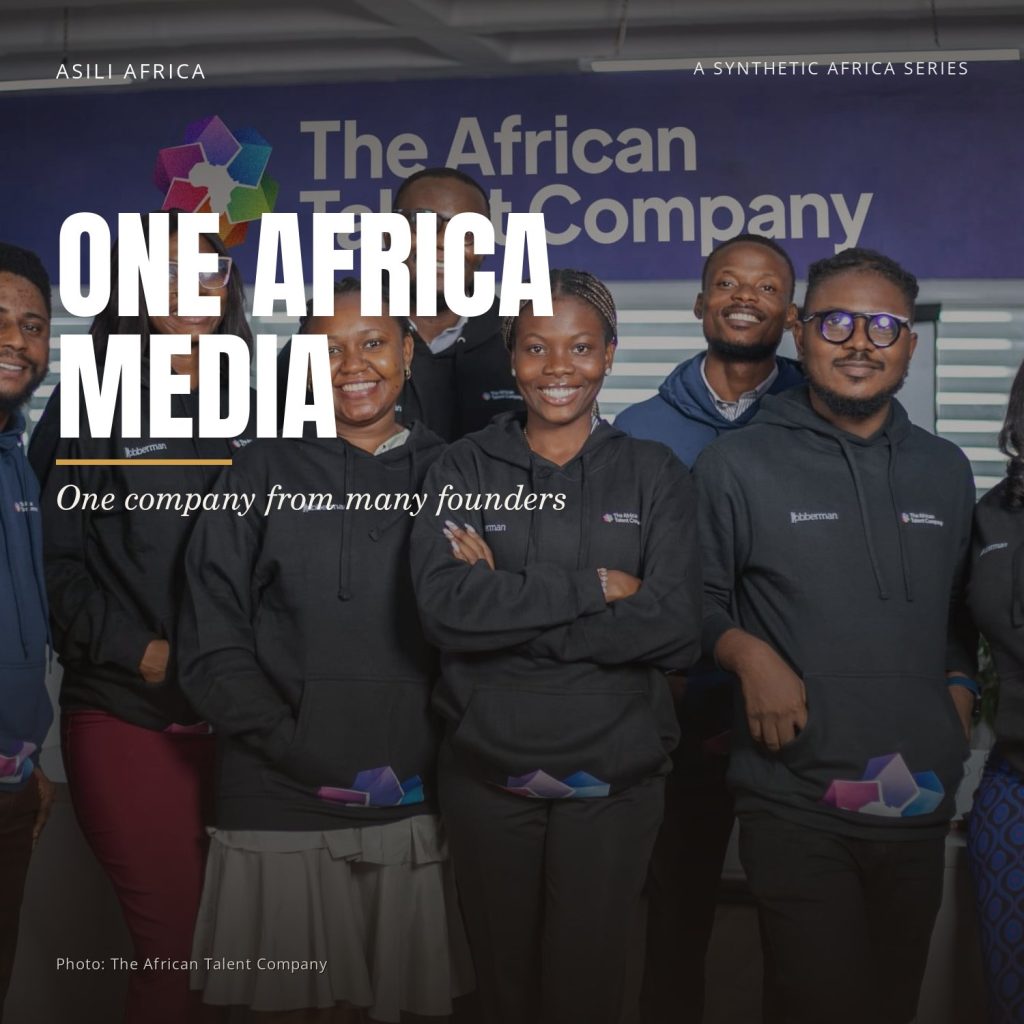
The One Africa Media Story: One company from many founders
In August twenty oh nine, in Nigeria, three people started a website for job listings.
On the other side of the continent, in Kenya, another job site had already been running since twenty oh six.
Different founders. Different countries. Nothing connecting the two.
Both are still running today.
The one in Nigeria is called Jobberman. The one in Kenya is called BrighterMonday.
Over the years in between, the name of the company above them changed three times.
First it was One Africa Media.
Then Ringier One Africa Media.
Then, for the jobs business, The African Talent Company.
Through all three names, the two sites kept their own.
Neither was started by the company that came to own it. Both of them are older than that company.
It was built on a single idea: that sites like these, started separately, by separate people, in separate countries, were worth more as one.
THE PARTS
In nineteen ninety nine, a South African entrepreneur named Justin Clarke took over a struggling registered web address, and gave it a proper business plan.
Clarke has described running it, in the early days, from a converted outhouse at his home.
The site was called Private Property. On it, a seller could list a home, with photographs and a price, and a buyer could contact the seller directly, without an estate agent in between.
In South Africa, as in most places, selling a home usually meant going through an agent, who took a commission on the sale.
Estate agents saw it as a threat. The whole model was a bet that a buyer and a seller did not need anyone standing between them.
It became one of South Africa’s pioneering property sites.
A site like that is a classifieds business. For most of the twentieth century, classifieds were the small advertisements in the back pages of newspapers, sorted into columns: jobs, cars, houses, things for sale.
For newspapers, those pages were a dependable source of income.
When those listings moved online, the columns came with them. Jobs, cars and property became websites of their own, each one built to do a single category well.
Classifieds tend to reward whoever is already biggest. Sellers go where the buyers are, and buyers go where the sellers are.
Private Property was Clarke’s company, and his first. It came more than a decade before the company this episode is about, and its early struggle belongs to it alone.
The other name at the start of this story is Carey Eaton. He was Kenyan, and his grounding in classifieds came from the other side of the Indian Ocean.
He had been chief information officer at SEEK, the Australian classifieds company, which built its business on online job listings and went on to run classifieds sites in Asia and Latin America.
Chief information officer meant he ran the technology.
In a classifieds business, the technology is most of what there is: the listings, the search, the systems that match one person’s advertisement to another person’s need.
In Kenya, in twenty oh six, a job site called BrighterMonday was founded, with Carey Eaton among its founders.
Employers posted their vacancies. People looking for work searched them. It was a Kenyan site, built in Kenya, for the Kenyan market.
In August twenty oh nine, on the other side of the continent, three people in Nigeria, Africa’s most populous country, started a job site of their own.
Their names are Ayodeji Adewunmi, Opeyemi Awoyemi and Olalekan Olude.
They called it Jobberman.
They had nothing to do with Justin Clarke or Carey Eaton. Jobberman was their idea and their site, and it had its own beginning, in its own country.
And in Kenya, in twenty ten, Carey Eaton and a partner named Nigel Neal co-founded Cheki, a website where people could list cars for sale, with photographs and a price.
Where BrighterMonday listed jobs, Cheki listed vehicles, the second of those three columns.
So by twenty ten, the parts of this story were in place, and every one of them was separate.
A property site in South Africa, started by Justin Clarke.
A job site and a car site in Kenya, with Carey Eaton among the founders of each.
A job site in Nigeria, with three founders of its own.
None of them yet belonged to a group. Separate countries. Separate founders. Each one working on its own.
ONE COMPANY
In twenty ten, Justin Clarke and Carey Eaton founded One Africa Media, and ran it together as joint chief executives.
Between them, they had already worked in all three columns. Clarke had built a property site. Eaton had helped found a job site and a car site, and had run the technology at a classifieds company on another continent.
The idea behind the new company was simple to state. Africa’s classifieds sites had been founded country by country, each by its own people, each with its own technology and its own money.
One Africa Media would buy into those separate national sites, join them together, and give them shared technology and shared capital.
The logic suits a business like classifieds, where the software behind a job site in one country looks a great deal like the software behind a job site in the next.
Instead of a site in Lagos and a site in Nairobi each building the same systems twice, and each raising money alone, they would be one company, building once.
The sites would keep their own names in their own countries. What they would share sat underneath.
It was an ambition the size of a continent, built out of sites that had each been made for one country.
There is a name in the trade for a company built this way: a rollup. It means buying companies that other people started, and joining them together.
Rollups are common in industries made up of many small, similar businesses.
The bet in a rollup is that the whole will be worth more than the parts were on their own. Here, the bet was in the company’s name.
In twenty eleven, Carey Eaton came home to Kenya to grow Cheki, the car site he had co-founded the year before.
By the accounts written at the time, Cheki became Kenya’s biggest online car site. One category, in one country, and the largest site in it.
In classifieds, that is the position that matters, because sellers go where the buyers already are.
In twenty thirteen, One Africa Media bought stakes in two job sites: BrighterMonday in Kenya, and Jobberman in Nigeria.
A stake is a share of a company, not the whole of it. The group was now a part owner of the sites it meant to join, and not yet their owner.
Owning part of a site gives you a say in it. Owning all of it gives you the decisions.
By around twenty fourteen, the group was reported to employ about three hundred and fifty people, in offices in four cities.
Cape Town. Durban.
Nairobi.
Lagos.
Two of those cities are in South Africa, where Clarke had built Private Property. The other two are where the job sites were.
By the middle of twenty fourteen, One Africa Media was growing a car site in Kenya and held stakes in two job sites. The parts were not yet one company.
On the fifth of June, twenty fourteen, Carey Eaton was shot during an armed robbery at a home in Loresho, in Nairobi, and he died.
He was forty one.
He left his wife and four children.
NINE COUNTRIES
In April twenty fifteen, One Africa Media, already backed by the American investment firm Tiger Global, raised ten million dollars from SEEK.
Tiger Global’s backing is on the record. When it came in, and how much it put in, is not.
In Kenya, the investment was reported as about nine hundred million shillings.
The money bought the whole of Jobberman and the whole of BrighterMonday.
Two years earlier, the group had held stakes. Now it owned both job sites outright, and with them their decisions, their systems and their accounts.
And the three people who had started Jobberman in twenty oh nine, Ayodeji Adewunmi, Opeyemi Awoyemi and Olalekan Olude, became directors and shareholders of One Africa Media itself.
The founders of one of the parts were now inside the whole. Three people who had built a site on their own, in their own country, now had seats at the table of the company that bought it.
On the tenth of May, twenty sixteen, One Africa Media and Ringier announced a joint venture.
Ringier is a Swiss media group. Through its African arm, it already ran classifieds businesses of its own on the continent.
A joint venture is a business two companies own together. Neither side was buying the other.
The joint venture put both sides’ African classifieds together, under one new name: Ringier One Africa Media.
Justin Clarke became its acting chief executive. The co-founder of One Africa Media was now running the larger group.
By then, Cheki had sites well beyond Kenya, in Tanzania, Uganda, Zambia and Zimbabwe. BrighterMonday had a site in Rwanda.
In December twenty sixteen, seven months after the announcement, the group reorganised.
BrighterMonday in Rwanda was shut. So was Cheki in Tanzania.
The group announced plans to close Cheki in Zimbabwe, in Zambia and in Uganda.
Staff were retrenched, which is to say their jobs were cut.
The strategy was narrowed to three markets: Nigeria, Ghana and Kenya.
In Kenya, where both BrighterMonday and Cheki had started, both carried on.
The record describes these decisions from the top. It holds no account at all from the people who worked in the offices that were shut. Nor does it say how many people lost their jobs in those markets.
Their side of it belongs in this story, and it is missing. We will not fill it with a guess.
On the thirteenth of November, twenty seventeen, eighteen months after the joint venture was announced, the merger was formally completed.
Ringier One Africa Media launched, in its own description, as Africa’s largest classifieds group.
It operated in nine countries. Its backers were Ringier, Tiger Global and SEEK.
Sites that separate people had started, in separate countries, were now one group, across nine of them.
THE NARROWING
In April twenty nineteen, Jiji, a Nigerian general classifieds company, bought the African businesses of OLX in Kenya, Ghana, Uganda and Tanzania.
OLX was an international classifieds business, and in those four countries it ran general listings sites.
General classifieds means every column at once: furniture, phones, clothes, a used fridge, all on one site, rather than a single category done in depth.
The technology press reported it as consolidation: Jiji buying its main competitor.
With OLX’s businesses added to its own, Jiji became, by its own account, the largest general classifieds player in those markets.
In classifieds, buyers and sellers go where the other side already is, so buying a rival’s sites means buying its buyers and its sellers too.
Ringier One Africa Media ran general classifieds sites too, among them PigiaMe in Kenya, one of the four countries in Jiji’s deal. Those sites carried on.
Nothing in the record measures the two against each other, and Jiji’s position is Jiji’s own description of it.
In September twenty twenty one, a company called Autochek bought Cheki Kenya and Cheki Uganda.
Cheki Uganda was one of the sites whose closure had been announced in twenty sixteen. It was still running five years later, when it was sold.
With that sale, the group left car classifieds altogether. What remained was jobs, property and general listings.
Of the three columns, jobs, cars and property, the group now had two.
On the tenth of May, twenty twenty two, the group’s jobs business, until then known under the group’s own name, was given a name of its own: The African Talent Company.
It brought together Jobberman in Nigeria and Ghana, and BrighterMonday in Kenya and Uganda, with a chief executive of its own, Hilda Kabushenga Kragha.
A name of its own means a business is presented, to employers, to job seekers, to anyone looking in from outside, as a company in its own right.
Jobberman had been founded in twenty oh nine. BrighterMonday had been founded in twenty oh six. Both were older than One Africa Media, and now the two of them had a name of their own.
Toward the end of that year, the group bought something as well: Homsters, a property software company built around artificial intelligence.
In these years the group sold, and it also bought.
One reading of all this is concentration: a group putting its weight behind the categories it knew, jobs and property.
Another is withdrawal: a group giving up ground, in cars and in general listings, while a rival consolidated the general market around it.
If it was concentration, the new name for the jobs business is its clearest expression. If it was withdrawal, the new name is what a group gives the part it is keeping.
The dates fit both. No market share, no traffic figure and no margin in the record decides between them, and the announcements give no reasons beyond themselves.
So we will leave it where the record leaves it. Open.
ONE OWNER
On the second of December, twenty twenty two, Ringier agreed to buy out SEEK and the remaining minority shareholders in Ringier One Africa Media.
A minority shareholder owns part of a company, but less than the part that controls it. To be bought out is to be paid for your share, and to leave.
SEEK gave its reason. Africa, it said, was no longer a core market for it, compared with its priorities in Asia Pacific and Latin America.
SEEK had put ten million dollars into One Africa Media in twenty fifteen. That was the money that bought Jobberman and BrighterMonday outright.
Two of the group’s backers made opposite choices at the same moment. SEEK sold, and Ringier bought.
Ringier had come into this story as a partner, in twenty sixteen. At the end of twenty twenty two, it was the buyer, and afterwards Ringier One Africa Media was owned by Ringier.
What became of the Jobberman founders’ stakes and roles, through the merger and then the buyout, the record does not say. Nothing in it says they stayed, and nothing says they left.
In May twenty twenty three, Clemens Weitz, who had been with Ringier’s African classifieds business since twenty fourteen, before the joint venture, was confirmed as the group’s chief executive.
The company is run now by executives, not founders: Clemens Weitz for the group, and Hilda Kabushenga Kragha for the jobs business, the one built on the two job sites from the start of this story.
No revenue, profit or valuation figure for One Africa Media, or for Ringier One Africa Media, has ever been published.
Ringier reported record earnings for its whole group in twenty twenty four, and named its digital portals among the reasons.
That figure covers about a hundred and thirty companies in twenty countries. It says nothing about this one on its own.
So this story ends without a number. No price, no profit, no loss.
Stakes in two job sites in twenty thirteen. Both bought outright in twenty fifteen. A joint venture in twenty sixteen. Nine countries in twenty seventeen. Cars sold in twenty twenty one. The jobs business given its own name in twenty twenty two, and SEEK and the other minority shareholders bought out at the end of that year.
Today the group runs Jobberman in Nigeria and Ghana, BrighterMonday in Kenya and Uganda, PigiaMe in Kenya, Expat-Dakar in Senegal, and Homsters.
Neither of the two people who founded One Africa Media is part of the company today.
Justin Clarke is no longer with the company in any documented role. He has gone on to other ventures, among them a firm called Accretiv Group.
Carey Eaton died in twenty fourteen. Nothing in the record ties his death to anything the company did afterwards: not the deal in twenty fifteen, not the merger, not anything since.
It was a loss, first of all, to his family. It was not, in any record we have, a turning point in this company’s story, and this episode will not make it one.
Every source behind this story comes from the companies, their investors, or the press that reported their announcements.
Not one job seeker, car buyer, landlord or tenant appears in it. The only numbers in the record are about the companies, not the people who used them.
So this episode will not tell you what these sites did for anyone’s working life. The record does not say.
Jobberman and BrighterMonday are still running.
In general classifieds, Jiji bought OLX’s African businesses in twenty nineteen, and describes itself as the largest player in those markets.
Jiji’s position rests on its own account of it. The group’s rests on no published figure at all. How the rest of this market settles, for jobs, for property, for the sites the group still runs, has not been written yet.
Separate sites were started by separate people, in separate countries. They were joined into one company. That company merged, narrowed, and came to be owned by its partner.
Whether the whole was ever worth more than its parts, the record does not say.
And the two job sites that were there before any of it have kept their own names through every name above them.
That is where this story stands, as of the twenty eighth of September, twenty twenty six.
This is Asili Africa. Every empire has an origin. See you on the next one.
Key Takeaways
- THE PARTS. In nineteen ninety nine, a South African entrepreneur named Justin Clarke took over a struggling registered web address, and gave it a proper business plan.
- NINE COUNTRIES. In April twenty fifteen, One Africa Media, already backed by the American investment firm Tiger Global, raised ten million dollars from SEEK.
- THE NARROWING. In April twenty nineteen, Jiji, a Nigerian general classifieds company, bought the African businesses of OLX in Kenya, Ghana, Uganda and Tanzania.
- ONE OWNER. On the second of December, twenty twenty two, Ringier agreed to buy out SEEK and the remaining minority shareholders in Ringier One Africa Media.
In this series: Failed Funded
- Sendy
- Twiga Foods
- MarketForce
- Copia
- One Africa Media (this episode)
Also available on YouTube — search “Asili Africa” or subscribe to our channel.