
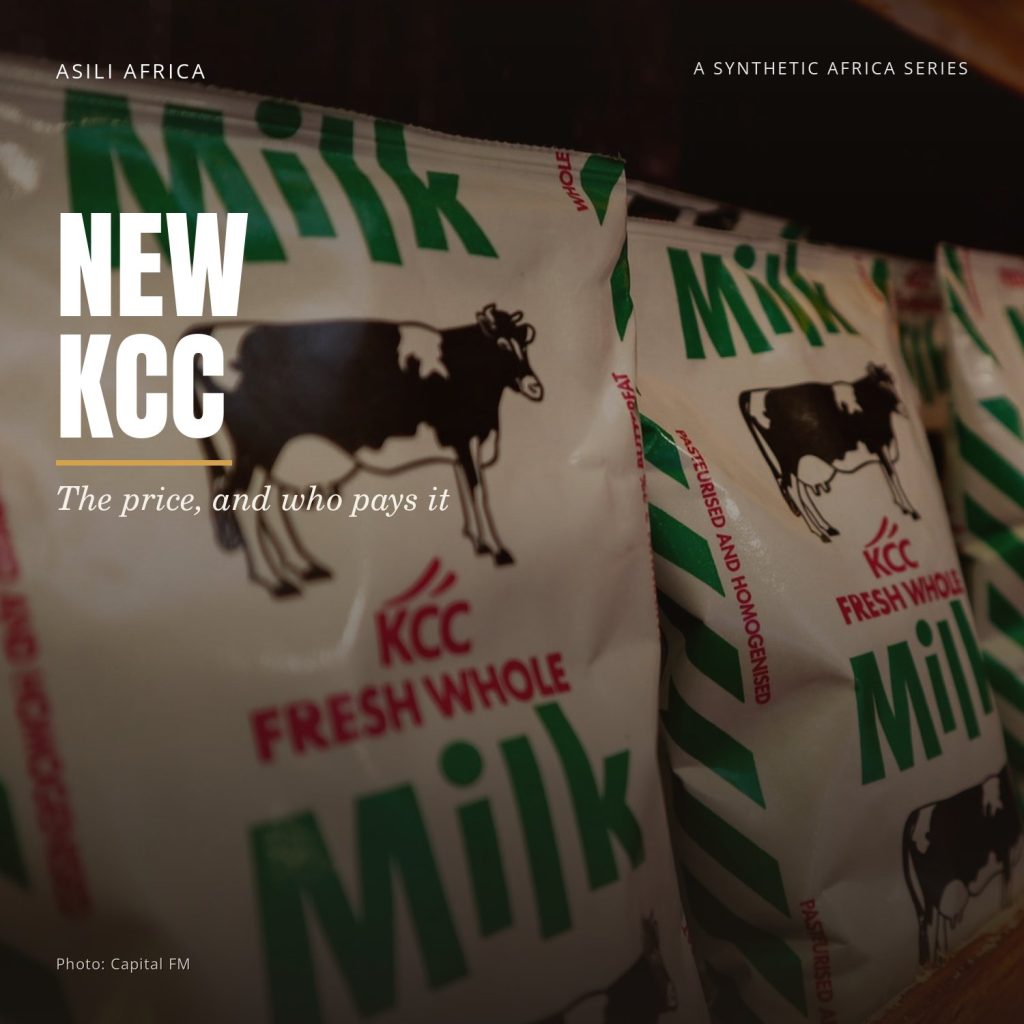
The New KCC Story: The price, and who pays it
In the year two thousand, a receiver sold Kenya Co-operative Creameries to a group of private investors.
The price was under half a billion shillings.
Three years later, the government of Kenya bought it back.
It paid five hundred and forty seven million shillings. That is more than the receiver had sold it for. Kenya paid a premium to take back what it had let go.
The state still owns it today. The company is called New KCC now, and it is Kenya’s oldest dairy processor.
In November twenty twenty five, at a conference in Naivasha, a Cabinet Secretary announced a plan to privatise it.
It was sold, then bought back for more, and now it has been proposed for sale again.
The story starts a century earlier, with farmers who could not get a steady price for their milk.
THE FLOOR
In nineteen twenty four, a meeting was called at a house in Nairobi. The man who called it was Lord Delamere. He was the most prominent voice of the colony’s white settler establishment, and his wider legacy on land and labour is contested. That legacy is not this episode’s subject.
The people he brought together were dairy farmers from the Rift Valley. Their problem had nothing to do with cows.
Nairobi was a small market. It could not take much milk, and it was too thin to hold a price.
A farmer who sold alone took whatever the buyer offered that week, and the next week the offer might be different. Every one of them was too small to argue.
What came out of that meeting was simple. Pool the milk, build a shared creamery, and sell it together. As a group they would have bargaining power that none of them had alone, and a buyer they could count on.
The creamery followed within a few years. The sources do not agree on exactly when, or exactly where. We found no founding document to settle it, so we are not going to pick one.
What the record does make clear is whose farmers these were. The founding story, as it has come down to us, is told entirely through white settler ranchers selling their own milk.
It says nothing about African farmers in those years. It does not say they were kept out, and it does not say they were let in.
The record we found is silent on it, and we are leaving that silence as it is rather than filling it with a guess.
The cooperative carried the name Kenya Co-operative Creameries, or KCC. Over the decades that followed, it grew from a settlers’ creamery into something far larger.
Kenya became independent in nineteen sixty three, and the institution carried on. The sources we found do not say how, or when, African smallholders came into its supply.
What they do show is where it ended up.
Looking back, the Daily Nation describes an institution that “linked smallholder farmers to urban markets, stabilised prices and created a dependable route through which milk could move from the countryside to processors and consumers.”
For most of that time, KCC was in effect the only buyer for the formal urban milk market. Milk reached the towns from the countryside through a single door.
That position made it more than a company.
For a farmer, KCC was the buyer who was always there, and its price was the price. It was a floor under the market.
That gave it two jobs. It was a cooperative that existed to hold a price for the farmers who supplied it. It was also a processor that had to buy milk, sell milk, and make the numbers add up.
So one legal body was a price floor for its members and a business answerable to a balance sheet. When those two jobs pull in the same direction, the arrangement works.
For a long time, they did pull together. The floor held through the end of colonial rule, through independence, and through the decades that followed.
By the start of the nineteen nineties, KCC had been buying Kenya’s milk for six decades or more, and the floor was still standing.
THE SALE
From the late nineteen eighties, the people running KCC began to change. Leadership was reshuffled from above, and political appointees took the place of professional managers.
A retrospective in the Daily Nation dates those reshuffles to that period. The institution began to work like a patronage machine.
The record of that decade is thin, and we will not pad it. It names no single decision that broke the company. What it describes is a drift, as the people at the top of an institution that had held a floor for sixty years were more and more often chosen for reasons other than running a dairy.
In May nineteen ninety two, the government liberalised the urban milk market, and KCC’s monopoly ended.
For the first time in decades, KCC had to compete for farmers’ milk and for shoppers’ money.
Private processors came in. The best known was Brookside, the Kenyatta family’s dairy, founded in nineteen ninety three. Others followed, including dairies in Meru and in Limuru, and by two thousand and five Kenya had forty five registered private processors.
Liberalisation asked KCC to act like a commercial business at the exact moment its management had stopped being chosen to run one.
So two failures arrived at once. The management had been captured, and the market now had to be won.
A monopoly buyer can hold a price because the farmer has nowhere else to sell, and the shopper has nothing else to buy.
Once there were other buyers, holding the floor cost money. The organisation that had to find that money was run by people who had been picked for other reasons.
It took the rest of the decade. By nineteen ninety eight the money was running out. Cash flow failed, and mismanagement and political interference did the rest, now with rivals on every side.
Seventy five years after the farmers met in Nairobi, the institution they had built could no longer pay its way.
On the fifth of August nineteen ninety nine, Kenya Co-operative Creameries was placed in receivership.
A receiver manager from the accounting firm PricewaterhouseCoopers was appointed to run it. An institution that had bought the country’s milk for most of a century was now in the hands of an accountant.
The record we found does not say what happened to the people who worked there. It does not say how many lost their jobs, on what terms, or where they went.
A receiver’s duty runs to creditors. Nothing in that job concerns the price a farmer gets for a litre of milk.
In two thousand, KCC’s assets were sold to a group of private investors.
The price was somewhere between four hundred and forty seven and four hundred and seventy five million shillings. The sources differ, so we have given you both figures.
By one claim, the business had been worth around two billion shillings before the collapse. It went for less than a quarter of that.
The buyers set up new companies to hold it, and gave the old name a new date. It became KCC two thousand.
We cannot tell you who they were. Every source we found describes them only as a group of private investors, and not one of them is named.
So the institution farmers had built by pooling their milk ended up with owners the public record does not name.
THE BUY-BACK
In two thousand and three, a new government had just taken office in Nairobi. It was the NARC coalition, under President Mwai Kibaki.
One of the things it did was buy KCC back.
It paid five hundred and forty seven million shillings. Every source we found gives the same figure.
Put that beside the sale. Three years earlier, the receiver had got between four hundred and forty seven and four hundred and seventy five million. The state paid between seventy two million and a hundred million shillings more to take back a company it had watched being sold.
Why it paid more is not given in anyone’s own words in the record we found, and we are not going to put words in anyone’s mouth.
By paying more to reclaim KCC than it had fetched when it was sold, the state judged it to be worth more to Kenya as a public instrument, a way of holding the price of milk, than as a private company. That is our reading of the arithmetic, not a quotation.
A private buyer values a dairy by what it will earn. The state was paying for something that earnings do not show, which was a buyer farmers could count on and a price that held.
The record does not say what the private owners gained or lost on the round trip, just as it does not say who they were.
The sources we found also do not describe what the three private years were like inside the business, so we will not grade them.
The company was remade as New KCC Limited, one hundred per cent government owned. In two thousand and five, it was formally registered as a state corporation.
It had the same creameries and the same milk routes, with a new word in front of the old initials.
A cooperative founded by farmers now belonged, on paper, entirely to the state. The job had not changed. It was still meant to hold a price for farmers, and it was still meant to pay its way.
The market around it had changed, though. By two thousand and five there were forty five registered private processors, and the monopoly was not coming back. Whatever New KCC did from now on, it would do with competitors on every side, buying from the same farmers and selling in the same towns.
The premium only made sense if the institution, back in public hands, could carry both jobs at once.
For a few years it did, and the two jobs pulled in the same direction again. The record we found says little about how the turnaround was done, but a great deal about the fact that it happened.
In the financial year to June two thousand and six, New KCC made a profit of three hundred and forty nine million shillings, on a turnover of four point nine billion. It was the first profitable year since the revival.
The next year, the profit was three hundred and eighty four million.
The Daily Nation called it a remarkable turnaround.
At one point during that recovery, New KCC handed the government a dividend cheque for thirty million shillings.
The state had paid a premium to take the floor back, and now the floor was paying the state.
THE CHEQUE
By the mid twenty tens, New KCC was once again the largest dairy processor in East Africa.
Its revenue peaked in the financial year to June twenty twenty one, at around seventy three million US dollars.
At the commissioning of an upgraded plant in Nyahururu, President William Ruto issued a presidential directive. From the first of March, New KCC would pay farmers fifty shillings for every litre of milk, and it would pay them every fifteen days.
The aim was the old one. Farmers had been going unpaid for months and selling their milk to hawkers instead, and the directive was meant to end that.
Later reporting gives the average price New KCC paid in the financial year to June twenty twenty five as about fifty three shillings a litre.
A dairy makes its money in the gap between what it pays for raw milk and what it can sell milk for. The directive fixed one side of that gap by order, whatever the market was doing on the other side.
New KCC’s gross margin, the share of each shilling of sales left after the cost of the milk and of making it, was twenty six point six per cent in twenty twenty one. By twenty twenty four it was five point four.
The gap was not left open. The Treasury filled it with grants, one and a half billion shillings in the financial year to June twenty twenty four and two point four billion the year after.
But a grant is paid whenever it is paid, while the price is owed every fifteen days. The grants arrive after the fact and unevenly, and in between the company carries the difference in overdrafts, in loans, and in money it owes to farmers.
The Auditor-General’s report for the year to June twenty twenty four set out where that left it. There was a loss before tax of one point five billion shillings, and negative equity of one point two billion.
At that year end, it also owed farmers three point two billion shillings in total, and some of it was more than a hundred and twenty days overdue.
The state that fixes the price does not always pay its own bills. Government agencies, including school feeding programmes, owe New KCC for milk they have already received. Depending on the source and the date, the sum is between a hundred and eighty four million and five hundred million shillings.
So New KCC is at once a subsidised debtor to farmers and an unpaid creditor to the state.
None of that means the company is well run. The same Auditor-General found five hundred and seventy one staff in a category whose approved establishment was four hundred.
That figure covers one category, not the whole workforce, and no source we found gives a total headcount.
It is a real failing, and it should be said. But it is one failing inside something larger. KCC broke the first time under entirely different people, when the floor had to be paid for and nothing had been arranged to pay for it. Now the floor is set by directive and paid for late, and it is breaking again.
Even the buy-back was never finished on paper. In April twenty nineteen, sixteen years after the state took it back, New KCC reported that it had recovered forty eight of ninety nine disputed property titles.
The last substantive managing director’s term ended in May twenty twenty four, and an acting managing director has run the company since then.
We found no source confirming that a permanent appointment has been made.
In the financial year to June twenty twenty five, New KCC made a net loss of nine hundred and fifty three million shillings.
Its auditors issued a going concern warning for the fourth consecutive year.
For five straight years it has taken in between eighty two and eighty seven million litres of milk, against a target of about a hundred and twenty million. That is about seventy per cent.
In twenty twenty five Kenya produced a record amount of milk, for the third year running. For the first time, the country’s formal processors took in more than a billion litres.
The industry is growing, and the institution built to anchor it is shrinking inside that growth.
SELL IT, KEEP IT, GIVE IT BACK
On the ninth of December twenty twenty three, dairy farmers marched through Nakuru against a proposal to privatise New KCC.
Their national chairman, Muchemi Nderitu, rejected the plan outright, and he gave a reason. He pointed to what had happened before two thousand and three, when, he said, the price farmers got at the farm gate fell to five shillings a litre.
That is the only time in the public record we found that anyone in this argument brings up the precedent, and it was brought up by the farmers’ side.
In July twenty twenty four, the Treasury published a list of eleven state corporations proposed for privatisation. New KCC was on it.
Within weeks, in August and September, the government was citing a Cabinet resolution from the twenty second of March twenty nineteen. That resolution had taken KCC off any privatisation list because of its role in holding the price of milk, and on that basis the government said New KCC would not be sold.
The list said sell and the resolution said keep. Both came from the state, and no source we found reconciles them.
In November twenty twenty five, the Cabinet Secretary responsible for cooperatives, Wycliffe Oparanya, announced a plan to privatise it anyway, pointing to its chronic failure to pay farmers.
Around the same time, the government sent three hundred million shillings to clear four months of arrears owed to more than ten thousand farmers in the Rift Valley and Trans Nzoia.
Two months later, in Eldoret, President William Ruto proposed the opposite. He did not want a sale. He wanted New KCC broken up into regional factories owned by farmers, on the model of the Kenya Tea Development Agency.
With the proposal came two billion shillings, which he called the government’s final bailout.
Farmers rejected that as well.
At the end of January and into February twenty twenty six, farmer groups argued that splitting the company would fragment the supply chain and leave them exposed to private processors. They asked for the factories to be modernised instead.
Kipkorir Menjo, a director of the Kenya Farmers Association, summed up their position. New KCC, he said, is owned by the farmers, despite government funding.
In law, it is not. The Treasury’s records list it as one hundred per cent government owned.
But the claim is not confused. It comes from where the institution started, as a cooperative of farmers, and farmers still pay levies into it. They can believe it is theirs and still not want it broken up in a way that leaves them facing private buyers on their own.
In February twenty twenty six, the High Court upheld the Privatisation Act of twenty twenty five, which cleared a legal obstacle to state sell offs in general. New KCC was not named.
In September twenty twenty six, the member of parliament for Sotik asked Parliament to establish who owns New KCC, when it might be sold, and what it owes.
He said the statutory deductions at the Sotik plant had gone unpaid since June.
The three options are to sell it, to keep it, or to give it back to farmers, and every one of those proposals answers the question of who should own New KCC.
In the reporting we found, none of them sets out how the price New KCC is required to pay farmers is to be funded. That is the question that has broken it, twice. This is our reading of the record, not something any of these sources says, but the record supports it.
The one ownership answer Kenya has actually tried was selling it, and that was reversed at a premium. In the public record we found, the government’s case for selling it again does not mention that it has been done before. The farmers remember it, but the proposals do not cite it.
In September twenty twenty six, farmers in Murang’a reported going about three months without payment for milk they had delivered. One of them was a dairy farmer named David Kirika Mwangi.
He now sells to private buyers. In his account they pay less and they pay later, but he sells to them anyway, because New KCC pays less reliably still.
He is one farmer, selling his milk alone, to whoever will buy it, for what they will pay.
He is one of very few farmers anywhere in this record who speaks for himself. The ten thousand in the Rift Valley arrears are counted, but they are not heard.
A century ago, farmers met at a house in Nairobi because none of them could get a steady price alone, and they built something to hold that price for them.
Since then Kenya has sold it, bought it back, and argued about selling it again.
Each time, it has changed the owner.
It has never settled what the institution is for, or who pays for the floor it was built to be. That question is still open. This is Asili Africa. Every empire has an origin. See you on the next one.
Key Takeaways
- THE FLOOR. In nineteen twenty four, a meeting was called at a house in Nairobi.
- THE BUY-BACK. In two thousand and three, a new government had just taken office in Nairobi.
- THE CHEQUE. By the mid twenty tens, New KCC was once again the largest dairy processor in East Africa.
- SELL IT, KEEP IT, GIVE IT BACK. On the ninth of December twenty twenty three, dairy farmers marched through Nakuru against a proposal to privatise New KCC.
In this series: State Assets
What does a state do with a company it owns?
- Mumias Sugar
- Pan Paper
- New KCC (this episode)
- KTDA
- Ethiopian Airlines
- Kenya Airways
- Precision Air
Also available on YouTube — search “Asili Africa” or subscribe to our channel.