
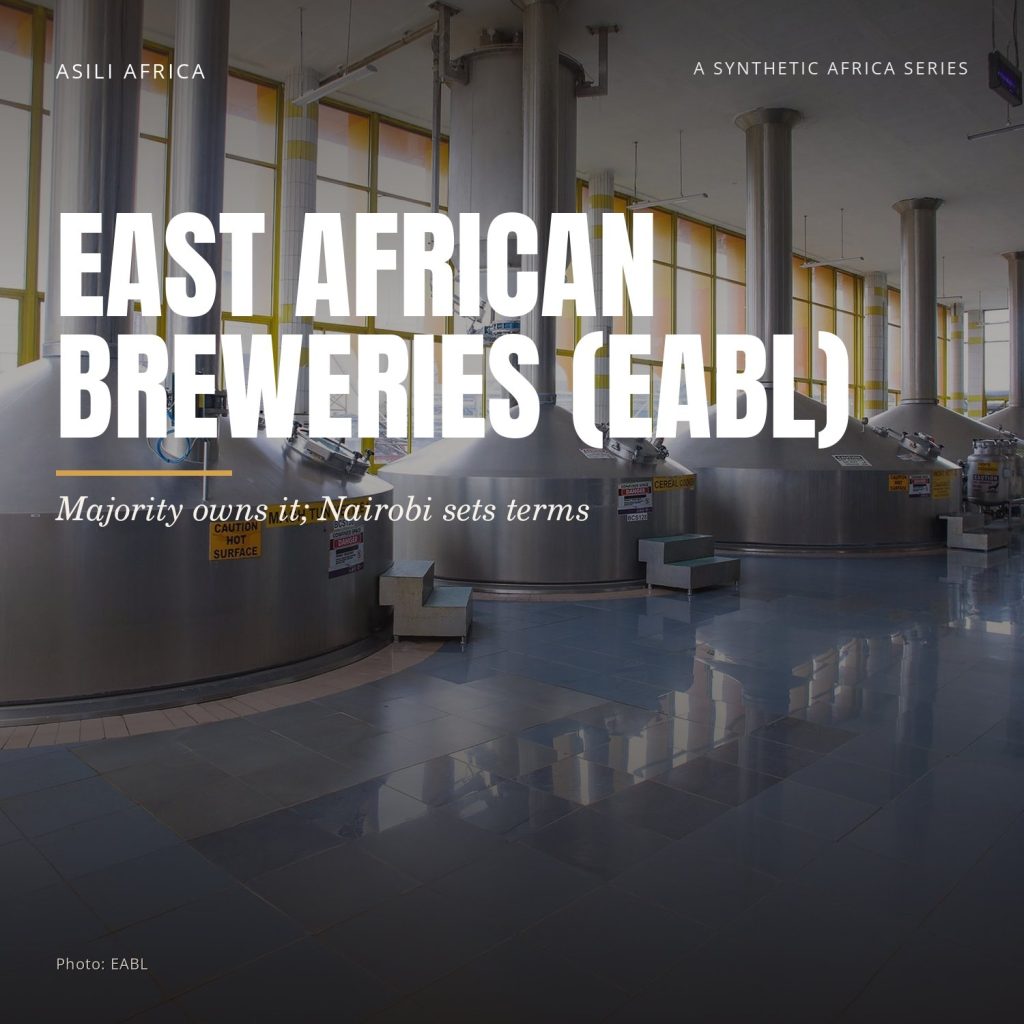
The East African Breweries (EABL) Story: Majority owns it; Nairobi sets terms
In the late nineteen nineties, Kenya had a beer war.
On one side stood the incumbent, a brewer founded on the edge of Nairobi in nineteen twenty two.
By one account, it had held the Kenyan market almost to itself for the best part of eighty years.
On the other side was a newcomer from the south.
A South African brewing group, best known by its later name, SABMiller, brought its Castle Lager into Kenya and set out to take a share of that market.
A fight like that can be fought on price, or on reach, or on who controls the depots and the lorries. In the press accounts of this one, it was fought on something else.
It was fought on belonging. The incumbent answered the newcomer as the Kenyan choice. Castle Lager, in that telling, was the foreign one.
It is a simple frame, and a strong one. A company from here, against a company from somewhere else. Everyone listening knows which side they are meant to be on.
The war ran into the new century. For a few years, two large brewers fought over one country’s formal beer market, and the press covered it as a contest of loyalties.
In the middle of a fight, nobody stops to ask what makes a company Kenyan.
Where it was founded? Where it brews? Who works on its floor? Or who owns it?
RUARAKA
On the eighth of November, nineteen twenty two, near Ruaraka, on the outskirts of Nairobi, a brewing company was founded.
Ruaraka lies inside Nairobi today. In nineteen twenty two it was the edge of things, open ground beyond the town.
Its founders were two Welsh brothers, George Hurst and Charles Hurst. By some accounts a friend of theirs, a man named H. A. Dowding, was involved in the arrangement for the land.
They called it Kenya Breweries. Kenya was a British colony, and Nairobi was a young town, barely a generation old, under a colonial administration.
The town had grown up around the railway, a stopping point on the line from the coast, and in nineteen twenty two it was still finding its shape.
What the record says about the brothers themselves is thin. They were Welsh. They were settlers in a colony. They founded a brewery.
Beyond that, the sources this episode draws on say almost nothing about who they were before Ruaraka.
A brewery was built on that ground, and by the fourteenth of December, nineteen twenty two, by most accounts, it had produced its first brew.
Somebody built it. Somebody laid its walls, and somebody worked inside them afterwards.
Under colonial administration, that work would have been done largely by African workers.
Every account of this founding that this episode draws on tells the story of the settlers. The company’s own heritage pages do. The centenary retrospectives do. The business press does.
None of them names the people who built the brewery, or the people who worked in it. Not one name. Not one account of what the work was, or what it paid.
We are not going to invent them. We are going to say that they are missing, because a founding story with nobody in it but its founders is not the whole story.
The part of the story that is told is brief. Soon after the brewery was founded, George Hurst was killed in an elephant hunting accident.
That is the whole of what the record holds about his death, and it is enough.
His brother was left with a new company, a new brewery, and a first beer that needed a name.
Charles Hurst named it for his brother. He called the beer Tusker, in George’s memory.
THE SETTLEMENT
In the middle of the nineteen thirties, around nineteen thirty five or thirty six, Kenya Breweries merged with Tanganyika Breweries, from the British territory to Kenya’s south. The combined company took a new name, East African Breweries.
In nineteen fifty four, East African Breweries listed its shares on the Nairobi stock exchange. It was one of the exchange’s earliest listings, and Kenya was still a colony. Independence was nine years away.
From that year on, part of the company belonged to the public. Anyone who bought its shares owned a piece of it, however small, and had a vote in it, however faint.
The listing did not hand the company to its public. It gave the public a part of it, to be bought and sold by anyone, and there has been a public part of it ever since.
In nineteen fifty nine it bought Uganda Breweries. Kenya, Tanganyika, Uganda. The name on the company now described the ground it covered.
Those are dates, and for those years the record we have offers little more than dates. After nineteen fifty nine, it goes quieter still.
The research this episode draws on carries almost nothing about the company itself for the next four decades.
Independence came. Governments changed. The company went on. How it was run through those years, and who decided what, the sources we have do not say.
Who held control of the company through those decades, the sources behind this episode do not establish either. That is not a claim that nothing happened. It is the limit of what we have, and we are not going to fill forty years with guesses.
The story picks up again in nineteen ninety seven, with a different brewery. That year, Tabitha and Joseph Karanja founded Keroche Breweries.
In the Kenyan press, Keroche is described as the first Kenyan owned brewery to break East African Breweries’ monopoly, a monopoly that, by that account, had lasted roughly eighty years.
A company founded by a Kenyan couple, in Kenya, entering a market one brewer had long led. Keroche’s arrival changed who was in the market. It did not change who led it.
The challenge that became a war came from further away. In the late nineteen nineties, SABMiller’s Castle Lager arrived in Kenya, and two large brewers were contesting one market.
This is the war this episode opened on. In the press accounts of the time, East African Breweries fought it as the Kenyan side, and Castle Lager was the outsider.
What the war cost either side is not in the sources we have. How much was spent, how much of the market moved, who was ahead in any given year: none of it is recorded there.
What is recorded is how it ended.
In two thousand and two, the two brewers settled. SABMiller left Kenya. East African Breweries gave up ground in Tanzania.
The war did not end with a winner. It ended with a map. Each brewer stepped back from one country, and the two companies divided the territory between themselves.
At home, East African Breweries no longer faced its largest challenger. Across the border, it had stepped back.
The line between the two markets was drawn by the two brewers themselves. The war had been fought in public, over which side was Kenyan. It ended with two companies agreeing where each would sell.
The war was over. The Kenyan side, as the press had cast it, had kept Kenya.
Two years before that settlement, in two thousand, majority control of East African Breweries had passed to Diageo, in London.
THE REMISSION
Sorghum is a grain that grows well in dry country. Its heads ripen red and brown, and in much of eastern Africa it has been farmed for a very long time.
East African Breweries brews a low cost beer from it, called Senator Keg.
The sorghum comes from outgrower farmers, farmers who grow the crop on contract and sell the harvest to the brewer. By the count in the business press, there were about twenty thousand of them.
They were not employees. They were suppliers, and a contract was what connected each of them to the brewery.
Excise is a tax charged on particular goods, on top of the ordinary taxes, and beer is one of the goods Kenya charges it on.
What lets a beer like that sell at a low price is, in part, a tax decision. For beer made from local sorghum, millet or cassava, the Treasury has granted a remission, a reduction in that duty.
The size of that remission is set in Nairobi, and it can be changed.
In twenty thirteen, it was. An excise duty of fifty per cent was imposed on Senator Keg, a beer whose market was its low price.
Sales fell sharply. East African Breweries suspended its contracts with the sorghum farmers.
Nothing about the crop had changed. Nothing about the farmers had changed. A rate set by the Treasury had changed, and the contracts stopped with it. The farmers did not set that rate, and neither did the brewer.
In the language of a budget, it was a policy decision. For the brewer, it was the difference between a product that sold and one that did not.
In twenty fifteen, the Treasury restored the remission, to ninety per cent. The farmer contracts resumed, and Senator Keg was back in the market.
At ninety per cent, a beer made from local sorghum paid a tenth of the full excise duty.
The remission was later cut, to eighty per cent. It is a large concession either way, and the Treasury gives up revenue by it every year. Why the rate moved, each time, the sources we worked from say less clearly than that it did.
Those rates moved, and the sales moved with them.
On our reading of the figures, a significant share of the low end of this brewer’s volume rests not on demand alone, but on a rate that the Treasury in Nairobi sets, and can change.
That is a different kind of power from ownership. Whoever holds the majority of this company takes the largest share of its dividends.
The Treasury, with one number, can decide whether one of its beers is viable at all. Ownership changes when someone sells. A tax rate changes when the Treasury decides.
About twenty thousand farmers grew the sorghum. Their contracts stopped in twenty thirteen and started again in twenty fifteen, on a tax rate set in Nairobi.
The business press recorded the rates, the dates, and what the remission cost the Treasury. No account in the research behind this episode records what those two years were like for any one of those farmers.
We are not going to fill that silence with a guess.
THE COOLER
In December twenty twenty five, Diageo agreed to sell its sixty five per cent of East African Breweries, together with its holding in U D V Kenya, to Japan’s Asahi Group. The price was about two point three billion dollars.
It was a sale agreed between two companies, one in London and one in Tokyo.
In Kenya, a change of control like that cannot simply close. It needs the approval of the Competition Authority of Kenya, and approval can come with conditions.
By one industry estimate, reported by Business Daily, about sixty per cent of Kenya’s alcohol market by volume in twenty twenty four was illicit, outside the formal trade altogether.
Every competitive fight in the rest of this story is over the smaller part.
The sale drew in complaints that rivals of East African Breweries had been making, in some cases, for years.
Keroche has long alleged that East African Breweries paid bar owners not to stock its rivals’ products. It is an allegation, and no finding confirming it appears in any source we have.
A distributor, Bia Tosha, petitioned in January twenty twenty six to halt the sale, alleging that East African Breweries had taken back distribution territory it had paid for, in a dispute that went back to twenty sixteen. In June, it withdrew its claim of forty five billion shillings.
In March twenty twenty four, a Nairobi startup, African Originals, had accused East African Breweries of copying its products and of backing a campaign on social media against it.
East African Breweries denied it, calling the claims false and defamatory. Nothing has been decided either way.
Then, in April twenty twenty six, Kenya Wine Agencies, a subsidiary of Heineken, filed a complaint alleging that East African Breweries abuses a dominant market position, through exclusive distributor agreements and through pricing.
This time the complainant was not a startup or a distributor. Its parent is one of the world’s large brewers. The complaint was used to argue that, if the sale went ahead, it should go ahead only with conditions.
None of these complaints has been adjudicated. They are claims made by rivals, and they are reported here as claims.
On the tenth of September, twenty twenty six, the Competition Authority of Kenya approved the sale.
It did not block the change of owner. It did not rule on the complaints. It used the moment a sale needs its approval to set terms on the market around the company.
A regulator reviewing a sale does not choose the buyer. It can choose the terms on which it lets the sale go ahead. Once before in this story, a Kenyan authority changed the terms this company trades on without deciding who owns it. That time it was a tax rate.
The first condition was a reserved liability fund, money held back against liabilities.
The second condition was set in the shops themselves.
East African Breweries must give twenty per cent of its retail cooler space to competing brands. In the coolers it controls, one shelf in five, for its competitors.
THE PETITION
In twenty twenty two and twenty twenty three, Diageo raised its stake in East African Breweries. It had held just over half. Through a tender offer, it took its holding to sixty five per cent.
A tender offer is an offer to a company’s shareholders to buy their shares at a set price, for a set time. Those who accepted sold. Those who did not kept what they had.
When it was done, the part of the company in public hands had fallen from just under half to about thirty five per cent.
Christine Irungu, an individual minority shareholder in East African Breweries, petitioned the court. The petition argues that what shareholders were told around that stake increase, the disclosure, was inadequate.
The petition is not about competition. It is not about cooler space, or distributors, or who stocks whose products.
It is about what minority shareholders were told when the majority holder went from half of the company to sixty five per cent of it.
And the stake Diageo agreed to sell to Asahi is that same sixty five per cent.
If the sale closes, the majority holder changes, from a company in London to a company in Tokyo. The petition asks whether shareholders were properly told how that majority was built in the first place.
On the second of September, twenty twenty six, the High Court froze the transfer of those shares, pending a review by the Capital Markets Tribunal.
It was not the first time the sale had been before the High Court. In April, the court had dismissed an earlier bid, by Bia Tosha, to block it. This time, one shareholder’s petition was enough to stop the transfer while the case is heard.
The Capital Markets Tribunal hears disputes arising from Kenya’s capital markets. Until it has dealt with this one, the shares do not move, and there is no confirmed date for the sale to close.
So the sale has been approved by one Kenyan authority, and frozen by another.
They were answering different questions. The Competition Authority asked what the sale would do to a market. The court was asked about what shareholders had been told, years earlier. Neither decision answers the other. One looks at the future of a market. The other looks at the past of a shareholding.
Nor is either of them Kenya taking on the owner. One is a review that a sale of this size requires. The other began with one shareholder and one petition.
Control of this company has changed hands by sale, between holders. The terms it trades on have been set in Nairobi.
In September twenty twenty six, those two met: a sale agreed between London and Tokyo, and two decisions in Nairobi about whether, and on what terms, it may close.
The business itself, meanwhile, had its best year on record.
In the year to the thirtieth of June, twenty twenty six, East African Breweries’ net sales rose thirteen per cent, to about a hundred and forty six billion shillings. For the first time, that was more than a billion dollars.
Profit after tax was eighteen point two billion shillings, up forty nine per cent, from about twelve point two billion the year before. The total dividend paid to shareholders rose fifty nine per cent.
Those dividends go to every shareholder. About thirty five per cent of East African Breweries is held outside Diageo, by the public, and the company has had public shareholders since nineteen fifty four.
They are the minority shareholders. In the coverage of this case, they appear mostly as a category. The petition carries one name.
The reporting this episode draws on quotes no other individual shareholder. No pension fund, no small investor, is recorded saying what they want from this sale, or whether they want it at all.
That silence is worth naming. We are not going to fill it.
The sale is approved. The transfer is frozen. What happens next is for the Capital Markets Tribunal to decide, and nobody can yet say what that will be.
In nineteen fifty four, East African Breweries put its shares on the Nairobi exchange, and part of it passed into public hands.
For seventy two years, part of this company has belonged to people who bought it a share at a time. Most of them have no name in this story.
The turns in this story have come from many hands: two founders, two rival brewers, an owner in London, the Treasury, a regulator, a court. The one it is waiting on now began with a single shareholder.
Now a sale between London and Tokyo is waiting on one of those public owners, and on a tribunal in Nairobi.
As of the twenty eighth of September, twenty twenty six, the sale is approved, and it is frozen, and there is no verdict to report. The next word belongs to the Capital Markets Tribunal. This is Asili Africa. Every empire has an origin. See you on the next one.
Key Takeaways
- RUARAKA. On the eighth of November, nineteen twenty two, near Ruaraka, on the outskirts of Nairobi, a brewing company was founded.
- THE REMISSION. Sorghum is a grain that grows well in dry country.
- THE COOLER. In December twenty twenty five, Diageo agreed to sell its sixty five per cent of East African Breweries, together with its holding in U D V Kenya, to Japan’s Asahi Group.
- THE PETITION. In twenty twenty two and twenty twenty three, Diageo raised its stake in East African Breweries.
Also available on YouTube — search “Asili Africa” or subscribe to our channel.