
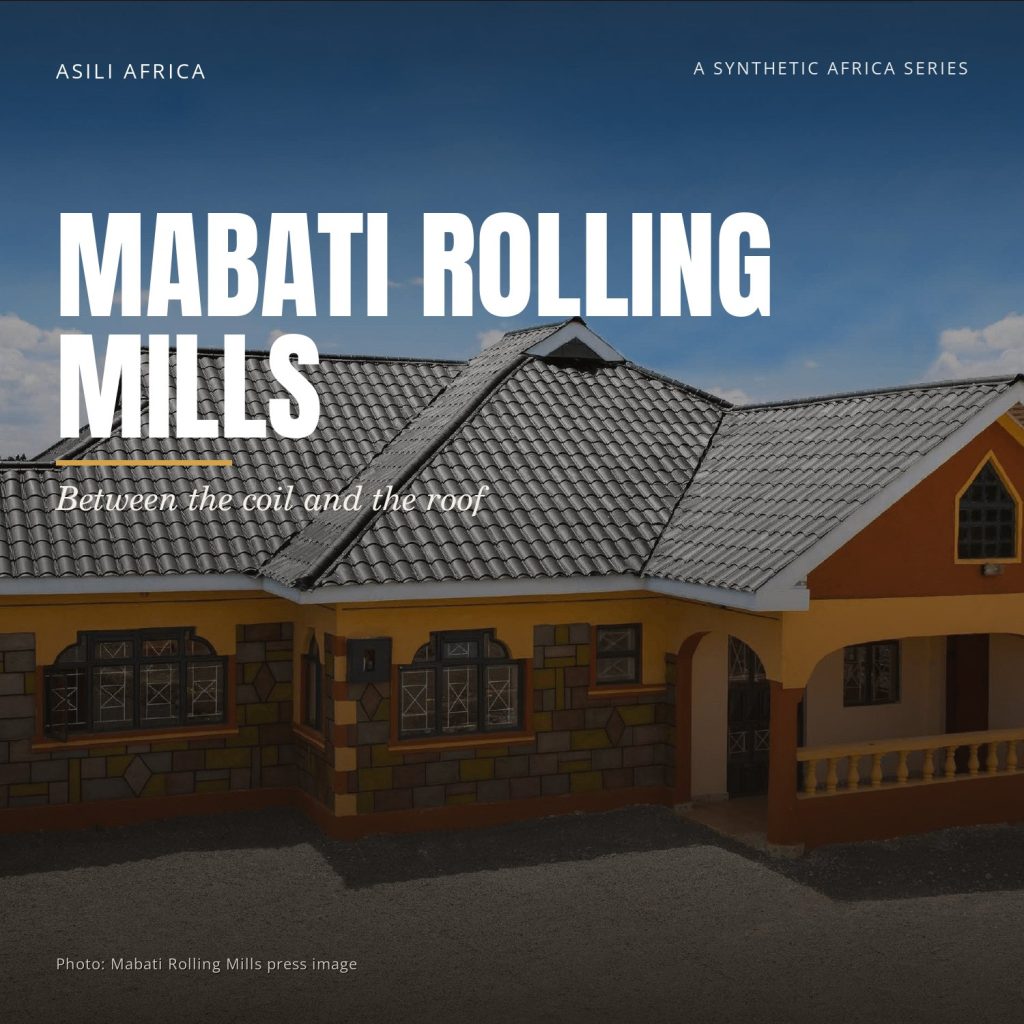
The Mabati Rolling Mills Story: Between the coil and the roof
Rain on a roof.
Most Kenyan roofs are made of the same thing: coated steel sheet, pressed into ridges.
It is light, quick to fix in place, and it sheds heavy rain.
In Swahili, those sheets have a name. They are mabati: iron sheets.
It is an ordinary word for an ordinary thing, and nobody owns it.
One company has that word as its name. It is the best-known name in Kenyan roofing steel.
It does not make steel.
It does not turn ore into iron, or iron into steel.
Its steel arrives at the port of Mombasa already made, as hot-rolled coil.
Hot-rolled coil is steel that someone else has made, rolled out while hot into a long strip, and wound up like a roll of tape.
A single coil can weigh twenty tonnes or more.
One trade report says most of that coil comes from Nippon Steel, in Japan, on long-term contracts.
From the port, it travels inland to the company’s lines.
Everything this company does happens between that coil and the roof.
For about sixty years, it has been adding steps to that stretch.
Its name is Mabati Rolling Mills.
GALVANISED
Mabati Rolling Mills was founded by Manu Chandaria, an engineer.
The founder was born in Nairobi in nineteen twenty-nine.
The founder studied first in India, at Jamnagar, and then took degrees in engineering at the University of Oklahoma, in the United States, at the start of the nineteen fifties.
The training fits the company’s record. Nearly every milestone it lists is a new line or a new plant.
The family’s history in Kenya is older than the company.
The founder’s father, Premchand Chandaria, came from Jamnagar, in India, around the time of the First World War, and kept shops in Nairobi and Mombasa.
In nineteen twenty-nine, the year the founder was born, the family and partners bought a saucepan maker, Kenya Aluminium.
It became the root of the family’s industrial business, Comcraft.
That is the family’s story, and Comcraft’s. It is not the founding of this company, which came about a generation later.
Today, Mabati Rolling Mills sits inside the Safal Group, the Chandaria family’s group, which calls it its founding operation.
The group’s own website describes more than thirty-six businesses, in somewhere between nine and twelve countries, depending on the page.
Manu Chandaria is known as the founder of the Safal Group.
The founder’s own account of how this company began comes from a single interview, published in twenty fifteen.
In it, the founder describes a visit to Japan, and a study of the plants there.
The decision, in the founder’s words, was to take “a small unit galvanising line”.
The interview does not say when the visit took place.
Galvanising means coating steel with zinc, so that it does not rust.
The line went in at Mariakani, a town about forty kilometres inland from Mombasa.
Mariakani sits on the main road that runs from Mombasa toward Nairobi.
That put the line close to the port where its steel would come ashore. Coil is heavy. A line near the port keeps its journey short.
That was in the early nineteen-sixties. The company says nineteen sixty-two; some accounts say nineteen sixty-one.
Either way, the line began in the last years of colonial Kenya, a year or two before independence.
According to the same interview, the steel came as coil imported from Japan, and the line started out at about twenty thousand tonnes a year, as reported.
Galvanised steel is the bare silver of an unpainted roof.
An engineer. A small line. Zinc on imported steel, near the sea.
That was the first step between the coil and the roof.
Once the manufacturing worked, the founder said in the same interview, it “could be replicated”. The founder names Tanzania, Uganda, Zambia and West Africa.
We found no independent account of any of those operations: how large they were, who worked in them, or how they fared.
In Kenya itself, from the early nineteen-sixties to nineteen eighty-two, almost nothing about Mabati Rolling Mills is on record.
How the first plant was paid for. What it made, and who bought it. How many people worked there. How it fared as Kenya became independent, in December nineteen sixty-three, and through the years after.
None of that is in any source we found. The company’s own history gives a few dates for new equipment, and nothing in between.
Twenty years of the story are close to blank.
ALUMINIUM-ZINC
Nineteen eighty-two. In that year, Mabati Rolling Mills says, it commissioned a cold rolling mill, which it describes as the first in Africa.
Cold rolling means pressing steel thinner and more even, without heating it again.
Thinner, more even steel covers more roof for every tonne.
With a cold mill, the company could take in its steel at an earlier stage, and do more of the work on it itself.
It was a step back along the chain, toward the coil.
Nineteen eighty-nine. The company says it introduced colour coating.
Colour coating means baking paint onto the sheet.
It is how a steel roof leaves the factory red, or blue, or green, instead of bare silver.
A painted roof is chosen for how it looks, as well as for keeping out the rain.
By the end of the nineteen eighties, the company was rolling, coating and colouring steel. It still did not make any.
The dates for all three come from the company, or from its founder. We found no independent record of any of them.
For more than fifteen years, according to a Business Daily profile, the company was led by Kaushik Shah, who was twice named CEO of the Year.
The same profile counted thirty-seven years with the Chandaria group.
The next step was a different coating. Aluminium zinc is a coating of aluminium and zinc, in place of zinc alone.
The International Finance Corporation is the arm of the World Bank Group that lends to private companies.
Each project it backs gets a public record: what the money is for, how much, and when.
In December nineteen ninety-nine, the International Finance Corporation approved eleven and a half million dollars for an aluminium zinc coating line at Mariakani.
The loan was signed in April two thousand.
That step is on the lender’s own record. After almost four decades of dates in the company’s words, this one was written down by someone else.
The record lists the project as completed.
The equipment, and technical support, came from Kawasaki Heavy Industries, a Japanese engineering group.
Japan again. The founder’s first line was chosen there, and the coil came from there too.
The lender’s record put the project at about eighty thousand tonnes a year.
In two thousand and one, the company says, it became the first African producer of this patented coating. It sells the sheet under the name Zincal.
In a twenty fifteen interview, Manu Chandaria said aluminium zinc sheet gives four times the life of an ordinary sheet.
We found no independent test of that claim.
Nothing we found examines what the households and builders who bought the sheet actually got from it: how long it lasted, or how it compared.
In July twenty seventeen, a new colour coating plant opened at Mariakani.
The Standard reported its capacity at more than a hundred thousand tonnes a year, for the colour plant alone.
It was opened under the company’s chief executive at the time, Andrew Heycott.
Galvanising. Cold rolling. Colour. Aluminium zinc. A larger colour plant. Each was something more done to the same imported steel.
Every step in this story so far is a machine, a line, a plant, a tonnage.
For about sixty years, workers have run those lines, at Mariakani and later at Athi River.
Nothing available says who they are, what they are paid, or what the plant has meant to the town around it.
THE NAME ON THE SHEET
Mabati Rolling Mills carries, in its own name, the ordinary word for what it sells.
The word mabati means iron sheets. Every company selling roofing sheet in Kenya is selling mabati.
The full name adds two more words: rolling mills. Neither part, on its own, points to one company.
A buyer who walks into a hardware shop and asks for mabati is asking for a kind of product, not for one maker.
Roofing sheet is not bought often. It goes up once and is expected to stay up for years, and a buyer in the shop has no way to test how long it will last.
On a stack in a yard, one sheet of a given colour and shape can look very like another.
What a buyer can go on is a name. And what a company can own is the name it puts on its own product.
MRM’s sheets and tiles have names of their own. Among them are Versatile, Orientile and Dumuzas.
A trademark is a legal claim to a name or a mark used in trade.
Goods sold under a mark by someone without the right to use it are called infringing, and a court can stop them.
In March twenty eighteen, MRM went to court against Royal Mabati Factory, a different company and another seller of roofing sheet, over the Versatile mark.
The two names sound alike. They belong to two separate businesses.
The case ran for about two years.
In twenty twenty, according to press reports of the ruling, the court found for Mabati Rolling Mills.
Royal Mabati Factory was ordered to stop using the mark, to pay about two million shillings, and to destroy the infringing sheets.
MRM had won.
When the common word for a product is also your own company’s name, that name cannot tell your sheet from anyone else’s. The mark on the sheet has to.
It is the only legal dispute involving the company that we found.
The company says it has twenty-seven showrooms and service centres, in nine Kenyan towns.
The last step between the coil and the buyer is not a machine. It is a name.
THE WHOLE BUILDING
In twenty twenty, at Athi River, Mabati Rolling Mills commissioned a new plant for steel buildings, which it sells as SAFBUILD.
Athi River is an industrial town on the edge of Nairobi, on the road to Mombasa. The company also coats and shapes sheet there.
SAFBUILD makes pre-engineered steel buildings: warehouses, factories and halls.
Pre-engineered means the frame and the cladding are designed and cut in a factory, delivered as a kit, and bolted together on site.
A steel frame can span a wide floor without pillars in the middle, which is what a warehouse needs.
The sheet is still there, on the walls and on the roof. Now the company makes the frame it is fixed to as well.
For almost sixty years, the company’s steps had run from the coil to the roof. This one runs past the roof, into the building underneath it.
A whole building, from the same imported steel.
A building like that can be steel almost all the way through: the frame, the walls and the roof.
The plant was opened under the same chief executive who had opened the colour plant at Mariakani in twenty seventeen.
The company also makes steel homes, sold as SAFHOME, and steel roof trusses: the frames that hold a roof up.
In much of Kenya, roof frames have long been made of timber. A steel truss does the same job in a different material.
The company positions this work alongside Kenya’s affordable housing agenda. That framing comes from a newspaper feature the company sponsored.
We found no figures for how many buildings it has sold, or how many homes it has delivered.
By July twenty twenty-five, the chief executive of Mabati Rolling Mills was Albert Sigei.
According to reports, Albert Sigei had earlier worked at Pretoria Portland Cement and at PPC Zimbabwe, and had been chief executive of the Safal Group.
On a building site, cement and steel sit side by side.
We did not find the date of the appointment.
In September twenty twenty-five, the company was reported to have partnered with Orb Energy on solar.
A steel roof is also a place to mount a solar panel.
Buildings, homes, trusses. Every new step still starts from the same place: a coil of steel, made somewhere else, coming in by sea.
THE COIL
February twenty twenty. On the tenth of that month, The Standard, a Kenyan newspaper, published a correction about Mabati Rolling Mills.
An earlier piece had listed Mabati Rolling Mills among Devki’s companies. It is not one of them.
It was a small notice. It shows how easily the names in this business run together, even in print.
Devki is another Kenyan industrial group, and a direct competitor in steel.
Devki says it holds over fifty per cent of Kenya’s multi-product steel market. A trade publication calls it Kenya’s largest steelmaker.
Mabati Rolling Mills, for its part, has a reputation as the largest.
Neither figure has been independently measured, and neither has MRM’s reputation as the largest.
We found no independent count of who sells the most steel in Kenya, by tonnes or by money.
Both could be true at once, if they are counting different things.
Market share can be counted in tonnes or in money. It can cover all steel, or one kind of product.
A company that makes steel, and a company that turns imported coil into roofing, could each come top of a different list.
What Devki’s figure counts, and how it produces what it sells, is not in anything we found. We are not going to pick a winner.
The market is not only those two. In April twenty twenty-two, Business Daily reported increased competition from new entrants.
Roofing sheet also comes in from outside Kenya. Tariff listings put the duty on imported finished steel products at up to twenty-five per cent, a figure we have not checked against the official schedule.
Mombasa is the main port for much of East Africa’s interior. Goods for Uganda, Rwanda and beyond move inland from it.
The trade report that named the Japanese supplier says about a fifth of the company’s finished output goes on to neighbouring countries with no coast of their own.
And the coil still arrives by sea, at Mombasa.
That report says the supply runs on long-term contracts. Nothing we found says what Mabati Rolling Mills pays for its coil, how long the contracts run, or what happens to the company when the price of coil moves.
Nothing we found says that importing coil has hurt the company either. Converting imported steel is how it has worked since its first line.
Mabati Rolling Mills publishes no accounts. It appears to be privately held, and we could not find its accounts anywhere public.
The estimates online disagree with each other by more than double, and one puts the whole group below the company inside it. That is why this episode carries no revenue figure.
Even its capacity is uncertain. Published figures for how much it can coat disagree with one another, and cannot all describe the same plant at the same date.
We found no news this year of a change of ownership, a listing, or any other major financial event.
Sixty years of steps, every one of them after the coil. The first step, making the steel, is the one it has never taken, on the record.
And how large the company is, nobody outside it can say.
A roof in the rain.
A name on the sheet, defended in court.
Colour, baked on.
A coating of aluminium and zinc, and a loan on someone else’s record.
A cold mill, in nineteen eighty-two.
A small galvanising line at Mariakani, in the early nineteen-sixties.
And at the far end, a coil of steel, made somewhere else, coming ashore at Mombasa.
Who in Kenyan steel is largest, and by what count, is still open. So is what the books would say, if anyone outside could read them.
That is where Mabati Rolling Mills stands, as of the start of October twenty twenty-six.
This is Asili Africa. Every empire has an origin. See you on the next one.
Key Takeaways
- GALVANISED. Mabati Rolling Mills was founded by Manu Chandaria, an engineer.
- THE NAME ON THE SHEET. Mabati Rolling Mills carries, in its own name, the ordinary word for what it sells.
- THE WHOLE BUILDING. In twenty twenty, at Athi River, Mabati Rolling Mills commissioned a new plant for steel buildings, which it sells as SAFBUILD.
- THE COIL. February twenty twenty.
Also available on YouTube — search “Asili Africa” or subscribe to our channel.