
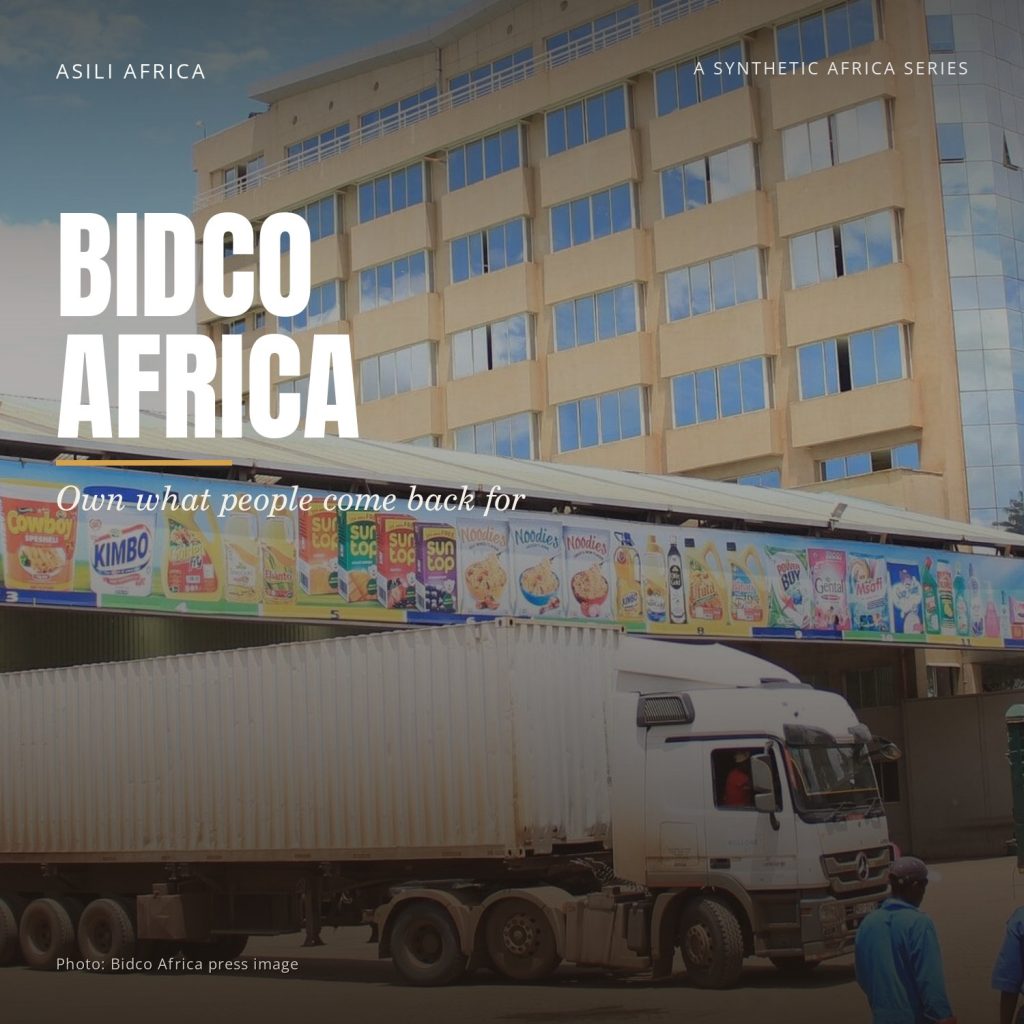
The Bidco Africa Story: Own what people come back for
Kimbo and Cowboy are cooking fats.
Kenyan shops have stocked them for decades: solid white vegetable fat, sold in tins.
For most of that time, they belonged to Unilever, the British and Dutch consumer goods multinational.
In twenty oh two, Unilever sold them.
The buyer was a family firm from Thika, an industrial town north east of Nairobi.
The family had not started out in food. It had started out making garments.
By Vimal Shah’s account, his family outbid the others who wanted those brands.
The firm was called Bidco.
Twenty two years later, in twenty twenty four, it happened again.
Another multinational. Another Kenyan business, this time in drinks.
The same buyer.
THE SHIRT
“You don’t buy a shirt every day. But you buy food every day.”
That is Vimal Shah, explaining why his family stopped making clothes.
As Vimal Shah tells it, nearly everything the family did afterwards follows from those two sentences.
The business he joined was his parents’ business. He came into it at twenty two, straight from university.
The founder was his father, Bhimji Depar Shah.
The family worked in cotton. It imported cotton and turned it into garments.
Many of those garments went abroad, to Europe, sold there as African prints.
For a while, that was the business: cloth in, garments out, and buyers on the other side of the sea.
Then polyester arrived.
Cheap synthetic cloth from Asia, sold as wash and wear. It did not need ironing, and it cost less than cotton.
At home in Kenya, buyers moved to it.
A business built on cotton was now competing with cloth that was cheaper to buy and easier to keep.
The family’s cotton garments did not sell. Dead stock piled up in the storerooms.
It had to go out at steep discounts, just to move it.
And the shops that did take the family’s garments were slow to pay. Retailers paid with promissory notes: written promises to pay on a date some months away.
A note is a promise, not money. The shop takes the garments now, and the family holds a piece of paper.
Vimal Shah remembers what happened when that date came.
“After a hundred and twenty days, when they were supposed to pay, they would instead ask for an extension.”
Four months of waiting, and then more waiting.
The family was still a garment maker. In practice, it had become a lender to its own customers, carrying the shops that owed it money.
A garment maker that is paid in four months still has to buy cotton now, and pay the people who cut and sew it now.
The gap between the two had to be carried by someone. Here, it was carried by the family.
And a shirt is something a customer may not buy again for a year.
Food is different, and so is soap. Oil runs out. Soap wears away. Whoever buys them this week is back for more soon after.
So the family studied its own supply chain, back toward the field.
Cotton is grown for its fibre. But every boll also holds seed.
Cottonseed can be pressed for oil. And the oil, and what is left after refining it, is the stock that soap is made from.
The same plant that made a shirt could also make things that people use up, and buy again within days.
That is the one pivot in this story. Everything after it keeps the same direction, and only changes the method.
In nineteen eighty five, the family opened a small soap factory in Thika.
Thika was already a town of factories, and the family’s soap works became one more.
A family garment business became Bidco in nineteen eighty five.
That story reaches us in one voice, the son’s. No source we read gives the founder’s own account: why Bhimji Depar Shah went into garments, or how he saw the move out of them.
The sources do not even agree on the year the company began. We have not filled that gap with a guess.
In nineteen ninety one, Bidco opened an edible oil refinery in Thika.
By the company’s account, it was the first in East Africa to refine and fractionate edible oil locally.
Fractionating means separating an oil into its liquid and its solid parts: oil for frying on one side, harder fats for the pan on the other.
Crude oil went in. Cooking oil and cooking fat came out.
Soap had come first. Now the company made food itself, the thing the founding sentence was about.
From the shirt, to soap, to food. In six years, the family had gone from a thing people buy rarely to the things they buy every day.
THE BRANDS
In nineteen ninety eight, Bidco bought another company’s business for the first time.
It was Elianto, an edible oil business, bought from Unga Group, one of Kenya’s oldest flour millers.
Until then, Bidco had sold what it made. Now it owned a name that shoppers were already reaching for.
That is the founding logic, bought ready made. A brand people already buy every day is a habit someone else has spent years building.
Building a brand from nothing takes years of shelf space and advertising before a shopper reaches for it without thinking. Buying one skips those years.
In twenty oh one, the company set up in Tanzania, at Dar es Salaam.
Kimbo and Cowboy were Unilever’s Kenyan cooking fats.
They were not new brands. Kenyan shops had been stocking them long before Bidco owned them.
They were sold with others of Unilever’s edible oil and soap brands in Kenya.
The usual story in African business runs the other way. A multinational arrives, and buys the local company that has grown big enough to notice.
With these two brands, it ran the other way round.
Why Unilever chose to sell them has never been made public.
Nor has the price, or the names of the others who bid. We looked, and found nothing on any of the three. We are not going to fill that with a guess.
In twenty oh two, Bidco bought them. By Vimal Shah’s account, it outbid the others.
A family that had once waited months to be paid for its shirts now owned two of a multinational’s cooking fats.
Bidco had not invented them. It bought them, as it had bought Elianto, because they were things people already bought every day.
It was still building as well as buying. In twenty oh five, Bidco opened a factory complex at Jinja in Uganda, close to where the Nile leaves Lake Victoria.
Jinja gave the company factories in a second country, across the border in Uganda. The plants at Thika and Jinja are real, and Bidco built them.
But much of what shoppers came to know as Bidco arrived on the shelf already known, under names other companies had made.
From there, the basket widened. In twenty eleven, Bidco launched into personal care, under a brand of its own.
In twenty thirteen, detergents.
In twenty fourteen, animal feed, with a production line that cost five hundred million shillings.
And in twenty sixteen, a joint venture in animal feed with Land O’Lakes, an American farmers’ cooperative, owned half each.
Feed is a farmer’s purchase rather than a household’s, but it runs out just the same, and it is bought again.
It was the same move each time: more of the things people use up and buy again, on the shelves beside the oil.
Soap and oil had come from the cottonseed. Detergent, lotion and feed came from the same idea.
By its own count, Bidco now has more than sixty brands, sold in about eighteen countries.
Some of those it built. Some of the best known it bought. The founding argument holds for both: own what people come back for.
THE SOURCE
In twenty oh two, the same year it bought the cooking fats, a Bidco subsidiary called Oil Palm Uganda signed on to a palm oil project backed by the Ugandan government.
The project was on Bugala Island, in Kalangala, out in Lake Victoria. Bugala is the largest of the Ssese Islands, off Uganda’s shore.
It was financed in part by the World Bank, and by the International Fund for Agricultural Development, a United Nations agency.
Palms went into the ground in long straight rows across the island.
The record we read does not say why Bidco wanted palm grown in Uganda.
Farmers and environmental groups said smallholders had lost their land to the project, and had not been properly compensated. Those are their claims.
Bidco’s position was that the land had been acquired by the Ugandan government, and that the government was responsible for it.
In twenty sixteen, a Ugandan court cleared Bidco Uganda of the claims against it.
A later mediation compensated some of the farmers anyway.
Cleared in court, and some farmers compensated through mediation all the same. The record holds both, side by side.
What happened to the individual farmers, and to the island over the long run, the record does not follow.
We have the courts, the campaigners and the company. We do not have the farmers’ own account.
The oil in Bidco’s refineries also comes by sea.
In twenty oh eight, Bidco imported crude palm oil, soya bean oil and palm kernel oil, shipped from Singapore and Indonesia.
For a refiner, that crude oil is the raw material. Almost everything else in the business is done to it after it lands.
And import duty is charged on what the cargo is worth at the port.
So the value written down when the ship comes in sets the cost of the oil before a single litre has been refined. That is where a refiner’s costs are set.
The Kenya Revenue Authority said the cargoes Bidco imported in twenty oh eight had been undervalued.
Its demand started at seven hundred and two million shillings. After a review, it was seven hundred and eighty million.
With interest and penalties, it reached one point three billion shillings. Interest kept running while the case did.
The argument was over a number: what those cargoes had been worth when they arrived. It was a question about what duty should be charged on.
A cargo that crosses an ocean carries more than one number. There is what the buyer paid for it. And there is the sum it is insured for on the voyage.
For a refiner whose raw material arrives by ship, that question does not belong to one cargo. It sits under every one.
In twenty twelve, Bidco went to court.
In twenty thirteen, the High Court dismissed its petition, and the matter went to the Tax Appeals Tribunal.
That tribunal is where a Kenyan taxpayer takes a dispute with the revenue authority over what it has been assessed to pay.
The case ran for years.
Through all of it, the oil kept coming in by ship, and the question stayed the same: what is a cargo worth at the border?
In December twenty twenty, after twelve years, the three member Tax Appeals Tribunal quashed the whole demand.
Customs value, it ruled, is the price actually paid.
Not the sum the cargo was insured for, which by industry practice ran ten per cent higher.
TWENTY SEVENTEEN
In twenty eleven, about three thousand workers at Bidco’s works in Thika went on strike. That is a count of strikers, not of everyone employed.
In twenty twelve, the company signed a union recognition agreement, which the courts later upheld.
A recognition agreement is what allows a union to bargain on behalf of the workers it represents at a company.
In twenty fifteen, about four hundred struck again.
And in June twenty seventeen, a new pay deal with the Kenya Chemical Workers Union gave a rise of nineteen and a half per cent.
Earlier that year, in April twenty seventeen, Vimal Shah stepped up from chief executive to chairman.
The new chief executive was Thiagarajan Ramamurthy, formerly of the retailer Nakumatt, at the time one of Kenya’s largest supermarket chains.
He was the first non-family chief executive in the company’s history. Until then, a Shah had always run Bidco.
In May twenty seventeen, the company set out a plan: two hundred million dollars over five years, and ten factories in an industrial park at Ruiru, a town on the road between Nairobi and Thika.
The money was to come in two phases: fifty million dollars first, then a hundred and fifty million.
The target was a billion dollars in turnover by twenty twenty one.
Turnover then was reported at about four hundred million dollars.
Two and a half times the business, in four years, with the first chief executive from outside the family to run it. It was the largest plan the company had set out.
In the same month, May twenty seventeen, former Bidco workers, representing more than four hundred and eighty colleagues, made a complaint.
This complaint was addressed not to the company, but to the company’s lender.
The International Finance Corporation, the World Bank’s private sector lender, had lent Bidco thirty six and a half million dollars.
Twenty three million of it came from the corporation directly, and up to thirteen and a half million from other lenders it brought in, toward a forty six million dollar expansion.
The corporation sets its own standards for how the companies it lends to treat their workers.
It also has its own ombudsman, the Compliance Advisor Ombudsman, which hears complaints from people affected by the projects it pays for.
The ombudsman cannot order a borrower to pay anyone. What it examines is whether the lender applied its own standards.
The complaint was about casual workers: people hired by the day, or for short spells, without permanent contracts. It concerned how they had been let go, and how they had been paid off.
In October twenty eighteen, the ombudsman reported. Its findings were about the International Finance Corporation’s oversight.
The lender, it found, had not done enough to check that casual workers’ termination pay met Kenyan law.
It lacked assurance that health and safety met international standards.
And there were shortcomings in protections against discrimination and retaliation, and in how grievances were heard.
On union recognition, it found no compliance issue. The agreement of twenty twelve had been upheld by the courts.
Those are findings about the lender. The ombudsman judges whether the International Finance Corporation did its own job. It did not rule that Bidco broke the law, and it did not clear Bidco either.
Bidco repaid the loan early, in October twenty twenty three.
After the findings, the International Finance Corporation had committed to audits, to regular reporting, and to changes in how it checks the companies it lends to.
In April twenty twenty six, the ombudsman’s monitoring of those commitments was still open.
The ombudsman’s file tells us what the lender should have checked.
It does not tell us what happened to the four hundred and eighty. Whether they were paid what the law required. What work they found. Whether any of them came back.
Their own account reaches the record only secondhand.
The people who made the soap and the oil are, in the record, mostly a number.
THE FAMILY
In July twenty nineteen, Thiagarajan Ramamurthy retired, at seventy, after about two years as chief executive.
He had served the first two years of the five year plan.
Vimal Shah became executive chairman. Executive means the chairman runs the business, as well as chairing its board.
In twenty seventeen, the family had handed the chief executive’s job to someone from outside for the first time. Two years later, the founder’s son was back at the top, with executive in his title.
Bidco is owned through a holding company, Hemby Holdings, in equal thirds, by three men: Bhimji Depar Shah, Vimal Shah and Tarun Shah.
Tarun Shah is described in one source as Vimal’s brother. By the company’s account, he leads its finance and operations.
The founder, and two of the family, own all of it between them.
In twenty twenty four, Bidcoro, a joint venture of Bidco and the Danish company Co-Ro, a maker of drink concentrates, bought Suntory’s business in Kenya. This time the buyer was not Bidco alone, but Bidco with a partner.
Suntory is a Japanese drinks group. Its Kenyan business made Ribena, a blackcurrant drink, and Lucozade, an energy drink.
The Competition Authority of Kenya approved the deal without conditions. The price was not disclosed.
In March twenty twenty five, Bidco bought the brands and assets of Groupaco, a Kenyan maker of breakfast cereals and snacks. That price was not disclosed either.
It took the company into breakfast cereals for the first time. Vimal Shah has described the aim as high quality, locally produced food products.
A bottle of cordial runs out. So does a box of cereal. The argument from nineteen eighty five had reached the breakfast table.
Twenty oh two, again. A multinational’s brands, bought by the family from Thika.
Ribena and Lucozade were built by others. Bidco bought them for the same reason it bought Kimbo and Cowboy: people buy them every day.
In twenty oh two, the seller was a British and Dutch multinational. In twenty twenty four, it was a Japanese one. The buyer, both times, was the family from Thika.
Who runs the group day to day is not on the record. The company’s own leadership page names no chief executive. Vimal Shah was still described as executive chairman in twenty twenty five.
Whether the ten factories at Ruiru were built, no source we found says. The plan was reported in detail when it was set out. We found no report of what became of it.
Nor does the record show a plan for who comes after the founders.
Whether turnover reached a billion dollars by twenty twenty one, no source reports. Bidco is privately held and publishes no audited accounts, so there is no public figure to measure it against.
The family is back at the top, and the company is buying again. The rest is not in the record.
A family that could not get paid for its shirts left them for the thing people buy every day.
First it made that thing: soap, then oil, then fat for the pan. Then it bought the brands people were already buying, twice from a multinational.
The people who do that buying, every day, what they paid and how it changed for them, are in the record mostly a market. We found them as totals, and almost never in their own words.
That is the record as of September twenty twenty six.
This is Asili Africa. Every empire has an origin. See you on the next one.
Key Takeaways
- THE SHIRT. “You don’t buy a shirt every day.
- THE SOURCE. In twenty oh two, the same year it bought the cooking fats, a Bidco subsidiary called Oil Palm Uganda signed on to a palm oil project backed by the Ugandan government.
- TWENTY SEVENTEEN. In twenty eleven, about three thousand workers at Bidco’s works in Thika went on strike.
- THE FAMILY. In July twenty nineteen, Thiagarajan Ramamurthy retired, at seventy, after about two years as chief executive.
Also available on YouTube — search “Asili Africa” or subscribe to our channel.