
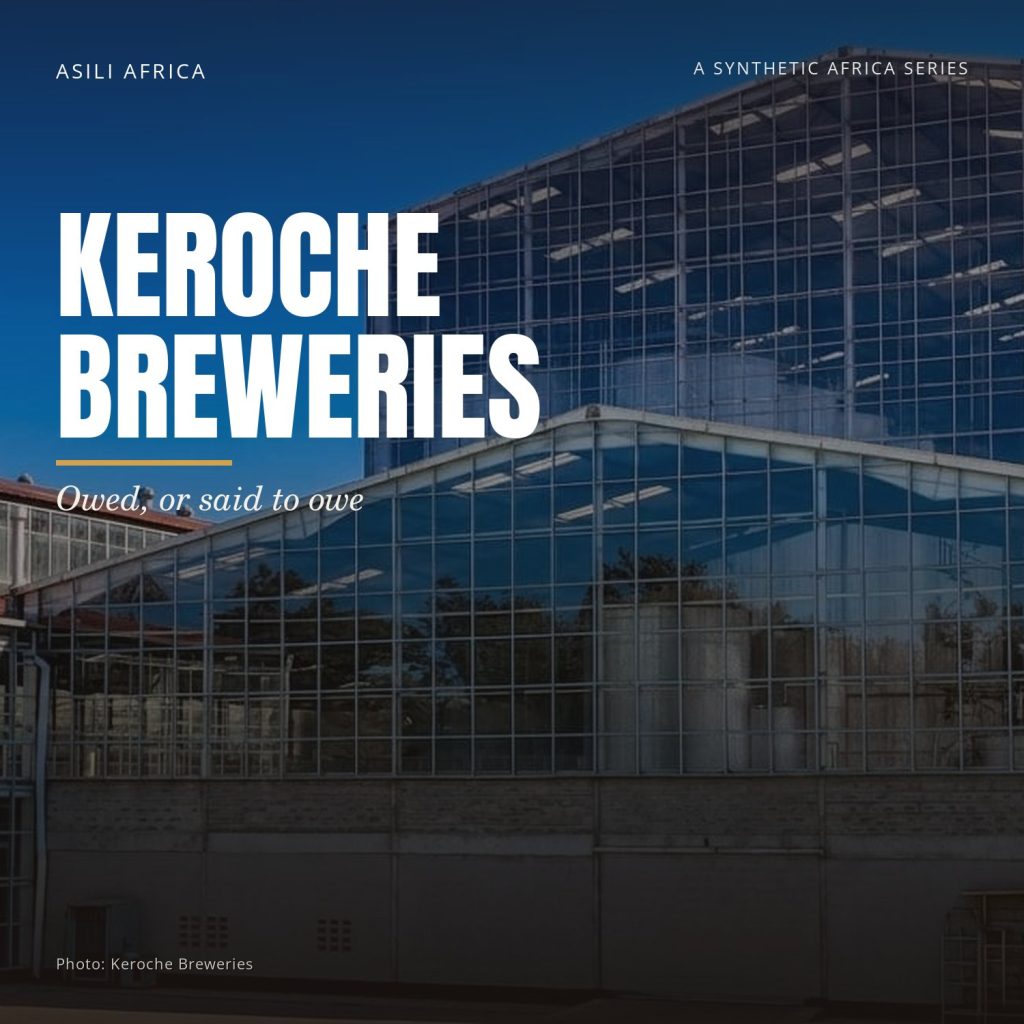
The Keroche Breweries Story: Owed, or said to owe
In two thousand and seven, at Naivasha, on the highway between Nairobi and Nakuru, a Kenyan company was making fortified wine for low income buyers.
It was ten years old. It had begun with a handful of employees and a small stake, and one product had carried it. By press accounts, fortified wine brought in about four fifths of its revenue.
Then the excise on that wine went up. Excise is a tax charged on particular goods, on top of the ordinary taxes, and in Kenya alcohol is one of those goods.
The duty rose, the price rose with it, and the product this company rested on became one its customers could no longer afford.
For a buyer on a low income, a price rise is not a detail. It is the end of the sale.
A company in that position has three choices. It can shrink. It can close. Or it can learn to make something else.
This one chose the third. In two thousand and seven it moved into spirits.
And in two thousand and eight, it brewed its first lager.
It brewed it into a market one brewer had dominated since colonial times, a far larger brewer, majority owned from abroad.
That became the thing this company is known for: the local challenger, the Kenyan brewer that took on the giant.
But it did not set out to take on anyone. The thing it would be known for, it did because of a tax.
THE HARDWARE SHOP
Tabitha Karanja was born in Kijabe, one of ten children.
Before she went into business, she worked as an accounting clerk at Kenya’s Ministry of Tourism, keeping the figures for other people’s decisions.
She and her husband, Joseph Karanja, owned a hardware shop. It sold the things people build with, and it made enough to save from.
Joseph Karanja would go on to be the company’s chairman. In nineteen ninety seven, what the couple had was the shop.
That year, they took about five hundred thousand shillings out of it. It was worth roughly five thousand dollars.
To the money they added family farmland at Naivasha, beside the highway between Nairobi and Nakuru.
And they hired five employees. That was the whole of the start: a shop’s savings, a piece of family land, and five people on the payroll.
Tabitha Karanja was thirty two. She had been a clerk. Now she was running a manufacturer.
Five hundred thousand shillings does not build a brewery. It built a small wine maker, and that is what they started.
They called the company Keroche Industries. The name it is known by now, Keroche Breweries, came later.
What it made was fortified wine, priced for buyers on low incomes.
At that end of the market, a small change in price can decide whether a product sells at all.
The company’s own stated reason was to give those buyers a legal alternative to illicit brews. That is how it has described its purpose, in its own account of itself.
Money to grow was harder to find. In the profiles Tabitha Karanja has given over the years, the banks refused her startup capital.
That is her account. We have nothing from the banks’ side of it, so we give it as hers and leave it there.
Of the company’s first six years, the record behind this episode holds very little. It picks up again in two thousand and three, with the standards body.
That year, the Kenya Bureau of Standards refused to certify Keroche’s products. It called them substandard.
For a company six years old, making one kind of product, it was a refusal that reached the whole business.
Keroche contested it, and the dispute was resolved in the company’s favour.
The first official obstacle in this company’s life was not a tax. It was a standards certificate, and the company won.
Six years after a hardware shop paid for it, Keroche Industries was still standing, and still making the one product it had started with.
THE EXCISE
In two thousand and six, the Kenya Revenue Authority changed how it classified Keroche’s fortified wine for tax, and applied the new classification backwards, to years already past.
A backdated assessment asks for tax on sales already made, at prices already charged, on a basis that did not apply when they were made.
On that basis, it assessed the company for one point one billion shillings. Nine years earlier, the whole business had been started on five hundred thousand.
Keroche went to court. In July two thousand and seven, the High Court quashed the assessment. But the fight over that one point one billion did not end there.
In the same years came the excise. The duty on fortified wine went up, on a product that, by press accounts, made up about eighty per cent of Keroche’s revenue.
The excise was not written for Keroche. It fell on a kind of product, and Keroche was made almost entirely of that product. At the new price, its buyers could not follow.
So it made something else. In two thousand and seven, it moved into spirits.
In two thousand and eight, it brewed a lager, Summit Lager, and took it into the Kenyan beer market.
That market belonged, in practice, to East African Breweries, which had held a near monopoly on Kenyan beer since the colonial era.
East African Breweries was majority owned by Diageo, the British drinks group. A company begun from a hardware shop was now brewing against a subsidiary of a multinational.
This is where the reputation comes from. In the business press, Keroche came to be described as Kenya’s most significant locally owned challenger to East African Breweries.
But the challenger did not choose the fight. It went into beer because a tax had priced out its main product, not as a plan to take on the market leader.
There is a gap in how that rivalry is known. Every account of it in the record behind this episode comes from Keroche, or from the tax authority.
East African Breweries’ own view of its local challenger, then or since, does not appear in any source we have. We cannot tell its side, and we will not invent it.
Seven years after that first lager, in twenty fifteen, Keroche borrowed to grow. Barclays, the bank now called Absa, lent it a reported fifty million dollars.
The loan was to expand the brewery’s capacity from ten million litres a year to a hundred and ten million litres.
Eleven times what it could make before. That is the scale the plant at Naivasha was built for.
How much of the market Keroche held is harder to say. Estimates run from about a tenth to about a fifth, depending on the source and the year.
We found no audited accounts for any year. Every figure in circulation comes from the company, from profiles of it, or from its opponents in court. So we give the spread, and no single number.
In the same year as the loan, the Kenya Revenue Authority raised a backdated duty claim of one billion shillings over a spirit drink called Viena Ice, and shut the plant for two weeks.
A plant being built out to a hundred and ten million litres a year stood still for a fortnight, over a claim about one product.
Then the gates opened again, and the work went on.
In twenty sixteen, the standards body moved against the company’s certification again. Again, Keroche won in court.
Through all of it, the older fight went on, over the one point one billion shilling assessment first quashed in two thousand and seven.
In twenty seventeen, that fight came to an end.
It had run for about a decade. Keroche won it.
THE ASSESSMENT
In August twenty nineteen, Tabitha Karanja and Joseph Karanja were arrested, and charged with tax evasion of fourteen billion shillings.
The charges concerned how excise duty and value added tax on Viena Ice had been declared, between twenty fifteen and twenty nineteen.
Both founders denied the charges. A criminal charge is an accusation made by the state, and it is for a court to test it.
The charges put the founders themselves in the dock, not only their company.
The tax itself was a separate question, for a separate body. In March twenty twenty, the Tax Appeals Tribunal ruled on how Viena Ice, and a pineapple wine the company made, should be taxed.
It ruled largely against Keroche. Interest and penalties were excluded, and appeals continued. But on how those products should be classified for tax, the tribunal mostly took the authority’s side.
It did not decide the criminal charges. It decided a tax question about the same product, and it did not decide it in Keroche’s favour.
So there are two readings of this dispute, and the record gives weight to both.
One is the tribunal’s. On the question it was asked, the company was largely wrong.
The other comes from the press, and from the company’s own history. One newspaper’s investigation reported errors and backdating by the tax authority, in at least one phase of the dispute.
And the first assessment, the one point one billion, the authority had fought for a decade and lost.
What does not exist is an independent account of who was right. No one outside the two sides has published one that we found.
And no source we found records the criminal charges being tried. We will not treat an accusation as a verdict. Nor is the dispute proof that the authority acted in bad faith.
In twenty twenty one, Keroche and the authority signed two settlement agreements, one in July and one in December, setting out how the arrears would be paid.
The authority later said Keroche defaulted, after paying ten million shillings of what had been agreed. Keroche’s side of that default is not in the sources we have.
In January twenty twenty two, the Kenya Revenue Authority shut the Naivasha plant again, over three hundred and fifty one million shillings in current tax arrears.
It put the total it claimed, across all the disputes, at twenty two point seven nine billion shillings. That is the authority’s own figure.
Two numbers now hung over the company. Fourteen billion shillings was the sum in the criminal charges. Twenty two point seven nine billion was the authority’s claim for tax, across every dispute. No court has confirmed either total, in any source we found.
On the twenty ninth of July, twenty twenty two, after further negotiation, the plant reopened.
The following month, Tabitha Karanja was elected Senator for Nakuru County.
In April twenty twenty three, she was charged afresh in the tax case. Joseph Karanja was left out of the new charges, because of his health.
In June twenty twenty three, after twenty five years at the head of the company, Tabitha Karanja stepped down as chief executive.
She had led it from a hardware shop’s savings to a plant built for a hundred and ten million litres, and through every one of these disputes.
She handed the company to its finance director, Potas Anaya.
THE SUCCESSION
In twenty twenty four, by Tabitha Karanja’s own account, the company was down to about thirty staff.
Nine years earlier, it had borrowed to build capacity for a hundred and ten million litres a year. About thirty people, by her account, were now inside a plant built for that.
The tanks were still standing. Most of the people were gone.
How it got there, we cannot chart. There are earlier staff counts, from different years and different sources, and nothing that tracks the line between them.
Around August twenty twenty four, by the family’s account, there was a choice to make.
Anerlisa Muigai, one of the founders’ daughters, described it in public in March twenty twenty five. The family could sell Keroche to a multinational, or try to revive it themselves.
Selling would have ended the family’s ownership, twenty seven years after the hardware shop. Keeping it meant keeping a company with its tax dispute still open and its plant nearly empty.
They chose to keep it.
That account comes from the family alone, given seven months afterwards, as the company was being relaunched. It names no buyer. We do not know whether a firm offer was ever made.
So we report the choice as they describe it, and no further. It is their account of their own decision, and it is the only one there is.
Late in twenty twenty four, Keroche reached an out of court settlement with the Kenya Revenue Authority, and the plant reopened.
The settlement ended the tax dispute without deciding it. We found no account of its terms, and no finding on who had been right.
And no source we found records the criminal case against Tabitha Karanja as concluded. The company’s tax dispute was settled. On her own case, the record we have goes quiet.
The settlement came first. Then, in January twenty twenty five, the founders’ son, Edward Muigai, became Group Chief Executive.
Reporting on his appointment described a closed family business that he had come to revive.
His sister, Anerlisa Muigai, became Marketing Director. Potas Anaya had held the chief executive’s chair in between.
The founders stayed on. Joseph Karanja remained chairman, and Tabitha Karanja a director. But the running of the company had passed to the second generation.
A third child, Tecra Muigai, had been the company’s Strategy and Innovation Director until her death in May twenty twenty.
That January, the new leadership announced a recruitment drive across all forty seven counties in Kenya.
From the thirty or so staff of its founder’s account, Keroche set out to hire up to a thousand people in three months.
THE GATES
On the twenty fourth of June, twenty twenty five, more than five hundred distributors, stockists and farmers came to Naivasha for a relaunch.
It was held under the new leadership, Edward Muigai and Anerlisa Muigai, at the plant their parents had built.
A plant that had been shut, and reopened, and shut again, had called the people it sells through and buys from to its own gate.
In January twenty twenty six, the company completed a new water treatment and recycling facility at the plant.
A brewery runs on water, and this one now treats and recycles its own.
In February, it signed partnership agreements with more than two thousand barley farmers. A brewer that buys from smallholders ties its revival to their harvests, and theirs to its own.
That figure is Keroche’s own. No source we found describes the terms of those agreements, or records what any of those farmers says about them.
The farmers appear again and again in the company’s account of its revival. In anyone else’s account, they have not yet appeared at all.
The relaunch was real. The new facility was real. A company its founder had described as down to about thirty staff was building again, and signing up suppliers.
Sam Shollei had been Keroche’s managing director. He sued the company for wrongful dismissal, in a case begun in twenty nineteen, the year of the arrests.
He won. The Employment and Labour Relations Court awarded him forty five million shillings.
That is the court that hears disputes between employers and the people who work for them.
Keroche did not pay. In October twenty twenty three, the company’s assets were first ordered auctioned to meet the award.
It was the first of several attempts by former workers to collect what courts had awarded them.
In twenty twenty five, he went further. He petitioned for Keroche’s liquidation.
Liquidation is the end of a company as a going concern. A liquidator takes control, sells what the company owns, and pays its creditors from what the sale raises.
For Keroche it was a different kind of threat. The tax disputes had closed its gates for a time. A liquidation would close them for good.
In May, the High Court granted Keroche a temporary stay, and barred Shollei from publicising the petition further. In June, Keroche lost its bid to halt the liquidation proceedings.
That ruling was reported less than three weeks before the relaunch at Naivasha. In the same month, the company was fighting to stay out of liquidation and gathering more than five hundred partners to start again.
In August, the petition was gazetted, published as a formal public notice in the government’s official gazette. It is over what it says is a debt of seventy five million shillings.
A notice like that tells every creditor, supplier and customer that someone has asked a court to wind the company up. That is the publicity Keroche objects to.
In September, Keroche countersued Shollei for ten billion shillings in damages. It says his petition spreads what it calls a false insolvency narrative, harming its reputation and its trade.
The petition asks a court to end the company the family chose to keep. The countersuit says the petition itself, and the publicity around it, is the harm. Neither case has been decided.
These debts are not like the tax bill. Most of that bill was a claim, the authority’s own total, never confirmed by a court in any source we found.
The award to Shollei is a judgment. A court heard his case and found for him. It is a finding, not an assertion, and it is unpaid while the relaunch goes on.
For years, the question over Keroche was what it owed the state, and the answer was contested. The question now is what it owes people who worked for it, and on that, courts have already answered.
And Shollei is not the only former worker holding a judgment.
Sixteen former employees hold court awards for unfair dismissal. Together, what they are owed comes to more than twenty two million shillings.
In twenty twenty six, auctioneers came to enforce those awards. Police stopped the exercise.
The factory gates stayed locked.
The courts record what these sixteen people are owed. No reporting we found records who they are, what work they did, or what the waiting has been like.
Twenty nine years ago, a couple took five hundred thousand shillings out of a hardware shop and started a company beside the highway at Naivasha.
As of the twenty eighth of September, twenty twenty six, that company is open. By its family’s account, they kept it when selling it was a choice.
It has a new water facility, agreements with barley farmers, and the second generation at its head.
Its gates have also been locked against former workers holding judgments against it. A liquidation petition and a countersuit are still waiting on the courts.
An excise sent this company into beer. A disputed tax bill closed its gates. What stands at those gates now is owed, by a court’s finding, to people who once worked inside them.
Whether keeping it was a rescue is not yet a fact. This is Asili Africa. Every empire has an origin. See you on the next one.
Key Takeaways
- THE HARDWARE SHOP. Tabitha Karanja was born in Kijabe, one of ten children.
- THE ASSESSMENT. In August twenty nineteen, Tabitha Karanja and Joseph Karanja were arrested, and charged with tax evasion of fourteen billion shillings.
- THE SUCCESSION. In twenty twenty four, by Tabitha Karanja’s own account, the company was down to about thirty staff.
- THE GATES. On the twenty fourth of June, twenty twenty five, more than five hundred distributors, stockists and farmers came to Naivasha for a relaunch.
Also available on YouTube — search “Asili Africa” or subscribe to our channel.