
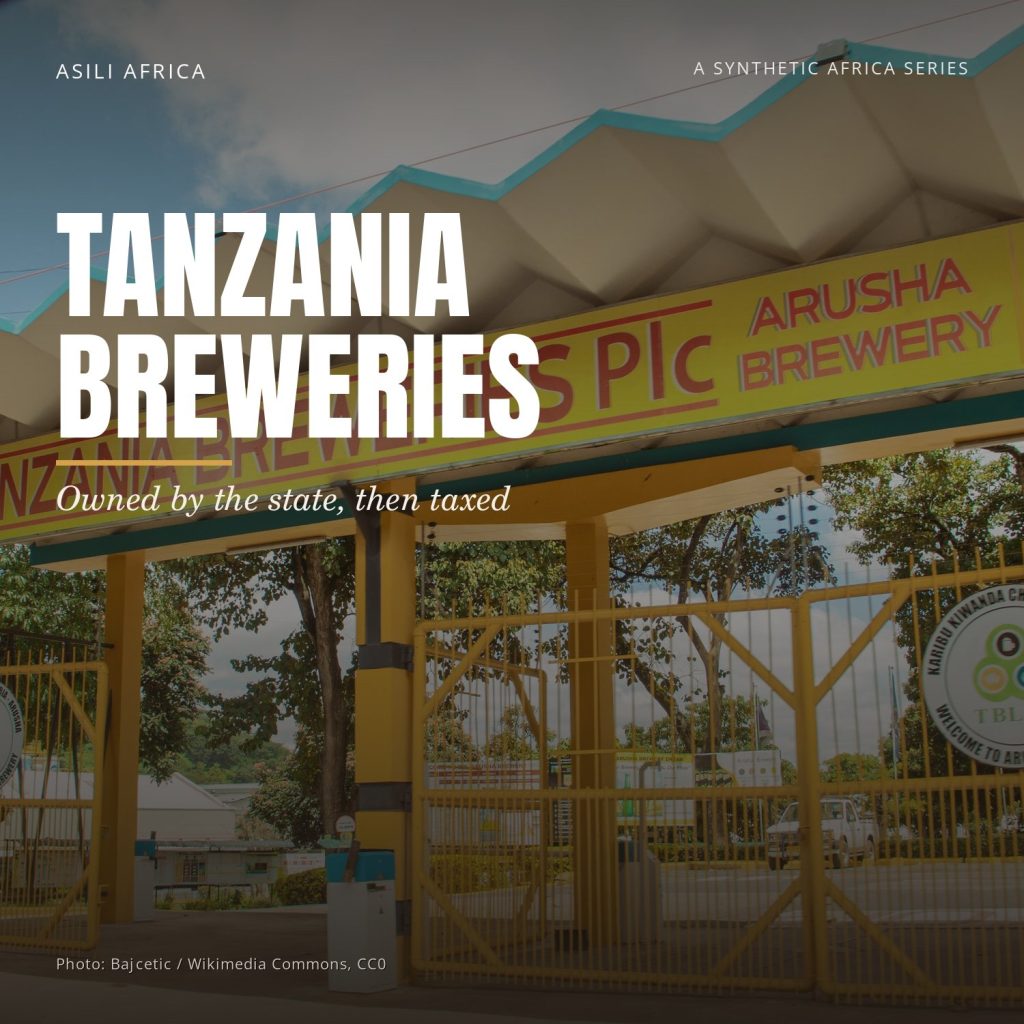
The Tanzania Breweries Story: Owned by the state, then taxed
In nineteen seventy, in Dar es Salaam, a distillery asked the country’s informal distillers to bring their spirit in.
These were people distilling without a licence, outside the formal economy altogether. The distillery did not turn them away.
It took what they brought, and it distilled it again, under licence, in its own stills. What had been made outside the law came in at the gate and went out inside it.
And it described the result in its own words. In Swahili, Kinywaji Safi. A clean drink.
The spirit was Konyagi. The distillery was Tanzania Distilleries.
Today, that distillery is controlled by Tanzania Breweries, the country’s largest brewer, and a company described as Tanzania’s oldest.
Konyagi is now the dominant spirit brand in the country.
And Tanzania Breweries has publicly commended the government’s crackdown on informal alcohol.
THE SUBSIDIARY
In nineteen thirty two, the idea of a brewery in Tanganyika Territory was first raised.
Tanganyika had been German East Africa until the First World War. Afterwards Britain held it, under a mandate from the League of Nations.
A year later, in nineteen thirty three, a private company called Tanganyika Breweries was founded there, in a territory governed from London.
A date, a name and a legal form. That is nearly the whole of what the record holds about its beginning.
No source we found names who founded it.
None says who put up the money, or who ran the brewery from day to day.
And none says who built the plant, or who worked in it, under the colonial administration.
For a company described as Tanzania’s oldest, that is a thin first chapter. We are not going to thicken it with a guess.
Tanganyika Breweries stood on its own for about two years.
In nineteen thirty five, it was bought by Kenya Breweries, a brewer founded in Nairobi in nineteen twenty two. Kenya Breweries was then thirteen years old.
Kenya and Tanganyika were neighbours, both under British rule, and the purchase put a brewer on each side of the border into one set of hands.
In nineteen thirty six, the two merged to form East African Breweries.
From then on, the brewery in Tanganyika was a subsidiary, one part of a group whose home was Nairobi.
That is also how its founding survives. Every account of it we found is told as a line in East African Breweries’ history, a few words inside another company’s story.
For the next three decades, the sources give the subsidiary in Tanganyika no separate story at all. No output figures. No managers. No events. Only its place in the group.
The Second World War, the territory’s move to United Nations trusteeship, and the long road to independence all pass without a line about the brewery in any source we found.
In nineteen sixty one, Tanganyika became independent.
In nineteen sixty four, it united with the People’s Republic of Zanzibar and Pemba, and the new country took a new name.
The name was made from the two it replaced, the start of Tanganyika joined to the start of Zanzibar.
For three decades as a subsidiary, the company had carried the name of a territory.
The local subsidiary took the new name with it.
Tanganyika Breweries became Tanzania Breweries.
THE DECLARATION
In nineteen sixty seven, Tanzania’s government issued the Arusha Declaration, which put the country’s major industries under state ownership.
The brewery was among them. That year, the state took a large stake in Tanzania Breweries.
How large depends on which source you read. One account says forty five per cent. Another says fifty five.
That is not a small disagreement. At forty five per cent, the state was a large minority shareholder. At fifty five, it was in control.
It decides who was running the brewery in the first years after the Declaration, and the sources do not settle it.
The sources also disagree on when the rest followed. One says nineteen seventy six. Most of the detailed accounts say nineteen seventy nine.
What they agree on is where it ended. By the end of the nineteen seventies, the state owned all of it. Every share was the state’s.
The brewery that had taken the country’s name in nineteen sixty four now belonged, entirely, to the country. It had been a private company, and then a subsidiary. Now it was a state enterprise.
The Declaration itself has been written about at length. The brewery’s part in it has barely been written about at all.
In nineteen seventy, three years into the Declaration, the distillery in Dar es Salaam made its offer to the informal distillers, and Konyagi began.
It is the one story from these years that survives with any detail in it, and it is not about the brewery.
The sources we have say Tanzania Breweries controls Tanzania Distilleries today, with a stake reported at sixty five per cent.
None of them says when the brewery acquired that stake.
So we cannot tell you whether, in nineteen seventy, the brewery had anything to do with the distillery at all. That date is missing, and we would rather say so than assume it.
About the brewery itself, the record is shorter still.
Every source that covers the state owned brewery reaches for the same two descriptions. Poorly managed. And loss-making.
Those are the sources’ words, not ours. And they are very nearly all the sources have.
Poorly managed is a judgement on the people running it. Loss-making is a statement about its accounts. Neither says by how much, or why.
No source we found gives an output figure for those years. None gives an investment figure, or says how large the losses were, or how they came about. If records of those years survive, they are not in any source we found.
No worker from the brewery is quoted. No manager. No official from the government that owned it.
We do not know what the brewery made in those years, who ran it, or what running it cost the state.
A large state employer, across more than two decades of the state’s involvement, and what the record keeps of it is two words.
That silence is what the sources leave us. We are not going to fill it.
THE HALF
In nineteen ninety three, twenty six years after the Arusha Declaration, the Tanzanian state sold half of Tanzania Breweries.
It came in a decade when Tanzania was selling, or opening up, many of the companies the state had taken over.
The buyer was South African Breweries.
The price, for a fifty per cent stake, was twenty two and a half million dollars.
The state kept the other half. For the first time since the nineteen seventies, it shared the company with a private owner.
It had been a subsidiary, and then a state company. Now it had two owners, and one of them was foreign.
After the years the sources describe as loss-making, production at Tanzania Breweries tripled within three years of the sale.
On the ninth of September, nineteen ninety eight, Tanzania Breweries listed its shares on the Dar es Salaam Stock Exchange.
It was the second company ever to list there.
The exchange was young. A brewery the state had once owned outright was now among the first companies anyone in Tanzania could buy into.
A listing opens a company to outside shareholders, and obliges it to publish its accounts. Members of the public could now own a piece of it.
By twenty thirteen, its shareholder register read like a list of the country’s savings institutions.
The Parastatal Pension Fund held a stake. So did the National Social Security Fund, the Public Service Pension Fund, and the Unit Trust of Tanzania.
The International Finance Corporation, the World Bank Group’s private sector arm, held a stake as well.
The rest, about a fifth of the company, was spread across other investors, in Tanzania and abroad.
And in twenty thirteen, so did the Government of Tanzania, with four per cent.
In twenty thirteen, four per cent was what the state held of a company it had once owned outright. It was still a shareholder. It was no longer running the company.
Somewhere between nineteen ninety three and twenty thirteen, the state’s half became four per cent. The sources we have do not record the steps.
The largest holder, in twenty thirteen, was SABMiller, as South African Breweries had become, with fifty seven point five four per cent.
By twenty thirteen, the state had gone from owner, to seller, to a shareholder with four per cent.
In twenty sixteen, AB InBev, the world’s largest brewer, completed its takeover of SABMiller.
The deal was made for SABMiller as a whole, across every country where it owned breweries, and Tanzania Breweries came with it, one company among many.
The decision that changed who controlled Tanzania Breweries was taken in a negotiation between two companies, over something far larger.
AB InBev holds its stake through SABMiller Africa, a holding company inside the group.
Tanzania Breweries had a new controlling owner.
Its shares went on trading in Dar es Salaam. There was no transaction inside Tanzania.
THE COMPLAINT
In two thousand and two, East African Breweries, the group Tanzania Breweries had once been part of, took a twenty per cent stake in it.
The group whose subsidiary it had been for three decades was now one of its shareholders.
Tanzania Breweries was not the only brewer in the country. The second was Serengeti Breweries.
In two thousand and nine, Serengeti Breweries filed a complaint against Tanzania Breweries with the Fair Competition Commission, Tanzania’s competition regulator.
It was registered as Complaint Number Two of two thousand and nine.
It concerned agreements Tanzania Breweries had made with bar owners. They were exclusive branding agreements, and they kept Serengeti’s products out.
An agreement like that runs between a supplier and the businesses it sells to. It is the kind of arrangement competition law exists to examine.
The Commission is the state’s referee between companies. It examined the agreements.
It found that the agreements had the object, effect or likely effect of preventing, restricting and distorting competition.
That is a finding. It was reached by the regulator after the complaint was heard, and it went against Tanzania Breweries.
The bar owners who signed those agreements do not appear in any source we found. What the arrangement meant for their businesses, nobody on the record says.
In nineteen ninety three, the state had sold half of this company. Sixteen years later, through its competition regulator, it was ruling on how the company did business.
In twenty ten, East African Breweries sold its stake in Tanzania Breweries.
In its place, it bought fifty one per cent of Serengeti Breweries. Fifty one per cent is control.
East African Breweries is majority owned by Diageo, the British drinks group.
So the group that had once owned Tanzania Breweries, and had then held a fifth of it, now controlled its main rival.
In twenty twenty three, Tanzania brought in a new structure of excise duty on beer. Excise is a tax charged on particular goods, on top of the ordinary taxes.
Under the new structure, the rate a brewer paid depended on what went into the beer. It was lower where more of the raw material was grown in Tanzania, and higher where the malt was imported. The rates were set by law, and they apply to every brewer in the country.
Serengeti Breweries argued in public that the rates favour certain players unfairly. It proposed a different rate of its own.
That is Serengeti’s claim. Tanzania Breweries’ own position on the rates is not in the sources we have. No ruling on the claim is recorded in any source we found.
Twice, the rival had taken its quarrel with Tanzania Breweries to the state. In the record we have, that is where the two brewers meet: not over prices or advertising, but in front of the state. The first time, the state ruled. The second time, there is a claim, and there is no finding.
THE TAXPAYER
In twenty twenty five, Tanzania Breweries reported record results.
Revenue was about one point six six trillion shillings, up thirteen per cent on the year before.
Profit after tax was two hundred and thirty six billion shillings.
Michelle Kilpin, managing director since February twenty twenty four and the first woman to hold the role in the company’s history, came to it from running Zambia Breweries, in the same group.
The company runs four breweries, in Dar es Salaam, Arusha, Mwanza and Mbeya, with a malting plant in Moshi and eight distribution depots across the country.
Tanzania Breweries is described as the country’s largest taxpayer. The description is repeated often. The sources we have do not show the ranking behind it.
A brewer pays tax at several points. Excise on what it makes. Value added tax on what it sells. Corporate tax on what it earns.
The company the sources call loss-making under the state is now described as the one that pays the state the most tax.
Since nineteen sixty seven, the state has held this company in one way after another. As its owner. As the seller of half of it. As a shareholder with four per cent in twenty thirteen. As the regulator that ruled on its contracts, and the government that set its excise.
And now as the collector of its tax. The state has changed what it holds the company with. It has not let go.
On the fourth of September, twenty twenty five, the Court of Appeal, the highest court in Tanzania, upheld an assessment by the Tanzania Revenue Authority against Tanzania Breweries.
The Tanzania Revenue Authority is the government body that assesses and collects the country’s taxes. An assessment is its own calculation of what a company owes.
This one was for six point five three billion shillings. Four point eight eight billion of that was value added tax, and one point six five billion was interest.
It covered the period from April twenty sixteen to December twenty seventeen.
The company had claimed back tax it had paid on its purchases. The claims relied on invoices that were missing details the law requires, among them the customer’s name, address and tax registration numbers.
It was Tanzania Breweries that brought that application to the court. The court found against it. On that matter, the authority’s figure stands.
That is one matter.
Tanzania Breweries and the Tanzania Revenue Authority also have disputes over excise duty, and over capital gains tax.
And over transfer pricing, which is how a company prices its dealings with other companies in its own group. The sources we have do not give the details of those disputes, or the sums involved.
Those disputes are unresolved. The country’s described largest taxpayer is also one side of some of its largest open tax disputes.
Tanzania Breweries holds about eighty per cent of the formal beer market.
Formal means made under licence, sold through the recorded trade, and taxed. A great deal of what is drunk in Tanzania is none of those things. It is homemade and informal alcohol, and it sits outside that eighty per cent entirely.
How large that informal share is, the sources cannot settle.
The World Health Organization puts unrecorded alcohol at about a third of what is drunk in Tanzania. Its figures for twenty sixteen count three point two litres per person unrecorded, against six point two recorded.
Unrecorded, in its terms, means alcohol that does not appear in official figures for production or trade. It is not counted, because nobody reports it.
Another estimate, repeated in reference sources without a primary source named, puts the informal share at more than nine tenths.
The first counts litres of alcohol per person. The second does not say what it counts. The two cannot be reconciled from the sources we have, and we are not going to choose between them.
On the lower figure, formal alcohol of every kind is about two thirds of what is drunk.
On the higher figure, it is less than a tenth. And beer is only one part of that formal share.
On either figure, the eighty per cent is a share of the formal part. It is measured the way every market share is measured, against what can be counted.
And the formal part is the part the state can tax. Informal alcohol pays no excise, because nobody declares it.
The government has been cracking down on illicit alcohol.
Tanzania Breweries has publicly commended that crackdown.
Konyagi, the dominant spirit brand in the country, made by the distillery Tanzania Breweries controls today, began in nineteen seventy as informal spirit, brought in by unlicensed distillers and distilled again under licence.
The spirit was built by bringing the informal market in. The company that controls it now applauds the crackdown on that market. Both of those things are on the record.
The distillers who brought their spirit in, in nineteen seventy, are not named anywhere we looked.
Neither are the people who make and drink what the crackdown targets today. On one estimate, they are most of the market. On the other, they are a third of it.
None of them speaks in any source we found. No source names them.
In nineteen thirty three, a company was founded in Tanganyika Territory, and within two years it belonged to a brewer in Nairobi.
It is described as Tanzania’s oldest company. Who founded it, and how the state ran it, are not in the record.
In nineteen sixty seven, the state began taking it. By the end of the nineteen seventies it owned all of it, and by every source it was loss-making.
In nineteen ninety three, the state sold half. Since then, it has held the company in other ways, through a shareholding, a regulator, an excise and a tax bill.
In more than ninety years it has been a subsidiary, a state enterprise, a company shared with a foreign brewer, and one holding among many for the world’s largest brewer.
Today the company is described as the country’s largest taxpayer, and it is in dispute with the state’s tax authority over how much it owes.
As of the twenty eighth of September, twenty twenty six, one of those disputes has been decided, and the company lost it. The disputes over transfer pricing, excise and capital gains remain open.
What Tanzania Breweries dominates, and what the state taxes, is the formal market.
Beside it is a market neither of them reaches. On one figure it is a third of the whole. On the other, it is nearly all of it.
The state once held this company by owning it, and now holds it by taxing it. Either way, it holds only the part it can see.
This is Asili Africa. Every empire has an origin. See you on the next one.
Key Takeaways
- THE SUBSIDIARY. In nineteen thirty two, the idea of a brewery in Tanganyika Territory was first raised.
- THE HALF. In nineteen ninety three, twenty six years after the Arusha Declaration, the Tanzanian state sold half of Tanzania Breweries.
- THE COMPLAINT. In two thousand and two, East African Breweries, the group Tanzania Breweries had once been part of, took a twenty per cent stake in it.
- THE TAXPAYER. In twenty twenty five, Tanzania Breweries reported record results.
Also available on YouTube — search “Asili Africa” or subscribe to our channel.