
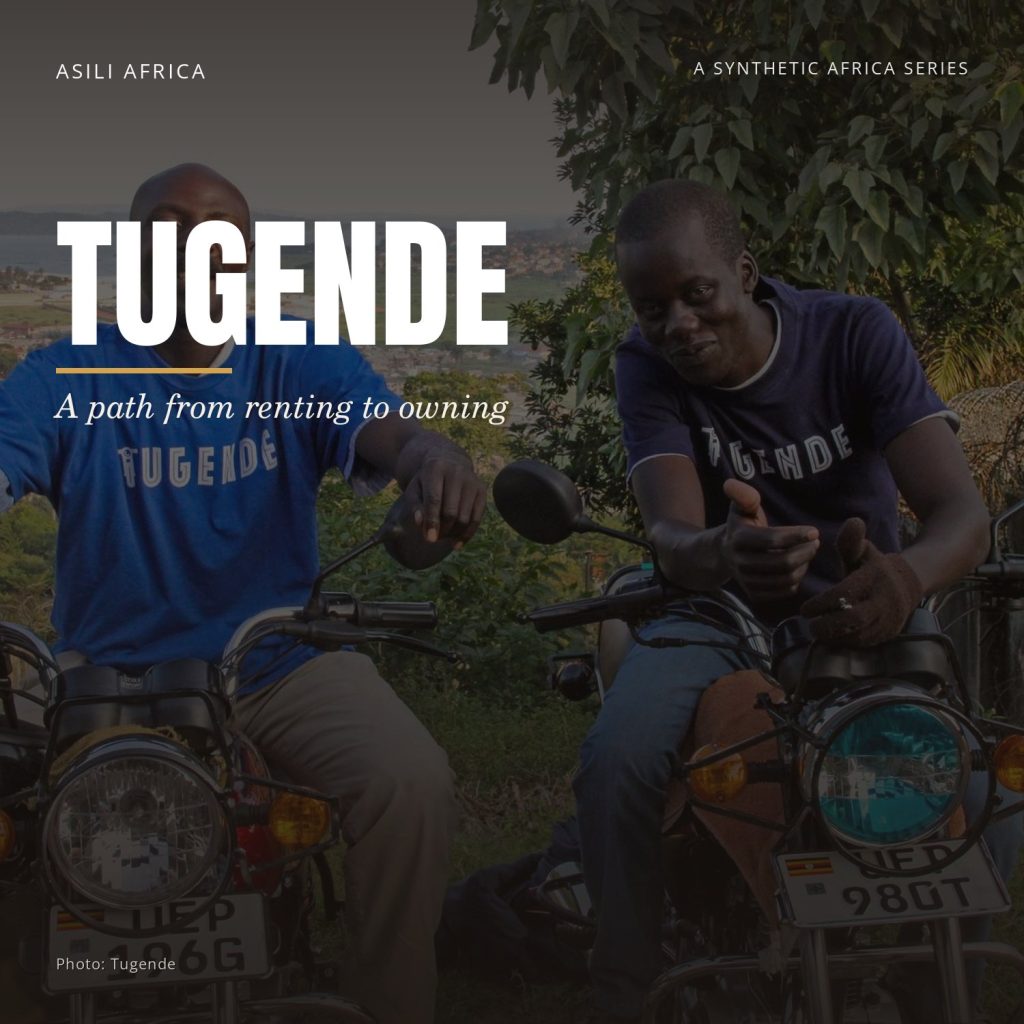
The Tugende Story: How a boda-boda lender in Kampala took Silicon Valley crypto money, defaulted live on the internet, and rode back on an electric motorcycle
In December of twenty twenty two, on the other side of the world from Kampala, an analyst at a Silicon Valley crypto lending platform called Goldfinch opened a quarterly report from a Ugandan motorcycle finance company. Buried in the numbers was a problem. One point nine million dollars, lent to the company’s Kenyan subsidiary and legally locked to Kenya, had quietly crossed the border into Uganda. Nobody had asked permission. Nobody had told the lender.
The company was called Tugende. For a decade it had been one of the great quiet success stories of East African finance. A lender that gave motorcycle taxi drivers something no bank would give them. A path to owning the machine they worked on. It had raised money from development banks, from Toyota, from European venture funds, and finally from the frontier of finance itself, a blockchain credit protocol backed by some of the biggest names in Silicon Valley.
By July of twenty twenty three, Tugende was in formal default on a five million dollar loan. It became one of the most public failures of the African funding winter, and the first major collapse of a real world loan in the short, strange history of crypto credit.
But this is not a story about crypto. It begins sixteen years earlier, with an American journalism student on the back of a motorcycle taxi in Kampala, asking his driver a simple question. You work this bike every single day. Why don’t you own it?
This is the story of Tugende. The company that bet everything on the credit of people banks refused to see, built an empire one daily payment at a time, lost its footing at the worst possible moment, and is now trying to ride back on an electric motorcycle.
THE ORIGIN
The origin of Tugende does not begin with a business plan. It begins with a commute. In two thousand six, a first year American journalism student named Michael Wilkerson arrived in Kampala for an internship at the Daily Monitor, one of Uganda’s leading newspapers. He had no car, and Kampala’s traffic does not forgive cars anyway. So he did what millions of Ugandans do every day. He climbed onto the back of a boda boda.
The boda boda is the circulatory system of urban Uganda. Where matatus stop, the boda goes. Through the traffic jam, up the dirt road, to the door. And behind every handlebar is a driver, almost always a young man, working one of the most common jobs in the country’s vast informal economy. Wilkerson did not just ride. He talked. He befriended his regular drivers, learned their names, learned their economics. And the economics shocked him.
Most drivers did not own their motorcycles. They rented them, day after day, from owners who collected a fee off the top of every shift. A driver could rent the same bike for years, pay for it many times over in rental fees, and still own nothing. There was no path from renting to owning, because the path ran through a bank, and the bank’s answer was always no. No payslip. No collateral. No credit history. No loan. The people doing some of the hardest work in the city were locked out of the most basic tool of wealth building. Ownership.
Wilkerson went home, finished his studies, and could not let the question go. In two thousand nine he came back to Uganda on a Fulbright research scholarship. And around twenty ten, he started an experiment that was almost embarrassingly small. He took his own money and made informal lease to own deals with a handful of drivers he knew and trusted. The terms were simple. Small regular payments, sized to a driver’s daily cash flow. And at the end, the bike was yours. No bank. No payslip. Just the asset, the work, and the promise.
The drivers paid. Not sometimes. Almost always. Because the bike was not a luxury, it was their income, and owning it outright could nearly double what a driver took home. In twenty twelve, Wilkerson moved to Kampala to run the experiment full time. Together with co-founder Matt Brown, he formally established the company and gave it a name in Luganda that captured exactly what it felt like. Tugende. Let’s go.
The insight underneath Tugende was the same one that would later power M-KOPA’s pay as you go solar empire in Kenya. A poor customer with steady daily cash flow is not unbankable. You just have to lend against the right thing. Not a salary. Not a land title. The productive asset itself, the machine that earns the money that makes the payments. The bank saw a man with no collateral. Tugende saw a man sitting on his collateral every working day.
THE STRUGGLE
Having the insight was one thing. Building a machine around it was another. The early years of Tugende ran on paper and shoe leather. Paper contracts. Manual collections. Staff who knew every client by face and name. There was no credit bureau to consult, so Tugende built its own underwriting out of the social fabric of the boda world. References from a driver’s stage, the corner association where he waited for fares. Referrals from existing clients. Reputation, verified the slow way.
And because trust needed teeth, every financed motorcycle carried a GPS tracker, and Tugende retained the right to repossess a bike if payments stopped. That is the uncomfortable heart of every asset finance model that serves the poor, and it is worth being honest about. A social enterprise that tracks and can take back the assets of very poor customers is living with a permanent tension. Tugende’s defense was its results. The overwhelming majority of its drivers made it to ownership, and a repossessed bike could be recycled to the next applicant rather than becoming a dead loss.
The model worked, and then it compounded. Excluding a single pandemic year, Tugende more than doubled its portfolio every year from twenty twelve onward. By twenty fifteen it had financed more than five thousand drivers, and a typical client was reaching full ownership in about nineteen months. Foreign journalists started showing up in Kampala to profile the American who lent to boda drivers when banks said no.
Capital was the harder fight. There was no established asset class called motorcycle finance for informal workers, and Wilkerson spent years knocking on doors trying to convince institutional lenders that his clients were creditworthy. The breakthroughs came slowly and then in sequence. In July of twenty eighteen, the Overseas Private Investment Corporation, the development finance arm of the United States government, extended a five million dollar debt facility. In February of twenty nineteen, PG Impact Investments, connected to the global firm Partners Group, added five million more. The proof was in. Tugende could raise real money.
Then came the year that tested what the company actually believed. In twenty twenty, the COVID pandemic reached Uganda, and the government imposed one of the strictest lockdowns in Africa. Boda bodas were banned from carrying passengers. For Tugende’s clients, income did not fall. It stopped. Overnight, more than twenty three thousand active clients, every one of them paying for a bike out of daily fares, had no fares.
A conventional lender protects its balance sheet first. Tugende did the opposite. It sent unconditional cash grants of twenty five thousand Ugandan shillings, roughly seven dollars at the time, to every single active client. It waived late penalties. And rather than lay off staff, the company deferred salaries, with leadership taking the deepest cuts. When the lockdown lifted, the drivers came back, and repayments recovered with remarkable speed. In the impact investing world, Tugende’s pandemic response became a small legend. It looked like proof that the company’s talk of loyalty and community was not just marketing. Loyalty, it turned out, could survive a pandemic. The harder question was whether the balance sheet could survive success.
THE PIVOT
Because what came next was the pivot. From a Ugandan lender growing carefully, to a venture backed machine trying to scale across borders at the speed of the money flooding into African tech. In November of twenty twenty, only months after the lockdown, Tugende closed a six point three million dollar Series A led by Mobility Fifty Four, the venture arm of Toyota Tsusho, the trading giant behind Toyota’s Africa business. In March of twenty twenty one, Partech and Enza Capital added a three point six million dollar extension, taking the round to nine point nine million dollars. By then Tugende had served more than forty three thousand clients, and more than sixteen thousand of them had reached full ownership of their assets.
The money had a destination. Kenya. The largest boda market in East Africa, right next door. Tugende had crossed the border and was now opening branches at speed, six of them in the first three months of twenty twenty one alone. The product line stretched too. Beyond motorcycles into taxis, boat engines, smartphones, refrigerators for shopkeepers, sewing machines for tailors. Anything that earned its owner a living could, in theory, be financed the Tugende way.
And then came the loan that would define the next chapter. In October of twenty twenty one, at the absolute peak of the cheap money era, Tugende’s Kenyan subsidiary borrowed five million dollars from Goldfinch, a decentralized credit protocol backed by Andreessen Horowitz, one of Silicon Valley’s most powerful venture firms. Goldfinch’s pitch to the crypto world was that blockchain capital could fund real businesses in emerging markets. Tugende was exactly the showcase it wanted. The loan carried interest of more than fifty three thousand dollars a month, and its terms were explicit. The money was for Kenya. Only Kenya.
Two months later, in December of twenty twenty one, Tugende announced another seventeen million dollars in debt from European and African lenders. The company had now served more than fifty four thousand clients and employed more than five hundred people. All told, over its lifetime, it had raised more than sixty million dollars in grants, debt, and equity. Ten years after a Fulbright scholar handed his first informal loan to a boda driver, Tugende was one of the largest lease to own platforms on the continent. And almost nobody, inside or outside the company, saw what was coming.
THE SCALE
Twenty twenty two arrived like a cold front. Global inflation surged. Fuel and energy costs in Uganda spiked, squeezing the daily margins of every boda driver on the road. Interest rates rose, and the cheap global capital that had funded Tugende’s doubling machine simply stopped flowing. Africa’s startup funding winter had begun. And Tugende was carrying the cost structure of a company that had planned for the boom to continue. It had expanded its headcount aggressively that year, a decision its own lenders would later flag as a critical mistake. Revenue strained under inflation. The Uganda balance sheet began to deteriorate.
And then someone at Tugende made the decision that turned a hard year into a scandal. As Uganda’s position worsened, one point nine million dollars of the Goldfinch loan, money contractually locked to the Kenyan business, was moved to prop up Tugende Uganda. It was a breach of the loan covenants. The lender was not told. In December of twenty twenty two, Goldfinch found it in the quarterly reporting. In May of twenty twenty three, Tugende stopped paying interest. By July, the company was in formal default.
The failure was uncommonly public. Because Goldfinch was a decentralized protocol, its lenders were not a bank committee behind closed doors. They were a community of token holders debating the default on open governance forums, in real time, for anyone to read. Goldfinch wrote down three point one million dollars of the five million dollar loan. Tugende’s collapse became the first major real world lending failure in the protocol’s history, and a case study passed around crypto circles as a warning about lending into markets you cannot see. A boda boda financier from Kampala had become collateral damage in crypto’s own credibility crisis.
Here is the honest reading. The macro storm was real, and it sank companies across the continent. But the diversion of the Kenya funds was not weather. It was a governance failure, a choice made under pressure and hidden from a lender, by a company whose entire brand was built on trust. Tugende’s defenders note that it kept operating, kept serving clients, and did not run from the debt. In September of twenty twenty three, Tugende signed a restructuring agreement with Warbler Labs, the team behind Goldfinch. It was the first loan ever restructured on the protocol. Wilkerson spoke of a larger transaction taking shape, and of a strategic investor coming in. Who that investor was, and on what terms, has never been made public.
TODAY AND TOMORROW
Which brings us to today. Tugende survived. As of this year, the company operates about twenty branches across Uganda and Kenya, employs more than eight hundred people, and has served more than eighty thousand clients since that first informal handshake. Thousands of them now fully own the motorcycles, boat engines, and shop equipment that feed their families. The deeper finances remain a black box. Revenue has never been disclosed, no valuation has ever been published, and the full repayment status of the restructured Goldfinch facility has never been publicly confirmed. The recovery is real, but its terms are private.
And then, in November of twenty twenty five, came the sentence few people expected to read. Tugende was expanding again. The company announced a partnership with Zembo, Uganda’s pioneering electric motorcycle maker, to finance electric boda bodas. Lease to own, the classic Tugende model, applied to the machines that could end the petrol era of African urban transport. The rollout began in Kampala, with Masaka, Jinja, and Entebbe next, and a target of nationwide coverage by the middle of twenty twenty six.
There is a symmetry to it. Tugende rose by financing the petrol boda when no one else would. Now it is betting that the same trust machine, the daily payments, the stage referrals, the relationship underwriting, can carry an entire industry across the electric transition. The question that hangs over the company is the same one that hangs over its whole category. Can a lender to the poor grow fast without breaking the thing that made it work? Tugende has answered that question wrongly once. It is now getting the rare thing African startups are seldom given. A second chance to answer it right.
In two thousand six, an American student climbed onto the back of a Kampala motorcycle and asked his driver why he did not own it. The answer to that question became a company that has put productive assets into the hands of more than eighty thousand East Africans, survived a pandemic, a funding winter, and a default that played out live on the internet, and is now financing the continent’s electric future one daily payment at a time.
This is Asili Africa. Every empire has an origin.
Key Takeaways
- THE ORIGIN. The origin of Tugende does not begin with a business plan. It begins with a commute.
- THE STRUGGLE. Having the insight was one thing. Building a machine around it was another.
- THE PIVOT. Because what came next was the pivot.
- THE SCALE. Twenty twenty two arrived like a cold front.
- TODAY AND TOMORROW. Which brings us to today. Tugende survived.
Listen to the Episode
Also available on YouTube — search “Asili Africa” or subscribe to our channel.