
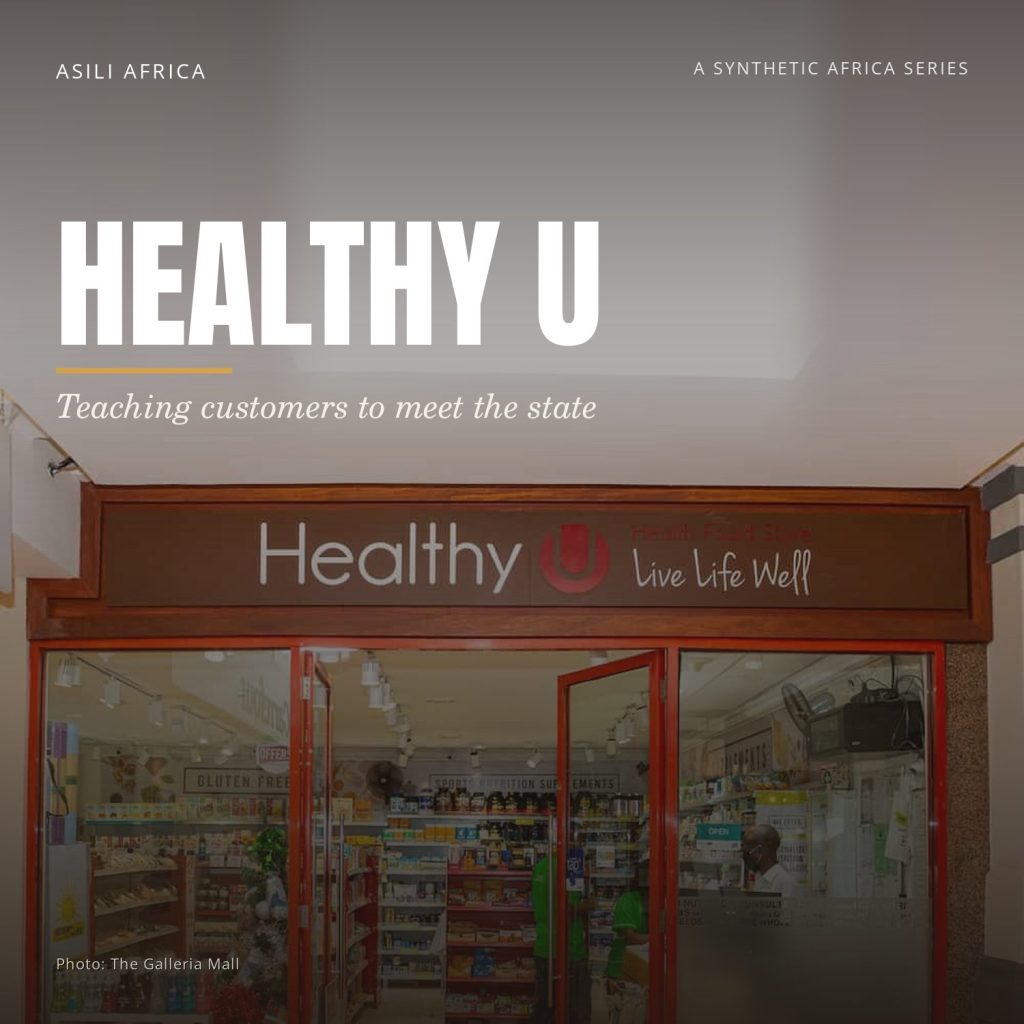
The Healthy U Story: Teaching customers to meet the state
By the family’s own account, in the middle of the nineteen nineties, a small shop at Sarit Centre, in Westlands, Nairobi, sold Heinz baked beans and Kellogg’s Frosties.
The shop was a single unit on a mall floor, run by a family that had set out to sell something else entirely.
Alongside the baked beans and the cereal, it sold vitamins and supplements that almost nobody walking past yet knew to buy.
Cereal boxes on one row. Jars of multivitamins on another. In a shop too small for the two to be far apart.
The shop that would one day call itself Kenya’s number one health food and supplement retailer kept itself alive, in those earliest years, by selling the opposite of what it would stand for.
That is the company’s own line about where it began.
So the question the next twenty minutes answer is how a shop makes a market that does not yet exist.
This is Healthy U.
BAKED BEANS AND FROSTIES
Start in Westlands, in Nairobi, in the middle of the nineteen nineties.
Westlands sits on the northwest edge of the city, and Sarit Centre is one of its anchor malls, a daylight courtyard with three storeys of shopfronts around it.
The family that would come to run Healthy U has one shop in that mall, one unit, selling vitamins and health food into a market that does not yet exist for those things.
In Nairobi, at that time, the words dietary supplement and organic food do not have a shelf of their own in most places.
They sit, when they sit anywhere, next to tinned goods and biscuits in general stores.
The pharmacies carry over-the-counter medicine. Not nutrition.
The supermarkets carry food. Not supplements.
There is no category in a customer’s head to walk into.
A shop that stocks only vitamins and supplements has nothing to sell, because the people walking past have nothing to buy.
By the family’s own account, the first years are difficult.
To keep the lights on, the shop widens into mainstream groceries. From Heinz baked beans to Kellogg’s Frosties, sold alongside the supplements nobody has yet learned to want.
A health food shop that cannot sell health food fast enough to live on, selling cereal to buy time.
The specific reason that strategy worked, or the margin on the groceries that paid the rent, is not stated anywhere we could read. The shop stays open. That is what the record carries.
The company’s own materials carry three different dates for when all of this begins.
One line, in a snippet of its own marketing, says the family’s journey started in nineteen eighty five, in general products.
Another says the company has been a trusted partner for nearly three decades, which would place the first health-oriented store around nineteen ninety five.
A third, in the mall directory for one of its stores, says one store in nineteen ninety eight.
No source we found reconciles them. The company dates its start to nineteen ninety eight. The earlier dates are the company’s own differing claims, said once and set aside.
The legal name on the record is Healthy U two thousand Limited.
The two thousand in the name is probably a year of incorporation, or a millennium reference. The record does not say which.
The two names attached to the running of it, in the only sources we could read, are Sailesh Rach, who is described as the Founder and Special Projects Director, and Avni Rach, who is described as the Managing Director.
How the two are related is not stated anywhere we could read. The record names titles, not kinship.
No readable interview with either exists in the sources we could find.
Not in a trade publication. Not in a national newspaper. Not in a specialist health press. The record on the two of them starts with a title and ends with a title.
The company’s own blog, where the leadership was supposed to tell its own story, returned a locked page every time we knocked.
Which leaves the first chapter of the shop in one sentence. The company has written that sentence. It is not a long one. It names no cause.
The first chapter of the shop ends, by the company’s own line, in nineteen ninety eight.
In the company’s own words: the real journey began in nineteen ninety eight, with the relaunch of the brand, following a challenging period for the business and family.
That is the sentence. The company has not said what the period was.
We looked. That silence is worth naming, and we are not going to fill it with a guess.
THE STORE AS CLASSROOM
After nineteen ninety eight, the shop commits.
Health food and supplements become the whole offer. The groceries are gone.
Nairobi still does not know what a lot of this is for.
Many of these products are new even to the pharmacies, which stock medicines, not nutrition. The supermarkets, which stock food, do not carry them either.
Multivitamins. Protein powders. Herbal teas.
Specialty foods for people who cannot eat gluten, for people who cannot eat lactose, for people cutting sugar.
Organic lines. Natural personal care. Eco-friendly household goods.
The problem is not supply. The problem is that most customers walking in cannot answer, at the till, the question of why they are buying any of it.
A jar costs money. A reason to buy it costs nothing. The shop has the jar. The customer does not have the reason.
So the shop takes an unusual answer. It will teach them.
The decision is to teach, and it is a decision with consequences. Teaching is slow. It happens one customer at a time. It does not scale by hiring more cashiers.
And it has to be free, because the customer who does not yet know what a supplement is for is not going to pay to find out.
So. Walk in. Sit down. The shop offers a free nutrition consultation.
Across the desk, someone in a company apron asks you about what you eat.
Step onto a scale for body composition analysis. The reading on the handheld is numbers you cannot see, interpreted by the person in the apron.
Ask for food allergy testing. A tray appears. A strip. A pipette.
A chart of what you can and cannot eat gets drawn from your result, in a shop that has an aisle for every answer.
Have your blood pressure taken, free, in a shop.
Have your blood sugar tracked, free, in a shop.
Have your vitamin and mineral levels mapped, free, in a shop.
By the end of a consultation, a customer knows things about their own body they did not know on the way in. And the shop has a shelf of products that answer each of them.
Everything the shop offers for free is a question with an answer that is also for sale three steps away.
The method is the strategic insight the Rachs built the shop on, as much as any product on it.
In a market where nobody knows what to want, the shop that teaches you what to want gets to be the shop that sells it to you.
The customer leaves with a jar. The shop keeps the margin on the jar. The service that produced the jar’s reason to exist was free. The shop pays for the service out of the same margin.
The circle closes inside the room.
The company’s own marketing calls its in-store experts qualified nutritionists, and names them as its differentiator.
Those nutritionists are not in the record. We looked for their names, their training, their professional registration, their numbers, their turnover.
No listing on a professional registry we could search. No author credit on company content. No name on a report.
The people whose work is the differentiator the shop is sold on are, in the material we could read, anonymous.
Nor is any customer heard. No testimonial. No survey. No complaint. No outcome measured by anyone outside the shop itself.
The method is described, from one end, by the seller.
What the shop built, after nineteen ninety eight, is a mechanism for making its own customers.
It teaches them, in a room that also sells them what the teaching recommends.
THE EDGE
A Healthy U store, at the front, is a wellness shop.
At the back of the same room, in a corner, there is a chair, a desk, a cuff on a counter, a strip-test tray, a scale, and a monitor.
A member of staff in a company apron sits across from a walk-in customer, reads the output of a small device on the desk, and recommends something that is on a shelf five steps away.
That is retail. It is also something close to clinical work.
The two activities, in a Healthy U store, happen in the same room, often with the same person moving between them.
In Kenya, the line between food and medicine is drawn by the state.
The Pharmacy and Poisons Board registers health supplements before they can be imported or sold.
Every batch. Every brand. Every claim.
The register is public, in principle. A product that is not on it is not supposed to be in the country.
The Kenya Bureau of Standards governs how food is labelled.
Ingredients. Daily values. Allergens. The claims on the box. All of it is a Bureau matter.
A product classed as a supplement sits on one side of that line.
A product whose claims become therapeutic, or whose doses become pharmacological, crosses onto the other side, into medicine, into a stricter pathway.
The classification is not only about the compound. It is about what the label says the compound is for.
The line is not the shop’s. It is the state’s.
And it moves depending on what the product on the shelf is claimed to do.
A shop that advises you on nutrition, measures your blood pressure, maps your deficiencies and then sells you the thing the measurement said you needed, works close to that line, every day, as the shape of its model.
Each measurement produces a reading. Each reading points at a product. Each product is on a shelf in the same room.
It is a structural property of what Healthy U does.
Not an accusation. A description.
Across every source we read, nothing found shows Healthy U crossing that line.
No Pharmacy and Poisons Board dispute involving the company appears in the record searched. No Kenya Bureau of Standards action appears either.
No recall. No inspection on either outcome. No consumer complaint on any register we could search.
Which does not mean none exists. The Pharmacy and Poisons Board’s own records are not fully public, and a complaint to a retailer, if any, would never show up anywhere a search engine could find it.
Clean or otherwise, the record is silent. That silence is a limit of the record, not a verdict.
The shape is here. The finding, from any direction, is not.
A shop that has worked the ground between food and clinical advice for a quarter of a century is a shop with practice in exactly the kind of thing a Ministry of Health might, one day, want to talk to it about.
THIRTY STORES
Thirty stores takes decades.
By the company’s own count, Healthy U is now a chain of more than thirty stores across Kenya and Uganda.
That is the company’s own figure, said often, in its own marketing.
One search summary of the company’s own material cites thirty-six outlets in Kenya and one in Uganda. The two counts are both the company’s own, and they do not reconcile.
No outside source we found settles between them. The company does not publish a list of stores or a count by city on any page we could read.
The footprint on the mall directories we could read includes Sarit Centre in Westlands, Galleria in Lang’ata, Capital Centre on Mombasa Road, and the Hilton.
Each is a shop with the same recognisable method. Shelves at the front. A desk at the back. The apron. The cuff. The scale.
A customer in one mall can expect the same back-corner desk as the customer in another. The retail format is standardised. The method is portable.
The shop at Sarit Centre is the original. The others, from the record, are variations on it. One mall, one new catchment, the method travelled.
What those stores sell against, in those malls and the suburbs around them, is unmapped in the record we could read.
The pharmacies that sell vitamins over the counter.
The supermarkets with wellness aisles, that put the same jars next to shampoo.
The informal and grey-market importers who undercut legal supply through routes the retail chains cannot use.
No source we found sets any of these against Healthy U. There is no table that compares them. No market-share figure. No basket comparison. No pricing study.
The company’s claim to be the number one health food and supplement retailer in Kenya is, every time it is said, the company’s own description. No independent ranking we found underwrites it.
The one line of regional footprint is Uganda. The record does not say when the Uganda store opened, where it is, how many of them there are, or how it does.
No revenue has been published. No profit. No funding. No ownership structure. No debt. No headcount.
No investor letter. No auditor’s note. No regulatory filing visible to the public.
The company is, by every indication we have, privately and family held. That is as deep as the public record goes.
Everything the shop has become, in the material we could read, is told in store counts and self-descriptions.
But in twenty eighteen, there is one hard number on the record.
Healthy U donates two and a half million shillings to UNHCR.
The gift goes to a programme supporting refugees in Kenya.
The programme is called LuQuLuQu, inside the UN refugee agency. The company joins it.
The context is Kenya in twenty eighteen. The country is hosting hundreds of thousands of registered refugees across camps and towns. The donation goes into that programme.
And in making the gift, Avni Rach, the Managing Director, says of the giving that it is in the spirit of Ujamaa.
Ujamaa, in Swahili, carries the extendedness of family.
The welfare of the house across the yard. The welfare of the stranger inside the gate.
The word has a political memory in East Africa. Julius Nyerere, in Tanzania, used it to describe a kind of social solidarity. Avni Rach, in giving, picks it up for the shop.
It is the one time, in the material we have, that the leadership of this company has told anyone, in its own words, how it understands what it is doing.
Everything else on the record is what the company sells. This is what the company says.
THE DOCTOR’S ROOM
In early September twenty twenty six, a different kind of meeting takes place.
The Principal Secretary for Medical Services at the Ministry of Health, Dr Ouma Oluga, meets Sailesh Rach, the Founder and Special Projects Director of Healthy U.
The meeting is exploratory. The word in the Ministry’s own release is explores.
No deliverables. No budget line. No timeline.
What is on the table is whether Healthy U might run nutrition awareness clinics inside the state’s medical camps, tied into community outreach for preventive health.
A medical camp, in Kenya, is a Ministry outreach to a community for a few days. Mobile tents. A line of patients. Basic checks. Free care. Often tied to a national public-health campaign.
The patient does not pay. The state carries the cost.
The ambition in the government’s own framing is preventive health, the thing that stops a condition before it starts. Universal health coverage, in Kenya, is the ambition that no citizen pays, at the point of care, for the basics. Prevention sits upstream of all of that.
What the Ministry is exploring, in that setting, is a corner where a Healthy U staff member in an apron does the thing a Healthy U staff member in an apron has done for decades.
The clinical corner at the back of the shop, in the model being explored, moves to the front of a medical tent.
A consultation. A measurement. A conversation about what to eat and what to avoid.
Done in a camp, by a company whose stated differentiator is doing exactly that.
A private partner whose stock in trade is already the thing the state wants to deliver. That is the match the Ministry is reportedly interested in.
The Ministry’s framing in the same release includes a commitment to supporting local manufacturing in the preventive health space.
That is state policy. It is not the shop’s position. The record we read does not say what share of what Healthy U sells is made in Kenya and what share is imported.
Who pays, in the model being explored, is not public.
Who sets the nutritional advice given at those camps, is not public.
What the commercial relationship between a state medical camp and a chain of health food retailers would look like, is not public.
The release says explores, and that is the strongest word any of this gets.
No agreement has been announced. No pilot has been named. No money has moved.
A conversation has taken place. That is the record.
The release is one page. It is dated early September twenty twenty six. It is written in the voice of the Ministry. The company has not issued one of its own.
But the question, now, is one that the shape of Healthy U has been asking of itself since nineteen ninety eight, without a counterparty on the other side.
A shop had to teach its customers to want what it sold.
Now the state is in the room, asking whether that same teaching should sit inside the Ministry’s own preventive health programme.
The answer is not in yet.
Back to the first chapter.
A small shop at Sarit Centre, in Westlands, that kept itself alive by selling the wrong thing to the right customers.
Twenty-eight years after the stated relaunch, the state is in the room, asking whether the teaching should be theirs too.
The answer is not in.
This is Asili Africa. Every empire has an origin. See you on the next one.
Key Takeaways
- BAKED BEANS AND FROSTIES. Start in Westlands, in Nairobi, in the middle of the nineteen nineties.
- THE EDGE. A Healthy U store, at the front, is a wellness shop.
- THIRTY STORES. Thirty stores takes decades.
- THE DOCTOR’S ROOM. In early September twenty twenty six, a different kind of meeting takes place.
Also available on YouTube — search “Asili Africa” or subscribe to our channel.