
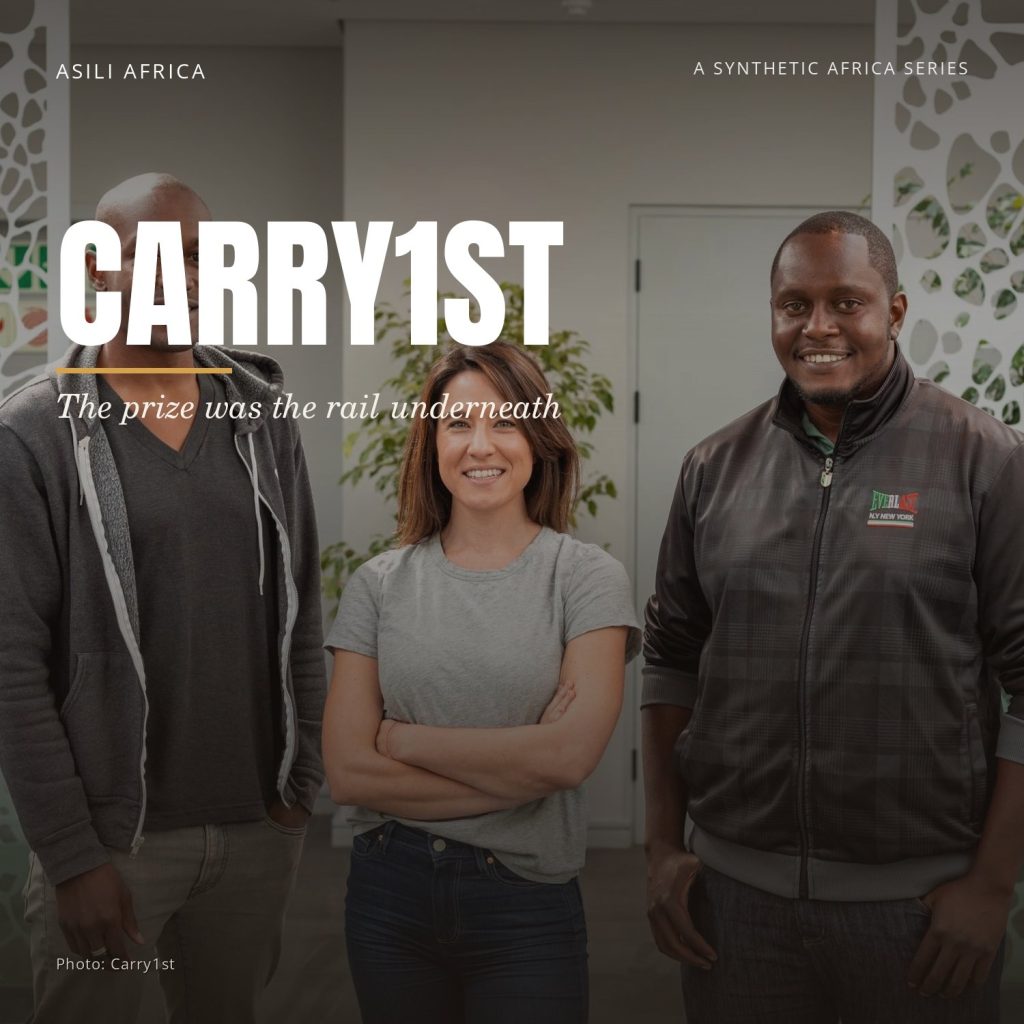
The Carry1st Story: A Sierra Leonean-American founder set up shop in Cape Town in 2018 and built
It is January, twenty twenty two. On Sand Hill Road in Menlo Park, California, the partners of Andreessen Horowitz are about to do something they have never done in the firm’s thirteen year history. They are about to lead an investment round in a company that is headquartered on the African continent.
The company is in Cape Town. It is four years old. It publishes mobile games. The cheque is for twenty million United States dollars.
The man who built it was, thirty years earlier, a four year old boy being carried out of Sierra Leone by his mother. The civil war that would last for a decade and become one of the most brutal conflicts in Africa’s recent history was just beginning. Cordel Robbin-Coker would grow up in the United States, win a scholarship to Stanford, spend a decade at Morgan Stanley and at the Carlyle Group running African private equity. And then he would walk away from all of it to start a games company in a country he had not grown up in, in an industry that did not yet exist on the continent, betting that three hundred million African gamers were waiting for someone to build them a way to play.
But here is the twist. By the time the Andreessen Horowitz cheque cleared, Carry1st was no longer really a games company. It had spent four years discovering, the hard way, that the real prize in African gaming was not the games. It was the payment rail underneath. And in trying to publish games that nobody could pay for, Cordel Robbin-Coker and his cofounders had accidentally built one of the most ambitious payments infrastructure plays on the continent.
This is the story of a refugee, a thesis, and the gaming company that became a payments company by accident.
THE ORIGIN
Cordel Robbin-Coker was born in Freetown, Sierra Leone. It is a small West African country, with one of the most beautiful coastlines on the continent, and one of the most violent recent histories. In nineteen ninety two, when Cordel was four years old, his mother decided it was time to leave. The civil war that would soon define the country, fueled by the international trade in blood diamonds, was tightening its grip. She took Cordel and his older sister out of Sierra Leone and resettled them in the United States. The war back home would last another ten years.
Cordel grew up American. He went to Stanford on a Morgan Stanley scholarship and graduated with a degree in Political Science. He won the Dean’s Award for Academic Excellence. And in two thousand and eight, the year Lehman Brothers collapsed, he took a job as an investment banking analyst at Morgan Stanley in New York. Three years later, he moved to the Carlyle Group, one of the largest private equity firms in the world.
At Carlyle, Cordel found something close to a calling. He spent seven years moving between the United States and Africa, eventually becoming a Vice President in the Carlyle Sub Saharan Africa Fund. That fund was seven hundred million dollars in size. It was the first dedicated Africa private equity fund ever raised by a major global private equity firm. Cordel helped form it. He helped deploy it. And by the time he left, he had developed a thesis that he could not shake.
The thesis was this. Africa had over eight hundred million young, mobile first consumers. The median age on the continent was under nineteen. Smartphones were spreading faster than electricity in many places. And almost nothing built for them, no localised content, no localised payments, no localised entertainment infrastructure, existed at any meaningful scale. The closest historical analogue was Southeast Asia in the early twenty tens. And there, a company called Sea Group, with a subsidiary called Garena, had taken the same demographic and built a thirty five billion dollar gaming and payments empire out of it.
Garena had published mobile games for young Southeast Asian players, owned the distribution layer, and built the payment rails underneath. Cordel looked at the African map and saw the same setup. Three hundred million potential gamers. No publisher serving them. No payment system reaching them. A continent waiting for somebody to do the work.
In May twenty eighteen, after seven years at Carlyle, Cordel resigned.
He brought in two cofounders. Lucy Hoffman, an American who had been with him at Morgan Stanley, had a History degree from Dartmouth, and had spent the post banking years building Africa focused education and business projects, including the African Leadership Academy in Johannesburg. She would be Chief Operating Officer. And Tinotenda Mundangepfupfu, a Zimbabwean software engineer, would be Chief Technology Officer, building the publishing platform and the payment engine from the ground up.
They set up in Cape Town. The choice was strategic. South Africa had the deepest pool of mobile engineering and financial services talent on the continent. The time zone overlapped with both Europe and the rest of Africa. The fintech ecosystem was already mature, with companies like Yoco and Luno and the Naspers alumni network. And it was, very simply, a soft landing for a startup that was going to need every advantage it could get.
The company they were building was called Carry1st. The name was a small joke. To carry the one is what you do in addition when the column overflows. The idea was that Africa was the overflow that the global gaming industry had failed to count.
THE STRUGGLE
The first two years were brutal. From twenty eighteen through twenty twenty, Carry1st built what was, on paper, the African continent’s first proper mobile games publishing platform. They signed up local studios. They picked up titles like Mancala Adventures, built by an Ethiopian studio called Qene Games. They published Mine Rescue. They licensed SpongeBob, Krusty Cook-Off. They published Match League and Football Clash. The portfolio was hybrid casual, which is industry shorthand for games that anyone can play, that monetise through small in app purchases, and that work on cheap Android phones with intermittent connectivity.
The investor reaction was hostile. The phrase Cordel and Lucy heard over and over again in venture meetings was African ARPU. ARPU stands for Average Revenue Per User. The accepted Silicon Valley wisdom was that African gamers would never spend enough money in app to justify the cost of building a publishing business around them. The market was too small. The customers were too poor. The piracy was too rampant. The infrastructure was too unreliable. Every objection had a number attached to it.
And then Carry1st discovered the real problem. The real problem was not that African gamers would not spend. The real problem was that they could not spend. When a Nigerian teenager wanted to buy a skin in a Carry1st published game, the only payment options the global publishers had wired in were international Visa and Mastercard and PayPal. None of which worked for most Nigerian teenagers. M-Pesa worked in Kenya. Paystack and Flutterwave and OPay worked in Nigeria. Electronic fund transfer worked in South Africa. Fawry worked in Egypt. Orange Money worked across francophone West Africa. None of them talked to each other. None of them had a single integration. None of them were wired into a single global games publisher.
The continent had more than two hundred and seventy mobile wallets, more than five hundred banks, multiple card networks, all spread across fifty five countries, and no single application programming interface to bridge them. Building one was not on Carry1st’s road map. It was not what they had told their investors they were going to build. It was a forced detour. But it was also, suddenly, obvious. If they did not build the payments rail themselves, every game they published would hit the same wall at the moment of monetisation. The wall between a player who wanted to pay, and a publisher who could not figure out how to collect.
In late twenty twenty, the team began quietly building. They called it Pay1st. The premise was simple. One integration for a global publisher. On the other side, every meaningful African payment method, wired in country by country, wallet by wallet, bank by bank. The work was grinding. Each country needed its own regulatory filings. Each wallet needed its own technical handshake. Each bank had its own settlement rhythm.
In May twenty twenty one, while Pay1st was still in early build, Carry1st closed a six million dollar Series A. Konvoy Ventures led it. Riot Games, the publisher of League of Legends and the company that would later publish VALORANT, came in as a strategic investor. It was the first signal from a top tier global games publisher that an African publishing partner might actually matter. But six million dollars was not going to build a continental payments rail. The clock was running.
In December twenty twenty one, the first external validation arrived. Pay1st announced partnerships with PayPal and with the African fintech Chipper Cash. The story was no longer a games pitch with a payments side bet. It was a payments pitch with games as the wedge. And the venture world started to pay attention.
The phone rang in Cape Town a few weeks later.
THE PIVOT
The call was from Andreessen Horowitz. Inside venture capital, the firm is usually shortened to a16z. Founded in two thousand and nine by Marc Andreessen and Ben Horowitz, the firm had built a reputation for being early into category defining companies. Facebook. Airbnb. Coinbase. Stripe. By twenty twenty two, a16z had tens of billions of dollars under management. What they had not done, in thirteen years of investing, was lead a round in a company headquartered on the African continent. Not once.
In January twenty twenty two, that changed. Andreessen Horowitz led a twenty million dollar Series A extension into Carry1st. David Haber and Jonathan Lai, two general partners at the firm, joined the board as observers. The Avenir growth fund and Google came in alongside. So did a list of angel investors that read like a tour of the global digital economy. The rapper Nas. Aleksander Larsen, cofounder of Axie Infinity. Gabby Dizon, cofounder of Yield Guild Games. Ham Serunjogi and Maijid Moujaled, the cofounders of Chipper Cash.
In the African startup ecosystem, the announcement was a milestone. Andreessen Horowitz had finally crossed the threshold. And the company they had picked to do it with was not a payments company, or a fintech, or a logistics business, which were the usual African venture darlings. It was a four year old games publisher in Cape Town.
But there was a problem hidden in the cap table. Several of the angel investors who came in with Andreessen Horowitz were leading figures in what was then called play to earn gaming. Axie Infinity. Yield Guild Games. The idea was that players in emerging markets would earn crypto tokens by playing games, and that those tokens would translate into real income. For a few months in twenty twenty one and early twenty twenty two, it looked like the future. Carry1st signaled, publicly and quietly, that it was exploring the model.
And then it died. The Terra crypto ecosystem collapsed in May twenty twenty two. The exchange FTX collapsed in November of the same year. Axie’s economy unraveled. The phrase play to earn became a punchline. Inside Carry1st, the team made a quiet decision. They would not chase the trend into the ground. They would take what was real from the crypto narrative, the stablecoin settlement layer, the cross border value transfer, and they would fold it into Pay1st as plumbing. They would stop talking about play to earn entirely. They would refocus, all the way, on the fiat rail.
In twenty twenty two, the bet started paying off. Activision struck a partnership with Carry1st that allowed South African players of Call of Duty Mobile to buy in game currency and battle passes through Pay1st. It was the first time a top tier global games publisher had given an African company exclusive payments rights in an African market. The deal was a proof point. Pay1st could service the largest mobile games in the world.
In January twenty twenty three, Bitkraft Ventures, the most prestigious dedicated games venture firm in the world, led a twenty seven million dollar pre Series B round. Andreessen Horowitz came back in. Konvoy doubled down. The total capital raised crossed fifty million dollars. The pivot was complete. Carry1st was a payments company that happened to have started in games.
THE SCALE
In August twenty twenty three, Riot Games launched local VALORANT servers in South Africa. For the first time, South African players could compete at competitive latency on one of the most popular shooting games in the world. The payment partner was Pay1st. By the end of the year, Carry1st was reporting that Call of Duty Mobile transaction volumes through Pay1st had grown six times year over year.
In January twenty twenty four, Sony Innovation Fund made an inaugural investment from a new vehicle it called Sony Innovation Fund Africa. Carry1st was the first cheque. Sony, the company behind PlayStation, the second largest games platform in the world by revenue, had picked Cape Town as the entry point for its African strategy. Cordel and the team were no longer pitching their continent’s relevance. They were the relevance.
In twenty twenty four, Fast Company named Carry1st to its Most Innovative Companies list. The framing in the article was telling. Carry1st was no longer described as a games publisher. It was described as the company building the consumer payments infrastructure for digital Africa.
In October twenty twenty four, the framing got its proof. Carry1st announced a partnership with Audiomack, the music streaming platform with tens of millions of African listeners. Pay1st would power local currency subscription payments across twelve African markets. Music streaming had nothing to do with games. And yet the same rail that processed Call of Duty Mobile micro transactions could now process monthly Audiomack subscriptions, in naira, in cedis, in shilling, in rand. Pay1st had graduated.
In January twenty twenty five, Carry1st announced its first move outside the African continent. The partner was a Middle Eastern publisher called Stellar Gate Games. The game was Blood Strike MENA, a mobile shooter targeted at the Middle East and North Africa gaming market. Pay1st would be the payments backbone. For a company that had defined itself as Africa’s gaming and payments platform, the move into the Middle East and North Africa was a statement of ambition. The Garena of Africa wanted to be the Garena of the broader emerging consumer world.
In February twenty twenty five, Carry1st copublished the Africa Gaming Report twenty twenty four with the global market intelligence firm Newzoo. The headline numbers landed hard. Africa’s gaming market had reached one point eight billion dollars in revenue. It had grown twelve point four percent year over year, which was six times the global gaming industry’s growth rate of two point one percent. There were now three hundred and forty nine million gamers on the African continent. Egypt led at three hundred and sixty eight million dollars in revenue. Nigeria followed at three hundred million. South Africa at two hundred and seventy eight million. The “Africa is too small” objection that Cordel had been hearing in venture meetings six years earlier was no longer credible.
By the end of twenty twenty five, Carry1st had raised sixty five point five million dollars across seven funding rounds. The headcount had crossed one hundred and seventy five employees, distributed across twenty eight countries. More than two million African gamers were active on Carry1st published titles every month. And Pay1st had stitched together more than one hundred and twenty local payment methods across six core African markets, with broader coverage extending across twelve countries, and the first Middle East integration live.
TODAY AND TOMORROW
Today, in twenty twenty six, Carry1st sits at a strange and powerful inflection point. The pivot that almost no other African startup has executed cleanly, from a single product line into the rail underneath every other digital business on the continent, has produced something that did not exist eight years ago. A consumer payments platform with gaming relationships, music streaming relationships, and the credibility to expand into the Middle East. The original Garena thesis has held. The continent has shown up.
And the macro tailwind has turned out to be even stronger than the founding thesis. Sub Saharan Africa now leads the world in stablecoin adoption, with nine point three percent of residents holding dollar denominated digital tokens. Nigeria leads the global ranking, with eleven point nine percent of its population, roughly twenty five point nine million people, using stablecoins regularly. In twenty twenty four, stablecoins accounted for forty three percent of all crypto transaction volume in Sub Saharan Africa. For a payments rail that can settle in stablecoins on the back end while accepting mobile money on the front end, this is the most generous tailwind imaginable. Pay1st is built for exactly this moment.
But the rest of the world has noticed. In twenty twenty five, Stripe acquired the stablecoin infrastructure company Bridge and rolled out stablecoin financial accounts to more than one hundred countries, including across Africa. The implication is uncomfortable. The competitor sitting opposite Pay1st now has a balance sheet measured in tens of billions of dollars and a global brand that even African banks have integrated with. Carry1st’s defence, the local payment method coverage, the gaming relationships, the on the ground presence in Cape Town and Lagos and Nairobi, is real. The question is whether it is durable.
There is also a Sony question. The inaugural Sony Innovation Fund Africa investment was a vote of confidence. But Sony is a slow moving corporate partner. Converting that vote into PlayStation distribution in African markets, or into Sony first party IP partnerships, is the next real test of the relationship.
And there is a final, larger question. Carry1st has not yet raised a proper Series B. The market is watching to see whether the company files for one, whether it becomes a strategic acquisition target for a Tencent, a Sea Group, or a Sony, or whether it does what the founders have always said they wanted to do, which is build the independent African champion in its category, the way Garena built it for Southeast Asia.
For Cordel Robbin-Coker, the kid from Freetown who was carried out of a civil war at four years old, the next chapter is no longer about whether African gamers will spend. They are spending. It is about whether the company he and Lucy and Tinotenda built can stay in front of the rail that the entire continent is now running on.
In nineteen ninety two, a four year old boy was carried out of Sierra Leone. In twenty eighteen, he carried a thesis back to the continent. In twenty twenty two, the world’s most famous venture firm made him their first African bet. And today, in twenty twenty six, the payments rail he built by accident carries three hundred and forty nine million gamers, a music streaming platform, and a continent’s worth of stablecoin settlement on its back. The next chapter is already being written, one transaction at a time.
This is Asili Africa. Every empire has an origin.
Key Takeaways
- THE ORIGIN. Cordel Robbin-Coker was born in Freetown, Sierra Leone.
- THE PIVOT. The call was from Andreessen Horowitz.
- THE SCALE. In August twenty twenty three, Riot Games launched local VALORANT servers in South Africa.
- TODAY AND TOMORROW. Today, in twenty twenty six, Carry1st sits at a strange and powerful inflection point.
Also available on YouTube — search “Asili Africa” or subscribe to our channel.