
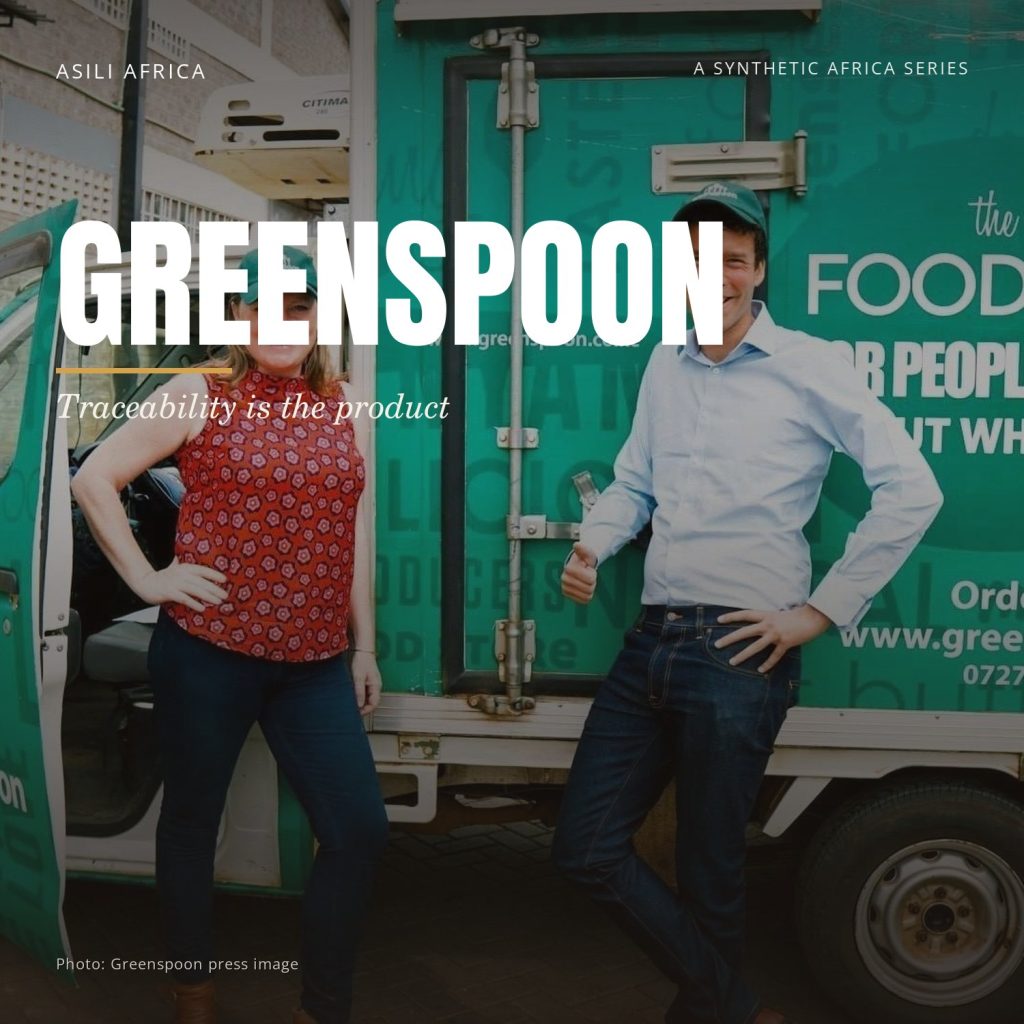
The Greenspoon Story
In a Nairobi kitchen, in two thousand and sixteen, a young mother named Juliet Kennedy was weaning her first child. She had done what any new mother in Nairobi does. She had walked into a supermarket. She had picked up carrots, pumpkin, spinach, chicken. She had brought them home. And now she was standing at her own countertop, holding a bowl of food she was about to feed to her baby, and realising, for the first time, that she did not actually know where any of it had come from.
She did not know which farm the carrot had grown on. She did not know which chemicals had been sprayed on the pumpkin, or how long ago. She did not know whether the chicken had spent its life in a shed or a yard. She did not know the name of the person who had picked the spinach, or the county it had come from, or the season it had been planted. And the supermarket she had bought it from, the largest formal retailer she had access to, could not tell her either. Because the Kenyan grocery supply chain, in two thousand and sixteen, was not organised to answer that question.
Ten years later, in Nairobi in mid twenty twenty six, Juliet Kennedy runs the online supermarket she built to answer that question. It is called Greenspoon. It is the first online retailer in Africa to hold B Corporation certification. It is the incumbent Kenyan online grocery brand of record. It is the one that is still standing while two of its much larger, much better funded competitors have collapsed or entered permanent crisis. And it began, literally, in this kitchen.
THE KITCHEN
To understand how Greenspoon came into being, we have to sit inside the kitchen of a specific Nairobi household in twenty sixteen. Juliet Kennedy was a Kenya-based mother, in her thirties, weaning her first child. Her pre-Greenspoon career is not extensively documented in the public record, and Kennedy herself has never made a great deal of it. The origin story she tells, consistently, over almost a decade, is not a boardroom story or a business school story. It is the story of a specific moment, at a specific kitchen counter, over a specific bowl of pureed food that she was about to feed to her daughter, when she realised that the food supply she was operating inside did not owe her an answer to the most basic question. Where did this come from.
Kennedy’s response was not a campaign. It was not a petition. It was a spreadsheet. She began to identify individual producers in and around Nairobi whom she trusted, at the level of the specific farm, the specific animal, the specific processing standard. Mlango Farm for vegetables. Brown’s Cheese for dairy. Farmer Max Chicken for poultry. Sunripe and Olkerii Farm for fresh produce. Tamalu and Forest Foods for specialty and forest sourced ingredients. Members of the Kenya Organic Agriculture Network for certified organic produce. That spreadsheet became the founding product catalogue of Greenspoon.
The first Greenspoon orders were placed by neighbours and friends, over WhatsApp. The first deliveries were made in Kennedy’s own vehicle. There was no company, in any meaningful legal sense, for the first months. There was one mother, a spreadsheet, a car, and a small growing circle of Nairobi households who had heard, from her, that there was a way to buy food you could actually trace. Greenspoon in twenty sixteen was not a business. It was a public health intervention operating at the scale of one neighbourhood.
Through twenty seventeen, twenty eighteen and twenty nineteen, Greenspoon grew slowly. It took a small physical warehouse in Hardy. It moved from spreadsheet and WhatsApp to a proper website at greenspoon dot co dot k e. It hired its first employees. It expanded its producer network from the initial handful to something in the low dozens. The customer base was a specific slice of Nairobi. Middle income and upper income households. Young families. A strong skew to expatriates and returning diaspora Kenyans. People who shared a particular willingness to pay a premium for traceable, organic leaning food. It was a niche. It was profitably serving that niche. And it was, at that point, still one of thousands of small Kenyan food businesses that had never crossed onto the national radar.
Twenty twenty changed the arithmetic. When COVID nineteen arrived in Kenya in March, home delivery of groceries went from a Nairobi convenience to a household imperative. Greenspoon’s order volume grew rapidly through twenty twenty and into twenty twenty one. Later interviews with the company have described the constraint of that period bluntly. The demand was there. The infrastructure was not. The Hardy warehouse had run out of picking capacity, and the small delivery fleet had run out of vehicle hours in the day. For the first time in the company’s history, Greenspoon had a problem that it could not solve out of the founder’s own effort. It needed capital.
THE DUTCH ROUND
The capital came from an unusual place. Not Silicon Valley. Not the London or Nairobi private equity circuit. Amsterdam. In September twenty twenty one, Greenspoon closed its first outside capital round. The lead investor was a Netherlands-based investment vehicle called The Blue Link. Blue Link was already an unusually specific kind of Kenya investor. Its Kenyan portfolio, before Greenspoon, included Bio Food Products, the Nairobi premium dairy business. Highlands Drinks, the Nyeri juices and beverages producer. And Maxim Agri Kenya, the Dutch parent agricultural inputs and services business founded in Nairobi in two thousand and seven. Blue Link was not a generalist venture fund. It was a Dutch food industry investment group that had, over a decade, developed a deep operating conviction on Kenyan agriculture.
The amount of the round was not disclosed. Independent estimates in the Kenyan business press put it in the low single-digit millions of United States dollars. What was disclosed was the use of proceeds and the commitment attached to it. The proceeds would fund three things. A new, much larger warehouse in Regen, in Kikuyu, Kiambu County, replacing the Hardy site. A new mobile application and a modernised back end for the technology platform. And a sustainability infrastructure programme, including an electric vehicle delivery fleet and a redesigned packaging system. The commitment attached to the round was to create three hundred new jobs at Greenspoon over the following five years.
Two operating hires arrived with the round. Alexander Osinga, previously Chief Operating Officer of Bio Food Products, took over Greenspoon’s operations. His mandate was warehouse throughput, procurement, and fleet. Aleeda Fazal, the founder of the Nairobi software agency Digital Tangent, took over technology. Her brief was to build the Greenspoon Kenya mobile application, which would launch in June twenty twenty two, and to modernise the back end. Kennedy remained Chief Executive Officer, refocusing on the customer, product, and marketing side of the business. The company was, structurally, becoming something it had not been before. A three-person leadership team, operating in three specialisms, working from a shared operating vocabulary that had been imported from Bio Food Products and the Dutch food industry.
By the middle of twenty twenty two, Greenspoon had physically relocated to Regen, in Kikuyu, Kiambu County. The new warehouse had roughly ten times the picking capacity of the Hardy site. The mobile application had launched, with payment integrations for M-PESA, PesaPal, and iPay, and would pass ten thousand Google Play downloads by December twenty twenty three. The producer network had grown from dozens to hundreds. The stock keeping unit count had passed two thousand and was climbing steadily toward four thousand. And the sustainability infrastructure had, by twenty twenty three, put three electric vans and four electric motorbikes on the road, making Greenspoon the first Kenyan online grocery with an electrified last mile fleet.
In twenty twenty two, Greenspoon received B Corporation certification. Its B Impact assessment score was eighty three point five, above the certification threshold of eighty. Greenspoon was, and remains as of twenty twenty six, the first online retail business in Africa to hold the mark. That is not a marketing line. It is the operational expression of the founding thesis. If the reason the company exists is that a mother could not trace the food she was giving to her child, then the company has to be, in its supplier practices, its packaging, its logistics, its employment terms, its energy footprint, and its board governance, the kind of company that another mother, ten years later, could actually audit. B Corp is the audit.
By late twenty twenty three, Juliet Kennedy had been named Top Woman Chief Executive Officer of the Year at the KPMG Business Daily Top One Hundred Mid-Sized Business Awards. Greenspoon had placed third in the Sustainability category at the same event. CNN Inside Africa had run a feature on the business. And, in March twenty twenty three, Business Daily had reported that Greenspoon had mandated Bravura Capital, a Nairobi advisory firm, to advise on a proposed five million United States dollar Series A raise for regional expansion beyond Kenya. That round, as of mid twenty twenty six, has not been publicly announced as closed. Greenspoon has, in other words, grown for the two most recent years on the strength of the twenty twenty one Blue Link round and its own operating cash flow.
THE COMPETITORS WHO DID NOT MAKE IT
The story of Greenspoon between twenty twenty three and twenty twenty six cannot be told without the story of the two companies it was competing with, and how they died. The first is Copia Global. The second is Twiga Foods. Together they had raised, over the previous decade, more than three hundred million United States dollars from a combination of Silicon Valley venture capital, London-based growth funds, development finance institutions, and, in Twiga’s case, Goldman Sachs. That is roughly one hundred times the plausible amount of the Blue Link round that financed Greenspoon.
Copia was founded in twenty thirteen with an unusually specific thesis. The rural Kenyan household, seventy per cent of the country by population, was buying its daily consumables from a mixture of small dukas, mama mboga stalls, and open markets. Copia would build a network of village-level agents who could take orders from rural households and get products delivered from a Copia warehouse to the village agent within days. The model was structurally admirable and structurally hard. Rural customers ordered less frequently. Basket sizes were smaller. Logistics costs per delivery were higher. And the trust infrastructure required to make the model work at scale had to be built one agent at a time across thousands of villages. Copia raised approximately one hundred and twenty three million United States dollars over eight rounds between twenty thirteen and twenty twenty three. In May twenty twenty four, Copia entered administration. By July twenty twenty four, the company was in liquidation. Delivery trucks, warehouses, and office equipment were being sold to pay creditors. The employer had laid off approximately one thousand and sixty people that June. The African tech commentary that followed the collapse converged on a single observation. The rural online grocery model needed ten to twelve years of patient capital to reach profitability, and the venture capital that had funded it had run out of patience.
Twiga Foods was a different business, on a different thesis. Founded in twenty fourteen, Twiga was a business to business fresh produce and consumer goods distribution platform. It connected smallholder farmers in the Kenyan Highlands to the tens of thousands of small dukas across Nairobi that were, in turn, selling to the households that Copia had been trying to serve directly. Twiga’s thesis was that the intermediation layer between farmer and duka was inefficient, and that a technology-enabled distribution business could compress it. Twiga raised, over its life, more than twenty five billion Kenyan shillings, roughly two hundred million United States dollars. In late twenty twenty two, Twiga laid off twenty one per cent of its workforce. In August twenty twenty three, it laid off two hundred and eighty three more. In March twenty twenty four, founder Chief Executive Officer Peter Njonjo exited the company after a thirty five million United States dollar raise. In August twenty twenty four, another fifty nine employees were let go. And in May twenty twenty five, the company announced a full restructure internally labelled Project Easter, creating a new holding company and executing further layoffs of more than three hundred employees, of a four hundred and thirty five person base. Two thirds of the workforce, in a single restructure.
That is the frame inside which Greenspoon has been operating for the last two years. Two much larger, much better funded, much louder Kenyan online commerce companies raised, between them, upwards of three hundred million United States dollars, and, when the twenty twenty three and twenty twenty four African tech funding contraction came, both broke. Greenspoon, financed by a Dutch food investor group and its own cash flow, in the low single-digit millions of dollars, did not break. It grew ninety six per cent in twenty twenty three, in the middle of the same contraction. That is not because Greenspoon is smarter than Copia or Twiga. It is because Greenspoon is a fundamentally different kind of business, financed by a fundamentally different kind of capital, aimed at a fundamentally different customer.
WHAT IS ACTUALLY DIFFERENT ABOUT GREENSPOON
Three things separate Greenspoon from the companies that failed around it. Not one thing. Three, all at once. Each one, on its own, would not be enough. Together, they are what has kept Greenspoon alive.
The first is the customer. Copia was serving a rural household. Low income. Highly price sensitive. Ordering infrequently. That is a structurally hard customer. Twiga was serving small dukas with thin margins. Also structurally hard. Greenspoon serves an upper-middle-income Nairobi household with a specific willingness to pay a premium for traceable food. That is a structurally easier customer. Basket sizes are larger. Order frequency is higher. Delivery windows are shorter. Price sensitivity is lower. Customer retention is higher. None of those things is a moral judgement. They are the arithmetic of the unit economics. Greenspoon’s unit economics work because Greenspoon’s customer is the customer whose unit economics work.
The second is the capital. Copia was funded by a mixture of Silicon Valley venture capital, London growth capital, and development finance. Twiga was funded by a similar mixture, plus Goldman Sachs. That capital, by construction, needs to see a venture-scale return, and it needs to see it inside a ten year fund life. That means growth. That means scaling in advance of profitability. That means the blitzscale playbook, run as an operating discipline, until you either hit escape velocity or run out of runway. Greenspoon was funded by The Blue Link, a Dutch food industry investment vehicle that already owned parts of Bio Food Products, Highlands Drinks, and Maxim Agri Kenya. Blue Link does not need Greenspoon to be a venture-scale outcome. Blue Link needs Greenspoon to be a durable, profitable food business. That is a fundamentally different set of instructions to give a founder.
The third is the founder. Njonjo left Twiga in March twenty twenty four. Copia’s leadership team saw multiple churns before the administration. Greenspoon has been run by Juliet Kennedy for ten years, and, in mid twenty twenty six, is still being run by her. The specific traceability instinct that made a mother in a Nairobi kitchen in twenty sixteen decide that the food supply chain was broken is the same instinct that runs the buying decisions of the company today. Founder continuity is not the whole story. But in this cohort, in this ten year window, in this specific market, it has correlated with survival.
The three things reinforce each other, and the mobile application is the operational surface on which they meet. When a Greenspoon customer taps on a bag of spinach in the app, they see the name of the farm, the name of the farmer, the harvest date, and a short description of the growing practices. That interface pattern is not a marketing feature. It is the founding thesis, rendered as software. It is also the reason the upper-middle Nairobi customer keeps coming back. Because no other Kenyan online grocery, no matter how much venture capital they raised, has been willing to make traceability the product.
TODAY AND TOMORROW
Today, at the beginning of July twenty twenty six, Greenspoon operates out of a single warehouse in Regen, Kikuyu, Kiambu County. It employs somewhere between one hundred and two hundred people. It runs a catalogue of over four thousand stock keeping units, sourced from a producer network of hundreds of farms and artisan producers. It delivers over seventy five thousand orders per year. It runs a delivery fleet that includes three electric vans and four electric motorbikes. It holds Africa’s only B Corporation certification for an online retailer. Its Chief Executive Officer is the same person who founded it, in her kitchen, ten years ago.
The public commitment attached to the twenty twenty one Blue Link round was three hundred new jobs at Greenspoon over five years. That target places the workforce at roughly three hundred and fifty to four hundred and fifty people by the end of twenty twenty six or the middle of twenty twenty seven. Multiple third-party data sources put the current workforce in the one hundred to two hundred band. That gap will either close in the next twelve to eighteen months, if the twenty twenty three Series A closes and regional expansion accelerates, or narrow to a slower cadence if Greenspoon chooses depth in Nairobi over breadth into East Africa. The gap is a real live operational question about the next chapter.
The March twenty twenty three Series A is the other real open question. Bravura Capital was mandated to advise on a five million United States dollar raise, or roughly six hundred and forty million Kenyan shillings, to fund regional expansion. Twenty six months later, no closing announcement has been made. Three readings are possible. The round closed quietly, and Greenspoon and its Dutch investor group chose not to announce it. The round was scaled down or restructured, in the difficult twenty twenty three and twenty twenty four African tech funding environment. Or the round did not close, and Greenspoon has grown for two years on internal cash flow and previous round proceeds. All three readings are consistent with what is publicly observable. The definitive answer is not on the public record. What is on the public record is that Greenspoon, whatever the round status, is still growing.
The competitive frame in mid twenty twenty six is unusual because the online-only segment of Kenyan grocery has effectively collapsed to Greenspoon and a handful of small competitors. Naivas and Quickmart have delivery arms that are not their primary business. Copia is dead. Twiga is a business to business platform, not a consumer offering, and is in restructure. The upper-middle Nairobi customer served by Greenspoon has, in twenty twenty six, no functionally equivalent online-first alternative. That is a real market position. It is also a fragile one. Any of the four large formal retail chains, at any point, could invest seriously in an online offering aimed at the same customer. None of them, so far, has.
The single most striking financial fact about the Greenspoon story is the ratio between the capital deployed and the durability delivered. Copia raised roughly one hundred and twenty three million United States dollars and is dead. Twiga raised over two hundred million and is on its fourth wave of restructuring. Greenspoon raised, in the round the public record can point to, a plausibly low single digit million United States dollar cheque from a Dutch food investor, and is Kenya’s incumbent online grocery brand. That comparison is not a moral argument. It is not a claim that venture capital is wrong or that development finance is wrong. It is a specific observation about the shape of a specific ten year experiment in Kenyan online grocery. Two capital-heavy scale-first models did not survive. One capital-light patient model did.
The best measure of whether Greenspoon has worked is not the store count. Greenspoon does not have stores. It is not the venture capital raised. Greenspoon did not raise much. It is not the international expansion. Greenspoon has not yet done any. It is whether another mother in Nairobi, in twenty twenty six, standing at her own kitchen counter, holding a bowl of food she is about to feed to her child, can answer the question that Juliet Kennedy could not answer in twenty sixteen. Where did this come from. If she can — if she can tap on her app and see the name of the farm and the name of the farmer and the harvest date and the growing practice — then Greenspoon has already done, at the household level, what the last ten years were designed to do. The rest is scale.
In two thousand and sixteen, a mother in a Nairobi kitchen realised that she could not trace the food she was about to feed to her daughter, and decided to build a company that could. Ten years later, at the beginning of July twenty twenty six, that company, Greenspoon, is the incumbent online grocery brand of Kenya, holds Africa’s only B Corporation certification for online retail, and has outlasted two much larger, much better funded competitors that raised more than three hundred million United States dollars between them. The mother who founded it is still the Chief Executive Officer. The traceability question that started it is still the product. The next chapter, the regional expansion, the second round of capital, the workforce climbing from one hundred to a target of three hundred, has not yet been written. But the ten year experiment is over. And the answer, so far, is that patient capital, a founder who stays, and a customer whose unit economics work, will beat blitzscale in Kenyan online grocery every time.
This is Asili Africa. Every empire has an origin.
Key Takeaways
- THE KITCHEN. To understand how Greenspoon came into being, we have to sit inside the kitchen of a specific Nairobi household in twenty sixteen.
- THE COMPETITORS WHO DID NOT MAKE IT. The story of Greenspoon between twenty twenty three and twenty twenty six cannot be told without the story of the two companies it was competing with, and how they died.
- WHAT IS ACTUALLY DIFFERENT ABOUT GREENSPOON. Three things separate Greenspoon from the companies that failed around it.
- TODAY AND TOMORROW. Today, at the beginning of July twenty twenty six, Greenspoon operates out of a single warehouse in Regen, Kikuyu, Kiambu County.
Also available on YouTube — search “Asili Africa” or subscribe to our channel.