
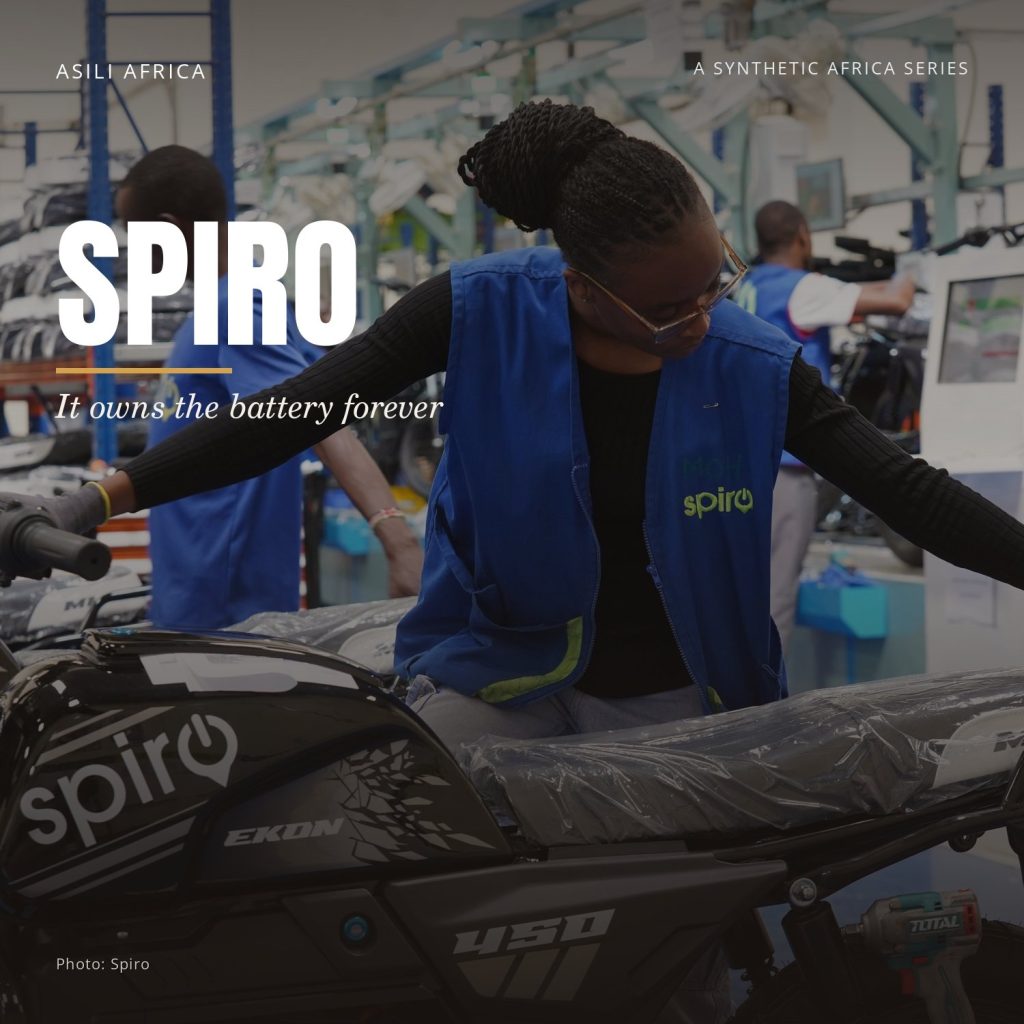
The Spiro Story: A serial Indian-African entrepreneur set up an electric-motorcycle company
On the first of June, twenty twenty six, a small West African startup that almost no global venture capitalist had heard of five years earlier announced a two hundred and fifteen million dollar funding round. The lead investors were Impact Fund Denmark and an Abu Dhabi private equity firm called Equitane. Three weeks later, on the twenty second of June, a Chinese investor called NewTrails Capital wrote a follow on cheque of fifty five million dollars. Total disclosed capital crossed five hundred and fifty seven million dollars. The valuation pushed close to one billion dollars. It was the largest single cycle commitment to an African electric vehicle company in history.
The company being capitalised was Spiro. One hundred thousand electric motorcycles deployed across seven countries. Two thousand five hundred battery swap stations. Thirty million swaps completed. One billion zero emission kilometres covered. And the answer to a question that, in twenty nineteen, almost no one in global venture capital was asking out loud: what if the most important electric vehicle market in Africa was not in Lagos, or Nairobi, or Cape Town, but in a country of nine million people on the Gulf of Guinea, called Togo.
This is the story of an Indian born industrialist who already had a port, an industrial zone, and the president’s phone number in two small Francophone countries, and who decided to use that infrastructure to build the largest electric vehicle company on the African continent.
THE ORIGIN
To tell the story of Spiro, we have to start with a man whose name almost no consumer in Africa knows. His name is Gagan Gupta. He was born in Rajasthan, in the north of India, in May of nineteen seventy five. He went to Delhi University for a degree in commerce. He sat for the All India examination of the Institute of Chartered Accountants and finished with a national rank. He started his career, like a generation of Indian commodities professionals before him, inside Olam International, the Singapore listed agricultural commodities major.
In two thousand and nine, Olam sent him to Gabon to run its small, loss making subsidiary there. He was thirty four years old. Over the next eight years, that subsidiary became the single largest investment platform Olam operated anywhere on the African continent. Gupta did not build a trading desk in Libreville. He built ports. He built special economic zones. He built rubber and palm processing facilities. He built railways. He turned the question of how to make money in African commodities into a much bigger question. Who owns the infrastructure underneath the trade? Because, in Africa, the answer was, often, no one. And the person who built it could, very plausibly, own the next thirty years of every industry that ran on top of it.
In twenty eighteen, Gupta left the operational side of Olam and founded his own company. He called it Arise. The thesis was direct. Africa lacked the basic industrial backbone that the rest of the world took for granted. There were not enough special economic zones. There were not enough deepwater ports with proper customs. There was not enough reliable power for export grade manufacturing. Arise was going to build that backbone, country by country, working hand in hand with governments. Within five years it would be operating in fourteen African countries.
Two of those countries were small Francophone West African states most outside investors barely tracked. In Togo, Arise built and operated the Adetikope industrial platform, a full service zone with its own power, customs, and logistics. In Benin, Arise built the Glo Djigbe industrial zone, a similar full service complex. By the time most of the world had heard of either project, Gupta personally had the direct mobile numbers of the presidents of both countries.
In twenty nineteen, sitting on top of that infrastructure platform, Gupta and his Abu Dhabi based private equity vehicle, Equitane, founded a new company. It was called M Auto Electric. The thesis came from a single observation about African urban transport. Across the continent, roughly thirty million informal commercial riders, the boda boda riders of East Africa, the okada riders of Nigeria, the moto taxi drivers of Francophone West Africa, collectively burned around thirty billion dollars a year in petrol. They earned, on average, only about one third of their fare income net of fuel and repair. If a company could collapse that fuel and maintenance line item for those riders, it could create both a consumer surplus and a recurring revenue stream, in the largest informal transport market on the planet.
The product template was already proven. A Taiwanese company called Gogoro had spent the previous decade building a battery swap network for scooters in Taipei. Riders did not charge their bikes. They swapped batteries at small stations on every street corner. The economics had been validated. What had not been done was porting that model to a low grid, high dust, subtropical operating environment, on a continent where the global venture capital industry had built almost nothing in two wheeler infrastructure.
And there was one more piece. In March of twenty twenty two, the Togolese government scrapped import duties on electric vehicles. It was, at the time, one of the most aggressive electric vehicle import regimes anywhere in Africa. Two and a half years later, the same government would go further and exempt electric vehicles from value added tax entirely. The Beninese government provided matching incentives. M Auto, sitting on factory space inside Arise built industrial zones in both countries, suddenly had a regulatory tailwind that did not exist in any larger market on the continent. The story could begin in earnest.
THE STRUGGLE
The first problem was that the riders did not believe in the bikes. The boda boda and moto taxi economies of West and East Africa run on trust built up over decades. A rider knows what a Bajaj motorcycle is worth. He knows which mechanic on his street can fix a Chinese imported chassis. He knows roughly how much petrol he burns a day. He does not know what a lithium iron phosphate battery is, and he does not know what happens when, in the middle of a fare, his bike stops moving and he has to push it.
The early go to market answer was theatre. M Auto launched its first two production models, called the Chap Chap and the Commando, through music concerts in Benin and Togo. The product was rolled out in front of crowds, with cultural ambassadors riding them on stage. The financing model was designed to remove every objection a rider could raise. There was no upfront cost. The rider paid a daily swap fee of around three to five dollars, which covered electricity, maintenance, and insurance. After roughly one hundred and fifty thousand kilometres of riding, the bike was theirs.
In September of twenty twenty one, M Auto activated its first assembly line, inside the Adetikope industrial platform in Togo. By the second quarter of twenty twenty two, the Chap Chap and the Commando were on sale commercially in both countries. The early adoption curve was real, but the operating problems were brutal. Battery swap stations needed reliable electricity to recharge spares. In both Togo and Benin, the grid was not always reliable. M Auto began retrofitting swap stations with solar panels and battery storage, an expensive workaround that quietly turned the company into a small distributed energy operator.
Then there was theft. The batteries were the operationally critical asset, and they were also small, valuable, and easy to walk away with. M Auto built remote disable hardware into every battery, with GPS tracking. A battery that had not been swapped or charged within a defined window could be remotely flagged as stolen and rendered inert. That single design choice, made in the early years to protect the asset base, would later become one of the most controversial features of the entire model, in a country thousands of kilometres from Lomé.
The macro environment was not friendly either. M Auto’s components, the battery cells, the controllers, the motors, were imported. They had to be paid for in dollars or euros. The bike prices and the swap fees were set in local currencies. The CFA franc, used by both Togo and Benin, was pegged to the euro, but when the company expanded into Kenya and Nigeria, it would face two of the most volatile currencies on the continent. Every devaluation widened the gap between cost and revenue. The only way to fund through that gap was patient capital that did not need quarterly returns.
The patient capital arrived. In twenty twenty two, Equitane formally injected approximately eighty five million dollars of equity into the business. At the same time, the company was rebranded. M Auto Electric became Spiro. The new name signalled the wider ambition. The company was no longer a Togolese motorcycle maker. It was being positioned as a pan African platform that would own the energy and mobility layer underneath the continent’s informal transport economy.
In May of twenty twenty three, Societe Generale, the French global bank, signed a sixty three million dollar debt facility with Spiro. It was the first time a major international bank had directly underwritten an African electric two wheeler operator at scale. The capital would deploy fifteen thousand seven hundred bikes, thirty one thousand four hundred batteries, and more than a thousand swap stations. Spiro was no longer a regional experiment. It was being structured as a continental balance sheet. What it needed next was an operator who could actually run it at that scale.
THE PIVOT
That operator was named Kaushik Burman. He was an Indian executive, born in Kolkata, who had taken an unusual route to electric mobility. He had spent the first decade of his career at Tata Consultancy, then at Nestle, Citibank, and HSBC. He had then spent seven years at Shell, including as a founding member of Shell’s liquefied natural gas for transport team in The Hague, and as general manager of Shell Fleet Solutions across Singapore and Indonesia. In twenty nineteen, he had joined Gogoro, the Taiwanese battery swap pioneer, and spent four years building out their network across Indonesia, Singapore, the Philippines, and India.
In August of twenty twenty three, Burman joined Spiro as chief executive officer. The business he inherited had roughly eight thousand bikes deployed and roughly one hundred and fifty swap stations, across two small Francophone markets. The plan he was hired to execute was the opposite of cautious. He was to push the company into East Africa and into Nigeria, simultaneously, and to grow the fleet by an order of magnitude inside twenty four months.
In the same month Burman arrived, the twin assembly plants in Benin and Togo were formally launched. Within months, Spiro signed an asset financing partnership with Watu Credit in Kenya, allowing East African riders to access bikes on familiar daily payment terms. In April of twenty twenty four, Spiro entered Nigeria, the largest motorcycle market on the continent, with an expansion plan that covered Lagos, Abuja, Ogun, Oyo, Ibadan, Delta, and Kwara states.
In May of twenty twenty four, Afreximbank, the pan African export import bank, extended a fifty million dollar debt facility for East and West Africa expansion. That same month, TIME magazine named Spiro one of the one hundred most influential companies in the world. The company that, two years earlier, had been a small Togolese motorcycle assembler, was now on a global recognition list alongside OpenAI and SpaceX.
In September of twenty twenty four, the Nairobi assembly facility opened. By February of twenty twenty five, the company was reporting eighteen thousand bikes on the road, eleven million swaps completed, and four hundred and twenty eight million kilometres of carbon free riding.
In May of twenty twenty five, at the Africa CEO Forum, Burman walked on stage with one of the most famous human beings on the continent. The Afrobeats superstar Davido was unveiled as Spiro’s global brand ambassador. The company launched two limited edition models, the Davido Collectible and the Alpha Plus by Davido, the latter built around a twelve kilowatt motor with three hundred and twenty Newton metres of torque. Davido’s framing, on stage, was telling. He said his decision was not about how big the brand was. It was about the motive. About making electric bikes that looked cool to young Africans.
By the middle of twenty twenty five, the company that had been launched through music concerts in Cotonou was running assembly plants in six countries, financing partnerships in three, and a brand campaign fronted by one of the biggest pop stars on the planet. What it needed next was an institutional cheque big enough to lock in the model before competitors could catch up.
THE SCALE
That cheque arrived in October of twenty twenty five. A round of one hundred million dollars in equity, led by FEDA, the impact arm of Afreximbank, with a seventy five million dollar lead. It was, at the time, the single largest investment in African electric mobility ever recorded. The post money valuation pushed Spiro to roughly three hundred and fifty million dollars. The company was now at sixty thousand bikes, twelve hundred stations, and twenty six million swaps completed.
In Kenya specifically, the dominance was almost total. Spiro’s market share in new electric motorcycle sales had crossed fifty two per cent. Including electric cars, it accounted for more than ninety per cent of all electric vehicle sales in the country. The thesis that nobody in global venture capital had bothered to fund five years earlier was now an entrenched continental category leader. And then, almost immediately, the public reckoning began.
In December of twenty twenty five, in Kenya, a viral wave of complaints from boda boda riders began circulating on social media. The complaints were amplified by a popular radio personality, Rapcha the Sayantist, who, on his programme, called the company criminals and accused it of fraudulent practices. The complaints had a structural shape. Riders pointed out that even after paying around ninety five thousand Kenyan shillings to own the bike frame, they did not own the battery. The battery, which is the operationally critical component, remained Spiro’s property forever. They were locked into a swap subscription. They alleged that if they did not swap or charge their battery within a window that some described as as little as five days, Spiro could remotely disable their bike, and they would have to tow it, at their own cost, to a Spiro station to reactivate it.
The grievance reached deeper than the operational complaints. Critics described the structure as digital slavery. A rider takes on a finance obligation, but has zero leverage if anything ever goes wrong, because the company controls the bike’s operability. For a rider earning around seven dollars and seventy five cents a day, with no margin for a sick week, a single inactive cycle could be existential.
Spiro’s response, from its Kenya deputy head Raymond Kitunga, denied that the company could shut off a bike in motion. He clarified that the inactivity disable window was forty five days, not five. He argued that the model kept the upfront cost low for riders who otherwise could not afford an electric vehicle at all. The company pointed to riders like Stephen Mutisya, who said publicly that he saved around two hundred shillings a day against his old petrol bike.
But the deeper truth was harder to manage. The exact feature that Spiro’s investors found attractive, that the company would own the swap infrastructure and the batteries forever and generate recurring revenue for decades, was the same feature that riders found oppressive. The investor’s word for a moat was, from the seat of a Kenyan rider, a lock. The same sentence described both. That tension would not be resolved by a press release.
And there was a second tension, even quieter. In October of twenty twenty five, Spiro had confirmed a partnership with a Dutch firm called Zeroca to aggregate and monetise carbon credits from its operations in Kenya and Nigeria, aligned with Article Six of the Paris Agreement. The indicative economics were telling. From thirty five thousand bikes, roughly two point one million dollars of carbon revenue, offsetting seventy thousand tons of carbon dioxide. About sixty dollars per bike per year, in pure carbon revenue, on top of swap fees and finance income. Critics like the Kenyan spoken word artist Willie Oeba framed the implication directly. The rider does the work of switching from petrol to electric. The company, because it owns the battery, claims the credit.
The capital, however, kept coming. In February of twenty twenty six, another fifty million dollars in debt was raised, from Afreximbank, Nithio, and the Africa Go Green Fund. On the first of June, twenty twenty six, the headline two hundred and fifteen million dollar equity round was closed, led by Impact Fund Denmark with Equitane. Three weeks later, on the twenty second of June, the Chinese investor NewTrails Capital wrote an additional fifty five million dollar cheque. Total disclosed capital since twenty twenty three crossed five hundred and fifty seven million dollars. The valuation pushed past nine hundred million and approached the unicorn line.
“A long term bet on Africa’s energy transition.” — Yufan Zhang, Partner, NewTrails Capital
Yufan Zhang, the partner at NewTrails, described the bet in terms that did not sound like venture capital at all. He said Spiro was a long term bet on Africa’s energy transition, and that the swap stations operated as infrastructure like assets generating steady revenue. The framing was deliberate. This was not a growth stock. It was a regulated utility, in disguise.
TODAY AND TOMORROW
Today, at the end of June twenty twenty six, Spiro sits in a position no electric vehicle company on the African continent has ever occupied. One hundred thousand electric motorcycles deployed. Two thousand five hundred battery swap stations. Thirty million swaps completed. Seven active markets, with five more announced and in pilot. Active assembly plants in Benin, Togo, Kenya, Rwanda, Uganda, and Nigeria. A battery recycling plant under construction in Nigeria. Reported twenty twenty five revenue of around two hundred million dollars. A valuation approaching one billion dollars. And a cap table that now spans the Gulf, Europe, pan African development finance, and Chinese strategic capital, in a single document.
The strategic positioning is also shifting. Spiro’s own statements around the latest round are explicit. The new capital will be used for additional energy related technologies. Solar powered swap stations. Battery storage systems. Potentially even grid services. The motorcycle is being repositioned. It is no longer the product. It is the demand side anchor for a distributed energy company that happens to also sell bikes.
The competition is real. Ampersand, the Rwandan first mover, has a smaller fleet but is pushing for open network interoperability, where any manufacturer’s bike can use any operator’s swap station. Roam, the Swedish Kenyan firm, raised twenty four million dollars in twenty twenty five and makes both motorcycles and electric buses. MAX, in Nigeria, is also pursuing a swap network model. The unresolved continental question is whether African electric two wheeler markets eventually consolidate around a single swap network monopoly per country, the Gogoro Taiwan outcome, or whether regulators force interoperability. Spiro is racing to entrench before that decision is made.
The future of Spiro will be written across three questions. Whether the Kenya rider grievance escalates into regulation that forces battery ownership reform across the continent. Whether the carbon credit revenue stream, the part of the business the rider never sees, eventually becomes a standalone climate finance company larger than most African green startups today. And whether the company can hit its own internal target of two million bikes in circulation by twenty thirty. A twenty fold scale up in less than four years. None of those questions has a clean answer. All of them are in motion.
In twenty nineteen, an Indian industrialist with a port in Togo bet that the most important electric vehicle market in Africa would be the one no one was paying attention to. Seven years later, that bet is a near unicorn with one hundred thousand bikes on African roads, and the contradictions of who exactly owns those bikes are still being argued out on every street corner from Lomé to Nairobi.
This is Asili Africa. Every empire has an origin.
Key Takeaways
- THE ORIGIN. To tell the story of Spiro, we have to start with a man whose name almost no consumer in Africa knows.
- THE PIVOT. That operator was named Kaushik Burman.
- THE SCALE. That cheque arrived in October of twenty twenty five.
- TODAY AND TOMORROW. Today, at the end of June twenty twenty six, Spiro sits in a position no electric vehicle company on the African continent has ever occupied.
Listen to the Episode
Also available on YouTube — search “Asili Africa” or subscribe to our channel.