
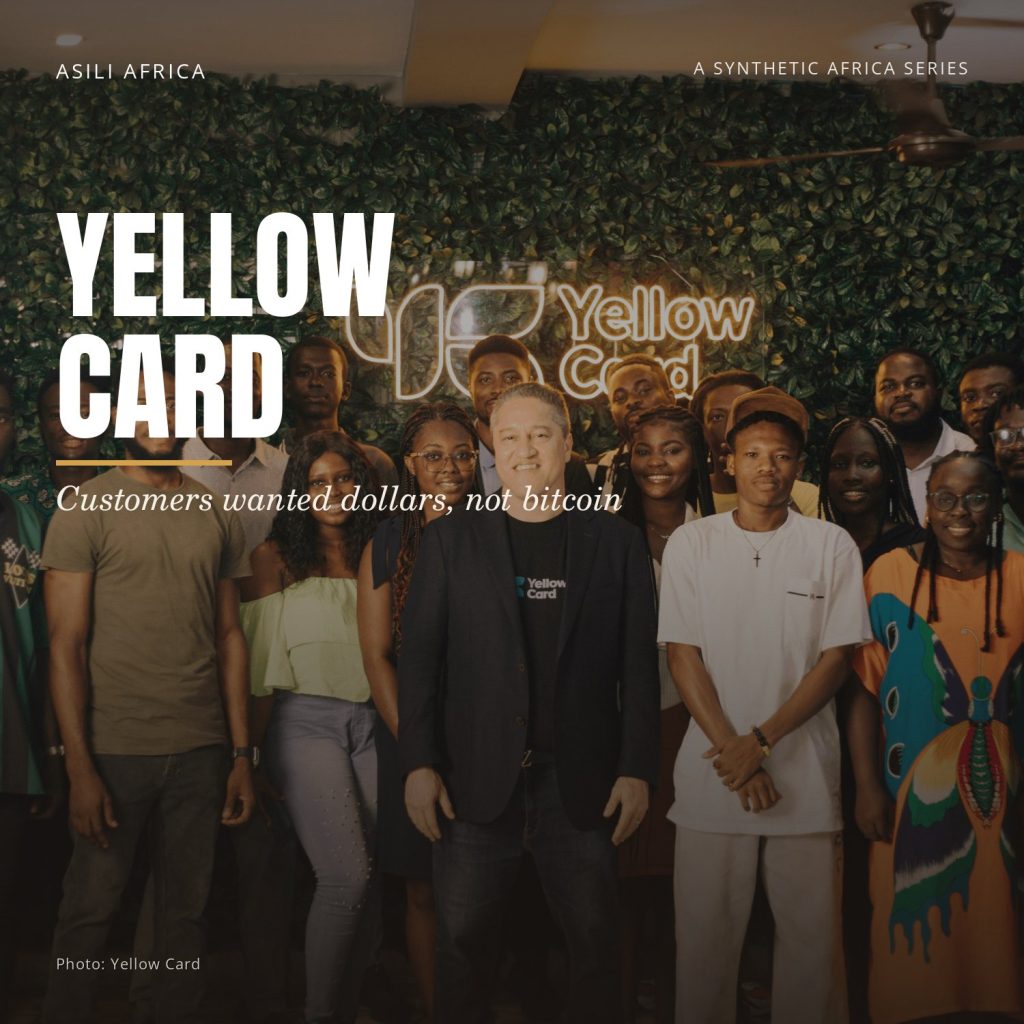
The Yellow Card Story: Two twenty-somethings
It is the seventh of May, twenty twenty six. Mastercard, the second largest card network on the planet, publishes a press release out of its Eastern Europe, Middle East and Africa newsroom. The headline announces a new strategic partner for stablecoin payments across the entire region. The first markets named are Ghana, Kenya, Nigeria, South Africa, and the United Arab Emirates. The partner is a company called Yellow Card.
Eleven years earlier, on a Wednesday night in twenty fifteen, the same company existed only inside the back corner of a Taco Bell on South Gay Street in Auburn, Alabama. Two undergraduates were sitting at a plastic table, eating a twelve pack of Doritos Locos tacos, swapping bitcoin for cash with strangers who had found them on Craigslist. They were nineteen and twenty years old. They had no investors. They had no app. They had no plan to start a company in Africa.
And then one of them walked into a Wells Fargo branch near campus, overheard a Nigerian man being charged ninety dollars to send two hundred dollars home, and decided to fly to Lagos on a six day old passport.
This is the story of two college kids, a Taco Bell back room, a near death encounter with the Central Bank of Nigeria, and the African crypto company that just convinced Mastercard to bet on it as the rail underneath the dollar economy of an entire continent.
THE ORIGIN
Chris Maurice grew up in Louisiana. He went to Jesuit High School of New Orleans. He was an Eagle Scout. He had a Taekwondo black belt. He paid his way through high school by flipping Pokémon cards on eBay. And when he arrived at Auburn University to study finance, his freshman roommate introduced him to a computer science kid one year behind him named Justin Poiroux. Justin had been obsessed with bitcoin since reading the original whitepaper as a teenager in two thousand and eight. He spent his evenings on web forums talking about it. He had absolutely no one else around him who would listen. And then Chris arrived, and finally there was someone willing to hear him out.
In twenty fifteen, when Chris was a sophomore, the two of them posted a Craigslist ad. The ad said, in effect, we have bitcoin, come give us cash. They picked the back corner table at a Taco Bell on South Gay Street as the meeting point. Every Wednesday at seven in the evening, they would sit there, eat a twelve pack of Doritos Locos tacos, and trade bitcoin for cash with whoever walked in. Within three weeks they had replicated the setup at roughly seven other Taco Bells on college campuses across the eastern United States. And then, in Chris’s own words, they decided they should probably do something less sketchy with their lives.
In twenty sixteen, out of his dorm room at Auburn, Chris and Justin formally incorporated a company. They called it Yellow Card. The first product was a bitcoin gift card. You walked into a participating retailer, paid cash, scratched a code, and the code unlocked bitcoin in a mobile wallet. They were not yet thinking about Africa. They were thinking about getting bitcoin into the hands of Americans who could not, or did not want to, use a credit card.
And then, in late twenty seventeen, Chris walked into a Wells Fargo branch near campus. There was a Nigerian customer at the counter trying to send money home. Chris overheard him being told it would cost ninety dollars to wire two hundred dollars to Nigeria. Forty five percent of the principal, gone in fees, before the money had even left the United States.
“I just became obsessed with this problem.” — Chris Maurice
He posted an online ad, looking, in his words, to speak to Nigerian men. He later admitted the wording could have been better. Within six weeks a Nigerian contact had convinced him to fly to Lagos. Chris’s quote on the matter is a small piece of folklore in African startup circles. Nigerians, he said, are the most convincing people you will ever meet in your life.
Four days after graduating from Auburn in twenty eighteen, Chris Maurice landed at Murtala Muhammed International Airport in Lagos with a six day old passport, no visa, and no vaccinations. He spent seven hours begging the immigration officers not to deport him. They eventually let him through.
In Lagos, Chris was introduced to a Nigerian engineer named Munachi Ogueke. Munachi was twenty something, born and raised in Lagos State, with a degree in Industrial and Production Engineering from the University of Ibadan. He had been a serial student entrepreneur, selling hoodies on campus, co founding a student e commerce platform called Vasiti. And then he had founded a Nigerian over the counter crypto desk called Cryset, which by twenty seventeen was moving up to three hundred bitcoin a month. Munachi had been forced into bitcoin because his international trading partners would not trust the naira to settle. He understood, more intuitively than almost anyone else in Lagos, that this was not a story about speculation. This was a story about a usable global currency.
Chris, Justin, and Munachi joined forces. In the early days of the Lagos operation, the founding African team would later say they shared a single twin bed in a hotel during market research, four people in a room meant for one. They piloted Yellow Card vouchers at over twenty five retail locations across Nigeria. And in June twenty nineteen, they launched the proper Yellow Card mobile app. You could buy bitcoin in your local currency. You could sell it back into your local currency. You could do it from a phone in Lagos in five minutes, in twenty fourteen Naira denominations. There was nothing else on the continent quite like it.
THE STRUGGLE
For the first eighteen months after launch, Yellow Card grew faster than the founders had any right to expect. In August twenty twenty, the company closed a one point five million dollar seed round. The lead investor was Polychain Capital. The co investors included Andreessen Horowitz and the Celo Ecosystem Fund. At the time, it was the largest seed round ever raised by an African crypto company. The cash funded expansion into Kenya, Cameroon, Botswana, and South Africa.
By the start of twenty twenty one, Yellow Card was operating in eight African countries. Nigeria was still, by an enormous margin, the centre of gravity. Over ninety percent of Yellow Card’s transaction volume was running through Nigerian customers and Nigerian bank rails. Lagos was the kitchen. Everything else was a side dish.
And then, on the fifth of February, twenty twenty one, the Central Bank of Nigeria issued a circular. The circular ordered every licensed bank in the country to immediately close the accounts of any individual or entity dealing in cryptocurrency. No transition. No grace period. Effective immediately.
For Yellow Card, this was an extinction level event. Ninety percent of the company’s revenue ran through the exact banking rails the Central Bank had just shut. The team had a few hundred employees, mostly in Lagos. Competitors began to fold within weeks. Lazerpay would eventually shut down. Nestcoin would lay off staff. LocalBitcoins and Paxful pulled their Nigerian operations. The phrase that circulated inside the company in those first seventy two hours was the only one that mattered.
“The options, very literally, were build something that works, or live in Lagos for the rest of my life.” — Chris Maurice
What saved Yellow Card was a combination of two things. The first was geographic diversification. Because the company had used its seed cash to push into seven other markets, it had revenue that was not running through Nigerian banks. The second was a pivot to peer to peer. Instead of routing customer funds through corporate bank accounts, Yellow Card rewired its system so that buyers and sellers met directly inside the platform, with Yellow Card escrowing the crypto and the customers settling fiat outside the rails. It was a software architecture change that the team executed in weeks.
On the twenty seventh of September, twenty twenty one, less than eight months after the CBN circular had been issued, Yellow Card closed a fifteen million dollar Series A. Valar Ventures, the firm founded by Peter Thiel, co led the round. Castle Island Ventures and Third Prime co led alongside. Block, the company then called Square, came in. Coinbase Ventures came in. Polychain came back. So did MoonPay, Blockchain dot com Ventures, and a long list of others. It was the largest Series A ever raised by an African crypto company.
“We were the only company that came out of that without having to fire anybody. We were the only Pan African crypto player that had actually built meaningful infrastructure outside of Nigeria.” — Chris Maurice
By the close of Series A, Yellow Card had one hundred and ten employees across sixteen countries. The near death had become the founding fact. And the next pivot was already underway, this time not forced by a regulator, but pulled by the customers themselves.
THE PIVOT
Through twenty twenty one and twenty twenty two, Chris and the team noticed something inside their own data. Customers were no longer using Yellow Card to buy bitcoin and hold it. They were using Yellow Card to buy bitcoin and immediately swap it into a stablecoin called Tether, ticker USDT, which trades one for one against the United States dollar. The customers did not want exposure to volatility. They wanted exposure to the dollar. They wanted savings that did not melt while they slept. In countries where the local currency had lost half its value against the dollar in five years, the stablecoin was not a speculation. It was a survival tool.
Yellow Card leaned into it. By twenty twenty five, ninety nine percent of all transaction volume on the platform would be stablecoins, not bitcoin. Tether would account for eighty eight point five percent of that. USD Coin, ticker USDC, would account for nine point nine percent. The rest was a long tail. The company that had begun as a bitcoin exchange had become, almost entirely, a dollar distribution machine.
In September twenty twenty two, Yellow Card closed a forty million dollar Series B at a two hundred million dollar post money valuation. Polychain Capital led for the second time. Maurice, in a Bloomberg Law interview, said the company was on track to be a unicorn by the end of twenty twenty three. That target would slip. The funding number was real, the valuation was real, the unicorn was not.
But ten days after the Series B closed, Yellow Card received the document that would matter more, in the long run, than any of the venture cheques. On the twenty ninth of September, twenty twenty two, the Non Bank Financial Institutions Regulatory Authority of Botswana issued Certificate eleven, one, five, one. It was a Virtual Asset Service Provider license. It was the first such license ever issued anywhere on the African continent. And Yellow Card was the company that held it.
“We are committed to building a regulated, secure, and reliable platform.” — Chris Maurice
The Botswana license unlocked a strategy that no other African crypto company could pursue. Yellow Card could now stand in front of any prospective enterprise partner, in any global financial centre, and say truthfully that it operated under formal regulatory supervision in Africa. That single fact would become the basis for almost every conversation the company would have with a Visa, a Mastercard, a Coinbase, a Stripe, in the years that followed.
Through twenty twenty three and twenty twenty four, Yellow Card built. It picked up a European operating license in Poland. It integrated USD Coin on the Stellar network. It expanded to twenty African countries. And on the twentieth of November, twenty twenty four, it picked up the second licence that mattered, a Category One Crypto Asset Service Provider license from the Financial Sector Conduct Authority of South Africa, FSP number five three seven nine zero, part of South Africa’s very first wave of CASP authorizations.
In October twenty twenty four, Yellow Card closed its Series C. Thirty three million dollars led by Blockchain Capital, with Polychain back for the third consecutive round, alongside Block, Galaxy Ventures, Winklevoss Capital, and others. The cumulative capital raised crossed eighty eight million dollars. The company now had thirty thousand business customers. Cumulative transaction volume had crossed three billion dollars and would cross six billion dollars by the middle of twenty twenty five. The unicorn timeline had slipped, but the unit economics had hardened.
THE SCALE
On the twenty ninth of October, twenty twenty five, Yellow Card sent a notice to every retail customer it had ever served. The consumer app, the same app the company had launched in Lagos in June twenty nineteen, would be shut down on the first of January, twenty twenty six. Final withdrawal deadline, the thirty first of December. The reason, in Chris’s own framing, was margin. Retail was costly to maintain. The real revenue, the real growth, the real strategic value, was in the business to business product. Yellow Card was going to walk away from the customer it had been built to serve in order to become the infrastructure underneath everyone else.
The product Yellow Card now sold to businesses was a single application programming interface. A company in New York, London, or Singapore could plug into Yellow Card and gain the ability to collect or disburse local currency across twenty plus African countries. Mobile money. Bank transfer. Cash agents. M Pesa in Kenya. Mobile Money in Ghana. Airtel Money across multiple markets. The currency conversion, the treasury management, the stablecoin settlement on the back end, was handled by Yellow Card. The customer just saw an API.
Through twenty twenty five, the partnerships piled up. On the eighteenth of June, twenty twenty five, Visa announced Yellow Card as its stablecoin payments partner for Africa. It was the first endorsement from a global card network. In October, Yellow Card joined the Fireblocks Network for Payments. In the same month, the company won the Money twenty twenty USA Grand Prix in Payments, the highest award at the world’s largest fintech conference. On the twenty eighth of October, a partnership with the Singapore based cross border payments firm Thunes opened corridors between Africa and Asia.
The geography expanded too. In August twenty twenty five, Yellow Card released a report called Stablecoin Adoption in Emerging Markets, and announced an expansion into seven new countries outside Africa. Argentina, where sixty one point eight percent of crypto transactions involved stablecoins. Brazil. Mexico. Colombia. India. Pakistan. Bangladesh. The pitch was no longer Africa. The pitch was the dollar starved consumer economy of the entire global south.
And then, on the seventh of May, twenty twenty six, the Mastercard announcement landed.
The deal needs to be read in context. Two months earlier, in March twenty twenty six, Mastercard had announced a one point eight billion dollar acquisition of a stablecoin infrastructure company called BVNK. It was the largest crypto deal the company had ever done. BVNK was the global plumbing. The May announcement, with Yellow Card, was the regional specialist play. Mastercard’s strategy was clear in retrospect. Buy the global generalist. Partner with the regional expert. Yellow Card was selected because it carried the Botswana license, the South African license, the local payment integrations across forty five banks and forty five mobile money providers, and the regulatory relationships that no acquirer could buy off a shelf.
“Stablecoins are an exciting and useful option for some payments, and we look forward to working on additional use cases with Yellow Card.” — Mete Guney, Mastercard
“Emerging markets represent the greatest opportunity for payment innovation, but success requires deep local expertise and regulatory navigation.” — Chris Maurice
TODAY AND TOMORROW
Today, in the middle of twenty twenty six, Yellow Card sits in a position that almost no African startup has ever occupied. It is a Delaware registered company, headquartered in Atlanta, operating across twenty African countries, with two real African crypto licenses, an EU operating license out of Poland, hubs in Singapore and Hong Kong, and the formal endorsement of both Visa and Mastercard. It has roughly two hundred and ninety five employees. It has thirty thousand business customers. It has processed more than six billion dollars in cumulative transaction volume. And its own publicly stated five year goal is to replace the global interbank messaging system known as SWIFT with stablecoin rails.
But there is a counter narrative the script would be dishonest to skip. African central banks are not uniformly happy about what Yellow Card is doing. South African Reserve Bank Governor Lesetja Kganyago has publicly questioned the entire stablecoin category, saying he has a problem with the name because he is not sure they are quite as stable as they are made out to be. The Bank of Ghana, in June twenty twenty five, issued a public warning naming a Yellow Card affiliated brand and an unrelated platform called HanyPay as unlicensed digital platforms. Yellow Card denied the partnership. The episode was the only formal regulatory action against the company to date, but it was a reminder that the regulatory ground is still moving.
There is also a deeper structural question. Every time a Nigerian, a Ghanaian, a Kenyan customer converts their salary into Tether, they are voting with their feet against their national currency. Yellow Card is, in effect, a dollarization vector. Its core business helps Africans escape the inflation tax that their governments impose on them. That is, depending on your view, either a service to the African saver or a threat to African monetary sovereignty. Both readings are true. Both have powerful constituencies. Yellow Card will spend the next decade negotiating that tension, one license, one circular, one central bank at a time.
The next chapter is no longer about whether stablecoins will scale in Africa. They have. Six of the top twenty stablecoin using countries on the planet are now African. The next chapter is about whether the company built in a Taco Bell back room can hold its position as the regulated, licensed, default rail under that flow as Stripe, Circle, Polygon, and every global incumbent now pushes into the same corridor.
In twenty fifteen, two college kids sold bitcoin to strangers in the back of a Taco Bell. In twenty eighteen, one of them flew to Lagos on a six day old passport. In twenty twenty one, a single Central Bank circular almost killed everything they had built. In twenty twenty two, they received the first crypto license ever issued on the African continent. And in twenty twenty six, the second largest card network on the planet bet on them as the rail underneath the dollar economy of an emerging world. The next chapter is already being written, one stablecoin transaction at a time.
This is Asili Africa. Every empire has an origin.
Key Takeaways
- THE ORIGIN. Chris Maurice grew up in Louisiana.
- THE PIVOT. Through twenty twenty one and twenty twenty two, Chris and the team noticed something inside their own data.
- THE SCALE. On the twenty ninth of October, twenty twenty five, Yellow Card sent a notice to every retail customer it had ever served.
- TODAY AND TOMORROW. Today, in the middle of twenty twenty six, Yellow Card sits in a position that almost no African startup has ever occupied.
Listen to the Episode
Also available on YouTube — search “Asili Africa” or subscribe to our channel.