
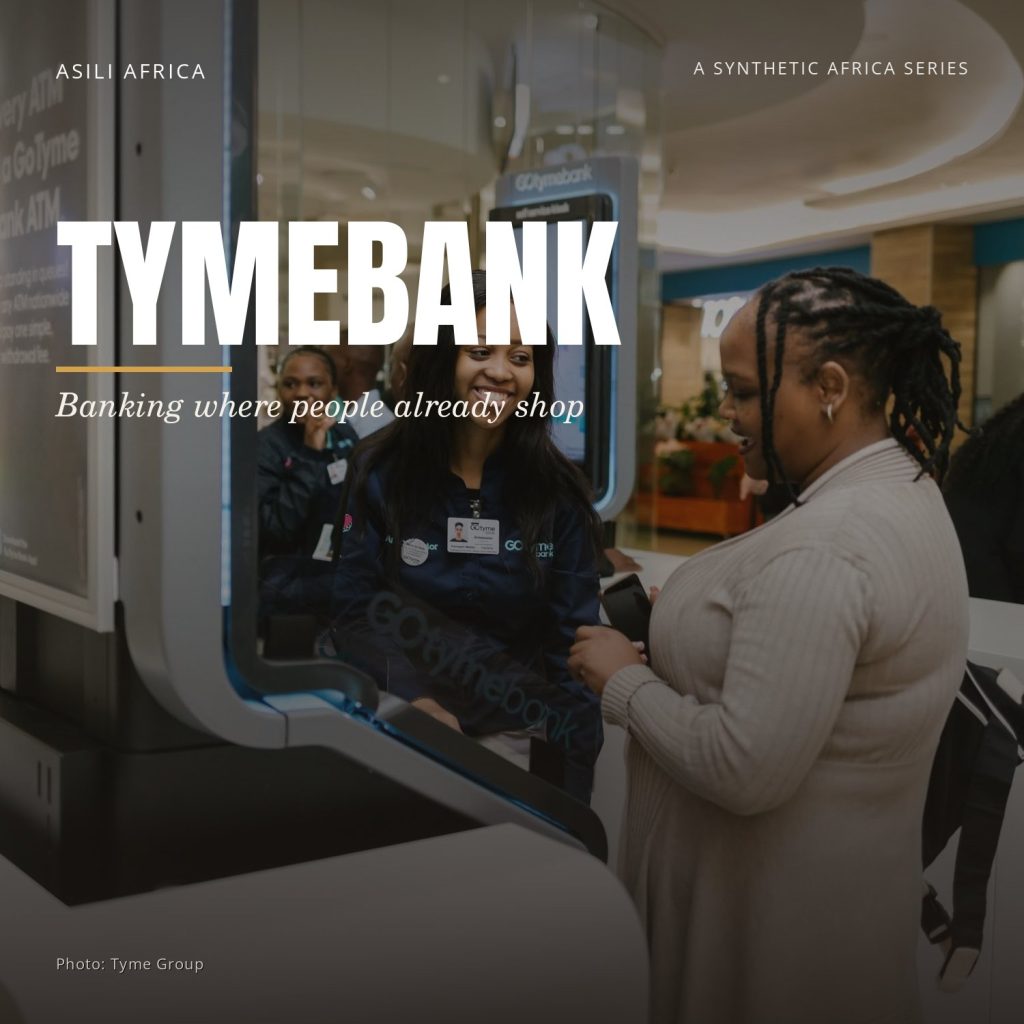
The TymeBank Story: A branchless digital bank backed by Patrice Motsepe’s African Rainbow Capital
It is twenty eighteen, in Sydney, Australia. Inside the headquarters of the Commonwealth Bank of Australia, the country’s largest financial institution, executives are making a quiet decision. A small South African experiment they have been funding for three years, a digital bank with no branches, biometric scanners, and a wild idea to onboard customers inside supermarkets, is being put up for sale.
The team in Johannesburg gets the news. After everything they built. After waiting two years to receive the first new commercial banking licence the South African Reserve Bank had issued since nineteen ninety nine. After designing kiosks that could open a real bank account in five minutes. The parent is walking away.
Then, in November twenty eighteen, an investment vehicle controlled by the South African billionaire Patrice Motsepe makes an offer. The cheque is for one point five billion rand. By accepting it, Motsepe will become the owner of the only majority black owned, majority black controlled commercial bank in South African history. A country whose banking sector had been white controlled for over a century. The deal closes in weeks.
Six years later, this orphaned Australian project, picked up by an African billionaire, will be valued at one point five billion United States dollars. It will reach over eleven million customers. And the world’s most successful digital bank, Brazil’s Nubank, will write a one hundred and fifty million dollar cheque to own ten percent of it.
This is the story of how an experiment nobody wanted became the bank that broke the South African oligopoly.
THE ORIGIN
In June twenty twelve, on an upper floor of the Deloitte building in Johannesburg, a small team is putting the final touches on a proposal. They have a name for it. TYME. Spelled T. Y. M. E. It stands for Take Your Money Everywhere.
The man leading the team is Coen Jonker. He is in his forties, soft spoken, with the careful diction of a lawyer. Which is exactly what he was. Coen had spent the first nine years of his career at one of South Africa’s biggest law firms, in Johannesburg. He became its chief executive at twenty nine years old. By any measure, he had won.
But Coen did not feel like he had won. The problem he could not shake was this. South Africa had a banking sector with five major banks. Standard Bank, First National Bank, Absa, Nedbank, and a younger challenger called Capitec. And those five banks, between them, were failing to serve a huge share of the country’s adult population. Millions of South Africans had no bank account at all. Millions more had accounts that they used once a month, to receive a salary, and then immediately withdrew everything in cash because the fees were too high.
In two thousand and five, Coen left law to join Standard Bank as director of community banking. His mandate was to extend banking to the underserved. Over six years, his team onboarded over a million additional customers. But he saw the structural limit. The big banks were too expensive. Their branches cost three to five million rand a year each to operate. Their fee structures were designed to extract value from middle class customers, not to serve poor ones. You could not solve financial inclusion from inside the establishment.
In twenty eleven, Coen left Standard Bank for Deloitte. A year later, he left Deloitte too. He took with him a small founding team. Tjaart van der Walt. Tshepo Phetla. Rolf Eichweber. And an idea. The idea was that money transfer in South Africa was broken. That the fees charged by Western Union and the big banks were absurd. And that if you could build a mobile money service that ran through retailers, you could undercut all of them.
The mobile network operator MTN gave them their first cheque. TYME was, in its first form, a remittance company. Not a bank. Just a smarter, cheaper way to send money. The team set up shop. They began signing partnerships with small retailers. And they built early biometric verification, because they knew that one day, if they were going to do this at scale, the regulator would demand it.
In twenty fifteen, something unexpected happened. The Commonwealth Bank of Australia, the largest bank in Australia by market value, came knocking. The Australians were looking at emerging markets. They had a sophisticated digital banking platform at home. And they saw, in this little South African remittance company, the bones of something much bigger. A full digital bank.
The acquisition closed. Suddenly, Coen Jonker and his team were employees of an Australian banking giant. The mission shifted. Forget remittance. They were going to build a real bank.
For three years they built. Real time identity verification. Biometric photo capture. Card issuance at the kiosk. A core banking platform that could handle millions of customers without the legacy mainframe costs of the big banks. They submitted their application to the South African Reserve Bank. And then they waited.
On the twenty eighth of September, twenty seventeen, the South African Reserve Bank issued TymeDigital by Commonwealth Bank SA a full commercial banking licence. It was the first new commercial banking licence the regulator had issued in eighteen years. A team that had started as a remittance project inside Deloitte was now, on paper, a fully licensed South African bank.
It should have been the launch moment. Instead, it became the beginning of the crisis.
THE STRUGGLE
In Sydney, twenty eighteen brought a reckoning. The Commonwealth Bank of Australia was being dragged through a Royal Commission into misconduct in the banking, superannuation and financial services industry. The hearings were brutal. Senior executives were being questioned on national television over charges that the bank had taken fees from dead customers and had failed to report suspicious transactions. The board’s appetite for international experiments collapsed overnight.
In Johannesburg, the team got the call. The Australians were pulling out. Three years of investment, a freshly minted banking licence, a biometric platform that nobody in South Africa could match, and the parent was walking away.
Coen Jonker had a choice. He could fold the project and walk away with his reputation intact. Or he could find a new owner. Quickly. Because a banking licence in South Africa is a fragile thing. If the regulator senses that the institution behind it is collapsing, that licence gets pulled. And once it gets pulled, you do not get it back.
He started knocking on doors.
The door that opened was in Sandton. Patrice Motsepe. To understand why this moment matters, you need to know who Motsepe was. Patrice Motsepe was born in nineteen sixty two in Soweto. He was the son of a school teacher and a small business owner. He studied law at the University of Swaziland and at Wits. He spent the first years of his career as the first black partner at a major Johannesburg law firm. Then, in nineteen ninety four, the same year apartheid ended, he started buying low producing gold mine shafts that the bigger mining houses considered worthless. He turned them into African Rainbow Minerals. By two thousand and eight, he had become the first black African billionaire on the African continent.
By twenty eighteen, Motsepe had built African Rainbow Capital, an investment vehicle focused on financial services. He had stakes in insurance, in asset management, in private equity. What he did not have was a bank.
When Coen Jonker showed him TymeBank, Motsepe understood three things immediately. One. He could buy a fully licensed commercial bank, with a working platform, for about one point five billion rand. Two. Doing so would, overnight, make him the owner of the only majority black controlled commercial bank in South African history. Three. The kiosk strategy, if it worked, was the only credible way to break the pricing power of the five banks that had dominated South Africa for a century.
He said yes.
On the fifth of November, twenty eighteen, the South African Reserve Bank approved African Rainbow Capital’s acquisition of the Commonwealth Bank of Australia’s ninety percent stake in TymeDigital. The founders kept the remaining ten percent. The Australian phase was over. The South African phase had begun.
In February twenty nineteen, TymeBank publicly launched. The strategy was operational, not technological. A typical South African bank branch cost three to five million rand a year to operate. A self service kiosk inside a Pick n Pay cost a tiny fraction of that. South Africans already visited supermarkets every week. And the killer move was this. Account opening had always been the choke point. At a big bank, opening an account meant a queue, a thirty minute interview, multiple forms, and three days of waiting for a card. At a TymeBank kiosk, you scanned your ID, took a biometric photo, and walked out with a working Visa debit card. In five minutes.
In its first month, TymeBank onboarded over fifty thousand customers. By the end of the year, it had crossed one million. The thesis worked. But the bank was bleeding money.
Building a bank from scratch, even a digital one, is expensive. Customer acquisition costs money. Engineering costs money. The kiosks cost money to manufacture and to install. Regulatory compliance costs money. And the revenue from a customer who keeps a few hundred rand in their account and uses it once a month for groceries does not cover those costs for years.
For four straight years, TymeBank lost money. Investors began to ask the same question that every challenger bank in the world gets asked. When does this thing actually make a profit. And it was not just abstract investor pressure. Inside South Africa, there was already a challenger bank that was running circles around TymeBank in profitability. Capitec. Capitec had launched in two thousand and one. By twenty twenty three, Capitec had twenty two million primary banking customers and was the largest retail bank in the country. Capitec was profitable. TymeBank was not. The market began to ask whether TymeBank would ever be.
The pressure intensified.
THE PIVOT
The decision that changed TymeBank’s trajectory was not made in South Africa. It was made in a conference room in Singapore.
By twenty twenty one, Coen Jonker and the senior team had reached a conclusion that would define everything that came after. TymeBank in South Africa, by itself, could not deliver the scale that investors wanted. South Africa is a country of about sixty million people. The total addressable market for digital banking was real but finite. To build a venture worth tens of billions of dollars, they needed to do something the big South African banks had failed to do for decades. They needed to take a South African product and turn it into a multi country business.
They picked Asia.
In the Philippines, they found a partner. The Gokongwei family. JG Summit Holdings, controlled by the Gokongwei dynasty, owned Robinsons Bank, Robinsons Retail, and a sprawling retail and real estate empire. The Gokongweis had the same insight in the Philippines that Motsepe had in South Africa. They had retail footprint. They needed a bank.
In December twenty twenty one, Tyme closed a one hundred and eighty million dollar Series B round. One hundred and ten million from Apis Growth Fund and JG Summit. Seventy million from Tencent and the British development finance institution then known as CDC Group. The capital was earmarked for one thing. Building GoTyme Bank in the Philippines.
On the twentieth of October, twenty twenty two, GoTyme Bank launched in the Philippines. Same kiosk strategy. Same biometric onboarding. Same five minute account opening. Now operating in two countries on two continents. The South African team had a product that, for the first time, was exportable.
Two months later, in December twenty twenty two, TymeBank made another move. It acquired Retail Capital, a South African small business funder, for about one point five billion rand. Retail Capital had a book of small business loans that TymeBank could fold into its product mix. And it brought to the company a man who would become central to the next chapter. Karl Westvig, the founder of Retail Capital, joined the executive committee.
The strategic picture had shifted. TymeBank was no longer a South African digital bank trying to outlast Capitec. It was a multi country fintech group with a credible play in two of the world’s most underbanked regions. And the investors began to respond.
In May twenty twenty three, a pre Series C round of seventy seven point eight million dollars closed, led by Norrsken twenty two and Blue Earth Capital, with Tencent doubling down. Cumulative capital raised had now passed two hundred and sixty million dollars.
But the real turn was still coming.
In December twenty twenty three, four years and ten months after launch, TymeBank posted its first month of profitability. It was the first digital bank in South Africa, and on the entire African continent, to break even. The criticism that the bank would never make money, the criticism that had dogged it for four years, was over.
The investors took notice.
THE SCALE
The phone call came from Sao Paulo, Brazil. On the line was a representative of Nu Holdings, the parent company of Nubank. Nubank was, at that time, the most successful digital bank in the world. Founded in twenty thirteen by a Colombian named David Velez, Nubank had grown to over one hundred million customers across Latin America. It was publicly listed on the New York Stock Exchange with a market value of tens of billions of dollars. David Velez was a household name in the global fintech industry.
And Nubank wanted in.
On the seventeenth of December, twenty twenty four, Tyme Group closed a two hundred and fifty million dollar Series D round. Nubank led it with one hundred and fifty million dollars for roughly ten percent of the company. M and G Catalyst Fund added fifty million. Existing investors put in another fifty million. The deal valued Tyme Group at one point five billion United States dollars.
Africa had a new unicorn. And not just any unicorn. A profitable one. The slow patient build that had taken twelve years from the Deloitte spinout, six years from the public launch, and four years from first profitability, had produced the kind of valuation moment that an entire continent of fintech founders had been chasing.
By June twenty twenty five, the Tyme Group had passed seventeen point five million customers worldwide. South Africa alone had over eleven million, making TymeBank the third largest bank in the country by customer count. Group annualised revenue had passed two hundred and fifteen million dollars. The South African business was profitable. The Philippines business was scaling. And Indonesia, the world’s fourth most populous country, was next.
In the first half of twenty twenty five, GoTyme Indonesia began offering working capital loans to micro and small enterprises. In parallel, the team began building a data processing hub in Vietnam, in preparation for a full retail banking launch in that market in the second half of twenty twenty six.
In October twenty twenty five, Tyme Group announced a decision that surprised many South Africans. The bank that had spent six years building the TymeBank brand into a household name was going to throw that brand away. The South African business would rebrand to GoTyme Bank in early twenty twenty six. The logic was simple. As Tyme Group prepared for a planned dual listing on the New York Stock Exchange and the Johannesburg Stock Exchange in twenty twenty eight, it needed a single global brand. GoTyme worked in Manila. It worked in Jakarta. And now it would work in Johannesburg too.
On the twenty second of January, twenty twenty six, the rebrand went live. TymeBank became GoTyme Bank in South Africa. The largest brand migration in South African banking history was, by most accounts, executed cleanly. On the thirteenth of April, twenty twenty six, the South African Reserve Bank confirmed via the Government Gazette that the legal name change was complete.
And on the first of January, twenty twenty six, Cheslyn Jacobs, a member of the founding team since twenty twelve, became chief executive of GoTyme Bank in South Africa. Karl Westvig moved up to a group role. Coen Jonker, the lawyer who had walked away from the legal profession sixteen years earlier to build a remittance company, was now executive chairman of a Singapore headquartered banking group worth more than a billion and a half dollars, with a New York listing in its sights.
TODAY AND TOMORROW
Today, in twenty twenty six, GoTyme Bank in South Africa operates over one thousand self service kiosks across Pick n Pay, Boxer and TFG stores. It has roughly fifteen thousand retail points where customers can deposit and withdraw cash. It has zero branches. It serves over eleven million South African customers, adds about one hundred and fifty thousand new customers every month, and holds about seven billion rand in customer deposits. Through Retail Capital, it has lent more than five hundred million dollars to over fifty thousand small businesses.
Beyond South Africa, Tyme Group is now an Asian story too. The Philippines business is scaling toward profitability. Indonesia is moving from small business lending to full retail banking via a planned acquisition. Vietnam is next. And the planned New York Stock Exchange listing in twenty twenty eight, if it lands at the comparable valuations that Nubank trades at, would value Tyme Group at a multiple of where it sits today.
For Patrice Motsepe, the calculation looks like this. The one point five billion rand he wrote in twenty eighteen has, on paper, multiplied many times over. The political asset of owning the only majority black controlled commercial bank in South Africa has held. The Asian expansion has given him a story that translates beyond the borders of South Africa.
For David Velez and Nubank, the ten percent stake bought in twenty twenty four is now an option on the African continent. If GoTyme Bank delivers, Nubank has a foothold in Africa it can scale. If GoTyme stumbles, Nubank can quietly write down the position. Either way, Nubank now has a presence in a market that no other major challenger bank can claim.
For the South African banking establishment, GoTyme Bank is now a permanent feature of the landscape. The big five, who for a century had set the rules of South African retail banking, now have a sixth competitor that they did not invite and cannot dismiss. The question for them is no longer whether GoTyme will survive. It is whether their own branch networks can survive against a digital first competitor that opens accounts in five minutes for free.
And for the eleven million South Africans who walk into a supermarket every week, the lesson is the one the big banks should have learned twenty years ago. The customer was always there. The big banks just refused to meet them where they stood.
In twenty twelve, four men sat in a Deloitte office in Johannesburg with an idea called Take Your Money Everywhere. In twenty eighteen, a billionaire wrote a cheque to save the orphaned project. In twenty twenty four, the world’s most successful digital bank invested to own ten percent of it. In twenty twenty six, it became Africa’s first profitable unicorn bank. The next chapter begins in New York, in twenty twenty eight.
This is Asili Africa. Every empire has an origin.
Key Takeaways
- THE ORIGIN. In June twenty twelve, on an upper floor of the Deloitte building in Johannesburg, a small team is putting the final touches on a proposal.
- THE PIVOT. The decision that changed TymeBank’s trajectory was not made in South Africa.
- THE SCALE. The phone call came from Sao Paulo, Brazil.
- TODAY AND TOMORROW. Today, in twenty twenty six, GoTyme Bank in South Africa operates over one thousand self service kiosks across Pick n Pay, Boxer and TFG stores.
Also available on YouTube — search “Asili Africa” or subscribe to our channel.