
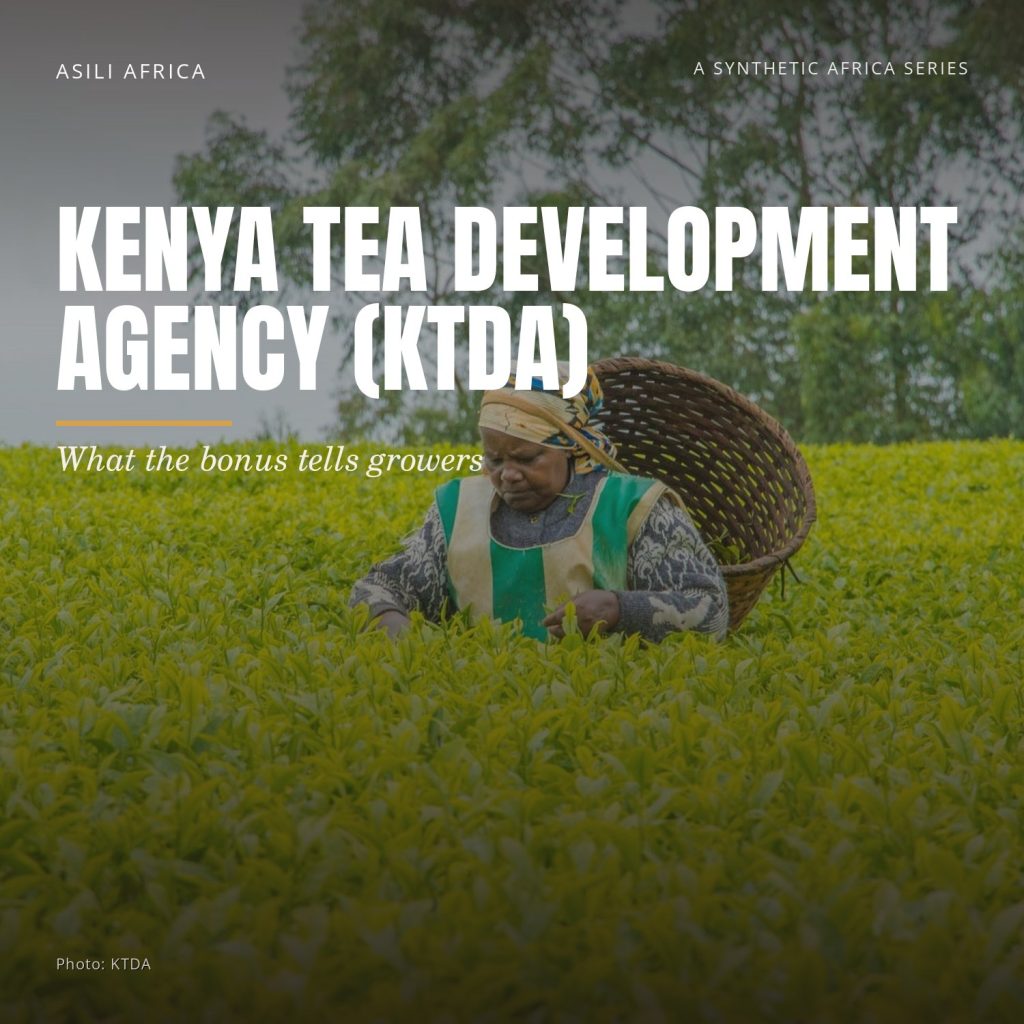
The Kenya Tea Development Agency (KTDA) Story: What the bonus tells growers
In the tea hills of Kenya, one payment each year tells a grower how the year went. It is called the bonus, and every year bonus season is news across the country.
Leaf is paid for month by month. The bonus comes after the year’s tea is sold. It is supposed to be what is left once the costs are covered. It is supposed to be surplus.
By June twenty twenty five, according to an audit by the Tea Board of Kenya, the factories those growers own were carrying just over twenty six billion shillings in loans.
Reporting on that audit found that in some factories, borrowing described as bonus financing had covered operating deficits.
In those factories, part of what arrived as a bonus was not surplus. It was debt.
The growers own those factories, and the reporting says the debt was left for them to carry.
Seventy years earlier, growers like them were not allowed to plant tea at all.
NOT PERMITTED
Commercial tea growing began in Kenya in nineteen twenty four. It began on estates held by European settlers, and for three decades it stayed on them.
In nineteen thirty one, the planters formed the Kenya Tea Growers Association, to speak for settler interests.
Two years later came an international tea agreement, signed in Amsterdam, that restricted the expansion of tea growing across the colonial territories. In effect it was a supply cartel among the producers.
From the start, tea in Kenya was organised around the people who already had it.
African farmers were not part of any of this. Until nineteen fifty six, they were legally barred from growing tea.
Legally barred means what it says. It was not a question of price, or credit, or distance from a factory. For an African farmer in Kenya, planting tea was against the law.
The same exclusion covered other lucrative cash crops, coffee among them.
The purpose was explicit. The ban preserved cheap labour for the settler plantations, and it kept African farmers out of the market as competitors.
African farmers could work the tea on the settlers’ estates. They could not plant it on their own land.
For its first thirty two years, Kenya’s tea industry had no legal place for an African grower.
In nineteen fifty six, colonial policy changed. For the first time, African smallholders were permitted to plant tea.
Permission to plant was only a beginning. Green leaf has to be processed into made tea, and that takes a factory.
In nineteen fifty seven, the first smallholder tea factory opened at Ragati, in Nyeri.
It was run under management agreements with the multinational tea companies.
The first factory built for African growers was managed by the companies that had grown the crop while Africans were barred from it.
In nineteen sixty, the government created the Special Crops Development Authority, under the Ministry of Agriculture, to promote and formalise smallholder tea growing by African farmers.
There is no founder in this story. No single person had the idea, raised the money or built the first factory. The state acted first, and later the growers acted together.
If the story has a protagonist, it is the grower, as a whole class of people rather than any one of them.
On the twelfth of December, nineteen sixty three, Kenya became independent.
On the twentieth of January, nineteen sixty four, about five weeks later, the Kenya Tea Development Authority was established by legal notice.
It took over the functions and the liabilities of the Special Crops Development Authority. Its mandate was promoting and fostering the development of tea for the small scale tea growers.
It was an act of nation building in a country only weeks old. Eight years after African farmers were first allowed to plant tea, there was a national authority whose written purpose was the small grower.
THE GROWERS’ COMPANY
On the fifteenth of June, two thousand, the Authority stopped being a state body. Of the thirty six years between its founding and that day, the record we found says almost nothing, and we will not fill them with a guess.
It was incorporated as a private company, the Kenya Tea Development Agency. The Authority became the Agency, and the initials stayed the same.
The state body was privatised directly into the hands of the farmers it served.
That is rare. It did not go to outside investors. It went to the people who had been selling it their leaf.
Each tea factory is a company in its own right, owned by the growers who deliver green leaf to it.
Fifty four factory companies are, in turn, the shareholders of KTDA Holdings, the parent company that manages them.
So the parent company is owned by its own suppliers. The growers own the factories, and the factories own the company that runs them.
A company usually buys from its suppliers. This one is owned by them. In the tea business worldwide, that is an unusual arrangement.
KTDA does not make its money by trading the tea. It charges the factories a management fee of about two point five per cent of their net sales.
That is deliberate. The company at the top is built to earn a fee, not to keep the profit. The value is meant to pass through it, on to the owners.
It reaches them in two payments. The first is for the leaf itself. A grower delivers green leaf to the factory, and the factory pays for it every month.
That monthly payment is the steady part, a price for what was delivered.
The factory turns the leaf into made tea, mainly black tea of the kind known as crush, tear and curl.
Then the tea is sold, including through the tea auction at Mombasa.
When the year’s tea has been sold and the costs have been met, what remains comes back to the growers as a second payment. That payment is the bonus.
This is where the word surplus gets its meaning. The monthly payment is a price. The bonus is a share of what the year made, after everything else is paid.
The factories can also pay a dividend to their shareholders. But it is the bonus that growers wait for.
The bonus is how a grower knows they are an owner and not only a supplier. A good bonus says the factory had a good year, and that the good year belonged to them.
The owners are not the only people on those plots. Picking on smallholdings is often done by hired pluckers, many of them women, often on informal or seasonal terms.
They are not shareholders, and they own nothing in this structure. No source we found looks at their wages, their conditions or their safety. It is an open question, and we are leaving it open rather than answering it for them.
The owners themselves are many. KTDA manages the tea of about six hundred thousand smallholders, across sixteen or seventeen counties.
Between them, they produce about sixty per cent of Kenya’s tea.
The structure built to answer an exclusion now carries most of the country’s tea.
Kenya is the world’s largest exporter of black tea. The smallholders in this structure account for roughly a quarter of the world’s black tea exports.
Until nineteen fifty six, African farmers in Kenya were legally barred from planting it.
Now, from plots like these, smallholders supply a quarter of the world’s black tea exports.
THE LEAK
In twenty twenty, KTDA paid its growers fifty two billion shillings. The next year, the total fell to forty four billion.
In twenty twenty, the bonus fell by about two shillings on every kilo of leaf. For people who measure the year by that payment, it said the year had gone badly.
That year, the Cabinet Secretary for Agriculture, Peter Munya, turned on the people running the factories. He publicly accused factory directors of forming a cartel and of obstructing reform. Cartel was his word.
A minister was saying, in public, that the growers’ own company had been captured by the people chosen to run it.
Farmers were angry about the smaller bonus. Some called for KTDA to be disbanded altogether.
In September twenty twenty, Munya called for a forensic audit of KTDA. His critics accused him of politicising the reforms.
The audit was ordered in twenty twenty. The report, by several government agencies working together, came in twenty twenty one.
It found that growers had lost money on land. Plots had been bought that were overpriced or unsuitable, at a cost of about five hundred and forty two million shillings.
It found legal fees of about a hundred and one million shillings that had been traced back to the personal accounts of KTDA officials.
Together, the land and the legal fees came to over six hundred million shillings, lost by the growers who own the system.
Separately, the audit examined power. KTDA had put four point eight billion shillings into four small hydro companies.
The portfolio was running below sixty per cent of its capacity, and the audit counted two point three billion shillings of overspend.
Separately again, there were about four hundred and eighty eight million shillings in receivables that had not been recovered, tied to tea exported to sanctioned countries between twenty fifteen and twenty twenty.
The report also recorded about three billion shillings in dividend deposits lost when two commercial banks collapsed. That was a loss to bank failures, not a theft, and it belongs in a different column.
The rest points one way. Money that belonged to the growers’ system had gone out of it, through decisions made above them.
The report recommended that former directors and senior staff be prosecuted for theft by servant. That is the charge for an employee who steals from an employer. Here, in the end, the employer was the growers.
What happened after that, the record we found does not say. It does not say whether anyone was charged, convicted, or made to pay anything back, and we will not suggest that justice was done.
In December twenty twenty, the Senate passed the reform bill that became the Tea Act. It was framed as a law to clear cartels and middlemen out of the tea sector.
Among its provisions was a ban on factories making direct overseas sales.
In October twenty twenty one, Wilson Muthaura was confirmed as Group CEO of KTDA, part of the leadership reset that followed the audit.
The audit had shown money leaving. The measure of the reset would be what reached the owners.
Then the payouts rose. Sixty three billion shillings. Then sixty seven point seven billion.
In the financial year twenty twenty three to twenty twenty four, KTDA paid its growers eighty nine point two nine billion shillings. It was a record.
More than fifty six billion shillings of it reached them as bonus.
On top of that, growers received dividends of just over a billion shillings, the largest dividend in the agency’s history.
After the audit, the growers’ company paid its owners more than it ever had.
THE LOAN
In the financial year twenty twenty four to twenty twenty five, KTDA paid its growers sixty nine billion shillings. That was the second-highest payout in its history.
It was also about twenty billion shillings less than the year before. That is a large fall, and it is real money. But in every other year of KTDA’s history, sixty nine billion would have been a record. It is not a collapse, and it should not be told as one.
The causes are real, and they are the ones KTDA gave. Green leaf production fell by twelve per cent, from about one point four billion kilos to about one point two four billion.
The price of made tea fell too, from the high three hundreds of shillings a kilo to the low three hundreds.
And the shilling strengthened against the dollar, from about a hundred and forty four to about a hundred and twenty nine. Tea earns dollars abroad, and each of those dollars now bought fewer shillings to pay the growers.
At the Mombasa tea auction, the government withdrew the reserve price, the floor below which tea would not be sold.
On the other side of the auction table sit the buyers. How much their concentration shapes the price the growers get is not something the record we found examines.
Without that, KTDA’s account of the price stands unexamined, and we are flagging the gap rather than filling it.
Less leaf, lower prices, a stronger shilling, and no reserve. As an account of why the payout fell, that is largely correct.
The Tea Board of Kenya audited the factories’ borrowing. By June twenty twenty five, the seventy one factories it examined were carrying just over twenty six billion shillings in loans.
A later loan schedule put the figure at the end of twenty twenty five at just over thirty four billion shillings. The debt was still growing.
According to reporting on the audit, some borrowing labelled as bonus financing had covered operating deficits. It had not paid out a surplus. It had filled a hole.
KTDA blamed the debt on unsold tea stocks. That is its explanation, and it belongs right beside the finding.
The debt was not spread evenly. Of the twenty six billion, about twenty one point six billion sat with factories west of the Rift. East of the Rift, it was about four and a half billion.
Factories west of the Rift owed factories east of it more than fourteen billion shillings, in loans from one factory to another.
So some growers were, through the factories they own, lending to other growers. This is not one charge that fits every factory.
Nor is it the failure of twenty twenty repeated. Then, the audit found money leaving the growers’ system, through land, legal fees and power projects.
This time money was coming in. The growers’ own factories borrowed it, and in some of them it went back out as a bonus that looked like surplus.
A bonus is supposed to say that the year left something over. Where it was paid with borrowed money to cover a deficit, the number said something that was not so. It is a different mechanism, and it happened under different people.
Which years’ bonuses were paid this way, and at which factories, the record we found does not say. It does not show that the record payout was borrowed, and we are not going to suggest that it was.
So two things are true together. KTDA’s explanation of the fall is largely right. And the debt means the bonus had stopped being a reliable signal.
A correct account of why this year’s bonus was smaller does not tell a grower what the bonus at their own factory, in any earlier year, was made of.
The government moved on one part of it. Farmers’ tea proceeds may no longer be pledged as collateral for loans.
In November twenty twenty five, in Kisumu, KTDA Holdings’ Vice Chairman, Omweno Ombasa, faced farmers who were angry about the smaller bonus.
He had come to reassure them. The company the growers own was explaining itself to its owners.
WHO CAN SEE IT
In January twenty twenty six, Wilson Muthaura left the post of Group CEO and went on terminal leave.
He had come in with the reset after the audit. His years in charge covered both the record payout and the borrowing the Tea Board found.
On the sixteenth of January, Francis Miano was appointed acting Group CEO. For now, the company is run by an acting chief executive.
It was the first change at the top of management since the reset of twenty twenty one.
In March twenty twenty six, Enos Njeru returned as chairman of the board, with Samson Mosonik Menjo elected as his deputy.
Njeru had first taken the chair in July twenty twenty three, after David Ichoho resigned, and he was re-elected in twenty twenty four.
In twenty twenty five he reportedly lost it, to someone the record we found does not name. Now he is back.
That is three changes of chair in under three years, at an institution whose whole claim rests on representing its owners steadily.
None of the reporting we found ties those changes to the debt. The first of them came before the debt had been reported at all.
What reaches a grower each year is the bonus. The loans behind it sit in a Tea Board audit and a loan schedule.
Farmers were being told the bonus had fallen because of global prices, while that audit trail ran alongside.
The Tea Act’s ban on direct overseas sales was part of the reform that followed the audit. It was meant to protect growers from middlemen.
In twenty twenty five, reporting cited that ban as one cause of oversupply at the auction, and so of lower prices.
Tea that cannot be sold directly overseas goes to the auction instead, the argument runs, and more tea at one auction pulls the price down.
If that is right, a law written to protect the growers is part of the reason they are being paid less. Some argue that it is.
The record does not settle it. The audit that came before the reform was real, and so is the price fall that came after. The record does not show that the reform worked, and it does not show that it failed.
Every figure in this story comes from an institution. The payouts, the bonuses, the debt and the production numbers come from KTDA, from the government, or from the business press.
About six hundred thousand growers are counted in almost every one of them.
In the record we found, not one of them is quoted saying what a smaller bonus, or a borrowed one, means at home.
They are the owners. They are counted, and they are not heard.
The growers were once forbidden the crop. Now they own the factories that process it, and the factories own the company that runs them. That was won, and it has held.
Once a year, one number tells them what that ownership is worth. Twice now, they have found out late that the number did not mean what they had been told. The reform that answered the first time is part of the question the second time raised.
The growers own it. Can they see it? This is Asili Africa. Every empire has an origin. See you on the next one.
Key Takeaways
- NOT PERMITTED. Commercial tea growing began in Kenya in nineteen twenty four.
- THE LEAK. In twenty twenty, KTDA paid its growers fifty two billion shillings.
- THE LOAN. In the financial year twenty twenty four to twenty twenty five, KTDA paid its growers sixty nine billion shillings.
- WHO CAN SEE IT. In January twenty twenty six, Wilson Muthaura left the post of Group CEO and went on terminal leave.
In this series: State Assets
What does a state do with a company it owns?
- Mumias Sugar
- Pan Paper
- KTDA (this episode)
- Ethiopian Airlines
- Kenya Airways
- Precision Air
Also available on YouTube — search “Asili Africa” or subscribe to our channel.