
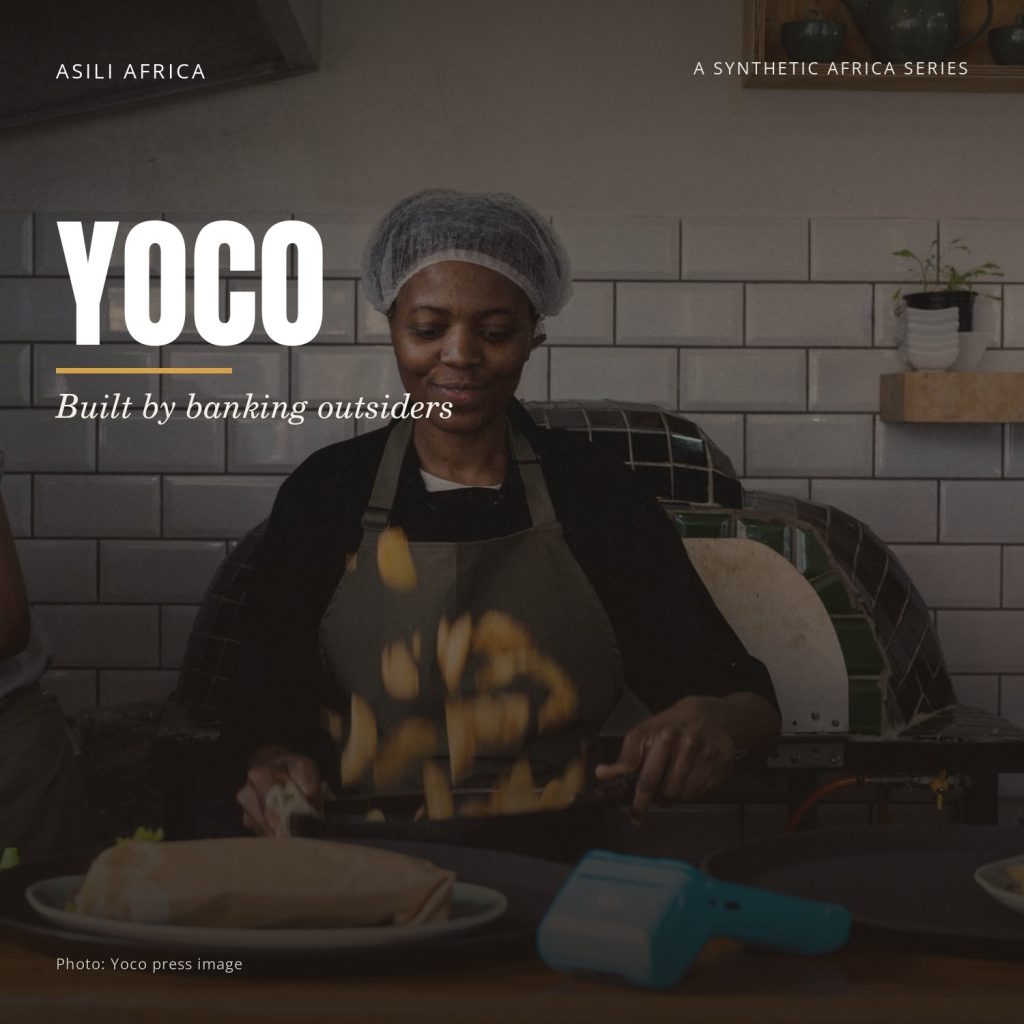
The Yoco Story
In a small restaurant in San Francisco, in mid two thousand and twelve, a young South African management consultant named Katlego Maphai was sitting across from a friend at a corner table. When the meal was over and the bill arrived, the friend did not pull out cash. He did not hand over a card to be run on a countertop terminal. He tapped his card into a small white dongle no bigger than a coin, plugged into the top of the waiter’s Android phone. The transaction took roughly six seconds. The receipt was emailed. The waiter walked back to the kitchen. Katlego sat at the table, and later, across the following decade, described that meal as the moment his career changed direction.
At that time, in South Africa, roughly seventy percent of adults carried a bank card. But fewer than seven percent of small merchants could accept one. That gap, the thing Katlego had just watched a company called Square solve on the other side of the Atlantic, was, in his own country, still unaddressed by the four large South African banks that had run the card acquiring industry for the better part of two decades. This is the story of the company Katlego went home and built to close that gap. It is called Yoco. And in mid two thousand and twenty six, roughly fourteen years after that meal in San Francisco, Yoco is the payments partner for more than two hundred thousand South African small businesses, processes more than one billion United States dollars in card payments every year, and is in the middle of the most consequential leadership transition in its eleven year history.
ACT 1 — THE ORIGIN
The story of Yoco does not begin in Cape Town, and it does not begin in Johannesburg either. It begins in three separate places on three separate continents, over roughly two decades. The first place is a Johannesburg after school care centre in the late nineteen eighties. Two boys, roughly six or seven years old, are sitting side by side at the same table. Their names are Katlego Maphai and Lungisa Matshoba. They will lose touch as their families move. They will not see each other again for another sixteen years, when they arrive at the University of Cape Town as freshmen.
The second place is a Delta Partners telecoms consulting project in the late two thousands. Delta Partners is a specialist advisory firm focused on telecoms in emerging markets. Its offices are in Dubai and its client work spans West Africa, the Middle East, and Southern Africa. On a specific mobile operator project in that period, Katlego, now a Delta consultant, meets a Lebanese analyst named Carl Wazen. Carl has grown up between London and Beirut, finished a business degree at the American University of Beirut at nineteen, and moved to Dubai to do investment banking at Citigroup before joining Delta. He and Katlego work on the same file for months.
The third place is a Rocket Internet office in Lagos, in two thousand and twelve. Rocket Internet is the German startup factory that clones proven Silicon Valley business models into emerging markets. In Lagos, that year, Rocket is standing up Jumia. Its e-commerce play for Africa. And on the Jumia founding team, in two positions, are Katlego Maphai and a South African actuary named Bradley Wattrus. Bradley has just finished two years at Monitor Group. He is being asked to build the finance function of a company that does not yet exist in a country he has not yet lived in. He does it. And when the founding rush of Jumia settles, and Katlego steps away from Rocket to think about what he actually wants to build, one of the first phone calls he makes is to Bradley.
So, in two thousand and thirteen, in Johannesburg, the four converge. Katlego from the Rocket Internet chapter that has just ended. Bradley from Lagos. Lungisa from Cape Town, where he has just wound down a smartphone based VoIP company called Yeigo Communications. And Carl from Delta Partners in Dubai. Four men. Complementary skills. Shared chemistry built from earlier chapters, one relationship at a time. And, notably, no fixed idea about what the company should be.
The idea comes from Katlego. From the twenty minutes he had spent, roughly a year earlier, sitting in front of a Square reader in San Francisco.
The thesis they wrote down was simple. In South Africa, twenty seven million adults held a bank card. Roughly seventy percent of the adult population. But of the country’s small merchants, fewer than seven percent could accept one. The four large South African banks, Standard Bank, Absa, First National Bank, and Nedbank, controlled the card acquiring market. Their point of sale terminals required extended banking history, multi year contracts, monthly rental, and paperwork that most small merchants could not clear. The demand existed. The infrastructure did not reach it. The thesis Katlego framed to his co founders was, in his own words later, all we really did was take the prepaid phone analogy and apply it to payments. No contracts. No monthly fees. Buy the device. Plug it in. Transact.
The problem was that the thesis needed a sponsor bank. In South Africa, in two thousand and thirteen, a company like Yoco could not obtain its own acquiring licence. It needed a bank willing to share its licence and take the compliance risk of onboarding thousands of small merchants under a shared master account. That was the specific moment the global Visa and Mastercard Payment Facilitator framework had opened up. It was the door that had let Square, iZettle, and SumUp exist in their own home markets. The four Yoco founders spent close to a year, in Johannesburg, negotiating with South African banks for a sponsor arrangement. They wrote a one hundred page proposal. They were competing, on the public record, against roughly fifteen other South African teams pitching the same play. They were four men in their late twenties and early thirties, and they had, between them, zero banking industry experience.
The bank eventually told them their outsider status was an asset. No legacy assumptions.
ACT 2 — THE STRUGGLE
They won the bank. The specific bank Yoco secured its sponsor arrangement with has never been publicly named, a fact worth pausing on, because that invisible partner is the reason everything that follows was possible. What is on the record is that Yoco closed the sponsor bank agreement and, in parallel, closed their first institutional capital. Their earliest investor was CRE Venture Capital, an Africa focused firm out of Johannesburg. Angel investors including Robby Hilkowitz and Greg Kidd of Hard Yaka followed. The initial capital was small. Roughly two point four million United States dollars raised across a pre seed and a seed round between two thousand and fourteen and mid two thousand and fifteen. In October two thousand and fourteen, in Cape Town, Yoco ran its first live card transaction. A pilot. A merchant, a customer, a small blue Bluetooth reader plugged into a phone, and a card swipe that cleared through a real acquiring rail. The company launched publicly in two thousand and fifteen.
The early merchants were the exact profile the thesis had predicted. Hair salons. Independent cafés. Restaurants without the Speedpoint contract. Fitness studios. Trades people running invoices for site work. Small tourism operators. Independent bookstores. None of them had the kind of banking history the big four banks required for a card machine. All of them had customers who carried cards. Yoco cleared the barrier by removing the lock in. There was no contract. There was no monthly rental. You bought the device from a retail partner. You linked it to the app. You started transacting. If it did not work for your business, you stopped, and the bank did not chase you.
The launch worked. The business grew. And, quietly, the company almost died.
In March two thousand and eighteen, at a Cape Town event where founders speak publicly about what has gone wrong, Katlego Maphai took the stage and disclosed something that Yoco had not, at the time, made public. There was a period in the company’s early history where Yoco averaged roughly sixty days of working capital between funding rounds. At one point, he told the room, the company was down to about one month of cash before the next round closed. There was no dramatic public announcement of that moment when it happened. The company kept operating. The next round of capital arrived. But the moment was real. It was the moment where every early stage payments company either dies or does not, and Yoco, on his own account, was on the wrong side of that line before the round closed and the trajectory shifted.
The other struggle of that early period was technical. By late two thousand and seventeen, Yoco’s merchant count had crossed seventeen thousand, and the codebase written to serve the first thousand merchants was no longer fit to serve the seventeen thousandth. Lungisa Matshoba, as chief technology officer, made the call to fully rewrite the point of sale software stack in React Native. It was a significant investment of engineering time in a company where every month of runway was still being counted. But the alternative was carrying a codebase into the next scale phase that would break under load. The rewrite went in. The company crossed the technical inflection.
ACT 3 — THE PIVOT
In October two thousand and eighteen, Yoco launched a second product on top of the payments layer. It was called Yoco Capital. And it was, at the time, the single most important strategic move the company had made since founding. Yoco Capital was a cash advance product for merchants. Not a loan. Not a credit line. Not a traditional bank overdraft. An upfront payment to the merchant, repaid as a fixed percentage of the merchant’s future daily card sales, with no fixed monthly instalment, no penalties, and no collateral.
The underwriting model was the specific innovation. Because Yoco was already processing every card transaction the merchant made, Yoco could see the daily revenue of the business in real time. It did not need a credit bureau file. It did not need audited financial statements. It did not need six months of bank statements. It had the daily card sales history of the merchant. That was enough. The pilot cohort was two hundred and twenty five merchants. The total advanced was seven and a half million rand. The default rate, disclosed a year later, was roughly two percent. A remarkable number in a market where consumer unsecured lending default rates run into the double digits, because the repayment was structurally tied to the very transactions the merchant was already running through Yoco.
Then, in March two thousand and twenty, the world stopped. The South African government moved to Level Five lockdown. Restaurants closed. Retailers closed. Salons closed. Yoco’s merchants, most of them small independent operators without a capital buffer, saw their card revenue drop, in some cases, by more than ninety percent overnight. In late April two thousand and twenty, roughly a month into lockdown, Yoco became one of the first high profile South African technology startups to publicly announce that it was reducing headcount and cutting leadership salaries. It was a hard call, made publicly, at a moment where publicity around it was the last thing any founder wanted. It was also, in retrospect, the call that let the company survive to the next chapter.
Six months later, in October two thousand and twenty, on the company’s fifth anniversary, Yoco launched the Yoco Neo. It was the company’s first fully standalone card machine. Not a Bluetooth dongle plugged into a phone. A full touchscreen device with its own built in SIM card and unlimited data and roaming. It cleared the specific objection that had been holding back the segment of merchants who did not want to run their business off a phone. And it launched precisely as the pandemic was accelerating the adoption of cashless payments across South African retail. Between March and July two thousand and twenty, Yoco’s own disclosure was that the number of small merchants using cashless payments through its platform had grown by three hundred percent.
ACT 4 — THE SCALE
On the twenty seventh of July, two thousand and twenty one, Yoco announced the largest single round in its history. Eighty three million United States dollars in Series C funding, led by Dragoneer Investment Group, the same San Francisco based crossover firm behind Chime, Klarna, Nubank, and, notably, Square. Behind Dragoneer, the round included Breyer Capital, HOF Capital, The Raba Partnership, and follow on capital from Partech, Velocity, Orange Ventures, and Quona. Angels on the cap table included operators from Coinbase, Revolut, Spotify, and Gojek. At the time of the round, Yoco had roughly one hundred and fifty thousand merchants, was adding five hundred new ones a day, was already processing more than one billion United States dollars in card payments annually, and was, by a distance, the largest independent card acquirer for South African small businesses.
The eighty three million was earmarked for three things. The first was expansion of the retail distribution footprint, and by October of that year, Yoco card readers were sitting on the shelves of Builders Warehouse, Makro, HiFi Corp, Incredible Connection, Cellucity, and the iStore. The second was hardware. That October, Yoco launched the Yoco Khumo, a South African designed, Chinese manufactured, locally assembled second generation card machine. The third was talent. Yoco opened an office in Amsterdam to hire product and engineering talent that was hard to source in South Africa, and, over the next three years, cycled through three tuck in acquisitions. Cobi Interactive in two thousand and nineteen. Dado in two thousand and twenty one. And Nona Digital in two thousand and twenty two, the last of which pushed the company’s total headcount past five hundred.
Between two thousand and twenty three and two thousand and twenty six, Yoco crossed a series of adjacent milestones. In October two thousand and twenty three, Yoco Capital passed two billion rand cumulatively disbursed to more than fifty thousand South African merchants. In December that year, Yoco formalised a partnership with the Taiwanese chip designer MediaTek, whose internet of things chipsets now power the Yoco Neo Touch. And on the twelfth of May, two thousand and twenty six, Yoco became one of Apple’s first two South African launch partners for Tap to Pay on iPhone. The specific feature that turns any iPhone from the XS model or newer into a contactless card acceptance terminal. No dongle. No reader. The iPhone itself becomes the point of sale.
By mid two thousand and twenty six, Yoco processes more than one billion United States dollars in card payments annually. Roughly thirty million individual card taps a year. Across more than two hundred thousand South African small businesses. Yoco Capital has, cumulatively, disbursed more than three billion rand. And on external estimates, the company is valued at around seven hundred million United States dollars. Not yet a unicorn. Widely described in the South African fintech press as a soonicorn.
ACT 5 — TODAY AND TOMORROW
In September two thousand and twenty five, after ten years as chief executive, Katlego Maphai stepped back from operational leadership of the company he had founded. In his place, on an interim basis, the board named two of the three remaining co founders, Bradley Wattrus and Lungisa Matshoba, as interim co chief executives. Katlego remained on as founder and chairman with a focus on strategy. In every interview across the next several months, he described the decision as a deliberate handover. A recognition that the company was moving into a phase that required a different kind of leader.
That leader arrived on the first of June, two thousand and twenty six. His name is Carsten Holtkemeyer. He is German. He is Yoco’s first non founder chief executive in the company’s eleven year history. His prior job was chief executive of Solaris, the Berlin embedded finance and banking as a service group. Before that, he spent roughly a decade as market chief executive of Barclaycard Germany. His hiring was framed publicly as the beginning of the phase in which Yoco prepares for a public listing. Bradley Wattrus returned to the chief financial officer role. Lungisa Matshoba became chief product and technology officer. Carl Wazen stayed on as chief business officer.
Three weeks before Carsten’s start date, on the twenty eighth of May, two thousand and twenty six, Yoco announced its first publicly disclosed strategic AI acquisition. A South African startup called Dyner, founded by two former Discovery Group actuaries, Thalentha Ngobeni and Chris du Plessis, and an engineer named David Young. Dyner had built an AI native operating system for restaurants and independent businesses. Its embedded assistant could answer merchant questions in real time. Why are stock levels inconsistent. Why did profits decline. What is unusual about today’s sales. The strategic framing from Yoco’s side was clear. Yoco was no longer a card reader company. Yoco was becoming, in its own language, a smart commerce platform. Payments, point of sale, working capital, savings, loyalty, and, now, AI driven business intelligence, all in one merchant graph.
At the Yoco Next twenty twenty six event in June, the company unveiled the shape of that platform in detail. Transaction fees cut by up to forty percent. Two hundred and fifty million rand a year reinvested into South African small businesses. A yield of four percent on the new Yoco Savings product, which four thousand merchants adopted in the first twenty one days after launch. Card linked loyalty. Industry modes for food, retail, and beauty. A third party developer platform called Yoco Connect. All of it stacked on top of the same acquiring rails Yoco had spent a decade building.
The pressure Yoco is walking into is real. Its closest South African competitor, iKhokha, was acquired by Nedbank for roughly ninety four million United States dollars, and is now a wholly owned subsidiary of one of the four incumbent South African banks Yoco was originally set up to route around. Capitec Pay is undercutting on price. Nedbank PocketPOS is undercutting on distribution. And, in twenty twenty six, a new South African payment service provider licensing regime is expected to arrive that will, for the first time, let Yoco become a licensed acquirer in its own right, without a sponsor bank, and, at the same time, let a wave of new fintech entrants do the same. The tailwind and the headwind are the same regulatory event.
In two thousand and twelve, in a small restaurant in San Francisco, a young South African consultant watched a friend pay a bill by tapping a card into a small white dongle. Two years later, in October two thousand and fourteen, in Cape Town, that consultant and his three co founders ran their first live card transaction on a company they had spent almost a year fighting to license. Twelve years later, in mid two thousand and twenty six, Yoco is the payments partner for more than two hundred thousand South African small businesses, has just handed the top job to its first non founder chief executive, and has just made the first strategic AI acquisition in its eleven year history. This is Asili Africa. Every empire has an origin.
Key Takeaways
- ACT 1 — THE ORIGIN. Four young Africans — Katlego Maphai, Bradley Wattrus, Lungisa Matshoba, and Carl Wazen — converged in Johannesburg in two thousand and thirteen with a thesis: seventy percent of South African adults held a bank card, fewer than seven percent of small merchants could accept one, and the four big banks were not going to close the gap.
- ACT 2 — THE STRUGGLE. Yoco launched publicly in two thousand and fifteen, grew fast, and at one point ran down to roughly a month of working capital before the next round closed — a moment Katlego did not disclose publicly until three years later.
- ACT 3 — THE PIVOT. Yoco Capital, launched October two thousand and eighteen, turned Yoco from a card-reader company into a merchant-financing company by underwriting cash advances against the daily card sales it was already processing — with a default rate around two percent.
- ACT 4 — THE SCALE. The eighty three million United States dollar Series C in July two thousand and twenty one, led by Dragoneer, funded retail distribution across Builders Warehouse and Makro, the launch of the Yoco Khumo, an Amsterdam office, and three tuck-in acquisitions that pushed headcount past five hundred.
- ACT 5 — TODAY AND TOMORROW. Katlego stepped back in September two thousand and twenty five; Carsten Holtkemeyer, formerly of Solaris and Barclaycard Germany, took over on the first of June two thousand and twenty six; and three weeks before his start date, Yoco announced its first ever acquisition — the AI-native operating system startup Dyner.
Also available on YouTube — search ’Asili Africa’ or subscribe to our channel.