
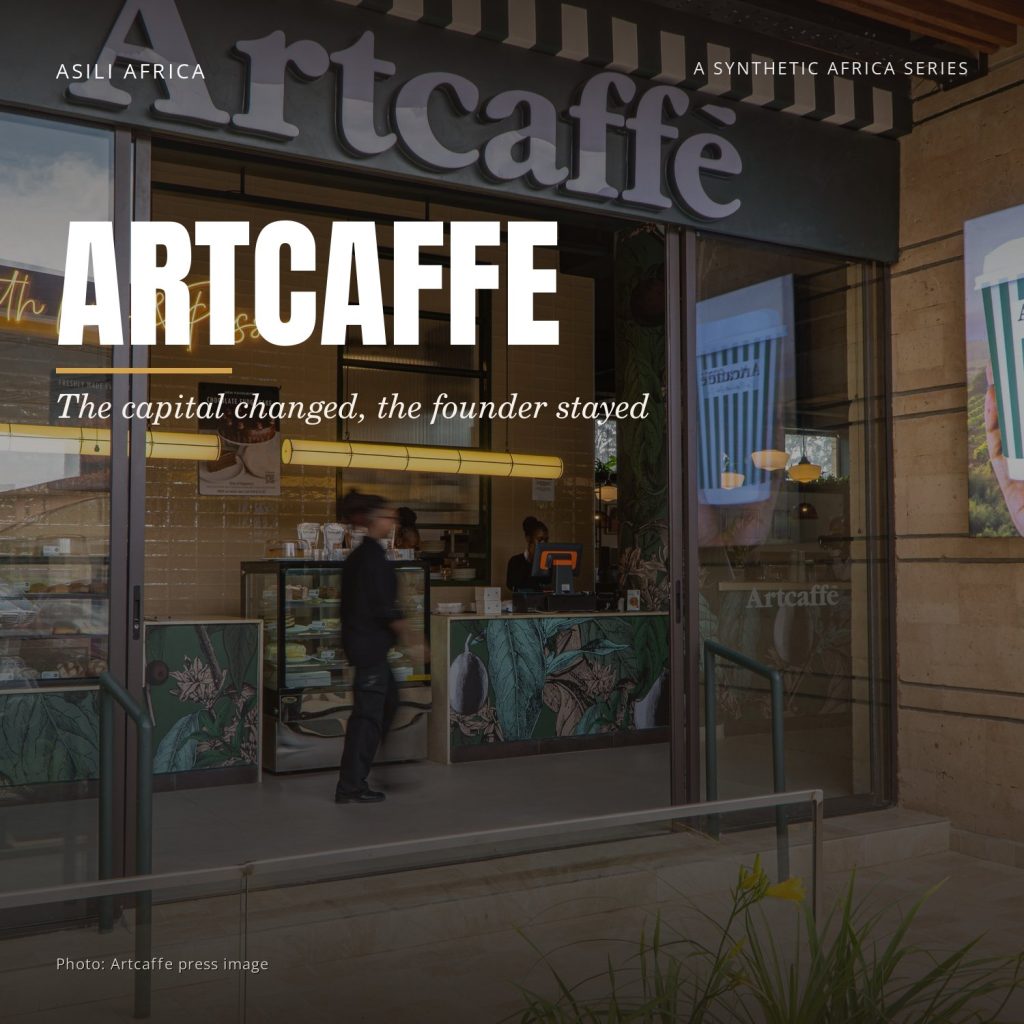
The Artcaffe Story
In two thousand and eight, in a shopping mall that had opened one year earlier in Westlands, Nairobi, a small European style café opened on the ground floor terrace. The café had wooden tables. A marble counter. An in house bakery. Imported espresso equipment. A wine list. And a design language that had never previously existed in a Nairobi coffee shop. The founder of the café was a man named Sagi Vaknin. The backers, per the trade press of the period, were a group of Israeli investors. The bet the café was making was on a demographic. Nairobi’s upper middle income professional. The expatriate consultant. The weekend brunch family. The Kenyan who wanted a European café inside a global standard mall. The café was called Artcaffé.
Five years later, on the twenty first of September, two thousand and thirteen, four al-Shabaab gunmen entered Westgate Mall. The first shots they fired, per multiple contemporary witness accounts, were fired at or near the outdoor terrace of that same Artcaffé, at the ground floor front entrance of the mall. Sixty seven civilians and members of the security forces were killed over the four day siege that followed. Two hundred were wounded. The mall closed. The country was reshaped. And Artcaffé, a Kenyan casual dining chain that had grown to just four outlets in its first five years of trading, was, four months later, in the aftermath of one of the deadliest attacks in Kenyan history, announcing the single largest strategic scale up in its history. That is the specific story we are going to tell today.
Eighteen years after it opened at Westgate, Artcaffé operates approximately sixty outlets across six brands, employs around one thousand two hundred people, and sits, in mid twenty twenty six, at the centre of a private equity ownership arc that connects it to Java House, to the Abraaj collapse, to a US private equity firm, and to an African food and agri fund that now sits on both sides of Kenya’s premium casual dining sector. This is the story of how a European style café at a Nairobi mall became one of the most structurally consequential casual dining chains on the continent. And how it survived the specific event, at the specific mall, that changed everything.
WESTGATE, TWO THOUSAND AND EIGHT
To understand how Artcaffé came into being, we have to sit inside Westgate Mall, in Westlands, Nairobi, in the year it opened. Westgate was developed by a Kenyan Ismaili businessman named Alnoor Kassam, and by his family’s real estate operation, and it opened in two thousand and seven. It was the first mall in Nairobi built specifically to serve an upper middle income Kenyan and expatriate customer at a global luxury standard. The anchor tenant was Nakumatt, then the country’s dominant supermarket. The retail footprint was two storeys, with an underground car park, and a design language that had not previously existed in Nairobi retail. Westgate was the mall that put Westlands on the international shopping map. And Westgate was the mall that Sagi Vaknin, an operator backed by a group of Israeli investors, chose to open his first café in.
The café opened in two thousand and eight. The name was Artcaffé. The format was European style bakery café. All day menu. Coffee, in house bakery, salads, pasta, wood fired pizza, burgers, breakfast, brunch, wine bar, cocktails. The customer was, from day one, positioned above Java House on premium, above Dormans on curation, and above every other coffee shop in Nairobi on design. Java House, founded in nineteen ninety nine by two Americans named Kevin Ashley and Jon Wagner, dominated the mainstream. Dormans, the older wholesale roaster brand, dominated the coffee purist end. What neither of them had built was the design heavy, all day, European style café that the incoming Westgate customer was walking through the mall to look for. Artcaffé filled that gap.
For the first five years of the company’s operating life, Artcaffé did not grow the way a private equity financed chain would grow. It grew the way an operator financed chain grows. One outlet at a time. Between two thousand and eight and the end of two thousand and thirteen, Artcaffé added three additional Nairobi locations, taking the total to four outlets across the city. Westgate, Galleria, The Junction, Village Market, Thika Road. A five year run at less than one outlet per year. That is a pace consistent with a founder operated, cash flow financed casual dining brand still learning its unit economics, still refining its central kitchen supply, still building out the Nairobi upper middle brand that Sagi Vaknin’s team had chosen to bet on.
And then came the twenty first of September, two thousand and thirteen.
THE TWENTY FIRST OF SEPTEMBER
On a Saturday morning in September two thousand and thirteen, four al-Shabaab gunmen entered Westgate Mall. The Somali militant group had, in its own claim of responsibility, framed the attack as retaliation for Kenya’s Operation Linda Nchi intervention against al-Shabaab inside Somalia. The gunmen entered through the front of the mall. According to multiple contemporary witness accounts, and corroborated by the KIFC Lessons Learned report and by the KDF’s own subsequent retelling, the first shots fired inside Westgate were fired at or near the ground floor outdoor terrace of Artcaffé, the café that fronted the mall’s main entrance.
The siege lasted four days. At least sixty seven civilians and members of the security forces were killed. Approximately two hundred were wounded. The Kenya Defence Forces, the Israeli Defence Forces, and international counter terrorism assistance all became involved in the response. Named survivor testimony from within Artcaffé itself appeared in the Wikipedia record of the attack, in Foreign Policy’s contemporary coverage, and in CBS News reporting. An Artcaffé employee, Patrick Kuria, gave contemporary press evidence about the arrival of the gunmen into the café at the ground floor. He described taking cover during the shooting. He described gunmen in black turbans. He described what he had seen. The public record does not preserve a named list of Artcaffé staff killed at Westgate. The counter terrorism reporting of the period listed civilians as an aggregate. What is on the record is that Artcaffé, five years old, four outlets in, had just lost customers and staff at its founding location, in a national tragedy that would reshape Kenyan security policy for the next decade.
Four months later, on the twenty seventh of January two thousand and fourteen, Business Daily broke the story that Artcaffé had reached agreement with a Kenyan coffee company called C. Dorman Limited to acquire seven Dormans Coffee outlets. The Dorman family business, historically Kenya’s oldest coffee roasting operation, had been sold by the UK based ED and F Man Group in two thousand and eleven to a third generation Kenyan named Jeremy Block. Block, whose father was the twentieth century Kenyan industrialist Jack Block, had kept the parent roasting business and was now willing to divest the retail café outlets. Artcaffé bought them. The Competition Authority of Kenya cleared the deal on the first of February two thousand and fourteen. The financial terms were not disclosed. The strategic effect was immediate. Artcaffé went from four outlets to eleven, in a single quarter.
The Dormans deal was not, on its own, unusual. Kenya has seen many small chain to chain retail acquisitions. What made the Dormans deal narratively important, and what marks it out in the pre scale Artcaffé story, was the timing. The mall reopening, the recovery from the loss, the funeral cycle for the Westgate dead, the police forensic investigation of the attack, and the al-Shabaab post attack messaging, were all still ongoing in the country when Sagi Vaknin’s team was signing the Dormans acquisition. Vaknin’s public commentary at the time, quoted in How We Made It In Africa, acknowledged the company was recovering from Westgate losses while committing to expansion. The scale up came in the same quarter as the tragedy. That is a specific, unusual, and consequential piece of operating history.
THE FIVE BRAND GROUP
Between two thousand and fourteen and the end of two thousand and eighteen, Artcaffé Group did three things at once. It continued to open new Artcaffé Coffee and Bakery outlets across Nairobi’s premium malls and standalone retail sites. It rolled the Dormans brand across the acquired outlets and expanded it. And it launched three additional in house sub brands. Urban Burger Bar. Tapas Ceviche Bar. OhCha Noodle Bar. Each of the new sub brands was positioned as an alternative to the parent Artcaffé menu, but each shared the operating infrastructure of the group. Central kitchen. Bakery supply. Back of house logistics. HR. Procurement.
By the end of two thousand and eighteen, the Group operated approximately twenty six outlets across the five brands. It employed approximately one thousand three hundred staff. It ran a Group central kitchen and bakery that supplied every Nairobi outlet. And it had, in eight years, turned a single Westgate ground floor café into the number two casual dining group in Kenya by outlet count, second only to Java House. Which meant, in mid two thousand and eighteen, one thing. It was ready for private equity.
On the nineteenth of December two thousand and eighteen, Emerging Capital Partners, a US based Africa focused private equity firm founded in the year two thousand by Hurly Doddy and Vincent Le Guennou, announced that its ECP Africa Fund Four had acquired a majority stake in Artcaffé Group from the founders. The financial terms were not officially disclosed. Business Daily and The East African, citing insider sources, put the deal size at approximately three point five billion Kenyan shillings, roughly thirty four million United States dollars. The Kenyan investment banking boutique StratLink advised Artcaffé on the sale. Sagi Vaknin retained a minority stake and operational control. The Group had, in a single stroke, moved from operator plus Israeli investor capital, to US private equity capital.
There is a specific structural point about the ECP transaction that matters. In two thousand and twelve, ECP had led the first institutional round into Java House. In two thousand and seventeen, ECP exited its Java stake to the Dubai based emerging markets private equity firm Abraaj at a valuation reported at over one hundred million United States dollars. Abraaj would, in two thousand and eighteen, collapse into liquidation under the weight of a fund misappropriation scandal that would take down its founder Arif Naqvi and reshape the entire African private equity ecosystem. Java’s stake would move, in two thousand and nineteen, to the UK’s Actis. And, six years later, would move again, in February two thousand and twenty five, into a Kenyan recapitalisation led by Alterra Capital Partners and Phatisa. That is Java’s story. What matters for Artcaffé’s story is that ECP sold Java in two thousand and seventeen, and, in the same twelve months, was in negotiation with Vaknin’s team over the Artcaffé stake that would close in December two thousand and eighteen. Kenya’s PE backed casual dining sector went from one ECP owned chain to a different ECP owned chain in a single calendar year. The chains were swapped.
Vaknin’s own remarks at the December two thousand and eighteen announcement were tight and on brand. He said, we are excited to partner with ECP, one of the most experienced investors in this sector and market. Paul Maasdorp, the ECP Managing Director who led the deal, reciprocated. He described Artcaffé, and I quote him, as an iconic Kenyan brand that has become synonymous with best in class service, excellent coffee, food, and baked goods. The announced strategic plan included regional expansion into Uganda and Rwanda, matching Java’s own East African footprint. Eight years later, in mid two thousand and twenty six, that regional expansion has not, on the public record, materialised. What did happen, in the two years between the ECP close and the arrival of COVID, was a rapid Nairobi expansion push. The thirty fifth outlet opened at Westminster House on Kenyatta Avenue on the thirteenth of November two thousand and nineteen, with two hundred and fifty seats, the largest single Artcaffé location up to that point.
COVID, MARKET, AND THE PHATISA DUAL POSITION
The pandemic arrived in Kenya in March two thousand and twenty. Artcaffé’s operating response was three part. First, it defended the physical stores through delivery, accelerating its integrations with Uber Eats, with the Barcelona based on demand delivery platform Glovo, and with the pan African e-commerce marketplace Jumia. Second, it built out an in house digital ordering pipe for grocery adjacent items, ready meals, pantry staples, coffee beans, that would become, three years later, the foundation for the Artcaffé Market launch. Third, it kept opening stores. In July two thousand and twenty, a third CBD outlet opened at Chester House on Kimathi Street, framed in Business Daily and by the analyst firm Cytonn Investments as a signal of continuing expansion through the pandemic downturn. In December two thousand and twenty one, four more outlets were announced. Three of them, on Shell petrol station forecourts. And a fourteen thousand square foot two storey flagship at Britam Tower in Upper Hill, with a five hundred person private terrace, the new largest outlet in the Group.
The Shell forecourt expansion is a specific operating signal worth pausing on. Historically, petrol station forecourt real estate had been Java’s most productive expansion channel. Kenya’s petrol forecourts, at Shell and at Total and at Rubis, had built themselves into small commercial hubs, with quick service casual dining tenants attached to the fuel stations along the Nairobi commuter routes. Java had leaned into that channel. Artcaffé, historically, had stayed inside malls and standalone premium retail. The December two thousand and twenty one Shell push was Artcaffé signalling, for the first time, that it was willing to compete site by site with Java on the forecourt.
In October two thousand and twenty three, Artcaffé Group launched Artcaffé Market, a gourmet grocery and deli sub brand, with a flagship at Village Market in Gigiri. The format is not a restaurant. It is a curated premium grocery store with a deli counter, an in house butchery, a bakery, a wine cellar and tasting room, a fresh produce section, and a same day online delivery pipe operated through stores dot artcaffé market dot co dot k e. The customer overlap with Village Market’s Zucchini outlet, which we covered in a previous Asili Africa episode, is significant. The two brands, Zucchini fresh produce and Artcaffé Market gourmet grocery, represent, in mid two thousand and twenty six, the two dominant premium grocery formats aimed at Nairobi’s Gigiri, Muthaiga, Runda, and Karen households. The Group had, in a single format launch, moved beyond casual dining and into premium retail grocery.
On the fifth of June two thousand and twenty five, the Africa focused food and agri private equity firm Phatisa announced a mezzanine debt growth facility into Artcaffé Group, deployed via its Phatisa Food Fund Two. The transaction was disclosed by Phatisa as its first ever mezzanine debt investment. The facility size was not disclosed. What matters about the Phatisa Artcaffé move is what happened four months earlier. In February two thousand and twenty five, Java House had been reorganised out of the UK’s Actis ownership. Alterra Capital Partners took majority equity. And Phatisa took a minority position with control rights. Four months later, Phatisa was in Artcaffé’s cap stack too. That is an unusual, structurally significant, dual side position. It means, as of mid two thousand and twenty six, Kenya’s two largest casual dining chains are financially linked at the shareholder level through a single Africa focused food and agri private equity firm. Whether that dual position hints at future consolidation, at sector level coordination, or simply at parallel bets, is not yet on the public record. But the fact of it is.
WHAT IS ACTUALLY DIFFERENT ABOUT ARTCAFFÉ
Three things separate Artcaffé from the Kenyan casual dining and grocery brands that surround it. Not one thing. Three, at once. Each one, on its own, is unremarkable. Together, they are what Artcaffé is.
The first is the capital. Java House was founded by two Americans and grew for its first thirteen years on founder cash flow before ECP came in in two thousand and twelve. Zucchini was founded by a Kenyan Asian graduate in nineteen ninety one and has, in thirty five years, raised zero disclosed outside capital. Artcaffé was founded by a foreign operator, Sagi Vaknin, backed by a group of Israeli investors, and, ten years in, sold a majority stake to a US private equity firm. Six years after that, added a mezzanine debt layer from an Africa focused fund. In eighteen years of operation, Artcaffé has had three material capital events. Zucchini has had one, in nineteen ninety one, and that was thirty five thousand shillings of personal savings. Java has had four. Artcaffé sits in between the two, structurally closer to Java, with foreign capital defining the shape of the business.
The second is the format. Java House is a single brand. Zucchini is a single brand plus a sister bakery. Artcaffé Group operates six brands under a single corporate structure. Artcaffé Coffee and Bakery. Dormans Coffee. Urban Burger Bar. Tapas Ceviche Bar. OhCha Noodle Bar. Artcaffé Market. Each brand serves a slightly different customer, a slightly different daypart, a slightly different price point. All of them share the central kitchen, the bakery supply, and the back of house logistics of the Group. The multi brand structure is what has let Artcaffé scale from twenty six outlets at the end of two thousand and eighteen to approximately sixty outlets in mid two thousand and twenty six, a two point three times increase in six and a half years, without diluting the flagship Artcaffé Coffee and Bakery positioning. Sub brands absorb the growth. Parent stays premium.
The third is the founder. Sagi Vaknin has been the operating founder of Artcaffé for eighteen years. Under ECP majority ownership since December two thousand and eighteen, and under the Phatisa mezzanine debt layer since June two thousand and twenty five, Vaknin has remained the CEO. Every material Group announcement of the last twelve years carries his name. That is a specific fact about Artcaffé that is different from Java. Java House has had four PE ownership changes in twelve years, and multiple senior management changes across them. Artcaffé has had one majority ownership change in eighteen years, and Vaknin has remained the operating leader through it. In Kenyan casual dining, that is unusual. And it is one of the reasons the Group’s operating discipline, its central kitchen quality, and its store level brand consistency, have held through every capital event.
Those three things, together, are what has allowed Artcaffé to do the specific thing it is doing in mid two thousand and twenty six. After sixteen years as a Nairobi only chain, the Group began its first material push beyond Nairobi in two thousand and twenty four. A Naivasha outlet at the Safari Centre. A Nanyuki outlet at the Shell fuel station on the Nyeri Nanyuki Road, opened in July two thousand and twenty five. A Redhill outlet at the Astrol petrol station, opened in October two thousand and twenty five. An Artcaffé Market Nanyuki location sourcing herbs, greens, and vegetables from Olepangi Farm, a Mt. Kenya organic producer. That is the beginning of the geographic expansion that the ECP December two thousand and eighteen announcement had promised. Six and a half years late. Executed under Phatisa mezzanine financing rather than ECP growth equity. And targeted at the Rift Valley, Mt. Kenya, and the northern commuter belt of Nairobi rather than at Uganda or Rwanda.
TODAY AND TOMORROW
Today, at the beginning of July two thousand and twenty six, Artcaffé operates approximately sixty outlets across six brands. It employs, across the network and the central operations, roughly one thousand two hundred to one thousand two hundred and ninety people. It runs a Group central kitchen and bakery that supplies every outlet in Nairobi. It fulfils delivery through Uber Eats, Glovo, and Bolt Food, plus its own online store for the Artcaffé Market brand. It is, thirty five per cent of the way to Java House’s ninety six plus outlet count, and it is the number two Kenyan casual dining group by outlet count in mid two thousand and twenty six.
The competitive context in mid two thousand and twenty six is unusual. Copia is dead. Twiga is a business to business platform in restructure. Nakumatt is a memory. Tuskys is a memory. Uchumi is a skeleton. Kenya’s mainstream retail sector has been reorganised over the last decade by private equity and by development finance. Casual dining, by contrast, has consolidated but survived. Java House operates approximately ninety six outlets across Kenya, Uganda, and Rwanda. Artcaffé operates approximately sixty across six brands in Kenya. Between them, Kenya’s mainstream casual dining sector is now effectively a two chain market, and both chains sit in Phatisa’s cap stack.
Two live questions sit against that mid two thousand and twenty six position. The first is regional expansion. The plan announced at the ECP December two thousand and eighteen close was Uganda and Rwanda. The plan re announced with the Phatisa June two thousand and twenty five mezz was regional expansion, digital investment, and B two B growth. As of mid two thousand and twenty six, the confirmed expansion has been Naivasha, Nanyuki, and Redhill. The Uganda and Rwanda outlets promised in two thousand and eighteen have not, on the public record, opened. Whether they will open under the Phatisa financing in the next twenty four months is the single most consequential operating question in the Group.
The second live question is the identity trade. The October two thousand and twenty three launch of Artcaffé Market is the operational admission that the Group’s next growth vector is not another Artcaffé Coffee and Bakery outlet. It is a different category. Gourmet grocery and deli format retail is a materially different economic model from casual dining. Different margin profile. Different labour intensity. Different real estate footprint. The pivot toward retail grocery puts Artcaffé Market into direct competitive contact with Chandarana Foodplus, with Zucchini, with Greenspoon, and with Carrefour, on the specific Village Market and Karen and Muthaiga customer that all of them are chasing. Whether the retail grocery bet delivers Group level accretion, or whether it dilutes the flagship Artcaffé casual dining brand, is not yet visible. It will be, in the next two to three years.
The single most striking fact about the Artcaffé story is the ratio between the events that have moved the business and the continuity of the person running it. In eighteen years of operating history, Artcaffé has survived Westgate. It has doubled its outlet count in a single quarter with the Dormans acquisition. It has been sold to a US private equity firm at an insider estimated thirty four million United States dollars. It has been layered with mezzanine debt from an African food and agri fund. It has been connected to Java House at the shareholder level through a single fund’s dual position. It has launched a gourmet grocery sub brand. It has pushed out of Nairobi for the first time. And through all of it, the same founder, Sagi Vaknin, has been at the top of the organisation. The physical outlets and the capital stack have been reshaped constantly. The operating leader has not.
The best measure of whether Artcaffé has worked is not the outlet count. Artcaffé has approximately sixty. It is not the private equity valuation. Artcaffé sold at an insider estimated thirty four million United States dollars. It is not the regional expansion. Artcaffé has not, in any material sense, left Kenya. The best measure is whether, eighteen years after a European style café opened on the ground floor of a Nairobi mall, in the specific corner of Nairobi retail where Westgate stood in two thousand and eight, and where the twenty first of September two thousand and thirteen happened, the café is still there, still serving customers, still owned and operated by the same founder, and still, in mid two thousand and twenty six, the number two casual dining brand of record in the country. It is. That is the entire measure. The rest is capital structure and sub brand experiments.
In two thousand and eight, in a shopping mall in Westlands, Nairobi, a small European style café opened on the ground floor terrace. The founder was Sagi Vaknin. The backers were a group of Israeli investors. The bet was on Nairobi’s upper middle income professional. Five years later, on the twenty first of September two thousand and thirteen, the al-Shabaab attack on Westgate Mall began at or near the outdoor terrace of that same café. Four months after that, in January and February two thousand and fourteen, the founder announced the acquisition of seven Dormans coffee outlets, doubling the chain in a single quarter. Four and a half years after that, in December two thousand and eighteen, US private equity firm Emerging Capital Partners acquired a majority stake at an insider estimated thirty four million United States dollars. Six and a half years after that, in June two thousand and twenty five, the African food and agri fund Phatisa layered a mezzanine debt facility on top, in the same year Phatisa took a minority position with control rights in Java House itself. Eighteen years after founding, in mid two thousand and twenty six, Artcaffé operates approximately sixty outlets across six brands, employs roughly one thousand two hundred people, has begun its first material push beyond Nairobi, and remains, throughout, operated by the same founder. It is not the founder cash flow patience of Zucchini. It is not the four times PE reshuffle of Java. It is a specific, foreign founded, foreign capital, multi brand, multi capital event, single founder Kenyan casual dining story. And it started on a Nairobi mall terrace in two thousand and eight.
This is Asili Africa. Every empire has an origin.
Key Takeaways
- WESTGATE, TWO THOUSAND AND EIGHT. To understand how Artcaffé came into being, we have to sit inside Westgate Mall, in Westlands, Nairobi, in the year it opened.
- THE FIVE BRAND GROUP. Between two thousand and fourteen and the end of two thousand and eighteen, Artcaffé Group did three things at once.
- COVID, MARKET, AND THE PHATISA DUAL POSITION. The pandemic arrived in Kenya in March two thousand and twenty.
- TODAY AND TOMORROW. Today, at the beginning of July two thousand and twenty six, Artcaffé operates approximately sixty outlets across six brands.
Also available on YouTube — search “Asili Africa” or subscribe to our channel.