
The Sun King Story: A kerosene-lamp fire in a rural Kenyan home in 2007 set two founders on a path
In the summer of two thousand and five, a twenty year old physics student from the American Midwest walked into a village in rural Orissa, India.
He was on his first trip with a student engineering charity called Engineers Without Borders. He was supposed to be helping install a small biofuel generator at a village school. The project did not really work. The generator ran. The school was a quarter of a mile down the road, too far to receive electricity from it. He spent most of the trip watching.
What he watched was simple. Every evening when the sun went down, every household in the village lit a kerosene wick lamp. Families ate by the light of those lamps. Children did their homework by the light of those lamps. The lamps were dim. The lamps were dangerous. If a child knocked one over while bent over a notebook, there was a flame and there was spilled fuel. And the lamps were expensive. A poor household spent between ten and twenty percent of its cash income on the kerosene to keep them burning, paid in tiny daily and weekly increments at the local shop.
Two billion people in the developing world were lighting their homes the same way that night.
The student’s name was Patrick Walsh.
Eighteen months later, he would come back to the same village with a hand built solar lantern, and he would sell the first one to a villager who insisted on buying it.
Twenty one years after that, the company he started with two friends from his university would be opening a manufacturing plant outside Nairobi. It would have ten million paying customers across Africa. It would have lit homes for ninety million people. It would control thirty eight percent of the world’s pay as you go off grid solar market. And one in every five Kenyans would flip a switch instead of striking a match.
This is the story of Sun King. The kerosene replacement company that became a finance company, and is now becoming a utility.
This is Asili Africa.
The Lab at Three in the Morning
Patrick Walsh had grown up interested in physics. By his own account, in his first interview at university, the questions that captured him were the largest possible ones. The origin of the universe. The behaviour of light. The mathematics that described both.
What changed him was a survey course in his second year. The professor was named Bruce Litchfield. The course was titled International Dimensions of Engineering. It introduced students to a small charity called Engineers Without Borders, where American engineering undergraduates were paired with rural development projects in poor countries. Walsh has said since that he was hooked from the first meeting.
In the summer of two thousand and five he went to Orissa. He came back with a single observation that would build the company.
Two billion people in the developing world were lighting their homes with kerosene. That market already existed. It was already being paid for. The poor households of rural India and rural Sub Saharan Africa were already, every week, handing over tiny increments of cash to the local kerosene seller. The cash flow was not the problem. The lamp was the problem.
Back at Illinois, Walsh started hand building prototype solar lanterns out of P V C plumbing tube, L E Ds and small solar panels he could buy in U S hardware stores. The work happened mostly at night, because he was still a full time undergraduate, and the lab was empty at night.
The other founding moment of the company is one his co founder still tells in interviews.
Anish Thakkar was an Indian American student at the same university. He was running a student cycling charity called Illini four thousand, raising money for U S cancer affected families. He had no background in solar. He had previously worked at a consultancy called Z S Associates. One night, sometime around three in the morning, he walked into a campus engineering lab to find his classmate, by his own description, haggard and dishevelled, surrounded by bits of P V C tube and small soldered circuit boards. He asked if Walsh needed help. Walsh’s pitch was specific. He was packing a suitcase with prototypes for a second trip to Orissa, where he was going to sell them to villagers, to see if villagers would buy. Thakkar volunteered on the spot. The two of them have been in business together for two decades.
In December of two thousand and six, Walsh returned to Orissa with the prototypes. He had intended them as field test units. One villager asked, instead, to buy one outright. Walsh, by his own account, was incredulous. The prototypes were rough hand built devices, not products. He sold one anyway. The villager paid cash. That was the moment the project stopped being a charity exercise and became a company.
Walsh and Thakkar were joined by a third University of Illinois engineering classmate, Mayank Sekhsaria, the following year. In two thousand and seven, the three of them incorporated a company. They called it Greenlight Planet.
In two thousand and eight, Walsh’s lantern design won the Lemelson Illinois Student Prize, a thirty thousand dollar student award. That prize money funded the first commercial manufacturing run.
The operating split was geographic. Anish and Mayank moved to India to build the distribution. Walsh moved to Shenzhen, in southern China, to build the product. They were three engineering students, none of them yet thirty years old, running a hardware company across three continents on thirty thousand dollars and the proceeds of a December village sale.
The Twenty Five Dollar Lantern
The first product worked. The second problem was harder.
The product was a single L E D desk light with a small roof mounted solar panel and a built in battery. It was called the Sun King Pro. The retail price in India was about twenty five U S dollars. Greenlight sold it through small dealers and rural retail networks across the north and east of the country.
The customer either had the twenty five dollars or did not buy.
That sentence is the entire first decade of the company.
The kerosene lamp business that Sun King was trying to replace was structured around paying for light in tiny chunks. A poor household never paid for a year of light at once. It paid the local shopkeeper a few rupees every few days for a top up of kerosene. The lamp itself, the brass body, had been a one off purchase decades earlier, often inherited. The household never thought about it as a product cost.
A twenty five dollar lantern, paid in cash, in one transaction, did not fit that mental model. To a household spending the equivalent of one to two dollars a week on kerosene, twenty five dollars was three months of light, paid in advance. It was the same kind of jump that asking a Western consumer to pay five years of electricity bills up front would be.
The first decade was a relentless education exercise. Solar was not a hand out from a charity. It was not a gift. It was a product, and it had to be paid for, and the customer’s life would be better afterwards. Field agents walked from village to village, lit lanterns at sundown, lit kerosene lamps next to them for comparison, and made the case one household at a time.
There was a second problem underneath the first. The category that Sun King was creating was being polluted, in real time, by a flood of two and three dollar Chinese solar lanterns from Shenzhen that died inside months. A household that had finally been persuaded to spend the equivalent of a month’s groceries on a solar product, and then watched it die, was not going to give the category a second chance.
Sun King had to over engineer. The Sun King Pro carried a longer warranty than the category expected. It was built to a higher standard than its price competitors. And it got a quiet, important assist in twenty ten when the World Bank launched a certification programme called Lighting Global, which standardised the technical claims that off grid solar manufacturers were allowed to make on their packaging. The cheap junk was, gradually, pushed out of the legitimate retail channel.
In twenty ten, Greenlight won the Ashden Award for Sustainable Energy, a small but credibility building international prize in the impact investor community. In twenty twelve, the company closed its Series A. The round was four million U S dollars. Bamboo Finance led. Deutsche Bank and Global Partnerships participated.
By the end of twenty eleven, the company was still, fundamentally, a hardware business selling twenty five dollar lanterns into rural India for cash. The product was good. The brand was real. The distribution worked. Growth was real but slow.
Something was about to happen in Kenya that would change what kind of company Sun King could be.
Light on Layaway
In two thousand and seven, the same year Walsh, Thakkar and Sekhsaria incorporated Greenlight Planet, Safaricom and Vodafone launched M-Pesa.
M-Pesa was a mobile money platform that let Kenyans send small amounts of cash to each other over text message. It moved very small payments very cheaply. By the early years of the following decade, M-Pesa had restructured how Kenyans paid for everything. Rent. School fees. Buses. Groceries. Small payments to small businesses. The country was, almost by accident, the world’s most advanced infrastructure for collecting tiny payments at scale.
In October of twenty twelve, a separate company called M-KOPA, founded by Nick Hughes and Jesse Moore, did something with that infrastructure that no one had done before. M-KOPA wired a Safaricom S I M card into the controller of a small solar home system from a Sun King competitor called d.light, and launched the world’s first pay as you go off grid solar product. The customer paid a small deposit. After that, the customer sent a small amount of money over M-Pesa every day. If the customer paid, the kit kept running. If the customer missed a payment, the kit locked. When the customer had paid off the full price over twelve to eighteen months, the kit unlocked permanently and was theirs.
Sun King was watching very carefully.
Inside twenty four months, Sun King had built its own pay as you go infrastructure. The platform was branded Sun King EasyBuy. The product was a step up from the lantern — a multi light Sun King Home solar kit with a panel on the roof, two or three L E D bulbs inside the house, a U S B charging port, and an embedded S I M in the control box. The entry price was as little as nineteen U S cents a day, twenty five Kenyan shillings, deliberately priced to undercut what families in those markets were already spending on kerosene per night. Pay every day, the lights stay on. Stop paying, the lights cut out. Pay off the kit completely, the family owns it outright. Sun King kept running the cash sale lantern business underneath, as the entry level product.
What Sun King discovered, over the next five years, was that it was not a lantern company. It was a finance company that ships solar.
The product the company was actually selling, the thing that had unlocked the market in a way the cash sale lantern never could, was a small consumer loan, denominated in Kenyan shillings or Nigerian naira or Ugandan shillings, secured by a solar kit that could be remotely switched off if the customer stopped paying. The lantern was the collateral. The S I M was the repo man.
The distribution model that grew up around the product was as important as the product. Sun King built an agent network. Fifteen thousand commission paid field agents, branded Sun King Energy Officers. The majority of them were themselves former Sun King customers. They knocked on doors in villages they lived in, signed up their neighbours on a tablet, and earned a commission on every paid up kit.
The capital followed the model. A ten million dollar Series B from Fidelity Growth Partners India in twenty fifteen. A five million dollar debt facility from O P I C in the same year, to fund the India loan book. And in December of twenty seventeen, the round that institutionalised what Sun King was becoming — a sixty million dollar mixed equity and debt round, led by the London based private equity firm Apis Partners, with a debt syndicate of Deutsche Bank, SunFunder, responsAbility and others.
The capital intensive era of the company had begun. Every kit sold was a twelve to eighteen month consumer loan from Sun King to a customer with no credit file. Funding that without diluting equity was the structural question the company would spend the next eight years answering.
From Venture to Capital Markets
The five years between twenty twenty and twenty twenty five are the years Sun King stopped being an impact investment story and became an African infrastructure story.
In September of twenty twenty, the company closed a ninety million U S dollar growth round. In October of twenty twenty one, it closed a seventy five million U S dollar Kenya debt facility. Volume kept climbing. The agent network kept expanding.
In April of twenty twenty two, the company closed a Series D of two hundred and sixty million U S dollars. One hundred million was primary capital. One hundred and sixty million was secondary — meaning existing shareholders selling stakes to incoming shareholders. The round was led by BeyondNetZero, the climate dedicated fund inside the U S private equity firm General Atlantic. M and G Investments and the African focused fund ARCH Emerging Markets Partners joined. LeapFrog Investments stayed in. The round was three times oversubscribed.
The Series D did something else that is rare in African climate investing. It allowed Apis Partners, the London private equity firm that had led the twenty seventeen round, to fully exit its position. A clean private equity exit, at scale, in an African off grid solar company, was a quiet first.
In the same year, the company retired the Greenlight Planet name and rebranded company wide as Sun King. The lantern had become the company. TIME magazine put it on the one hundred Most Influential Companies list. Fast Company ranked it fourth in the world for social good innovation.
Customer growth was now running at about one hundred and fifty thousand new African customers a month.
But the equity rounds were not the structural innovation. The structural innovation came a year later.
In July of twenty twenty three, Sun King and the U S investment bank Citi closed a one hundred and thirty million U S dollar transaction in Kenya. The structure was new for the region. Sun King’s Kenyan business pooled the future cash flows of millions of customer micro payments — sixty Kenyan shillings here, one hundred Kenyan shillings there — and packaged them into a financial instrument that commercial banks and development finance institutions could buy. The senior tranche of the instrument was rated as investment grade. The first deal was, at the time, the first of its kind in Sub Saharan Africa.
Two years later, in July of twenty twenty five, Sun King and Citi closed the same structure again, this time at one hundred and fifty six million U S dollars. Twenty point one billion Kenyan shillings. Stanbic Bank Kenya placed it. The senior tranche was taken by A B S A, Citi, Co operative Bank of Kenya, K C B Bank Kenya and Stanbic. The mezzanine tranche was taken by three development finance institutions — British International Investment, F M O of the Netherlands, and Norfund of Norway.
It was the largest securitisation ever closed in Sub Saharan Africa outside South Africa.
What that deal meant, beneath the financial engineering, was this. The cost of growing Sun King’s loan book was no longer coming out of equity raised from venture capital. It was being funded by the local currency balance sheets of African commercial banks, lent against the daily payments of African customers. The model had decoupled. Equity could go into the next product. Debt would fund the next loan.
Three months later, on a different front, the company answered the other long standing question.
Sun King had imported its hardware in U S dollars and sold it on credit in Kenyan shillings and Nigerian naira for almost two decades. Every currency move ate the margin. In October of twenty twenty five, the company opened its first ever African manufacturing facility, a seven thousand six hundred square metre plant in Tatu City, in Kiambu County, just outside Nairobi. Capacity, seven hundred thousand units a year. C O O Kota Kojima led the opening. The company announced that a second plant would follow in Nigeria.
Manufacturing in the customer’s currency. Financing in the customer’s currency. The structural answer to the structural problem.
The company was no longer the same company.
Solar Company, Fintech, or Utility?
In February of twenty twenty six, the first product to come off the Tatu City line was not a solar lantern. It was a smartphone.
The Sun King E Z one is a six and a half inch Android phone, made in Kenya, sold in Kenya, on the company’s familiar pay as you go terms. Two thousand nine hundred and ninety nine Kenyan shillings as a deposit. Sixty Kenyan shillings a day, for three hundred and sixty four days. About twenty five thousand shillings in total, roughly one hundred and ninety U S dollars. It is, unmistakably, a direct competitive answer to the smartphone pay as you go category that the rival firm M-KOPA opened in Kenya five years earlier.
Three months earlier, at the Global Citizen NOW summit in Johannesburg, Patrick Walsh had laid out the company’s twenty thirty plan in public. Five point six billion U S dollars of deployed capital. Fifty million solar kits. Two hundred million Africans served. Equivalent to two thirds of the World Bank and African Development Bank’s Mission three hundred target, which aims to electrify three hundred million Africans by twenty thirty.
Sun King was, in effect, offering itself as a co architect of pan African electrification.
There are honest shadows in the story.
The Energy for Growth Hub, a U S think tank, has published the sharpest available critique of the pay as you go model that Sun King leads. It uses Sun King’s own product as the example. A Sun King fifty watt Home five hundred X kit in Nigeria costs one hundred and sixty five thousand naira if a customer pays cash. Under the seventy four week pay as you go plan, the same kit costs three hundred and nineteen thousand three hundred naira. A markup of about ninety four percent. The argument is that the cost of capital, the interest on the debt funding the loan book and the return expected by the equity, is being paid by the rural household, while urban grid customers pay subsidised electricity tariffs. The poorest household in the country pays the highest effective electricity bill.
A separate study, by researchers at the University of Oxford, published in early twenty twenty six in the journal Energy for Sustainable Development, looked at roughly a thousand African pay as you go solar households. It found that seventy seven percent reduced their consumption beyond the first year of ownership, and that mean demand fell by about a third by the end of year two. The kit, in many homes, was solving the kerosene replacement problem. It was not yet solving the full electrification problem.
Sun King is not blind to either critique. The Tatu City plant, by manufacturing in country, is meant to take cost out of the kit. The smartphone launch is a higher value asset that should improve unit economics. Two new securitisations have lowered the cost of capital. None of those measures resolves the structural question.
Is Sun King a solar company that happens to do consumer finance? Is it a consumer finance company that happens to ship solar? Or is it the first scaled, privately operated electrification utility for the twenty first century African home?
The company has not answered that question yet. Neither has the continent.
The story of Sun King is the story of a kerosene lamp in a village in Orissa, and three engineering students who spent twenty years figuring out how to sell its replacement to families that had never bought one before.
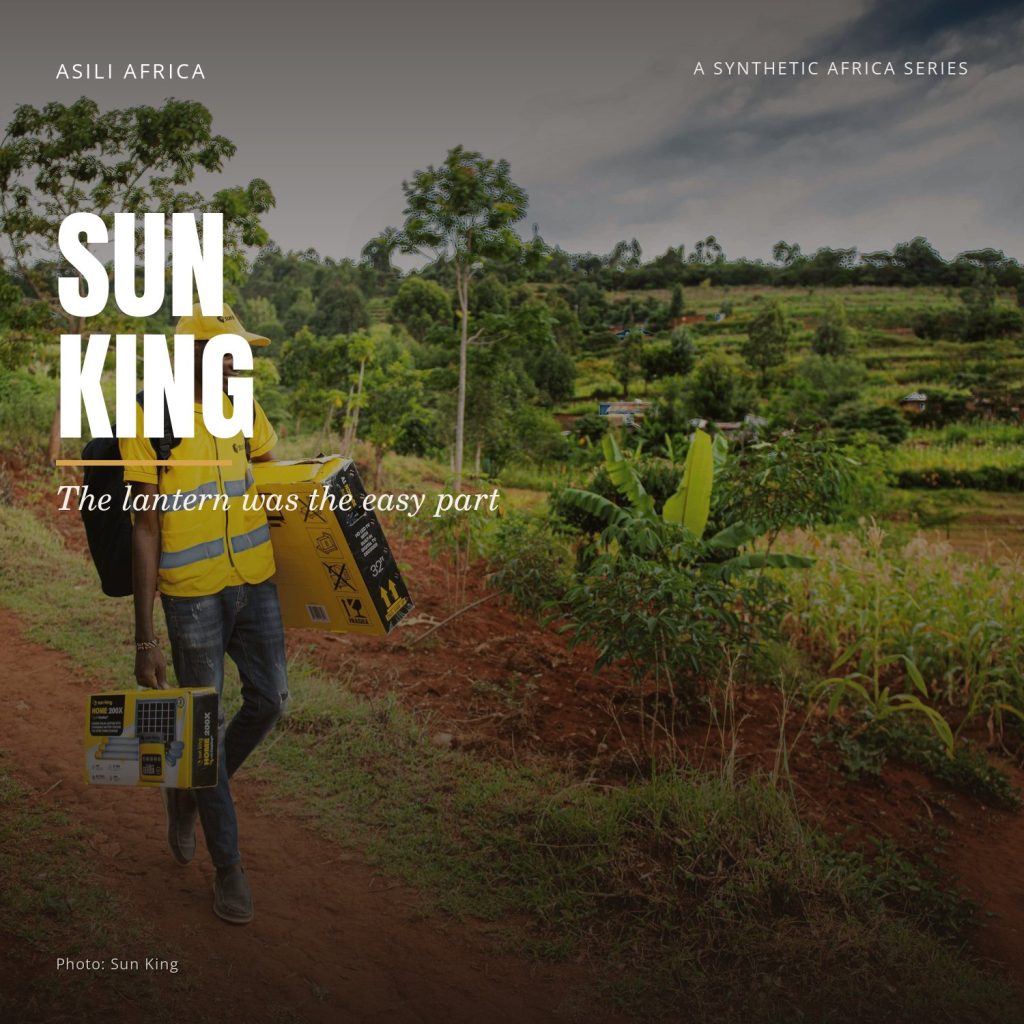
The lantern was the easy part. The way the lantern gets paid for was the company.
Every empire has an origin. This one began with a flame, in a doorway, in a village at sunset.
This is Asili Africa. Every empire has an origin.
Key Takeaways
- The Lab at Three in the Morning. Patrick Walsh had grown up interested in physics.
- Light on Layaway. In two thousand and seven, the same year Walsh, Thakkar and Sekhsaria incorporated Greenlight Planet, Safaricom and Vodafone launched M-Pesa.
- From Venture to Capital Markets. The five years between twenty twenty and twenty twenty five are the years Sun King stopped being an impact investment story and became an African infrastructure story.
- Solar Company, Fintech, or Utility?. In February of twenty twenty six, the first product to come off the Tatu City line was not a solar lantern.
Also available on YouTube — search “Asili Africa” or subscribe to our channel.