
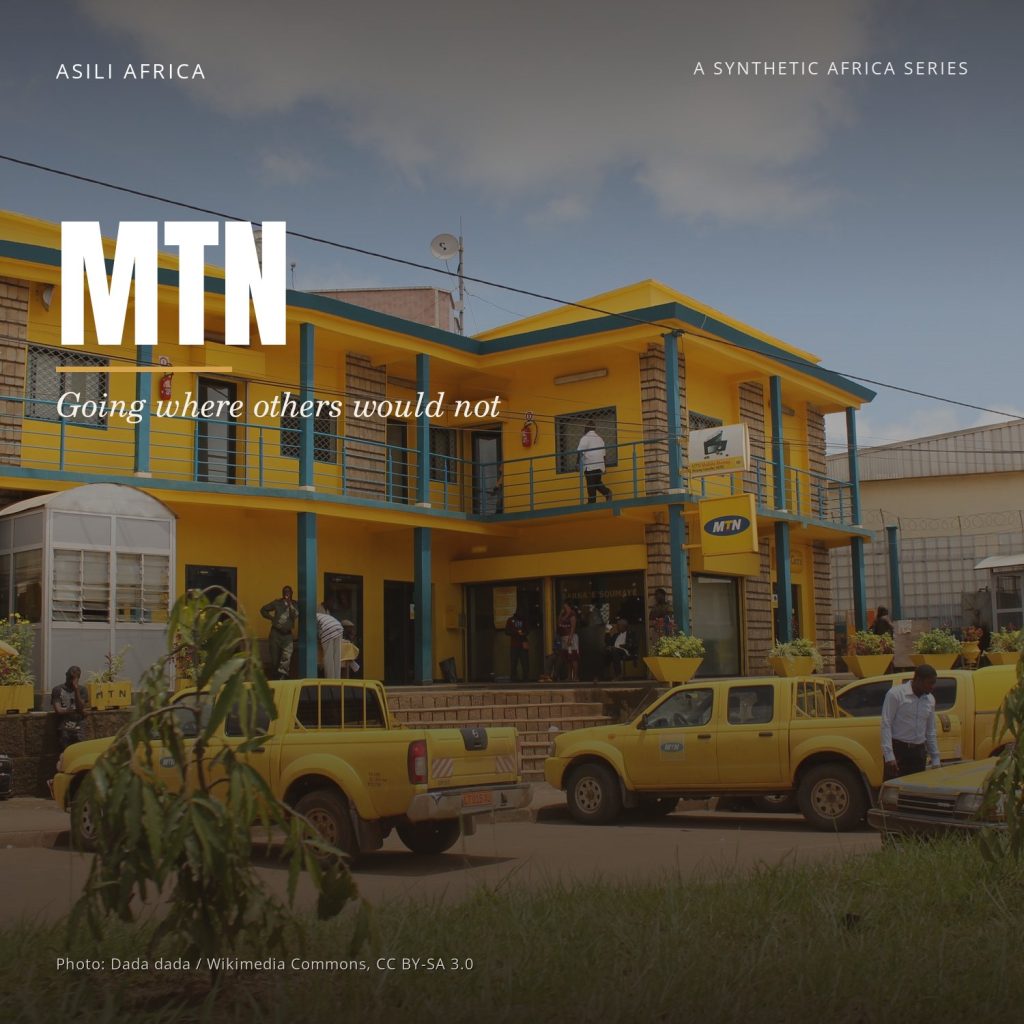
The MTN Story: Post-apartheid bet became Africa’s largest telco
On the afternoon of October 26th, 2015, a regulator in Abuja issued a press release. The number on the page was one trillion and forty billion naira. In US dollars, it was five point two billion. It was the largest regulatory fine ever levied on a single company anywhere on Earth.
Within two weeks, MTN’s share price on the Johannesburg Stock Exchange had collapsed by a quarter. The Group’s chief executive, a Zimbabwean engineer named Sifiso Dabengwa, had been forced to resign. And the company that had spent twenty-one years building Africa’s largest mobile network was looking at the prospect that a single regulatory ruling, in a single foreign capital, could break it in half.
It was, in many ways, the bill arriving for a strategy that had defined the company since the day it was born — going where the political risk was highest, because that was also where the customers were.
This is the story of MTN Group.
The Republic and the Network
To understand MTN, you have to begin in the last months of apartheid.
On the 29th of September, 1993 — seven months before South Africa’s first democratic election — a brand-new regulator called the Independent Broadcasting Authority awarded the country’s first two GSM cellular licences. One went to Vodacom, a joint venture between state-owned Telkom and the British telecoms giant Vodafone. The other went to a consortium called M-Cell, which would, eight years later, change its name to the one the continent now knows: MTN.
The licence was a piece of paper. But the cap table behind it was a political document.
Twenty per cent of the company was held by NAIL — New Africa Investments Limited — the first Black-controlled group ever listed on the Johannesburg Stock Exchange, founded by Nthato Motlana, the physician who had been Nelson Mandela’s personal doctor for thirty years. Five per cent was held by SACTWU, the Southern African Clothing and Textile Workers Union. Five per cent more was held by FABCOS, a Black business federation. Thirty per cent of one of the most strategically important corporate licences in the new South Africa was, by design, in Black hands on day one. This was not an accident, and not a marketing line. The licence had required it.
The other names on the share register were just as deliberate. Transnet, the state-owned railway. Naspers, the Afrikaans media house. Cable and Wireless of the United Kingdom, brought in for the engineering. And in the chairman’s seat, an attorney and former trade unionist named Cyril Ramaphosa — who, twenty-four years later, would become President of South Africa.
The network went live on the 1st of June, 1994. It was five days after Mandela had been sworn in as the first democratically elected president of the new republic.
The optics were deliberate. So was the logic underneath them.
In June of 1994, fewer than one in a hundred adult Black South Africans had a telephone in their home. The apartheid-era Telkom had built a copper fixed-line network that almost perfectly mirrored the racial geography of the country: dense in the white suburbs, almost completely absent in the townships and the rural homelands. The new government did not have the time, the money, or the political appetite to rebuild that network from scratch.
But it did not have to. Wireless could leapfrog all of it. A cell tower could serve a township in months. The first call from the new South Africa’s democratic majority did not need to wait for a copper line to be dug.
The first CEO was a telecoms executive named John Beck. He was replaced in 1995 by Bob Chaphe, who would build the launch network. The company’s own thirtieth-anniversary history would, decades later, title the chapter on this period — with admirable honesty — “A lily-white company.” The BEE structure on the share register, the history admits, took years to filter into the operational and management ranks. The licence was Black-owned at the holding-company level. The engineering room, for most of the first decade, was not.
And there was one more uncomfortable truth about those early years. M-Cell was not winning at home.
Vodacom — better capitalised, better resourced, with a multinational parent — passed one million subscribers in 1996. M-Cell would not follow until 1998. In its own home market, the company that would one day serve more Africans than any other operator was, structurally, the perpetual number two.
The question facing M-Cell at the end of the 1990s was the question facing every challenger in every industry. If you cannot win at home, where can you win?
The answer, when it came, was north.
The Northbound Bet
By the mid-1990s, MTN’s executive team understood something the South African press was slow to write about. The opportunity for a South African telecoms operator was not South Africa.
Vodacom had the home market locked down. The South African market, even fully built out, was no more than fifty million people, half of whom would never afford a phone. The fight there was a fight for the second-place ribbon.
But step over the Limpopo River, and the picture changed completely. North of South Africa lay a continent of seven hundred million people. The fixed-line penetration was, in most of those countries, below one per cent. The state telecoms monopolies were the same kind of sclerotic, apartheid-shaped institutions that South Africa had just inherited at home. And the incumbent mobile operators — where they existed at all — were small, undercapitalised, and slow.
A South African operator that could move first, that knew how to build a GSM network in a market with bad power and no incumbent, and that did not need to wait for European or American boards to approve a Lagos site visit — that operator could have the entire continent.
Vodacom’s strategy was to grow at home. MTN’s strategy would be to leave.
In 1998 — the same year MTN finally hit one million subscribers in its home market, two years behind its rival — the company launched commercially in Uganda. The Ugandan market in 1998 had fewer than fifty thousand fixed lines for a population of more than twenty million people. Inside eighteen months, MTN Uganda would have more subscribers than Uganda Telecom had ever had on copper. The thesis worked.
Months later, MTN went live in Rwanda. Four years after the genocide. A market that the rest of the global telecoms industry had written off as politically unbankable. MTN Rwandacell was, for years, one of the only meaningful foreign-direct-investment vehicles in the country. It built the network as the country was rebuilding itself.
In 2000, MTN acquired and rebranded Camtel Mobile in Cameroon. Eswatini followed. The shape of the company began to change. It was no longer a Johannesburg telecoms challenger. It was becoming something Africa had never had before — a pan-African operator, built and managed from the South, expanding into markets where the South African passport was not a foreign one.
And here, the unwritten rule of MTN’s strategy began to show itself.
MTN went into markets where political risk was high, because political risk was where the incumbents were not. It built in Uganda when most foreign capital still saw Uganda as a Museveni-era frontier. It built in Rwanda when the country’s name still meant only one thing in international headlines. The premium it earned was the premium of being first.
But the same logic — go where others will not — would, in the years to come, take the company into rooms it should never have entered. Sudan, during the Darfur war. Syria. Yemen. Afghanistan. Iran.
Every one of those licences was a number on a balance sheet. Every one of them, twenty years later, would be a courtroom.
By the year 2000, none of that was yet visible. What was visible was a South African challenger that had stopped competing with Vodacom and had instead, quietly, gone around it. The home-market loser was about to bid for the prize that would define the company forever.
The prize was Nigeria.
Lagos, and Everything After
In early 2001, the Nigerian Communications Commission ran an open spectrum auction for three GSM licences. The auction was, at the time, an unusual event in the global telecoms industry. Most African telecoms licences were awarded in closed rooms, on political timetables, by ministerial decree. Nigeria’s NCC ran a public, sealed-bid process with a published reserve price. International regulators would later study it as a model.
MTN bid two hundred and eighty-five million US dollars. It won.
On the 16th of May, 2001, MTN Nigeria made the first GSM call ever placed on Nigerian soil. The company launched commercially in Lagos, Abuja and Port Harcourt simultaneously.
What happened next is one of the fastest customer-acquisition stories in the history of African business. Nigeria in 2001 had a population of one hundred and twenty million people and fewer than half a million working telephones. The country had been waiting forty years for a working national network. Inside three years, MTN Nigeria would have more than four million subscribers. Inside ten years, it would have more than forty million. The MTN-yellow umbrella above a roadside kiosk, selling recharge vouchers by the minute, would become one of the most ubiquitous commercial images of twenty-first-century West Africa.
The Nigerian win changed the centre of gravity of the company. South Africa was still the headquarters. But Nigeria was, increasingly, the profit pool.
In 2002 — the same year the company formally renamed itself from M-Cell to MTN Group — a new chief executive took over. His name was Phuthuma Nhleko. He was a civil engineer by training, an Ohio State graduate, an MBA from Atlanta University. He had grown up in KwaZulu-Natal. And he was about to become, by a wide margin, the most consequential executive in MTN’s history.
Under Nhleko, the company stopped picking off markets one at a time. In 2005, MTN was awarded a second Iranian mobile licence — over Turkcell, the Turkish operator that had been the original preferred bidder. The reversal would become the longest-running corporate-bribery dispute in African business history. Turkcell has alleged ever since that MTN secured the licence by improper means. MTN, through an independent committee chaired by the British Law Lord Leonard Hoffmann, has consistently denied wrongdoing. The case is, as of 2026, still in front of the South African courts. We will come back to it.
Then, in 2006, Nhleko did something no African telecoms executive had ever done. He spent five and a half billion US dollars in cash to acquire a single Lebanese-headquartered operator called Investcom.
In one transaction, MTN absorbed Investcom’s licences across Sudan, Syria, Yemen, Afghanistan, Ghana, Côte d’Ivoire, Benin, Guinea, Liberia and Cyprus. Ten countries, in a single signing. The footprint that had taken MTN twelve years to build organically was now, overnight, more than doubled.
By the end of 2006, MTN was operating in twenty-one countries across Africa and the Middle East. It had more than fifty million subscribers. It was no longer a regional South African operator. It was the largest single mobile network on the African continent.
The pivot was complete. The northbound bet had become a continental empire. And the empire was now everywhere.
Which, as it turned out, was both the answer to MTN’s strategy and the source of every problem it would face for the next twenty years.
The Bill Comes Due
Between 2009 and 2024, two stories ran in parallel inside MTN. One was the quietest of strategic wins, almost an accident. The other was the loudest of strategic crises, fully self-inflicted.
Start with the accident.
In March of 2009, MTN launched a small mobile-money service in Uganda and Rwanda. The idea was simple: let people send airtime credit to each other from a basic phone, and let kiosk agents convert that credit into cash. It was called MoMo — Mobile Money. It was modelled on Safaricom’s M-Pesa, launched two years earlier in Kenya.
MoMo was not, in 2009, a serious business. It was a feature. A defensive product. Something the regulators liked because it nudged the unbanked into a digital trail.
By 2025, MoMo had seventy million customers across sixteen countries. It processed one hundred and sixty-three billion US dollars of transaction value in a single year. It was a separate reportable segment with its own profit and loss statement. The accidental fintech had become one of the largest payment networks on the African continent.
Now the crisis.
Between 2014 and 2015, the Nigerian state — under pressure from the Boko Haram insurgency in the north-east — instructed every mobile operator in the country to disconnect any SIM card not properly registered against a verified national identity. MTN Nigeria missed the deadline. When the NCC audited the network, it found five point two million unregistered SIMs still active.
On the 26th of October, 2015, the NCC announced its fine. One thousand US dollars per unregistered SIM. Five point two billion dollars in total. ₦1.04 trillion. The largest regulatory fine ever levied on a single company anywhere in the world.
The market reaction was immediate. MTN’s share price fell by a quarter in two weeks. In early November, the Group’s chief executive Sifiso Dabengwa resigned. The CEO of MTN Nigeria, Michael Ikpoki, resigned with him. The Group’s head of corporate affairs followed. Phuthuma Nhleko, the architect of the Nigeria win fourteen years earlier, was pulled back in as executive chairman to negotiate the country’s largest corporate crisis personally — including, by his own later account, multiple direct meetings with then-President Muhammadu Buhari.
The settlement, when it came in 2016, reduced the fine to three hundred and thirty billion naira, about one point seven billion US dollars. But it carried a binding condition that would reshape the company forever.
MTN Nigeria had to list publicly on the Nigerian Stock Exchange.
That listing happened on the 16th of May, 2019 — exactly twenty-five years to the day after MTN’s launch in South Africa. MTN Nigeria became, on day one, the second-largest listed company on the NGX, behind only Dangote Cement. The settlement had forced the company to do something it had resisted for fifteen years: surrender its Nigerian operating subsidiary to public ownership and public scrutiny.
And then, five years later, the second blow arrived — and it had nothing to do with regulators at all.
In June 2023, the new Nigerian government under Bola Tinubu unified the country’s multiple foreign exchange rates and let the naira float. The currency collapsed from nine hundred and seven to a dollar in December of 2023 to one thousand five hundred and thirty-five to a dollar a year later. MTN Nigeria’s debts were in US dollars. Its revenues were in naira. The mismatch incinerated the balance sheet.
In 2024, MTN Nigeria — the group’s single largest profit pool for the better part of two decades — reported a four-hundred-billion-naira after-tax loss. Its worst result ever as a public company. The bill for the strategy that had defined MTN since 2001 had arrived, again, in a different form.
Ambition 2030
The man running MTN in 2026 is a Zimbabwean engineer named Ralph Tendai Mupita. He was born in Harare in 1972. He took a civil engineering degree at the University of Cape Town, then an MBA, then a Harvard programme for managers. He spent fifteen years at Old Mutual, running its emerging-markets business. He joined MTN as Group CFO in 2017, and on the 1st of September, 2020, he became Group CEO.
Mupita inherited a company that had spent the better part of a decade in a defensive crouch. His response has been a strategy he calls Ambition 2030. It rests on three platforms.
The first is connectivity — defending and growing the mobile broadband core in MTN’s sixteen African markets. The second is fintech — running MoMo as its own platform business, with lending, insurance, remittances and a Mastercard virtual-card partnership now built on top of the basic peer-to-peer rails. The third is digital infrastructure — fibre, data centres, and as of February 2026, the proposed six-point-two-billion-dollar acquisition of the seventy-five per cent of IHS Towers MTN does not already own.
The IHS deal is a strategic reversal. MTN sold most of those towers to IHS more than a decade ago, in sale-and-leaseback deals that turned passive steel into one-off cash. Buying them back is an admission that owning the physical infrastructure under the network is, after all, a moat — not a balance-sheet drag.
The Middle East exit is almost finished. Syria was formalised at Mobile World Congress in March 2026. Yemen was sold in 2021. Afghanistan in 2024. Only Iran remains.
And Iran is what is left of the bill from the strategy that built the company.
Mupita has publicly described MTN’s forty-nine per cent stake in MTN-Irancell as, in his own words, “a frozen asset.” US Treasury sanctions prevent the repatriation of capital. There is no authorised counterparty left to sell it to.
Meanwhile, the Turkcell bribery case — twenty years old and refiled in South Africa after the US courts dismissed it on jurisdictional grounds — was, in May 2025, cleared by the Supreme Court of Appeal of South Africa to proceed to full trial on the merits. Four point two billion US dollars. The substantive allegations are now courtroom-testable for the first time. And separately, in the United States, sixty-seven Gold Star families are suing MTN under the Anti-Terrorism Act, alleging that MTN-Irancell revenues helped finance attacks that killed American servicemembers in Iraq and Afghanistan. That case is in discovery. Reports of a federal grand jury criminal probe surfaced in August of 2025. MTN denies wrongdoing in both cases and points to the 2013 Hoffmann report.
The bigger question — the one African policy thinkers are arguing about right now — is whether MTN, in finally retreating to a pure Africa-first footing, has earned the right to be the continent’s permanent telecoms backbone — or whether the courts of the next five years will redraw the boundaries of the empire one more time.
Every empire has an origin.
MTN’s origin is a licence award in a republic that did not yet exist, a Black-empowerment cap table written in the same months as a new constitution, and a young challenger that could not win at home and so went looking for the rest of the continent. The empire it built now connects three hundred and seven million people. The question it leaves us with is whether the company that came of age in a frontier era can survive the courts of the era it now lives in.
This is Asili Africa.
Key Takeaways
- The Republic and the Network. To understand MTN, you have to begin in the last months of apartheid.
- Lagos, and Everything After. In early 2001, the Nigerian Communications Commission ran an open spectrum auction for three GSM licences.
- The Bill Comes Due. Between 2009 and 2024, two stories ran in parallel inside MTN.
- Ambition 2030. The man running MTN in 2026 is a Zimbabwean engineer named Ralph Tendai Mupita.
Also available on YouTube — search “Asili Africa” or subscribe to our channel.