
The M-Kopa Story: Pay-as-you-go solar for 3 million homes
On the sixth of November, 2025, a man named Chad Larson walked into the offices of the Capital Markets Authority in Nairobi and filed a formal complaint against the company he had helped found.
The company was called M-KOPA. Larson was its first chief financial officer, one of its three original co-founders, and, on paper, still a shareholder. His complaint, distilled, was this. That the share buyback being offered to M-KOPA’s Kenyan employee shareholders during the company’s latest funding round was manipulated. That it had been priced, in his estimation, roughly ninety-five percent below fair value. And that the discount disproportionately fell on the African employees while the foreign institutional investors preserved their value.
Three weeks earlier, the same company had announced its first profitable year in its entire history. Four hundred and sixteen million dollars in revenue. Nine-point-two million dollars of profit. Up sixty-six percent year on year.
Three weeks after Larson’s filing, the company would announce that it had crossed one-point-six billion dollars in cumulative loans disbursed to Kenyan customers alone.
Five million customers. A factory in Nairobi making seven and a half thousand smartphones a day. The largest connected consumer-financing platform in sub-Saharan Africa.
All of it built on top of an idea, hatched fifteen years earlier, that you could finance a solar panel for a rural Kenyan household, forty shillings at a time, by bolting a SIM card into it.
This is the story of how three men, two of them friends, one of them now an adversary, took the rails that M-Pesa had laid across Kenya and used them to do something nobody had ever done in Africa before. And how that idea, eventually, became something none of them, at the start, could have imagined it would become.
The Rails
The story of M-KOPA does not start with a solar panel. It starts with a piece of software.
In March 2007, a small team at Vodafone, in partnership with the Kenyan mobile operator Safaricom, launched a service called M-Pesa. The product, in its first iteration, was extraordinarily simple. A way for ordinary Kenyans, most of them unbanked, to send small amounts of money to each other over their basic mobile phones. The system used SMS rails and a network of human agents at duka shops to convert cash to digital balance and back again.
The team that built it was led by a Welsh engineer named Nick Hughes.
Within three years of launch, M-Pesa had done something that nobody, including the people who had built it, had really planned for. It had become a behaviour. Kenyans were transferring money over their phones not in occasional emergencies, but in millions of small daily transactions. Rent. School fees. Wages. Grocery payments. The country had quietly built, almost by accident, one of the deepest mobile-payment networks in the world.
Two questions started circulating among the people who paid attention to that network.
The first was what else can we sell on top of these rails? The second, and far more interesting, was what kinds of things could we make affordable, if we could collect a hundred shillings a day from a customer, every day, for a year?
Nick Hughes was asking those questions from the inside. Around the same time, a Canadian named Jesse Moore was asking them from the outside.
Moore had grown up in Toronto and gone, on a Morehead scholarship, to the University of North Carolina at Chapel Hill, where he had studied communication studies and graduated in 2001. From there he had gone, on a Skoll scholarship, to do an MBA at Oxford. He had spent a stint at Monitor Group, the strategy consultancy. He had spent five years at CARE, the international development NGO, travelling Africa and Asia. And by 2009, he was working at the GSM Association — the global trade body for mobile network operators — in London, in a role whose entire function was, in effect, to help mobile operators around the world figure out how to do for their own markets what Safaricom had done in Kenya.
Moore knew the M-Pesa playbook intimately. He also knew its limits. M-Pesa moved money between people who already had money. It did not, in itself, finance anything.
A third man, an American banker called Chad Larson, was a classmate of Moore’s at Oxford. The two had stayed close. By 2010, the three of them — Hughes, Moore, and Larson — were having the kind of conversations that the founding stories of African fintechs are eventually built out of.
The thesis they kept returning to was a piece of household arithmetic.
In 2010, somewhere around eighty percent of Kenyan households lived without access to grid electricity. The average rural household, by their estimates, was spending around seventy Kenyan shillings a day on kerosene for lighting and on phone-charging fees at local kiosks. Over a year, that was around twenty-five thousand shillings — about two hundred and fifty US dollars. More than enough, in principle, to pay off a small solar home system. The problem was nobody had a way to actually collect that money in the daily, granular increments that the household was already spending.
Except now, in Kenya, somebody did. M-Pesa.
In 2010, Jesse Moore and his wife Natasha moved to Nairobi. He, Hughes, and Larson incorporated a company. They called it M-KOPA. The name was a play on M-Pesa — kopa in Swahili means to borrow.
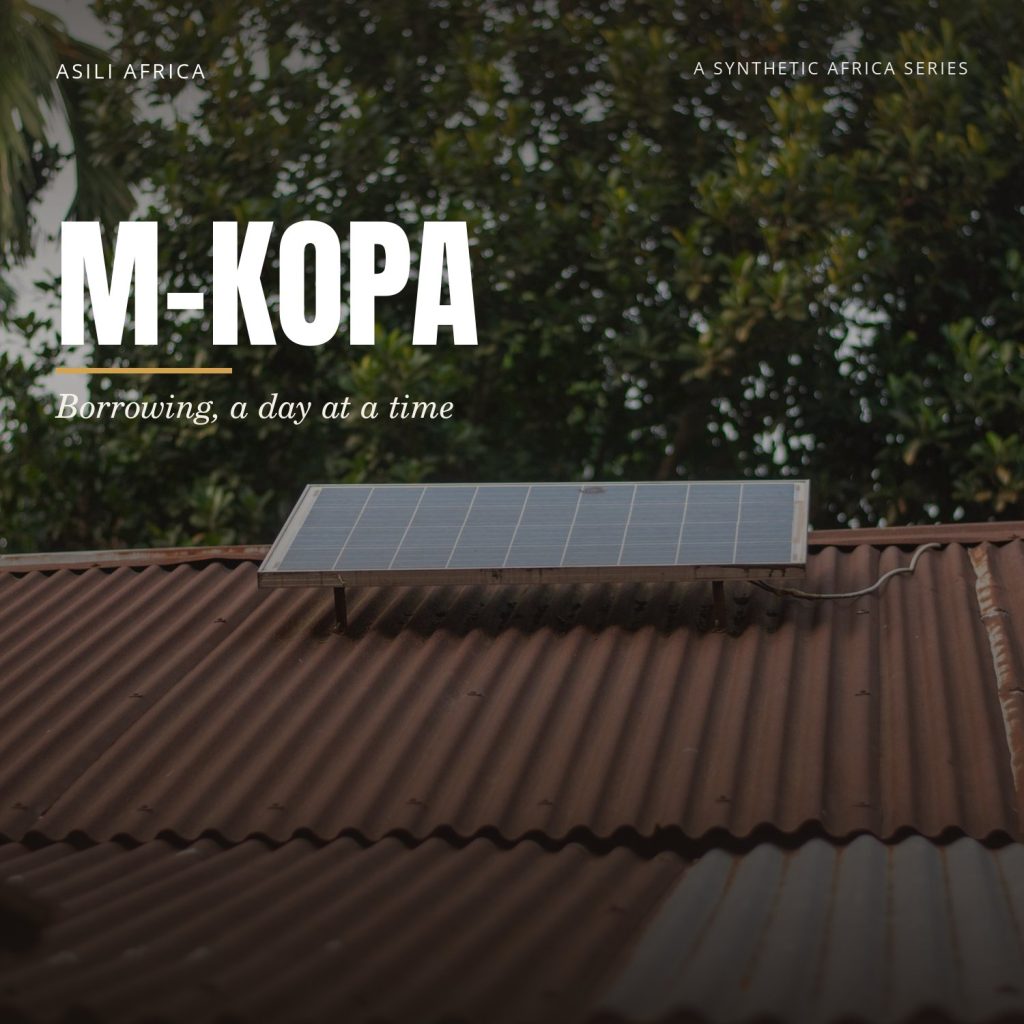
They spent 2011 incubated inside Signal Point Partners. They closed their first cheques. They built a prototype. The prototype was, in its first version, almost embarrassingly simple. They took an existing solar home system from a startup called d.light — a panel, two LED lights, a phone-charging port, a small radio — and they bolted a Safaricom SIM card into it, along with a tiny GSM modem that could lock and unlock the unit depending on whether the household had paid.
The pitch to the customer was equally simple. Two thousand five hundred shillings deposit. Forty shillings a day, for three hundred and sixty-five days, paid into the unit by M-Pesa. At the end of the year, the SIM unlocked permanently, and the family owned the kit.
On the nineteenth of October, 2012, Safaricom and M-KOPA stood together on a small stage in Eldoret, in the Rift Valley, and announced the product.
Seventy-five dukas. The Eldoret and Kitale corridor. The smallest possible commercial launch.
Two months later, the company closed a five-point-two-million-dollar Series B.
The race had begun.
The Long Solar Decade
The first seven years inside M-KOPA were a long, patient, capital-hungry grind.
By the end of 2015, the company had connected around one hundred and fifty thousand Kenyan households. It had crossed forty million dollars in revenue. Around eighty percent of its customers were earning less than two dollars a day. The model was working. It was also, in a way that nobody on the impact-investor circuit liked to dwell on, exposing the company to a punishing structural reality.
M-KOPA was, in practical terms, a one-year-loan factory. Every solar kit sold was a small, individually underwritten installment loan to a customer with no formal credit history. The collateral was the device itself — locked remotely if the customer fell behind. The repayments, forty shillings at a time, were collected over twelve months. The unit economics were positive. But the cash had to be put up front, in dollars, today, for a return that arrived in Kenyan shillings, daily, over a year.
Which meant that growth, for M-KOPA, was not a function of how many customers wanted the product. It was a function of how much capital the company could raise to finance customers who already wanted the product.
The list of names that ended up on the cap table during those years reads like a roll call of global impact finance.
Acumen. Generation Investment Management, the fund co-founded by Al Gore. The Blue Haven Initiative. LGT Venture Philanthropy, backed by the Princely Family of Liechtenstein. The Bill and Melinda Gates Foundation. Shell Foundation. Richard Branson, personally. CDC Group, the British development finance institution. FinDev Canada. Norfund. FMO. Standard Bank. The Norwegian export credit fund.
By 2018, the company had connected more than five hundred thousand homes. It had sold around ninety thousand solar TVs as a category extension. It had won the Bloomberg New Energy Finance Award, the Zayed Future Energy Prize, and a place on Fortune’s list of fifty companies changing the world. It had been named, by MIT Technology Review, one of the fifty smartest companies on Earth.
By every standard impact-investor metric, it was a success.
What it was not, was profitable. Not even close.
For most of those years, M-KOPA’s gross customer book was the largest single line item on its balance sheet, and the cost of financing that book was the largest single drag on its income statement. The company was, in the polite language of structured-finance memos, “structurally undercapitalised”. In plain English, it was running flat out, raising every round, every facility, every line of credit it could find, just to keep up with the household demand it had already created.
And there were quieter pressures running alongside the financial ones.
The remote-kill-switch — the same elegant piece of engineering that made it possible to lend to no-credit customers in the first place — was attracting a particular kind of critique. Customers who fell briefly behind would find their units shut off without warning. Households who had paid most of the way toward ownership could still be locked out by a missed weekly run. Field officers visited delinquent customers and sometimes repossessed kits. The company maintained, with some justification, that this was the only way the math worked. That without the kill switch, no lender on Earth would extend a year of unsecured credit to a smallholder farmer earning two dollars a day. The critique persisted anyway. Some of the kindest descriptions of M-KOPA’s collections process, in the Kenyan press of the time, used the word firm.
The company also began, around 2015, to report defaulting customers to credit bureaus — which gave the unbanked, formally, a credit identity for the first time in their lives, and also, formally, a credit blemish in some cases.
Geographically, the company stretched into Uganda and into Tanzania. Tanzania did not work. M-KOPA quietly pulled out of the market at some point before 2022. Among the things the public press release never quite said was that not every mobile-money-plus-solar market actually replicates what Kenya had built.
And then, in 2019, the company made a decision that, six years later, would land in the file at the Capital Markets Authority.
In that year, M-KOPA restructured its employee share scheme. The internal logic at the time was the routine kind of corporate housekeeping that happens at every growing startup. The downstream consequence, alleged by one of the three original co-founders six years later, was that the shares held by employees of African descent were diluted in a manner the shares held by other employees were not.
At the time, nobody outside the company was paying attention. The headlines were about the next chapter.
Because by 2019, with five hundred thousand kits in the field and a slow, grinding solar model that was nine years in and only partially profitable, the company was beginning to ask a harder question.
What else could it sell, with the credit muscle it had built?
The answer, when it came in 2020, would change the company more than anything in its first decade.
From Light Bulbs to Smartphones
Sometime in early 2020, in the first weeks of the global pandemic, the senior team at M-KOPA looked carefully at the data running through their own platform and made a decision.
They were going to sell smartphones.
The decision, at the surface level, looked like a logical product extension. Smartphones were, by 2020, the single most desired durable good among the customers M-KOPA was already serving. They cost roughly the same as the solar systems M-KOPA was already financing. They generated, in many cases, more daily economic value for the household — because a smartphone gave you access to mobile money, to messaging, to information, to remote work — than a light did. And critically, they were tractable to the same model. SIM card, kill switch, daily payment. Just a different device on the other end of the line.
The decision, at a deeper level, was a complete bet-the-company pivot.
Selling smartphones meant that M-KOPA was no longer, strictly, a solar company. It was no longer, strictly, a clean-energy access company. It was no longer the brand that Acumen and the Gates Foundation had invested in. It was, in the most accurate description anyone has applied to it since, a consumer-credit company. A connected-asset-financing platform. A fintech.
What happened next is the single most striking statistic in the company’s history.
It had taken M-KOPA ten years to cross five hundred thousand cumulative solar kits.
It took eighteen months to cross five hundred thousand cumulative smartphones.
Twelve times the velocity. The same factory, the same agents, the same credit muscle, the same mobile-money rails. Different product on the other end. Same model. A violently better outcome.
The economic reason was almost embarrassingly simple. The total addressable market for an off-grid solar home system, in any given African country, was bounded by the number of off-grid households — which, as electrification advanced, was slowly shrinking. The total addressable market for a smartphone was bounded by the number of human beings — which, as African demographics continued to do what African demographics do, was steadily growing. M-KOPA had pivoted out of a slowly contracting market into the largest consumer-electronics market in human history.
And the moment the curve bent, the company poured fuel on it.
In July 2021, M-KOPA launched in Nigeria.
Later that year, it quietly opened a thirty-agent pilot in Accra.
By March 2022, the company had crossed two million cumulative customers, across four markets. It announced a seventy-five-million-dollar growth equity round led by Generation Investment Management and Broadscale Group. Total equity raised, across the company’s history, crossed one hundred and ninety million dollars.
A year later, in May 2023, it closed the biggest single round in its history. Two hundred and fifty million dollars, blended. Two hundred of it in sustainability-linked debt, arranged by Standard Bank and Stanbic, with IFC, BII, FMO, and a small consortium of impact debt funds participating. Fifty-five million of it in equity, led by Sumitomo Corporation of Japan, whose first cheque of thirty-six and a half million dollars made it the largest single private institutional investor in M-KOPA’s history. Sumitomo took a board seat.
The company that had, for a decade, been built on Kenyan rural-household solar arithmetic and Anglo-Saxon impact capital, now had a Japanese conglomerate at the board table and was selling Android phones in five African countries.
The pivot was complete.
The Factory and the Bolt
Between 2023 and 2025, M-KOPA stopped being a startup and became something the African business landscape had not really seen before.
In January 2023, in a working-class industrial estate on the outskirts of Nairobi, the company opened a smartphone assembly line in partnership with HMD — the Finnish-owned licensee of the Nokia brand. Within twenty months, the line was producing roughly seven and a half thousand smartphones a day. By October 2024, it had assembled one and a half million cumulative units. The company stated publicly that it intended to scale the line to ten million units a year by 2027.
What this meant, in plain terms, was that M-KOPA was now running the largest smartphone assembly operation in sub-Saharan Africa. Not a final-stage import-and-relabel operation. A genuine assembly line with imported components, on-site quality control, and Kenyan workforce. The same Kenyan factory floor logic that BURN Manufacturing had pioneered for cookstoves on the other side of Nairobi, M-KOPA was now applying to consumer electronics.
In November 2023, the company quietly launched a pilot in South Africa. The same month, it formally launched, nationwide, in Ghana — after a hundred-thousand-customer pilot through 2023 in which roughly ten million dollars of credit had already been extended.
In April 2024, it announced a partnership with Bolt — the European ride-hailing company that had taken a significant share of the East African motorcycle-taxi market — and with electric two-wheeler manufacturers ROAM and Ampersand. The product was a pay-as-you-go electric boda boda. Five thousand units. Three years. Riders would lease the bikes on the same daily-payment model M-KOPA had refined on solar and on phones, with the difference that the asset, in this case, was paying the rider back in fuel savings against a petrol motorcycle.
The capital stack expanded to match. In early 2025, a second sustainability-linked debt facility, again two hundred million dollars, again Standard Bank-led, closed. By late 2025, the company was deep in talks on a Series F. Term sheet around one hundred and sixty million dollars. Lead investor, again, Sumitomo Corporation. Valuation, by every public commentary on the round, in unicorn territory for the first time.
And then, in October 2025, the company released its 2024 financial statements.
Four hundred and sixteen million US dollars in revenue. Sixty-six percent year-on-year growth. Nine-point-two million dollars of net profit.
The first profitable year in the company’s thirteen-year existence.
By November 2025, M-KOPA had crossed five million cumulative customers across five countries. Three million of them were active. The company had extended more than two billion US dollars of cumulative credit. One-point-six billion of that, around two hundred and seven billion shillings, had gone to Kenyan households alone. The company employed three thousand full-time staff and worked with more than thirty thousand sales agents across the continent.
By any reasonable accounting, it had become the largest connected consumer-credit platform in sub-Saharan Africa.
And then, on the sixth of November, one of its co-founders walked into the Capital Markets Authority.
The Reckoning
The company that walked into 2026 was the largest connected-asset-financing platform on the African continent. It was also, simultaneously, in the middle of three open fights about what kind of company it actually is.
The Larson dispute is the first. M-KOPA has publicly described his allegations as baseless and as a coordinated campaign to undermine the company during a critical funding window. Larson, for his part, traces the practice he is alleging back to a 2019 restructuring of the employee share scheme that, on his account, diluted the shares of African-descent employees in a way it did not dilute the shares of others. The Capital Markets Authority has the file. The resolution, as of mid-2026, is unresolved.
The second is the lending-rate critique. Independent academic reviews have calculated that the effective annual interest rate embedded in some M-KOPA products runs as high as two hundred and fifty-four percent. That number is more than four times the legal cap on consumer lending in several African jurisdictions. M-KOPA’s counter-argument is the one it has made since 2012 — that without the kill switch, without the daily-payment structure, without the rates that compensate for the unsecured nature of the loan, none of these customers would qualify for any credit at all. The Kenyan parliamentarian Babu Owino has called for legislation to cap consumer phone-financing rates. Whether that bill passes will determine whether M-KOPA’s unit economics, on the lending side, hold.
The third is the tax fight. In September 2024, the Kenya Tax Appeals Tribunal ruled that M-KOPA, despite being headquartered for tax purposes in London, had a permanent establishment in Kenya — and ordered it to pay eight hundred and eighty-five million Kenyan shillings in back corporate taxes. The ruling was a landmark, and it set a precedent that every cross-border fintech operating in Kenya through a UK holding company is now contending with.
The company that handles those three fights at once is, in many ways, exactly the company that fifteen years of capital, three founders, and one violently good pivot, were always going to produce. Big enough now to be regulated like a bank. Profitable enough now to be priced like one. Visible enough now to be challenged on the terms it set for itself in 2012.
The harder, longer question hanging over M-KOPA is the one Asili Africa has run into in episode after episode of this series. What happens when a company built on an impact narrative becomes, by the math of its own success, a consumer fintech selling Chinese-designed Android phones at three-point-one percent monthly interest?
The forty shillings a day was once the most generous payment structure in rural Kenya. By 2026, depending on how you counted, it was also one of the most expensive forms of consumer credit on the continent.
Both of those things are true at the same time. That is the M-KOPA story.
Every empire has an origin.
M-KOPA’s was a SIM card bolted into a solar panel. Two thousand five hundred shillings deposit. Forty shillings a day. Seventy-five dukas in Eldoret and Kitale.
Five million customers. A factory in Nairobi. One co-founder at the regulator.
This is Asili Africa.
Key Takeaways
- The Rails. The story of M-KOPA does not start with a solar panel.
- From Light Bulbs to Smartphones. Sometime in early 2020, in the first weeks of the global pandemic, the senior team at M-KOPA looked carefully at the data running through their own platform and made a decision.
- The Factory and the Bolt. Between 2023 and 2025, M-KOPA stopped being a startup and became something the African business landscape had not really seen before.
- The Reckoning. The company that walked into 2026 was the largest connected-asset-financing platform on the African continent.
Also available on YouTube — search “Asili Africa” or subscribe to our channel.