
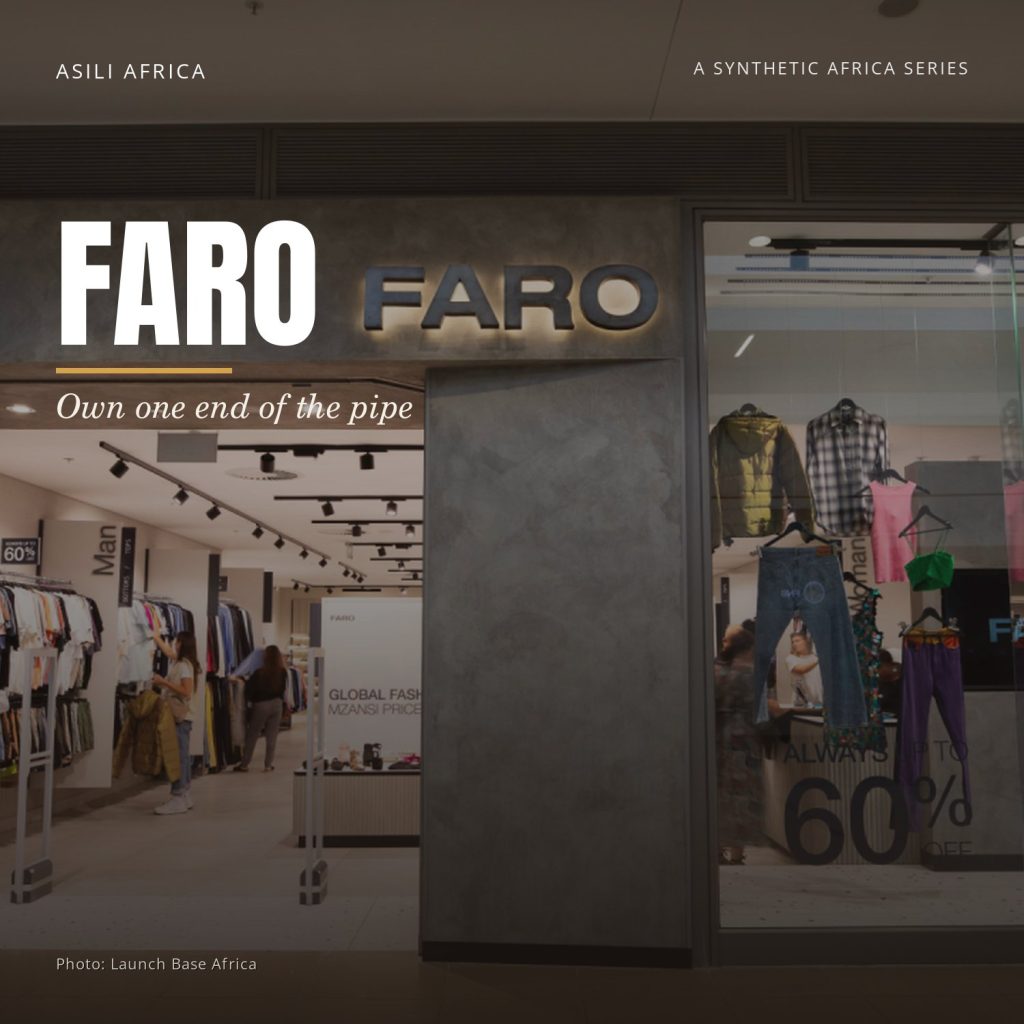
The FARO Story: Own one end of the pipe
In a warehouse in Cape Town, three hundred people are at work on other people’s clothes.
A shirt arrives on a trolley. The collar has lipstick on it.
Someone, somewhere in Europe, has worn this shirt once, left a kiss on the collar, and returned it to the brand. The brand does not want it back on the main shelf.
Someone, somewhere in a Cape Town suburb, is going to pay about forty percent of its retail price for it next Saturday, inside a shopping mall.
In between those two moments is this room.
Not the app. Not the pricing engine. Not the computer-vision model the trade press writes about.
This room. This trolley. This collar. This hand.
The company is called FARO. It is three years old. It operates about twenty physical stores in South Africa.
And in almost every piece written about it, the warehouse is a footnote. The headline is the artificial intelligence. The subhead is the WhatsApp recommendations. The restoration floor, with its three hundred people on it, gets a paragraph.
We are going to start where the pieces stop.
THE WASH
A pallet arrives at a side door. Inside the pallet are clothes nobody has sold. Some have never been worn — surplus the brand over-ordered, miscounted, or printed last season’s label on. Others have been worn once, twice, maybe a week, and sent back under a returns policy somewhere in Europe or the United States.
They have travelled by container from somewhere else to here, because here, in a warehouse in Cape Town, the hour of a person’s labour is cheaper than the garment it is attached to.
The pallet is opened and the clothes are sorted. One pile for cleaning. One pile for tailoring. One pile that is both. A fourth pile, smaller than the others, for garments nobody is going to try to fix.
About half of FARO’s six hundred staff work on what the company calls restoration. Of that work, by the company’s own account, seventy percent is cleaning.
Lipstick on a collar. Coffee on a cuff. The darker stain further down a shirt front that someone has decided not to try to identify.
The rinse cycle on the industrial washer runs longer than the one in your home, at a lower temperature, with a different detergent, and it finishes with the garment steamed back into the shape it came off a factory floor in.
The other thirty percent of the restoration work is tailoring. A missing button. A split seam at the shoulder. A hem that has come half-undone. A label with somebody else’s number that has to be removed and replaced with a new one.
Human hands. Needles. Thread. A labelling machine. A steam press.
This is what FARO is at the level of water and labour.
Not what FARO says it is, which is a technology company. What FARO is, if you walked in and looked.
The press profiles will tell you the company runs a computer-vision model that scores the attributes of each garment, and a pricing engine that decides what each piece is worth, and a messaging system that tells you about the shirt in your size when it hits the floor at your local store.
All of that is true. All of that is also a layer above the layer where the money is made.
Because the margin in this business is not in the model. The margin is in the gap between what a worker in Cape Town costs per hour and what a worker in the factories that originally made these clothes would cost per hour.
That gap is wide enough to pay for the cleaning, the mending, the warehouse rent, the floor supervisor, and the shop at the end of the chain, and still leave something over.
That gap is the whole business. The computer-vision model is useful. The messaging engine is useful. Neither pays the warehouse rent. The gap between a Cape Town hour and a Zara hour pays the warehouse rent, and leaves the room for everything the company is going to do next.
The press calls FARO an artificial-intelligence company. The warehouse says otherwise. The warehouse says FARO is an industrial laundry and a repair bench with a retail front attached.
The warehouse, in other words, is the company. Everything else is a layer.
Why would someone build this?
THE GHOST OF ZUMI
The answer begins about three thousand five hundred kilometres north, and about three years back.
In Nairobi, in twenty sixteen, a man called William McCarren co-founded a company called Zumi.
McCarren had worked at Amazon. He had worked at Jumia. He understood how clothes move at scale between a factory and a shelf, and he understood, as fewer people in that trade did at the moment he started, that the shelf itself was changing.
The shelf, in East Africa, was not a department store. It was a small shop. One of thousands. Owned by one person. Stocked a few dozen pieces at a time. The buyer, when she bought, walked up the street with cash and chose a wholesaler.
Zumi’s bet was that she would, if given a better way, do that part on a phone. A business-to-business platform. An app for small retailers to buy clothes from a central supplier, with delivery, and the supplier would be Zumi.
It worked, for a while. At its peak Zumi was moving around three million garments a month. One hundred and fifty people worked there. The company raised what it needed to raise, roughly a million dollars across its life, by the account that survives it.
For about seven years, it was one of the better-known young commerce companies in East Africa. It restructured in twenty nineteen, shut briefly, restarted the next year as a business-to-business operation, and recovered.
And then the shape of being a middleman caught up with it.
Zumi bought clothes from one party and sold them to another, and it kept a margin on the way through. That is what a middleman does.
A middleman’s margin is set by the people on either side of it. The brand on the supply end sets the price it will take. The shop on the demand end sets the price it will pay.
The middleman takes what is left, and when the market tightens the people on either side take more, and what is left shrinks.
A middleman has no pricing power. That is not a dramatic sentence, but it is the sentence that explains everything that comes next.
If you want pricing power in this trade, you have to own one end or the other. You have to be the brand, or you have to be the shop.
Zumi was neither.
In March of twenty twenty three the macro environment turned, the last few investor conversations did not become the next round, and the clothes that were in the warehouse were still there when the money for the next container was not.
The company announced that it was closing.
McCarren wrote a statement citing the macro environment and the difficulty of fundraising.
One hundred and fifty people lost their jobs.
The money ran out.
THE STOREFRONT
On the first of July, twenty twenty three, three and a half months after the Zumi announcement, a small team sat down in a shared office in Gardens, a neighbourhood in Cape Town.
McCarren was there. The company’s chief executive, David Torr, was there. Torr had, the year before, sold his previous company, a meal-kit business, to a local holding group in a deal reported at twelve million dollars.
A third co-founder, Amber Penney, was there. Her role in the sources that follow is undescribed, and we are not going to invent one. The sources also disagree about a fourth founder’s name, and we are not going to invent that either.
What they drew on the whiteboard was a version of Zumi with the middleman removed.
The flow of clothes would be similar. Buy surplus and returns from global fashion brands at a steep discount to retail. The brands have a problem: they over-produce every season, and the leftover stock has to end up somewhere, and the somewhere cannot be the main store without undercutting their own prices.
FARO’s bet, like Zumi’s, was that it could be the somewhere.
The difference, and it was the whole difference, was what sat at the other end of the pipe.
The other end would not be a small shop that someone else owned. The other end would be a shop that FARO owned, in a mall FARO had chosen, on a lease FARO signed.
The clothes would arrive at that shop clean, mended, pressed and relabelled, out of a warehouse FARO ran.
The person who sold the shirt to a customer would be a FARO employee. The till would be a FARO till. The price would be a FARO price.
The company would not be a middleman. It would be a shop. And the engine that let the shop sell a shirt from one of Europe’s biggest fashion labels for sixty percent off retail would not be the artificial-intelligence model. It would be the warehouse, where the lipstick comes off collars.
That is the whole structural answer to what Zumi had taught. If the margin keeps getting squeezed because you do not control either end of the pipe, then build your own end.
A pop-up store opened later that year to test the demand.
By one account, in its first month, it did about a hundred thousand dollars in sales.
On the ninth of November, twenty twenty three, the first permanent store opened. The location was a shopping centre called Liberty Promenade. The suburb was Mitchells Plain, a dense residential area on the Cape Flats, several kilometres from the parts of Cape Town that make it onto tourism posters.
The first store did not open in the city centre, where tourists and office workers would see it. It did not open in a southern-suburbs mall where the local middle class would see it. It opened at the kind of mall where the people who most need a sixty-percent discount on a Levi’s shirt actually buy their clothes.
The store did well. More stores followed, in similar locations. By the end of twenty twenty four, there were four. Revenue for that year came in at about two point three million dollars.
In January of twenty twenty five, FARO announced a funding round of six million dollars, led by an investor named JP Zammitt. Several other funds and angel investors joined the round. By some measures it was one of the larger early-stage rounds that South Africa saw that year.
The round came after a result from the operations side.
Four stores delivered revenue that the original business plan expected would need seven.
THE FRICTION
In the same year that the first FARO store opened, a union representative gave an interview to a South African fashion journal and said that what FARO was doing was dumping.
His name was Etienne Vlok. The union was the Southern African Clothing and Textile Workers’ Union, known as SACTWU.
The quote was specific. Instead of second-hand goods, Vlok said, we are now, in his words, blessed by international brands being dumped.
The word dumping was his word. He meant it in two senses. He meant it in the trade sense, where dumping is a technical term for selling goods below their domestic price in another country, and he raised the possibility that FARO’s inventory flow might breach international trade rules on that definition.
He also meant it in the plainer sense. A country already competing with cheap imports from Asia was, in his reading, now also being used as a landing site for Western surplus, and the people whose jobs were in local manufacturing would carry the consequence.
Torr, FARO’s chief executive, responded. He said that over-production was an allocation problem the brands had to solve one way or another, and that if the surplus did not come to a FARO store it would be destroyed, or sent somewhere else, or burned. He said that each FARO store was also an opportunity for small businesses in its neighbourhood.
He also acknowledged, in the same year, that FARO had no South African textile-waste diversion programme yet, though the launch pitch had promised one.
Nothing happened next. No regulator looked into it. No second union statement followed. The critique was made once, in twenty twenty three, and it sat where it was made.
That could be read as resolution. The absence of follow-up could mean the critique was wrong, or it could mean the critique was correct and nobody acted. The record we have does not tell us which. We looked. That silence is worth naming, and we are not going to fill it with a guess.
Vlok’s critique concerned what the clothes do when they land. There is a different critique available, which the record does not contain. It concerns what has to be true for the clothes to keep arriving at all.
FARO sells global fashion brands’ overflow. Its stated mission has two legs. One leg is affordability: get a shirt from a top European label to a shopper in Mitchells Plain for sixty percent off.
The other leg is sustainability: keep the shirt out of landfill.
Both legs depend on the same thing. Both legs depend on the global fashion industry continuing to produce more clothes than its own stores can sell.
If brands get better at demand forecasting, if they trim their production runs to match what people actually buy, if the fashion industry’s over-production problem starts to shrink, then FARO’s inputs start to shrink.
The affordability story and the sustainability story both come from the same bucket. That bucket is other companies’ mistakes.
That is not a crisis today. In twenty twenty six the over-production is still enormous and the surplus still arrives. But the model is positioned on the assumption that it will keep arriving.
Nobody has asked what the company does when the inputs thin. The company has not been asked, and the company has not volunteered.
One other shift in positioning is worth noting. In the twenty twenty three pitch, FARO led with impact. The language was about textile waste, about ecosystems, about the Faro Impact Initiative that would recycle a kilo for every kilo sold. Three years on, the micro-merchant hubs and the recycling programme are not visible in any later coverage, and the pitch has quietly moved. The twenty twenty six pitch leads with a simpler sentence. Every fashion ecosystem needs an off-price business. FARO is the off-price business.
That is not a lie, and it is not a scandal. It is a company in its third year telling a different story about itself than it was telling in its first.
Two questions. Dumping, and dependency. Both named. Neither closed.
THE OPEN BOOK
By September of twenty twenty six, FARO operated about twenty stores. It employed close to six hundred people. Its revenue for the previous financial year was about fifteen point eight million dollars, up from two point three million the year before, from four stores to roughly twenty.
The company said that its next move was Botswana and Namibia, in the coming months. It also named Brazil and Chile as the point of entry for Latin America. It said that India, Mexico, Turkey, Argentina and Indonesia were under consideration.
And it said this.
In six to eight years, the company intends to be doing a billion dollars in revenue.
That is the on-the-record story. We have also been building, through this episode, a quieter story, and now is the place to put the pieces of it down.
Three hundred people work on the restoration floor, and the record has not spoken to a single one of them.
Not one of the three hundred is quoted in any of the press coverage this episode draws on. Their wages, their hours, their contract type, their turnover rate, whether they are permanent staff or on short contracts, whether they are from Mitchells Plain and the surrounding Cape Flats or from somewhere further off, how long they stay — all of this is described, when it is described at all, by the company’s management, not by them.
Half the company is unreported.
The company’s customer has not been quoted either. No source we found interviews a shopper in a FARO store. No source gives a demographic breakdown of who the customer is. The affordability story is told to us. It is not told to us by the person it is about.
The brands on the other end have not been quoted. The European and American fashion labels whose clothes travel to a Cape Town warehouse and come back out at sixty percent off are described as stocked. Our sources do not quote a single person from any of them saying how they feel about their clothes being resold in a Cape Town suburb, or whether they view the arrangement as a partnership or a leak.
The union critique was made once, in twenty twenty three. No second critique has followed. The union has not said anything about what has happened in the three years since.
And the company’s own financials are, by the standards of a fast-growing retailer, almost unexamined. Revenue is reported. Headcount is reported. Store count is reported. Profit is not. Loss is not. Cash burn is not. We looked. We did not find a single number that tells us whether this company is making money at the till, after rent, wages, water, electricity and detergent.
FARO is three years old, growing fast, and still in its own founding period. The way the record about it is written, by the end of twenty twenty six, is that the company is almost entirely covered through its own voice.
The ending we would like to give this story is not the ending the record supports.
The ending is that the ending is not written.
Twenty stores. Six hundred people.
Three hundred of them, half the company, working on lipstick and buttons and coffee stains in a warehouse the trade press writes about as if it were the back office of an artificial-intelligence company.
The founder who closed one company in Nairobi and started another in Cape Town learned the specific lesson that if you want pricing power in the clothes trade, you have to own one end or the other. He now owns the shop. He also owns the water, the soap, the needle, the thread, and the hands that use them. That is where the margin lives.
What is less resolved is whether the model is a correction or a repetition. Whether the critique that was made once in twenty twenty three is wrong, or whether it is right and nobody looked. Whether the industry that supplies this one will keep supplying it. Whether the people in the warehouse would describe the work the way management does.
What we know is the facts. What we do not know is almost everything else. This is Asili Africa. Every empire has an origin. See you on the next one.
Key Takeaways
- THE WASH. A pallet arrives at a side door.
- THE STOREFRONT. On the first of July, twenty twenty three, three and a half months after the Zumi announcement, a small team sat down in a shared office in Gardens, a neighbourhood in Cape Town.
- THE FRICTION. In the same year that the first FARO store opened, a union representative gave an interview to a South African fashion journal and said that what FARO was doing was dumping.
- THE OPEN BOOK. By September of twenty twenty six, FARO operated about twenty stores.
Also available on YouTube — search “Asili Africa” or subscribe to our channel.