
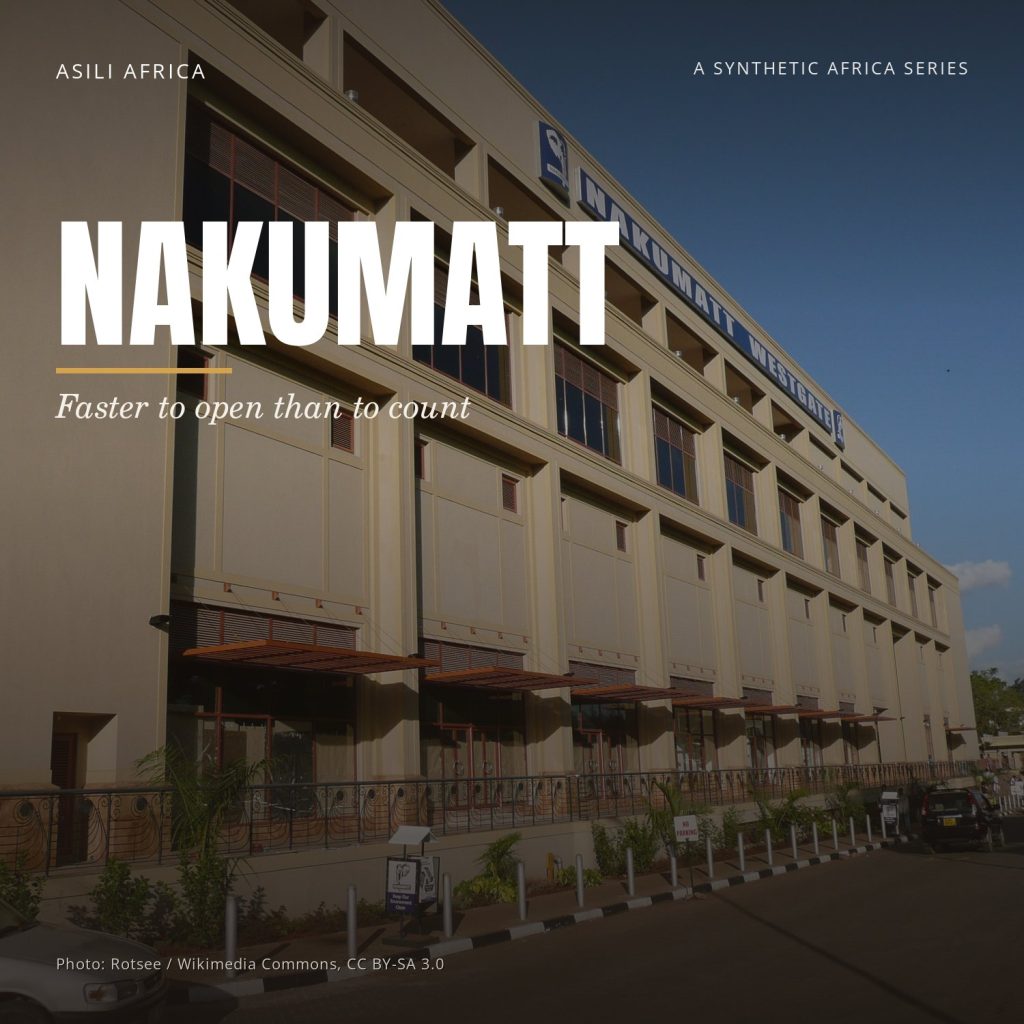
The Nakumatt Story: Redefining African Business Horizons *(carried from prior generation
In March, twenty eighteen, the man appointed to run a collapsed Kenyan supermarket chain put a report in front of its creditors. The chain was Nakumatt. Three years earlier, it had been the largest supermarket chain in East Africa.
In the year to December, twenty seventeen, the report said, the company had written off eighteen billion shillings of stock.
In the year before that, the whole chain had sold fifty-two point two billion shillings of goods. The stock written off came to about a third of a year’s sales.
The report was the administrator’s. The write-off was management’s own. Management gave four reasons for it. Theft. Pilferage. Stock shrinkage. And stock that had become obsolete.
The administrator, Peter Kahi, called those explanations unsatisfactory. They raised, he said, more questions than answers.
Nobody has explained the figure on the public record since.
Earlier that year, in January, the founder had given a different explanation. Atul Shah said the business had relied heavily on bank loans. And then, in his words, the money dried up.
One man built the company. The other counted what was left of it. Two accounts of the same collapse.
ACROSS THE ROAD
Around nineteen forty-seven, in the town of Nakuru, in the Rift Valley north west of Nairobi, a man named Mangalal Shah kept a shop called Nakuru Mattresses.
Across the road stood another shop, run by the Kamau family. It was called Tusker Mattresses. Two mattress shops, facing each other on one street.
They were not rivals in the way that sounds. Mangalal Shah and John Kago Kamau were close friends.
Shah supplied the Kamau shop on credit. Goods crossed the road before they were paid for, and the arrangement helped the Tusker business grow.
That is all the sources say about it. A friend, a shop across the road, and generous terms.
The Kamau shop became Tuskys, which grew into a supermarket chain. A brother in the same Kamau family later built another chain, Naivas.
The Shahs were not related to either. Two of the chains that grew out of that street began with one family’s brothers. The third began with their friend.
That account of the families was reported in twenty eighteen, and it is the one this episode follows.
In nineteen seventy-eight, as it has been reported, Mangalal’s son Atul Shah and his brother Vimal opened a clothes shop in Nakuru called Furmatts. Atul, born in nineteen sixty-one, was about seventeen.
The brothers pooled their savings and bought their uncle’s shop.
In nineteen eighty-seven, the business was registered as Nakumatt. The name is a contraction of Nakuru Mattress.
At the top of Kenya’s formal supermarket trade, that year, stood Uchumi, a chain set up in nineteen seventy-five by three state corporations. Nakumatt was a family business from a provincial town.
Between that registration and the chain’s first store abroad, the record is thin. Almost nobody from those early decades is on the record about how the business was built.
What is missing is almost everything a founding story usually rests on: how the first supermarkets were paid for, who ran them, and what they sold to whom.
The long interview Atul Shah gave about his company came in twenty eighteen, and it was about how it ended.
Stories have grown up to fill that gap. We are not going to repeat them as fact, because nobody we can cite was there to tell them.
By the late two thousands, Nakumatt was a Kenyan chain looking outward.
On the twenty-third of August, two thousand and eight, it opened its first store outside Kenya, in Kigali. Rwanda was the first of three countries beyond the border.
OTHER PEOPLE’S MONEY
In June, two thousand and nine, ten months after Kigali, Nakumatt opened in Kampala.
The next year it bought a Ugandan chain called Payless. Then it went into Tanzania.
In twenty eleven it had about thirty-six stores. By twenty fifteen and twenty sixteen it had more than sixty, across four countries: Kenya, Uganda, Rwanda and Tanzania.
It employed more than five thousand people.
About fifteen hundred suppliers sold through its shelves.
In the year to February, twenty thirteen, the group’s sales came to about six hundred and fifty million dollars.
Atul Shah would later put the cost of opening a branch at about a hundred million shillings.
Between twenty eleven and twenty sixteen, the chain went from about thirty-six stores to about sixty-two. At his price, that is roughly two point six billion shillings of new branches. That is our arithmetic, from his figure and the published store counts. The company never published one.
The money came from bank loans. The banks were the first layer of other people’s money.
The suppliers were the second. Goods arrived on Nakumatt’s shelves on credit, and much of it was sold before it was paid for.
A chain that sells quickly and pays slowly is holding its suppliers’ money in the gap between the two.
Every time one of those fifteen hundred suppliers made a delivery, it was lending to Nakumatt until the invoice was paid.
The third layer was the public. Nakumatt sold commercial paper to retail investors.
Commercial paper is short term debt. A company sells it, promises to repay it with interest within months, and usually repays it by selling more. If new buyers stop coming, the old paper still has to be repaid.
In July, two thousand and thirteen, the company sought to sell a twenty-five per cent stake, to pay for more expansion. Money raised that way would not have had to be repaid. No sale of that stake appears in the record we have.
Banks, suppliers, the public. Three layers of other people’s money, under one family’s private company. Of the three, only the banks were in the business of lending.
All three were repaid out of the same place: the money coming through the tills.
By twenty fifteen, one point three million shoppers carried the chain’s Smart Card, collecting points on what they bought.
On the twenty-eighth of January, two thousand and nine, fire broke out at Nakumatt Downtown, in the centre of Nairobi. It started in the generator room.
Twenty-nine people died. Some sources say thirty. Five of them worked for Nakumatt.
The inquest concluded in January, twenty twenty-two, thirteen years later. It found that the fire could not be shown to be deliberate, and that Nakumatt was not negligent as the tenant. It recommended that exit doors be kept open and clear.
No source in our research names the dead, or reports any compensation to their families.
On the twenty-first of September, twenty thirteen, the Westgate mall in Nairobi was attacked.
The Nakumatt branch inside it was destroyed.
The stock lost there was worth more than one point five billion shillings.
By the end of that year, insurers had paid about one point four one billion of it.
The Business Daily put the hit to sales at about four point three billion shillings.
In the following year, group sales went from about six hundred and fifty million dollars to about six hundred million. A fall of seven point seven per cent.
Nakumatt absorbed the blow, and went on opening stores for two more years.
EMPTY SHELVES
In October, twenty fifteen, Imperial Bank was placed under receivership.
In April, twenty sixteen, Chase Bank followed.
In October, twenty sixteen, a new law put a cap on the interest rates Kenyan banks could charge. The interest rate cap had arrived.
Also in twenty sixteen, the businessman Harun Mwau, who held a minority stake in the company, sold it to Atul Shah. The family now owned all of Nakumatt.
The sale came ahead of a planned investor, described as deep pocketed, who was expected to come in.
The investor never arrived. No source we have identifies who it was, or why the deal did not close.
The Daily Nation reported that Mwau’s exit triggered the company’s cash troubles.
The administrator rejected that. So did Shah, who said he had not paid Mwau a shilling, and that the exit was not abnormal.
If the exit had drained the company’s cash, the collapse would have a trigger and a date. If it had not, the cause lies somewhere else. The sources disagree, and we are going to leave them disagreeing.
People inside the business had another account. Management had planned on the Kenyan economy growing by ten per cent or more a year.
That growth did not arrive. Stores opened on a forecast of ten per cent a year were trading in an economy that did not deliver it.
In November, twenty seventeen, The Star ran the story under a headline saying the chain had been ruined by explosive growth. Its verdict, in one line, was that the business outgrew the management capacity.
Andrew Dixon, who had come from the British retailer Tesco to run the chain’s marketing, called it a tragedy that needn’t have happened. He said it in the same month, as the shelves were emptying.
The first store closed in May, twenty seventeen.
By October and November, twenty seventeen, the cash had run out.
Suppliers stopped delivering.
A chain that pays its suppliers late can carry on for years, as long as the goods keep arriving. When the deliveries stop, the shelves show it.
The shelves emptied.
Shoppers walked into branches that were lit and staffed, and found almost nothing to buy.
Of everything in this collapse, the empty shelves were what the public saw. They were the effect, and they said nothing about the cause.
In January, twenty eighteen, a week before a judge put the company into administration, the Business Daily published Atul Shah’s account. It is the fullest account anyone inside the company has put on the record, and it came from the top.
The paper ran it under a headline in his own voice: how debt took down my Nakumatt empire.
The Nakumatt engine, he said, relied heavily on bank loans to roar on.
He named the failures of Imperial Bank and Chase Bank, and the rate cap. And then, he said, the money dried up.
In his telling, the company had borrowed to grow, and when its lenders failed and credit tightened, the money to keep it running was no longer there.
He would not give a figure for the debt. What matters, he said, is that it is a liability.
By his count, the staff had gone from more than five thousand to about twenty-five hundred.
And the stores, he said, from sixty-three to thirty-four.
That is his account, given as his company went under. The banks did fail, and the rate cap was real. It stands here as he gave it.
THE COUNT
On the twenty-second of January, twenty eighteen, a High Court judge appointed Peter Kahi, of the accountancy firm PKF, administrator of Nakumatt. A stranger now held the books.
Administration is a court process. The administrator takes control of a failing company from the people who ran it, and tries either to rescue it or to sell what can be sold for the people it owes.
That mattered, because Nakumatt was private. The family held it through a company registered in Mauritius. It had no listed shares, and no source has found audited accounts for the years twenty thirteen to twenty sixteen.
For the years that matter most, there are two windows into the numbers. One is the founder’s interview, given when he had the most at stake. The other is the report of the insolvency professional appointed to take over. Neither can be checked against a third.
From then on, the only count of what was inside the company would be Kahi’s.
On the sixteenth of March, twenty eighteen, Kahi reported to the creditors: the banks, the suppliers, the tax authority, and the holders of the paper.
In the year to February, twenty seventeen, sales were fifty-two point two billion shillings, with a net loss of three point two billion.
In the year to December, twenty seventeen, sales were fourteen point eight billion shillings. The net loss was twenty-three billion.
Liabilities stood at thirty-five point eight billion shillings. Assets stood at five point two billion. The company owed nearly seven times what it owned.
Inside that loss was the write-off. Management had written off eighteen billion shillings of stock.
A write-off is an entry a company makes in its own books. It says the stock is gone, or worth nothing. This one was booked by management. The administrator reported it. He did not discover it.
Management’s explanation, in its own words, was theft, pilferage, stock shrinkage, and losses arising from stock obsolescence.
Kahi said the explanations were clearly unsatisfactory, and raised more questions than answers, if the company was to claim this expenditure for tax purposes.
There was earlier evidence, and it came from management itself, months before the administrator arrived. In November, twenty seventeen, management had acknowledged stock theft of between ten and fifteen per cent.
The Star set that against a global norm of two to three per cent.
Theft at several times the norm, and a write-off the size of a third of a year’s sales. That is the second account of the collapse. It is about control, not money.
Kahi called for a special audit, an investigation beyond the ordinary accounts, into where the stock had gone. Two years later he said a forensic audit had still not been carried out, because there was no money to pay for it. No charge over the write-off has been found on the public record.
The figure has never been explained on the public record.
The two accounts are not exclusive. A chain can lose its lenders and its stock at the same time, and the record documents both. It does not say which one brought Nakumatt down, and neither will we.
A restructuring plan was put to the creditors, as it was reported: a three year pause on loan repayments, a twenty-five per cent waiver of what creditors were owed, and a stock market listing before March, twenty twenty-four.
It went no further, and no listing took place.
There was also a rescuer. Tuskys, the business that had grown from the shop across the road, offered a package of six hundred and fifty million shillings. Against a company that owed more than thirty-five billion, it was a small sum.
It advanced fifty million. In April, twenty eighteen, the rescue collapsed, and the fifty million became a dispute.
In Nakuru, the credit had run from the Shah shop to the Kamau shop. Seventy years later, it ran the other way.
THE LEDGER
By the time the creditors met to decide its fate, Nakumatt owed about thirty-eight billion shillings.
The largest group was the suppliers. By the administrator’s count in March, twenty eighteen, they were owed about eighteen point six billion shillings.
Holders of the commercial paper were owed about four billion.
Among the banks, Diamond Trust Bank was owed three point six billion, and KCB one point nine billion. Standard Chartered, Bank of Africa and others were owed smaller sums.
The Kenya Revenue Authority was owed two point one billion.
Those are the same three layers that paid for the stores. The banks, the suppliers and the public lent the money on the way up. On the way down, they are the list of who was owed.
And the order changed. The banks were the first layer, but they were not the largest loss. On the administrator’s figures, the suppliers were owed more than twice as much as all the banks named in the claims put together. That comparison is our arithmetic. Most of the loss fell on people who had lent by delivering goods, or by buying paper, and not on the lenders.
About fifteen hundred suppliers had sold to Nakumatt.
In the record they appear only as company names in court. Kevian, owed ninety million shillings. African Cotton, owed seventy million. Gold Crown, owed more than sixty million.
Those are the names of companies, in filings. No small supplier is on the record about what non-payment did to their business.
Roughly four thousand employees were owed wages.
The law capped what each of them could claim at two hundred thousand shillings, for four months’ wages.
Their claims are put at anything from three hundred and seventy-four million shillings to one point three seven billion, depending on the source. One payment plan came to six hundred and eighty million shillings, stretched over years.
No worker is named in any account we have, and no source follows up on whether they were paid. Of everything missing from this story, the workers are the largest gap.
The one point three million Smart Card holders had points that lost their value when the stores shut.
Some had been spending them on school fees. By twenty fifteen, forty-three million shillings of points had gone that way. One report says customers were told to forget their points unless the chain came back. No total of what was lost was ever given.
In Uganda, Rwanda and Tanzania, the record is thinner still.
In November, twenty nineteen, the last things of value were sold.
Naivas paid four hundred and twenty-two million shillings for the furniture, fixtures and fittings of six branches. There was no stock.
An independent valuer had put those fittings at one hundred and ten point five million. Naivas paid nearly four times the valuation. By our arithmetic, more than three hundred million shillings of the price paid for something that was not on the valuer’s list.
There were other bids. Chandarana bid for all six branches, Quickmart for the Nakuru branch alone, and Tuskys for three.
The administrator explained the price. Naivas, he said, had paid for goodwill and for the location. Without those, the assets had no value.
So what the buyer took was fittings and addresses. It did not buy the business.
Where the rest of the chain’s prime mall space went is not established in the record we hold.
By February, twenty twenty-one, the administrator had raised about five point two billion shillings, and paid out more than three point five billion. Against thirty-eight billion owed, what had been paid out was about a tenth, by our arithmetic. No final figure appears in any source we have. And no criminal charge against Atul Shah over Nakumatt has been found on the public record.
Kahi’s view, by then, was that liquidation was the only route. Liquidation ends a company. What is left is sold, and the money is shared among the creditors in an order the law sets.
On the seventh of January, twenty twenty, the creditors voted to liquidate Nakumatt.
The employees voted against liquidation.
The court did not follow the vote. In March, twenty twenty-one, a judge extended the administration instead. In September, twenty twenty-five, another judge ruled that the administrator’s authority had lapsed in March, twenty twenty-two. We found no order liquidating the company.
The workers’ vote is the only time their own voice appears in the record. It was a vote to keep the company alive.
In Nakuru, around nineteen forty-seven, a mattress shop sold goods on credit to a friend’s shop across the road. The goods crossed before they were paid for.
More than seventy years later, one of the six branches whose fittings were sold stood in Nakuru.
The buyer, the administrator said, had paid for the location, which cannot be valued. This is Asili Africa. Every empire has an origin. See you on the next one.
Key Takeaways
- ACROSS THE ROAD. Around nineteen forty-seven, in the town of Nakuru, in the Rift Valley north west of Nairobi, a man named Mangalal Shah kept a shop called Nakuru Mattresses.
- EMPTY SHELVES. In October, twenty fifteen, Imperial Bank was placed under receivership.
- THE COUNT. On the twenty-second of January, twenty eighteen, a High Court judge appointed Peter Kahi, of the accountancy firm PKF, administrator of Nakumatt.
- THE LEDGER. By the time the creditors met to decide its fate, Nakumatt owed about thirty-eight billion shillings.
In this series: The Retail Collapse
Who took the shelf space when the chains fell?
- Uchumi
- Nakumatt (this episode)
- Tuskys
- Naivas
- Quickmart
- Chandarana Foodplus
Also available on YouTube — search “Asili Africa” or subscribe to our channel.
Pingback: Uchumi — Kenya’s First Supermarket, Two Collapses, One Brand Still Standing - Synthetic Africa
Pingback: Naivas - Synthetic Africa