
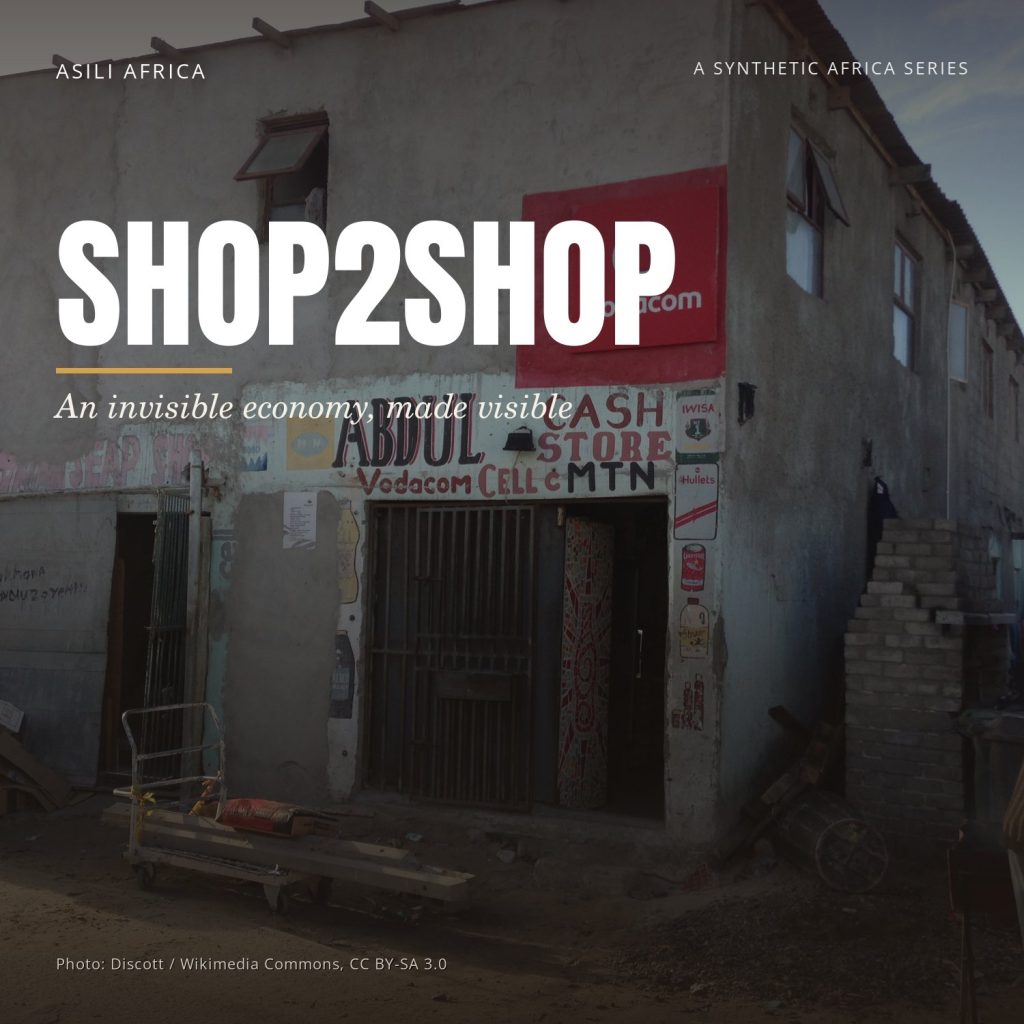
The Shop2Shop Story: How a Cape Town founder built two informal-market fintechs for the same buyer, and turned South Africa’s two-hundred-billion-rand shopkeeper economy into a listed asset class
On the twenty second of July, twenty twenty six, five days before this episode was written, a listed South African retail group called Pepkor filed an announcement on the Johannesburg Stock Exchange that most of the continent’s fintech industry immediately understood as the biggest African fintech dealroom event of the year. Pepkor would inject one point five seven billion rand of cash into a Cape Town company called Shop2Shop. In exchange, Pepkor would also fold its own fintech arm, called Flash, into the same company at a valuation of ten point six billion rand. The combined entity would be worth twenty one point three billion rand. It would process more than two hundred billion rand of transactions every year across the formal and the informal South African economy. And a listing on the Johannesburg Stock Exchange was already signalled.
The number that mattered was not the twenty one billion. It was the two hundred billion. That is how much money moves every year through the shopkeepers, the spaza owners, the midi wholesalers, and the corner counters that South African retail banks and card networks quietly stopped serving two decades ago. It is roughly one third the size of the country’s formal supermarket sector, and it had been sitting outside the visible financial system for most of the twenty first century. Shop2Shop is the company that decided that money was too big to leave alone.
But Shop2Shop is the second act of a founder who had already built and sold one informal market fintech to the same buyer, fourteen years earlier. His name is Peter Berry. His first company, called Flash Mobile Cash, was acquired by Pepkor on the eleventh of April, twenty twelve. He stayed inside Pepkor to run it, then quietly walked back out, then built the next one, then had Pepkor buy that one too. This is the story of the man who sold Pepkor an informal market twice.
This is the story of Shop2Shop. The company built for the shopkeepers the banks would not serve. The company that quietly wired one hundred and seventy seven thousand South African traders together on card acquiring, cash counting safes, and merchant to supplier payments. And the company that on a single Wednesday in July of twenty twenty six turned an invisible economy into a listed unicorn in waiting.
THE ORIGIN
The origin of Shop2Shop does not begin with a startup. It begins with a market that the formal economy had already given up on. By the middle of the two thousands, South Africa had roughly one hundred thousand spaza shops. They were small township counters, often the size of a garage, selling airtime, bread, sugar, cold drinks, and paraffin. Between them, they moved somewhere between one hundred and fifty and two hundred billion rand of goods a year. They sat inside a larger township economy that the researcher GG Alcock has estimated at more than one trillion rand. And essentially none of that money touched the formal banking system.
The reason was arithmetic. A South African retail bank card terminal cost between one thousand two hundred and two thousand rand. Interchange rates were priced for shopping mall retail, not for a shop taking two hundred and forty rand per average sale. Cash in transit costs to bank informal takings were punishing. And the robbery risk of walking the day’s cash to a wholesaler was, for many operators, the single largest operational danger of the whole business. So the money stayed in cash. Cash walked to the wholesaler. Cash walked to the taxi rank. Cash walked home. An entire economy, moving in physical notes, sitting outside every metric the country’s finance industry knew how to measure.
The first person to build a business around that gap at scale was a South African founder named Peter Berry. His original company was called Flash Mobile Cash. It was not, at first, a payments company. It was a value added services company. It sold small handheld terminals to spaza shopkeepers so they could dispense airtime, data, prepaid electricity, and lotto tickets from behind the counter. It was small margin. It was high volume. And by the early twenty tens, Berry had deployed roughly ninety thousand of those devices across the country. That, in a single number, was the largest informal market device fleet in South Africa.
On the eleventh of April, twenty twelve, the South African Competition Tribunal approved, unconditionally, the acquisition by Pepkor Capital of three companies in a single bundled transaction. Flash Mobile Cash. SharedPhone International. Take It Eezi Vending. Pepkor’s stated rationale, filed with the Tribunal, was to expand its business operations to serve the informal market. The sellers’ stated rationale was simpler. They wished to realise their investment. Peter Berry did not leave. He stayed on to run Flash inside Pepkor. And for a while, that looked like the end of the story.
THE STRUGGLE
It was not the end of the story. Somewhere in the years after the Pepkor acquisition, Berry left the Flash operation he had built and returned to his second act. There was, already, a Cape Town legal shell registered in his name and one other, called Shop2Shop. The company had been incorporated on the twenty seventh of September, two thousand and five. It had sat, largely dormant, for over a decade. And around twenty seventeen, according to industry consensus, Berry reactivated it as the vehicle for a very different informal market bet. Flash had solved value added services. It had put small devices onto the counters of ninety thousand shops. What Flash had not solved was the three problems that shopkeepers themselves said were the most painful things about their working day. Accepting card payments from customers. Getting cash out of the till and into a bank. And paying suppliers without physically carrying money to a wholesaler.
Shop2Shop was built to solve all three. First, a tap to pay terminal, priced meaningfully below the standard South African bank device. Not sold as a profit centre. Sold as a foothold. The head of sales at Shop2Shop, a man named Richard Charlie, has said publicly that the goal of the device pricing is, quote, not to make money from the device. The goal is to empower businesses, end quote. Second, cash counting smart safes for larger stores and wholesalers. A shopkeeper drops the day’s takings into the safe. The safe counts them. The safe credits a Shop2Shop digital wallet. Cash in transit collects the physical notes on a schedule. And the shopkeeper never carries cash out of the shop again. Third, that same wallet then pays upstream suppliers digitally. The bakery. The beverage distributor. The wholesaler. No cash walks. No robbery risk. And every transaction that used to be invisible now leaves a data trail the platform can underwrite loans against.
There is a detail in this story that does not appear in any pitch deck. The Shop2Shop logo is a camel. Berry chose it because a camel is a burden bearer, an animal that carries weight over long distances without complaint. But by the time Shop2Shop was rolling out across South African townships, a large share of the country’s spaza owners were not native South Africans. They were Somali migrants, Ethiopians, and other African trader communities who had steadily built up ownership of what came to be called the spazarette. And in the Somali trader community, the camel is not a burden animal. It is a wealth motif. It signals prosperity. The logo, chosen for one meaning, was read as another, and it materially helped the platform earn trust in a customer segment that no South African retail bank had ever taken the time to understand.
Over the same years, an institutional investor moved onto the Shop2Shop cap table. Lebashe Investment Group. A one hundred percent black owned South African investment holding company, chaired by a former Public Investment Corporation executive named Tshepo Mahloele, and with a former Deputy Minister of Finance, Jabu Moleketi, as its deputy chairman. Lebashe was the only publicly named institutional backer of Shop2Shop before the July twenty twenty six announcement. The company did not run priced venture rounds. It did not publish a valuation. It did not disclose revenue. It grew, quietly, for the better part of a decade, entirely inside private cap table arrangements between Berry, Lebashe, and management. That is unusual for a company this size. It also meant that when the numbers were finally forced into daylight, they arrived all at once.
THE SCALE
The numbers arrived because Pepkor was legally required to disclose them. When a listed South African company acquires or merges with a target of this size, the target’s financials go into the deal circular. And so, on the twenty second of July, twenty twenty six, for the first time in Shop2Shop’s history, the country got to see the print. For the twelve months to the thirtieth of June, twenty twenty five, Shop2Shop had generated revenue of nine point three billion rand. It had generated earnings before interest, tax, depreciation and amortisation of six hundred and sixty one million rand. It had generated a profit after tax of three hundred and eighty five million rand. And its three year growth rates were unusual for any company at that scale, anywhere in the world. Revenue compounding at roughly twenty eight percent a year. Earnings compounding at roughly eighty five percent.
The operating scale, for the twelve months to the thirty first of March, twenty twenty six, was equally arresting. One hundred and seventy seven thousand traders on the platform. One hundred and fourteen thousand tap to pay devices deployed. Two thousand nine hundred cash counting safes installed at larger stores. One hundred and seventy two billion rand of transactions digitised inside the year. And of that, one hundred and thirty one billion rand was supplier payments, digital rails moving money from shopkeepers directly to their bakeries, beverage distributors, and wholesalers.
The deal itself is unusually elegant on paper. Pepkor injects one point five seven billion rand of cash into Shop2Shop in exchange for new shares. Shop2Shop uses the cash to settle its debt and fund growth. In the same transaction, Pepkor contributes the entirety of its Flash subsidiary, valued at ten point six billion rand, into the same company. The combined entity, provisionally called FintechCo, is worth twenty one point three billion rand, roughly one point three billion United States dollars. Pepkor holds fifty seven point one percent. Peter Berry, through associated entities, holds an indirect twenty four percent. The remainder, approximately nineteen percent, sits with Lebashe and Shop2Shop management. Combined transaction throughput exceeds two hundred billion rand a year. And Pepkor has signalled its intention to separately list the combined business on the Johannesburg Stock Exchange in the medium term.
There is one governance detail worth naming. The chief executive of Pepkor is a man named Pieter Erasmus. Erasmus is reported to hold an indirect thirteen point two percent economic interest in the deal structure, worth roughly two point eight billion rand through personal association. As a direct result, he recused himself from Pepkor board deliberations on the transaction. This is not, in the ordinary sense of the word, a controversy. But it is the kind of detail that will follow the deal through its regulatory approvals, and any reader of the deal circular will find it.
THE CATEGORY
To understand why Pepkor was willing to write a one and a half billion rand cheque for an informal market payments company most South Africans had never heard of, look at what was happening in the rest of the merchant acquiring sector. In August of twenty twenty five, less than a year before the Shop2Shop announcement, Nedbank had acquired a formal small merchant card reader company called iKhokha for roughly one point six five billion rand. That deal placed the formal small business acquiring segment inside a big four South African bank. It also made clear that every bank in the country now understood that the merchant counter, at every size, was strategic. If Nedbank took the formal side, and Standard Bank was building an Instant Money cash out network across four hundred thousand points, and TymeBank was onboarding customers through supermarket kiosks, then Pepkor’s largest strategic vulnerability was the informal side. Shop2Shop closed that vulnerability. Flash added scale. And in a single transaction, Pepkor moved from being a retailer with a fintech arm to being a fintech at retail scale.
Berry’s own framing, in the TechCentral interview on the day of the announcement, was that South Africa is now closer to a cashless informal economy than most people realise. Card acquiring is solved. Cash out is solved. Supplier payments are solved. The last true holdout, he said, is the minibus taxi industry, which moves roughly two thirds of urban South African commuters and still runs on cash. Solve taxis, Berry said, and cash dies in townships. That is a five year thesis. The News24 headline distilled it into six words. Only taxis stand between South Africa’s informal market and a cashless future.
TODAY AND TOMORROW
Which brings us to today, five days after the announcement. The deal is signed but not closed. Regulatory approvals from the South African Competition Commission and Competition Tribunal are pending, alongside other customary conditions. Close is targeted for the first quarter of twenty twenty seven. The Johannesburg Stock Exchange listing is medium term, which in South African market language means somewhere between twelve and thirty six months after close. And several important questions have not yet been publicly answered. Who runs the combined FintechCo. What is Peter Berry’s operating role after the deal closes. How the two overlapping merchant bases, one hundred and seventy seven thousand at Shop2Shop and one hundred and seventy six thousand at Flash, will be de duplicated and integrated. And whether the Standard Bank Instant Money distribution partnership survives in its current form once Pepkor controls the merged network.
The larger picture is easier to state. Two decades of quiet informal market building has, in a single transaction, converted an invisible South African economy into a listed asset class. The two hundred billion rand of transactions that flow through South African spaza counters every year now sit inside a company with a real valuation, a real cap table, a regulator watching, and a listed parent responsible for disclosing its numbers. That has never been true before. And it happened because a Cape Town founder built the same informal market fintech, twice, and had the same buyer buy it, twice.
The open questions are the ones that will define the next five years. Whether FintechCo can actually list on the Johannesburg Stock Exchange at the valuation it is now marked at. Whether the informal market can be formalised on the timeline Berry believes it can. Whether the taxi rank finally digitises. And whether the specific pattern of a South African founder building two consecutive informal market fintechs for the same acquirer becomes a template that other founders in Nairobi, in Lagos, in Cairo, in Kigali, will now try to copy. The bet is placed. The regulator will decide the close. The listing is on the horizon. And an economy that spent two decades outside the formal financial system is, at last, on the inside.
In the mid two thousands, a Cape Town founder registered a dormant company called Shop2Shop and set it aside. He spent the following seven years building a different informal market company called Flash Mobile Cash and sold it to a listed South African retailer called Pepkor. Then, quietly, he walked back out and reactivated the dormant one. Fourteen years later, the same retailer bought the second one too, at a twenty one point three billion rand combined valuation, and set it on a path to a Johannesburg Stock Exchange listing. The invisible economy is no longer invisible.
This is Asili Africa. Every empire has an origin.
Key Takeaways
- THE ORIGIN. The origin of Shop2Shop does not begin with a startup. It begins with a market that the formal economy had already given up on.
- THE STRUGGLE. Somewhere in the years after the Pepkor acquisition, Berry left the Flash operation he had built and returned to his second act.
- THE SCALE. The numbers arrived because Pepkor was legally required to disclose them.
- THE CATEGORY. To understand why Pepkor was willing to write a one and a half billion rand cheque for an informal market payments company most South Africans had never heard of, look at what was happening in the rest of the merchant acquiring sector.
- TODAY AND TOMORROW. Which brings us to today, five days after the announcement.
Listen to the Episode
Also available on YouTube — search “Asili Africa” or subscribe to our channel.