
The Pesapal Story
In a Nairobi office, in two thousand and nine, a Kenyan merchant with a small e-commerce website was staring at the checkout page of that website, trying to work out how to make it accept a payment. On the page were three logos. M-Pesa. Airtel Money. Visa. Each one, a rail. Each rail, a separate integration. Each integration, a separate acquiring bank, a separate settlement account, and a separate reconciliation email arriving in the merchant’s inbox at the end of every business day. The customer, who was trying to buy something from the merchant’s site, wanted one button. The rails behind that button, the merchant had learned over the previous six months of trying to build it, were not one button. They were three separate businesses that had never spoken to each other.
Two years earlier, in March two thousand and seven, Safaricom had launched M-Pesa as a person to person mobile money remittance product. By two thousand and nine, M-Pesa had roughly six to seven million registered users, was already being used for merchant payments in Nairobi’s physical retail, and had become the default cash substitute for the Kenyan urban consumer. But M-Pesa was not integrated into any online checkout in Kenya. There was no plug in. There was no API. And there was no company, anywhere in Nairobi, whose entire product was the checkout that would make M-Pesa, Airtel Money, and card rails settle to a merchant through a single button on a single web page.
That is the specific problem, at the specific moment, that a Nairobi based technologist named Agosta Liko decided to build a company around. The company would take every mobile money and card rail in Kenya, and every mobile money and card rail in every country Kenya’s payment infrastructure connected to, and hide them behind a single checkout that a merchant could put on any website in about a day. The company was called Pesapal. It launched in two thousand and nine. Seventeen years later, in mid two thousand and twenty six, Pesapal is still headquartered in Nairobi, is still run by the same founder who started it, and is one of the very small number of independent, founder led, single country origin African payment companies of its generation that has never been acquired, restructured, or replaced at the top. That is the story we are going to tell today.
THE GAP, TWO THOUSAND AND NINE
To understand what Pesapal was solving, we have to sit inside the Kenyan online commerce market as it existed in two thousand and nine. Two years earlier, on the sixth of March two thousand and seven, Safaricom had launched M-Pesa. And in the two years since, M-Pesa had done something no other mobile money product on the African continent had ever done. It had crossed from a niche remittance product used by roughly a hundred thousand early adopters into a general purpose consumer payments habit used by millions of Kenyans every week. By the end of two thousand and eight, M-Pesa had over five million registered users. By the end of two thousand and nine, it was over eight million. The Kenyan consumer had, in less than three years, learned to pay for things with a phone.
What the Kenyan consumer had not yet learned to do, because it was not yet possible, was pay for things through a website. Kenyan e-commerce in two thousand and nine was small, fragmented, and almost entirely blocked by the payment step. If a Nairobi merchant wanted to sell you something online, they had four options. Cash on delivery. Direct bank deposit into a stated account, followed by a screenshot of the deposit slip emailed to the merchant. A card payment through a manual acquiring relationship with a specific Kenyan bank. Or M-Pesa, entered manually, paybill by paybill, with the merchant reconciling the confirmation SMS against the customer’s order in a spreadsheet. None of those options were checkout. All of them were workarounds.
The specific business insight that Agosta Liko brought to that market was that the checkout was the product, and the rails behind it were plumbing. If you looked at the checkout from the merchant’s side, you saw three separate businesses that had never spoken to each other. If you looked at it from the customer’s side, you saw one page with three logos and a lot of confusion. The customer did not want to think about rails. The customer wanted to buy the thing. The merchant did not want to reconcile rails. The merchant wanted the money in their account at the end of the day. Somebody had to sit in the middle. Somebody had to hide the plumbing.
Liko decided to be that somebody. The company he built to do it was called Pesapal. It launched, in Nairobi, in two thousand and nine.
THE BUILD, TWO THOUSAND AND NINE TO TWO THOUSAND AND THIRTEEN
The founding team was small. The build was pragmatic. Pesapal in its earliest form was a hosted checkout page and a merchant API. A Kenyan merchant would sign up on the Pesapal website. Pesapal would provision the merchant a settlement account. The merchant would add a piece of code to their website, or paste a Pesapal payment link into their WhatsApp business chat, and the customer would click through to a Pesapal hosted page. On the page, the customer picked how they wanted to pay. M-Pesa. Airtel Money. Card. The rail specific credentials would appear. The customer would authorise the payment. Pesapal would settle the money into the merchant’s account. The merchant would receive a reconciliation report.
The first customers were exactly the kind of customer that a Nairobi startup in two thousand and nine would find. Small e-commerce operators. Independent hoteliers taking online bookings. Independent event organisers selling tickets to a Sunday concert. Universities and colleges taking student application fees. Churches taking online tithe. None of them had marketing budgets. All of them had the specific problem Pesapal was built to solve.
Two of those verticals became durable in a way the others did not. The first was ticketing. Live events and cinema tickets are a payment heavy business. Every ticket sold is a payment. Every ticket refunded is a reverse payment. The unit economics of a ticketing platform sit almost entirely inside the payment layer, and if the ticketing platform can build on top of its own gateway, the gross margin arithmetic gets very interesting very quickly. Pesapal took that observation and built out a ticketing product, historically known as Ticketsasa, that ran on Pesapal’s own rails.
The second was the institutional customer. Kenyan universities collecting fees. Kenyan churches collecting tithe. Kenyan hospitals collecting bill payments. These were merchants who were not part of the venture capital startup ecosystem, who were not going to be featured in the tech press, who were not going to churn to the next platform when a Silicon Valley funded competitor arrived with cheaper pricing. They were, and are, structurally sticky customers. Pesapal built the specific product features they needed. Recurring billing. Payment plans. Vertical customised checkout flows. And it embedded itself in a Kenyan institutional layer that most of the pan African fintech that would arrive in the twenty tens simply never got close to.
Around Pesapal, in Nairobi between two thousand and ten and two thousand and thirteen, an entire Kenyan technology startup ecosystem was coming together. The iHub, founded by Ushahidi’s team in two thousand and ten, was the central meeting point. Google’s Umbono program was seeding early stage teams. Adlevo Capital, Africa focused, was making its first Kenyan investments. Safaricom, having watched M-Pesa become larger than most of its own product portfolio, was starting to think about what an M-Pesa developer API might look like. And into that ecosystem, Pesapal walked with the specific claim that it had already, quietly, built the thing that everybody else was talking about building. The multi rail online checkout for the Kenyan merchant.
GROWTH CAPITAL AND REGIONAL EXPANSION
In two thousand and thirteen, four years after founding, Pesapal took what remains, on the public record, its most widely reported institutional capital event. Adlevo Capital, an emerging markets Africa focused technology private equity firm founded by Genevieve Sangudi, invested in the company. The financial terms of the investment were not publicly disclosed. Adlevo’s other Kenyan portfolio activity around this period included BRCK and other early stage East African technology companies. The Pesapal deal was reported in Business Daily and in the Kenyan technology trade press. Adlevo’s status as an early institutional backer of Pesapal is on the record. What has happened to the cap table since, and whether subsequent rounds have occurred, has not been publicly disclosed in a comparable way.
Between roughly two thousand and ten and two thousand and fifteen, Pesapal executed a regional expansion into the countries whose payment infrastructure Kenya’s own naturally connected to. Uganda first. Then Tanzania. Then Rwanda. Then Malawi. Then Zambia. Then Zimbabwe. The specific years of first live in each country are approximate on the public record and worth verifying. What is not approximate is the shape of the footprint. Pesapal expanded into the English speaking common law East and Southern African corridor. It did not go into Nigeria. It did not go into Ghana. It did not go into the Francophone West African markets. It stayed inside the geography where the M-Pesa style mobile money product and the Kenyan payment operating model would drop in most readily.
That is a specific and deliberate strategic choice that separates Pesapal from the pan African fintech companies that would emerge later. Flutterwave, Cellulant, Chipper Cash, DPO, and Interswitch all built, at some point in their trajectories, an explicit pan African ambition. Pesapal did not. It went to the countries where the product worked, and stopped where the product would have needed to be materially re engineered.
The distinction matters for the story. A continental fintech has to fundraise like a continental fintech. It has to hire a country manager in every market it enters. It has to negotiate acquiring relationships with the specific banks and mobile money operators in every country it enters. Its cash burn scales with the number of countries it is trying to be simultaneously live in. A regional fintech, by contrast, gets to be deeply competent in a smaller number of markets. It gets to know its acquiring partners by name. It gets to build product for a specific customer profile that recurs across markets. Its cash burn stays roughly proportional to its actual revenue. The trade off is real. The continental fintech, if it works, is much bigger. The regional fintech, if it works, is much older.
TICKETSASA, SABI, AND THE VERTICAL PRODUCT PLAY
Around the core gateway, Pesapal built out a set of adjacent products. The first, historically, was Ticketsasa. The event and cinema ticketing platform. A Kenyan concertgoer buying a ticket to a live event, a moviegoer buying a ticket to a Nairobi cinema, or a matatu commuter reserving a seat on a long distance bus, could, at various points across the twenty tens, be running that transaction through a Ticketsasa customer facing product that cleared through Pesapal’s own gateway.
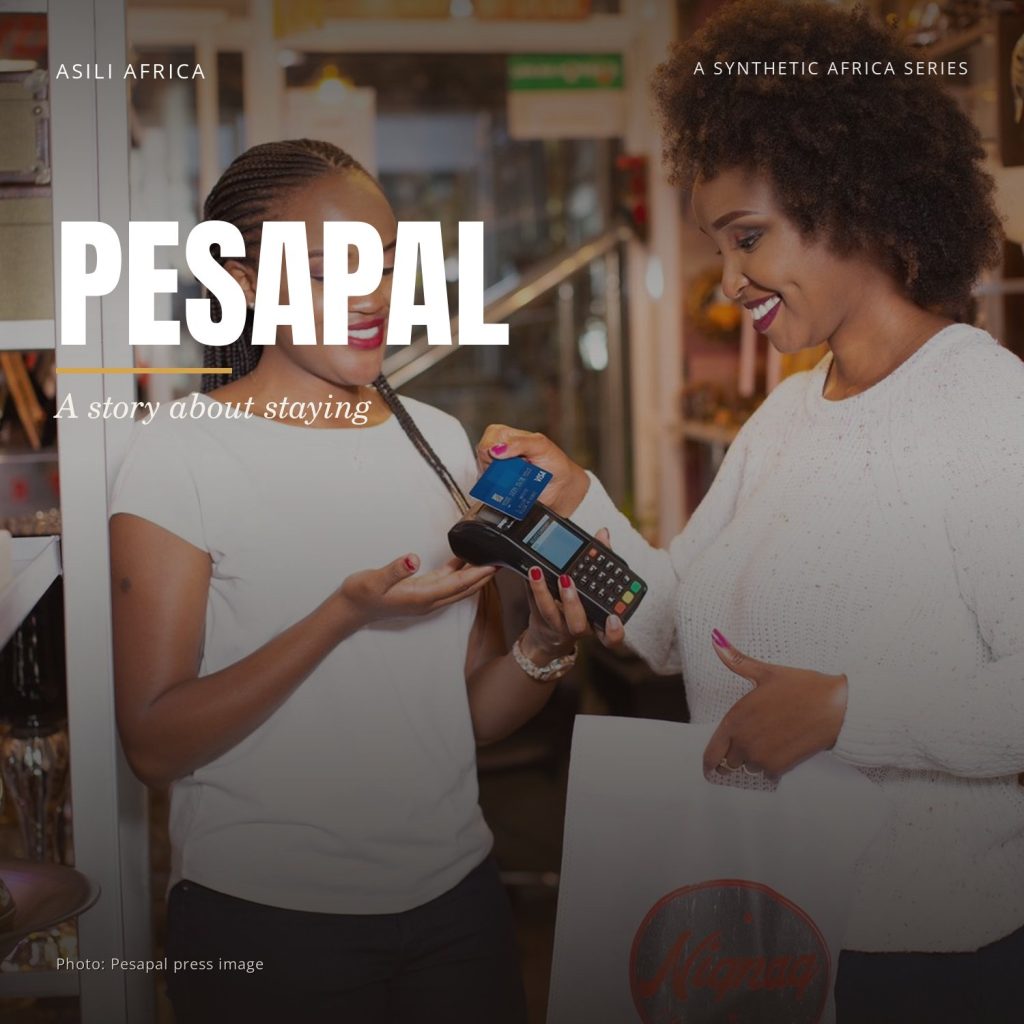
The second, more recent, was Sabi. Sabi is Pesapal’s family of point of sale hardware terminals. A physical retailer in Nairobi, or in Kampala, or in Dar es Salaam, takes delivery of a Sabi terminal, connects it to their till, and starts accepting card taps, mobile money confirmations, and QR scans at their counter. The transaction clears through the same Pesapal gateway that has always sat behind Pesapal’s online checkout. Sabi is Pesapal’s answer to the specific question, what does an online first payments company do about the fact that most African retail commerce is still done in a physical store. The answer was to bring the physical store into the same rails.
The strategic architecture across those products is consistent. There is one gateway. Every product on top of the gateway is a different way for a specific customer, in a specific vertical, to route their payment through it. Online checkout for e-commerce merchants. Ticketsasa for the ticketing vertical. Sabi for physical retail. Recurring billing for subscriptions. School fees for universities and colleges. Church tithe for religious institutions. The gateway is the moat. Everything else is distribution.
That architecture, quietly, is what has allowed Pesapal to scale without the venture capital that its later arriving competitors have needed. Every vertical product is a way of increasing the transaction volume on the gateway. Every increase in gateway volume increases Pesapal’s negotiating leverage with its acquiring bank partners and mobile money operators. Every increase in that leverage tightens the unit economics of the gateway. And the gateway funds the next vertical product. It is a compounding architecture, run over seventeen years, in a market where most of the venture financed competitors have had to raise fresh capital every eighteen months to keep the model alive.
THE FLUTTERWAVE ERA
In two thousand and sixteen, seven years after Pesapal launched, a new company was founded in Lagos and San Francisco. It was called Flutterwave. Its founders were Iyinoluwa Aboyeji and Olugbenga Agboola. The company’s founding thesis was, in its architecture, very close to Pesapal’s. A single API. Multiple African rails. A checkout that hides the plumbing from the merchant and the customer. What was different was the scale of the ambition and the source of the capital. Flutterwave launched with immediate pan African ambition, immediate Silicon Valley capital, and immediate San Francisco investor relations. Between two thousand and sixteen and two thousand and twenty two, Flutterwave raised, across a Series A, Series B, Series C, and Series D, more than four hundred million United States dollars from investors that included Y Combinator, Tiger Global, Avenir Growth Capital, and, at the Series D, a reported valuation exceeding three billion United States dollars.
For the seven year old Pesapal that was already in market when Flutterwave launched, Flutterwave arriving was not a small event. Every institutional customer in Kenya, every acquiring bank, every mobile money operator, every hotel chain, and every large e-commerce merchant that Pesapal had been building a relationship with since two thousand and nine, was suddenly being pitched by a much better funded company with a bigger sales team and a Silicon Valley story. The choice for Pesapal at that moment was a strategic one. Either raise a large round of matching capital and go pan African, or continue the founder led, regional, cash flow financed model.
Pesapal, on the public record, chose to continue. Agosta Liko has not, in any material public interview across the last decade, indicated that a large fundraise was on the near term roadmap. The company has continued to expand product surface area, has continued to open in East and Southern African markets, and has continued to be described by its founder as an operationally profitable, region focused, founder led company. The public strategic posture has not shifted.
What has shifted, in the years since Flutterwave’s Series D, is Flutterwave itself. Between two thousand and twenty two and two thousand and twenty six, Flutterwave has weathered a period of internal governance controversies, has faced United States federal court proceedings around an alleged fraud claim, has cycled through multiple senior executive transitions, and has, in May two thousand and twenty six, consolidated the sector further through the acquisition of the Nigerian open banking startup Mono for an undisclosed sum. Cellulant has been through its own restructures. DPO Group was, in two thousand and twenty, acquired by the United Arab Emirates listed Network International in a deal reported at approximately two hundred and eighty eight million United States dollars. Interswitch has, across the same period, been navigating its own long delayed public listing plans. Kenyan fintech peers like Chipper Cash have burned through crypto pivot cycles and layoffs.
Through all of that, Pesapal is still Pesapal. Still Nairobi. Still Liko. Still the founder led company that solved the two thousand and nine Kenyan online checkout problem and has, for seventeen years, continued to solve it.
TODAY AND THE TWO LIVE QUESTIONS
Today, at the beginning of July two thousand and twenty six, Pesapal operates its payment gateway across Kenya, Uganda, Tanzania, Rwanda, Malawi, Zambia, and Zimbabwe. It runs an online checkout, a family of Sabi point of sale terminals, a ticketing product, and a merchant dashboard. It counts, among its historically named reference merchants, Kenya Airways, KFC Kenya, a portfolio of Kenyan universities and hotels, and a substantial number of Kenyan churches and religious institutions. Its exact merchant count, transaction volume, and employee count in mid two thousand and twenty six are not publicly disclosed at the level of specificity that would allow us to quote a hard figure. What is on the record is that the company continues to be named across Kenyan trade press coverage of the East African fintech sector as one of the leading Kenyan headquartered payment gateways, and that Agosta Liko remains CEO.
Two live questions sit against that mid two thousand and twenty six position.
The first is the consolidation question. The African fintech sector between two thousand and twenty and two thousand and twenty six has consolidated in a way that would have been very hard to predict from the two thousand and eighteen peak of the sector. DPO sold to Network International. Cellulant restructured. Flutterwave acquired Mono. The pattern is clear. The sector is consolidating around a smaller number of larger players. The question for Pesapal is whether it sits, in that consolidation, as an acquisition target for a larger regional or global payments company, or whether it stays independent under founder continuity for another cycle. The public record does not answer that question. Agosta Liko’s public commentary has not indicated a pending transaction. But the structural pressure exists.
The second is the hardware question. The Sabi point of sale line represents Pesapal’s bet that physical retail is a big enough share of African commerce that a payments company that only serves online merchants is leaving too much of the market uncovered. That bet, if it delivers, means Pesapal’s next decade of growth comes from terminals in shops, not from checkouts on websites. The economics of a hardware business are structurally different from the economics of a gateway business. Higher upfront capital cost per terminal. Longer sales cycle per customer. Deeper support and logistics operation. The question is whether Sabi scales to become the dominant share of Pesapal’s group revenue in the coming years, or whether it stays a strategic adjacency to the online gateway that continues to define the company’s identity.
The single most striking fact about Pesapal in mid two thousand and twenty six is the ratio between the events that have moved the African fintech sector and the continuity of the person running Pesapal through it. In seventeen years, Pesapal has seen M-Pesa go from a two year old remittance product to a payments platform serving fifty plus million Kenyans. It has seen the launch, the scale up, and the governance crises of Flutterwave. It has seen DPO acquired by a Dubai buyer. It has seen Cellulant restructure. It has seen a full generation of pan African fintech competitors raise, spend, pivot, and, in some cases, disappear. Through all of it, the same founder, Agosta Liko, has been at the top of Pesapal, in Nairobi, running the same core product. The transaction volumes on the gateway have moved. The regional footprint has moved. The product surface area has moved. The operating leader has not.
In two thousand and nine, in a Nairobi office, a Kenyan technologist named Agosta Liko decided that the online checkout was a product and that the rails behind it were plumbing. He built a company called Pesapal to hide the plumbing behind a single button. Four years later, in two thousand and thirteen, the Africa focused private equity firm Adlevo Capital made the one widely reported institutional investment in the company. Between two thousand and ten and two thousand and fifteen, Pesapal walked its gateway product into six additional East and Southern African countries. Between two thousand and sixteen and two thousand and twenty two, a much larger, much better funded pan African competitor called Flutterwave launched, scaled, raised over four hundred million United States dollars, was valued above three billion, and became the loudest African fintech company in the world. Pesapal stayed the same size relative to the sector. It kept its Nairobi head office. It kept its founder. It kept its regional footprint. Between two thousand and twenty and two thousand and twenty six, the African fintech sector went through a consolidation wave that acquired DPO, restructured Cellulant, and reshaped Flutterwave. Pesapal is, in mid two thousand and twenty six, still independent. Still Nairobi. Still Liko. And still doing exactly the thing it was set up in two thousand and nine to do. It is not a company that chased the biggest possible outcome. It is a company that survived long enough to be the incumbent in the market it was built for. And it started with a whiteboard, in a Nairobi coworking space, in two thousand and nine.
This is Asili Africa. Every empire has an origin.
Key Takeaways
- THE GAP, TWO THOUSAND AND NINE. To understand what Pesapal was solving, we have to sit inside the Kenyan online commerce market as it existed in two thousand and nine.
- GROWTH CAPITAL AND REGIONAL EXPANSION. In two thousand and thirteen, four years after founding, Pesapal took what remains, on the public record, its most widely reported institutional capital event.
- THE FLUTTERWAVE ERA. In two thousand and sixteen, seven years after Pesapal launched, a new company was founded in Lagos and San Francisco.
- TODAY AND THE TWO LIVE QUESTIONS. Today, at the beginning of July two thousand and twenty six, Pesapal operates its payment gateway across Kenya, Uganda, Tanzania, Rwanda, Malawi, Zambia, and Zimbabwe.
Also available on YouTube — search “Asili Africa” or subscribe to our channel.