
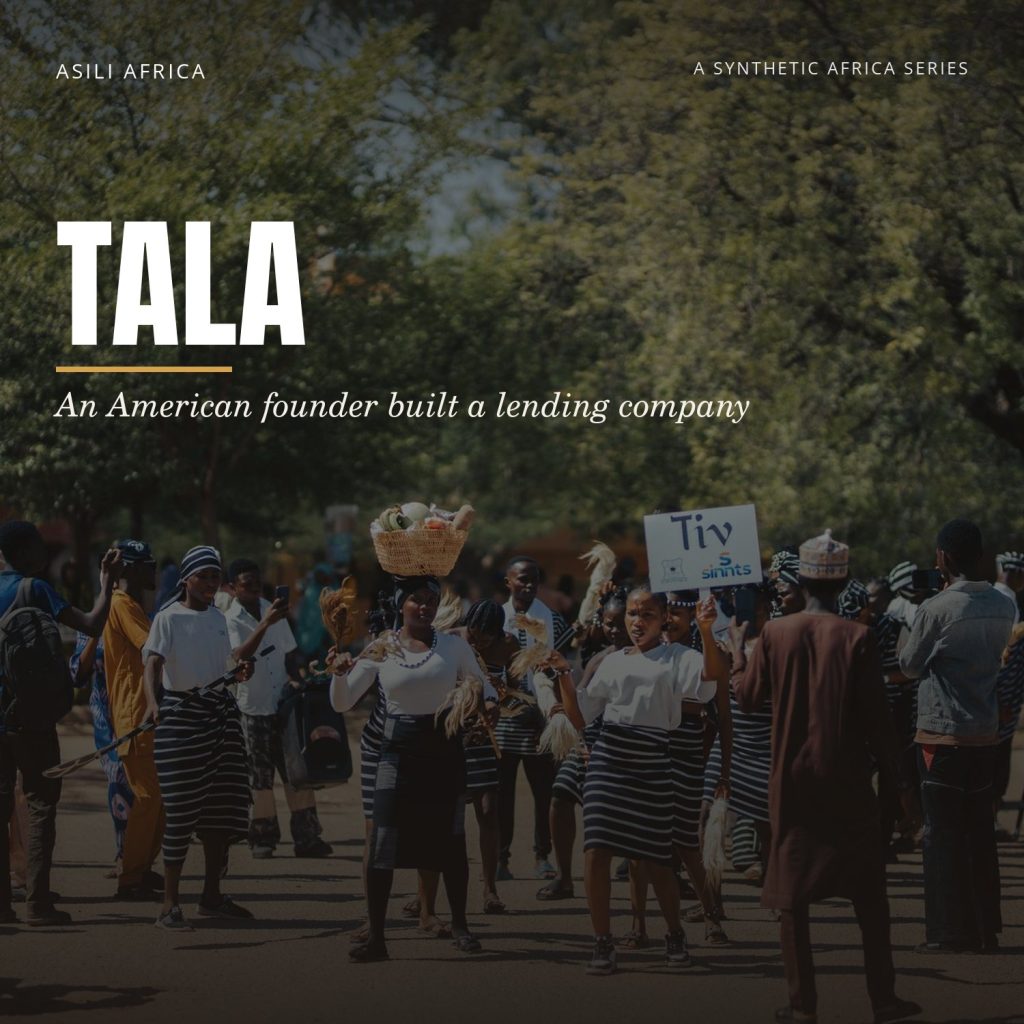
The Tala Story: The phone that became a paper trail
Sometime in the late two thousands, in a market on the outskirts of Nairobi, a young American researcher named Shivani Siroya was following an older Kenyan woman around her stall with a small green notebook in her hand.
She was not buying anything. She was counting.
She was tallying the woman’s daily takings. Her inventory costs. Her school fees. The cousin she sent money to every Sunday. The little she set aside in a tin under the bed. By the end of the week, Shivani had a complete picture of this woman’s economic life. Cash in. Cash out. Risk taken. Risk managed.
Then she went home and wrote up a profile that every bank in Nairobi would have refused to read. Because the woman had no payslip. No bank statement. No collateral. No land title. By the rules of the formal financial system, she did not exist.
Shivani Siroya did this three thousand five hundred times. Across nine countries. Across four years. And every single time, the conclusion came back the same.
The bank was wrong. The woman was creditworthy. The bank simply could not see her.
So Shivani went back to Los Angeles. And she asked a question that, a decade later, would have moved more than six billion US dollars to people exactly like that market vendor.
If a bank cannot see them, what can?
This is the story of Tala. The Los Angeles fintech that decided the phone in a Kenyan stranger’s pocket was a better paper trail than any payslip.
This is Asili Africa.
The Invisible Borrower
Shivani Siroya was born in Brooklyn, New York, to a Rajasthani family. Her mother had immigrated to the United States to practise medicine. The household was high achieving, immigrant, and serious about education.
She went to Wesleyan University in Connecticut for her undergraduate degree in International Relations. Then to Columbia University in New York for a Master of Public Health, focused on econometrics. By her mid twenties she had already worked in global health investment at Citi, then UBS, then Credit Suisse. The traditional path for a smart immigrant daughter with a Columbia degree was wide open in front of her. Investment banking. Corporate finance. A New York apartment by thirty.
Shivani Siroya walked away from it.
She joined the United Nations Population Fund as a microcredit researcher. For roughly four years, between two thousand and six and twenty ten, the UN sent her into the field. Sub-Saharan Africa. West Africa. South Asia. Her job was to study small business owners. Mostly women. Mostly working in the informal economy. Mostly invisible to the formal financial system.
She did not study them from a desk. She shadowed them. She spent days in their stalls. Days in their kitchens. Days at the school gates when they paid fees. She tallied everything. By the end of her time at the UN, she had personally interviewed more than three thousand five hundred small business owners across nine countries.
And she had arrived at a conclusion that was, in the polite language of development economics, a quiet heresy.
These people were creditworthy.
Not maybe creditworthy. Not creditworthy in some redefined moral sense. Creditworthy by every behavioural measure that mattered. They managed cash flow. They serviced family obligations. They reinvested in inventory. They were, in most cases, more disciplined with money than the salaried middle class clients the banks were happy to lend to.
But they had no payslip. No bank statement. No collateral. No formal credit history. The formal financial system was built to read documents that the working poor simply do not produce. And so the formal financial system had concluded that the working poor were not creditworthy, when the truth was that the formal financial system could not see them.
Shivani Siroya kept asking the same question. If a bank cannot see them, what can?
She did not have the answer yet. But she could see, in the late two thousands, the answer beginning to arrive. Cheap Android smartphones were spreading across the African and Asian markets she was studying. The market women she had been shadowing were starting to carry phones. The phones logged calls. The phones logged contacts. The phones logged movement. The phones logged how often a person topped up airtime, and when.
A phone, Shivani realised, was a paper trail. A different kind of paper trail than a payslip. A paper trail of behaviour, not of employment. And behaviour, she had spent four years discovering, was the actual signal.
On the first of October, twenty eleven, in Santa Monica, California, Shivani Siroya formally founded a company called InVenture. She had no engineers yet. She had no loan capital yet. She had a thesis. The thesis was that a smartphone, with the borrower’s permission, could replace a credit bureau. The thesis was that the invisible borrowers were the largest underserved market in the world.
The thesis was, in twenty eleven, almost impossible to fund. Silicon Valley had not yet learned to listen to founders building for emerging market consumers. Microfinance was a charity word, not a venture word. And asking a stranger for permission to read her phone sounded, to most Western ears, like surveillance, not service.
The first three years of InVenture were quiet. There was no app yet. There was a research project, a few engineers, and a slow campaign to convince investors that a model built in a tiny office in Santa Monica could underwrite a market vendor in Nairobi.
The breakthrough came in twenty thirteen. Lowercase Capital, the venture firm founded by Chris Sacca, wrote the seed check. Google Ventures and Collaborative Fund joined the round. TED named Shivani Siroya a Fellow that same year.
The company finally had what it needed. A check. A signal. And one specific market that had been chosen, with care, to be the place where the thesis would either survive contact with reality, or not.
That market was Kenya.
The Phone Says Yes
Kenya, in twenty fourteen, was the most obvious place in the world to test Shivani Siroya’s thesis.
Kenya already had M-Pesa. Launched by Safaricom in two thousand and seven, M-Pesa had quietly become the most successful mobile money system on earth. Almost every adult Kenyan with a phone could send and receive money instantly, without a bank account, by typing a short string of numbers into a feature phone. That solved the disbursement problem. If Tala approved a loan, the cash could land in the borrower’s wallet in seconds.
What Kenya did not have, in twenty fourteen, was an underwriting system that could decide who deserved the loan in the first place. Bank credit went to a small minority of the country who could produce payslips and collateral. Everyone else borrowed from family, from cooperatives, or from shylocks at brutal rates.
Tala launched into that gap in twenty fourteen, under a Kenyan brand name chosen with care. Mkopo Rahisi. Swahili for easy loan. The name was the marketing. The product was a smartphone app, available on Android only, that asked three things of a borrower.
Permission to read the phone. A few minutes to fill in a short application. And a registered M-Pesa number.
What followed was new. The app asked for the borrower’s consent and then quietly read the phone. Not the photos. Not the messages. The metadata. How many contacts did the borrower have. How often did they call those contacts. Did they pay their phone bills on time. Did the device have a calculator app installed, suggesting a small business. Did the location patterns match someone holding down a regular routine, or someone moving erratically. How carefully did they fill out the form itself.
Roughly two hundred and fifty individual signals went into a machine learning model that had been training on early borrowers since the soft launch. The model scored the application in seconds. The phone said yes, or the phone said no. If the phone said yes, Tala wired the loan, between one thousand and ten thousand Kenyan shillings at first, directly to the borrower’s M-Pesa wallet.
No branch visit. No collateral. No bank statement. No human loan officer.
The first loans, in twenty fourteen, were experiments. Tala did not know yet which signals predicted repayment. They had to lend, watch what happened, and adjust. Early default rates were the single most guarded number inside the company.
The model worked. Slowly at first. Then less slowly. Within eighteen months, Mkopo Rahisi had become the first widely used smartphone app in Kenya that issued unsecured loans on the basis of phone data alone. It was, by most measures, the first of its kind anywhere in the world.
By the twenty sixteen rebrand to Tala, the Kenyan app had disbursed more than one billion Kenyan shillings to over seventy five thousand customers. The ceiling on a single loan had been raised from ten thousand to fifty thousand Kenyan shillings. Repayment rates were quietly climbing.
The challenges, in those first three years, were not technological. They were human.
The first challenge was permission. Asking a stranger to grant an app access to her contact list was, and still is, a meaningful cultural ask. Tala leaned on plain language consent dialogs and the speed of disbursement. The trade you were being offered was simple. Let us read your phone, and within minutes, money will arrive that no bank in the country was ever going to give you. Hundreds of thousands of Kenyans, over time, decided the trade was worth taking.
The second challenge was capital. Tala was not a pure software company. To lend money, Tala needed money to lend. Equity capital paid for engineers. Debt capital paid for loans. The early team had to build two parallel fundraising tracks at once, a discipline most Silicon Valley startups never had to learn.
The third challenge was investor conviction. Convincing a Silicon Valley venture firm that a model trained on Kenyans’ phones could one day underwrite borrowers in Mexico and the Philippines and India took years of patient explanation. The Series A did not close until twenty fifteen.
But it closed. And by twenty seventeen, Tala had crossed the first threshold of any consumer fintech. People in Nairobi were telling their cousins about it. The phone said yes. The cash arrived. The world had not ended.
From An App To A Platform
In twenty sixteen, InVenture and Mkopo Rahisi both quietly disappeared from the company’s marketing. In their place was a single global brand. Tala.
The name had been chosen, deliberately, to resonate across many cultures and languages. It was short. It was easy to say. It did not anchor to a single country. The rebrand was, in plain language, a declaration. Tala was no longer a Los Angeles experiment running a Kenyan side project. Tala was going to be a global financial platform for the underbanked.
In twenty seventeen, Tala launched in the Philippines. The country had the same combination Kenya did. Cheap Android phones, deep mobile penetration, an under-served working class.
In twenty eighteen, Tala closed a sixty five million US dollar Series C round led by Revolution Growth. The money paid for a Mexico launch. Mexico, with a hundred and twenty million people and a banked share well under fifty percent, looked structurally identical to Kenya. The same year, Tala entered India.
In August of twenty nineteen came the Series D. One hundred and ten million US dollars, led by RPS Ventures, whose founding general partner Kabir Misra joined Tala’s board. PayPal Ventures, GGV Capital, IVP, Revolution Growth, Lowercase, DCVC, and ThomVest all wrote checks alongside. Total equity raised crossed two hundred and fifteen million US dollars. The implied valuation was above seven hundred and fifty million US dollars.
But the same month brought the first significant failure of the global thesis.
Tala had been operating in Tanzania since twenty fourteen, the same year as Kenya. In September of twenty nineteen, after five years, the company quietly paused its Tanzanian operations. Press coverage at the time cited rising local competition, a hostile regulatory environment for foreign owned digital lenders, and an unverified allegation from Tanzanian authorities of a two and a half million US dollar state loss through alleged misuse of the network. Tala framed the move as a review. As of this episode, Tala has not returned to Tanzania.
Kenya was now, more clearly than ever, the proving ground that mattered. Mexico and the Philippines were growing. India was a question mark. But Kenya was where the model had been built, where it had scaled, and where the company’s reputation would either survive or break.
In May of twenty twenty one, Tala announced a partnership with Visa, the payments company Circle, and the Stellar Development Foundation. The product on the slide was a non-custodial crypto wallet, holding the dollar-pegged stablecoin USDC, accessible inside the Tala app. It was a bold pivot. From a single product lender, Tala was telling the world it intended to become a full neo-bank for the global underbanked. Loans, savings, payments, dollar exposure, all in one app.
Five months later, in October of twenty twenty one, the Series E closed. One hundred and forty five million US dollars, led, with a certain symmetry, by Upstart Holdings. Upstart was itself a listed company that had built its entire business on alternative credit scoring. Total equity raised passed three hundred and fifty million US dollars. The valuation crossed eight hundred million.
Tala was, by every measure, on a trajectory toward becoming the first alternative credit scoring platform built for emerging markets to reach a billion dollar valuation.
And then, in Kenya, the regulator picked up the phone.
The Regulator And The Redemption
Between twenty eighteen and twenty twenty one, Kenya’s digital lending sector became a public scandal.
The basic mechanic, across the worst players in the market, was simple and ugly. When a borrower fell behind on a small loan, the lender’s collections team would dig into the borrower’s phone contact list. The same contact list the borrower had consented to share at the point of application. The collections team would then call the borrower’s family. Their employer. Their pastor. Their friends. Often with shaming messages alleging fraud or theft.
Kenyan newspapers ran story after story. Marriages broke down. People lost jobs. At least one suicide was reported in the press as having followed digital lender harassment.
Tala consistently said it did not use these tactics. It limited borrowers to one outstanding loan at a time. Its collections were, by the company’s own account, soft. But Tala’s required permissions, contacts and SMS, put it in the same legal bucket as the worst actors. The Office of the Data Protection Commissioner, the ODPC, eventually named Tala among forty digital lenders under investigation over two hundred and ninety nine complaints. Tala was not directly fined in the early enforcement notices. But the company was in the bucket. And the bucket needed cleaning.
In December of twenty twenty one, President Uhuru Kenyatta signed the CBK Amendment Bill, granting the Central Bank power to license, regulate, and revoke digital lenders. The law explicitly outlawed the breach of borrower confidentiality. Debt shaming, in plain terms, became illegal.
In March of twenty twenty two, the Digital Credit Providers Regulations were gazetted. Every existing digital lender in Kenya had six months to apply for a licence. Show your source of funds. Show your AML compliance. Show your consumer protection. Apply, or shut down.
On the nineteenth of September, twenty twenty two, the Central Bank published its first list of ten licensed digital lenders. Tala was not on it.
Inside the Tala Kenya office, the absence was a five alarm event. Tala had spent eight years building the country’s most recognisable digital lending brand. Three and a half million customers were a few news cycles away from being told the regulator had not approved the company they trusted. The Tala team issued a careful public statement explaining that the application was pending and that the company was operating under the law’s transitional provisions.
On the thirtieth of January, twenty twenty three, the second list arrived. Tala was on this one. One of twenty two licensed Digital Credit Providers in the Republic of Kenya. The company posted the news on its Kenyan blog the same day. Tala is proud to be one of the twenty two licensed digital credit providers in Kenya.
The redemption arc closed cleanly. The product that had been built in a Los Angeles office had been formally adopted, with conditions, into the Kenyan financial system.
And the numbers underneath the regulatory story were, by any measure, extraordinary.
By February of twenty twenty three, Tala had disbursed more than two hundred and forty billion Kenyan shillings into the Kenyan economy. By November of twenty twenty four, that figure had crossed three hundred billion Kenyan shillings. About two point four billion US dollars in cumulative credit, into a country whose formal banking system had spent decades telling the same borrowers they were not creditworthy.
Globally, Tala crossed ten million customers in the same month. Six billion US dollars in lifetime originations. A reported repayment rate above ninety five percent in the Kenyan market.
Tala had quietly become the largest non-bank, non-telco digital lender in Kenya. Behind M-Shwari, Fuliza, and KCB M-Pesa, all of which were bank or M-Pesa joint ventures, Tala held roughly thirteen percent of the Kenyan digital credit market. By the rules of the original thesis, the rules Shivani Siroya had set in a Santa Monica office in twenty eleven, the company had won.
The Question The Numbers Cannot Resolve
In April of twenty twenty five, Tala announced it was laying off twenty eight customer operations staff in Kenya. About three percent of global headcount. An internal memo in February had floated as many as fifty five.
The official reason was striking. Tala said defaults had fallen so far, and self service tools had become so effective, that the customer ops team simply had less work to do. A feature introduced in twenty twenty two, which let borrowers pick their own repayment dates, had cut inbound queries sharply. The narrative was not we are bleeding. The narrative was we are healthier and leaner.
The bigger strategic story is the one Annstella Mumbi, the Kenya General Manager confirmed in October of twenty twenty three, has been telling the Kenyan press since. Tala Kenya, she has said publicly, is becoming a full service financial provider. Not just an app for unsecured credit. Savings. A non-custodial USDC crypto wallet built on the Stellar partnership announced in twenty twenty one. A future Visa product. The thin lender of twenty fourteen is becoming, slowly, the thick neo-bank of the late twenty twenties.
Underneath all of it sits the question this episode is, by design, not going to resolve.
Is Tala a financial inclusion success story, or a high cost credit business in inclusion clothing?
The honest answer is that it is both at once. The same company that handed three and a half million Kenyans their first ever formal loan also charges effective annual rates between eighty four and two hundred and nineteen percent. The same company that reports that more than seventy percent of its borrowers use the money for income generating activity also operates in a sector that, three years ago, was being called predatory in the Kenyan parliament. The same company that scored a ninety five percent repayment rate also paid the trust cost of being named in a forty lender data privacy probe.
Shivani Siroya is still the CEO. She is still, in television interviews and at financial inclusion conferences, telling the world there are three billion people whose financial identity is invisible to the banking system. The thesis has not changed. The criticism has not stopped. The model keeps lending.
The market vendor in the cold open is older now. She still sells tomatoes. She also has a smartphone in her apron pocket. And every now and then, when inventory runs low and school fees are due, a small green notification flashes on the screen. The phone says yes.
Shivani Siroya’s story is, in the end, about a notebook in a market. About a young researcher who refused to accept that millions of careful, disciplined, hard working people did not exist because a bank could not see them.
She did not build a bigger bank. She built a different kind of paper trail. And she handed it to the people the old system had been refusing for a century.
Every empire has an origin. This one began with a stranger in a Nairobi market, counting tomatoes in a small green notebook.
This is Asili Africa. Every empire has an origin.
Key Takeaways
- The Invisible Borrower. Shivani Siroya was born in Brooklyn, New York, to a Rajasthani family, walked away from a Wall Street career, and spent four years interviewing three thousand five hundred small business owners across nine countries for the UN Population Fund.
- The Phone Says Yes. Tala launched in Kenya in twenty fourteen as Mkopo Rahisi, the first widely used smartphone app to issue unsecured loans on the basis of phone metadata alone, scoring two hundred and fifty signals to disburse via M-Pesa in minutes.
- From An App To A Platform. The twenty sixteen rebrand to Tala signalled global ambition; Series C, D, and E rounds totalling three hundred and twenty million US dollars funded expansion into the Philippines, Mexico, and India, alongside a Visa-Circle-Stellar crypto pivot.
- The Regulator And The Redemption. Kenya’s debt shaming scandal led to the CBK Amendment Act of twenty twenty one; Tala was excluded from the first licensed lender list in September twenty twenty two but secured its licence on the thirtieth of January, twenty twenty three.
- The Question The Numbers Cannot Resolve. Three and a half million Kenyans served and three hundred billion shillings disbursed sit alongside effective APRs of eighty four to two hundred and nineteen percent — financial inclusion and high cost credit at the same time.
Also available on YouTube — search “Asili Africa” or subscribe to our channel.