
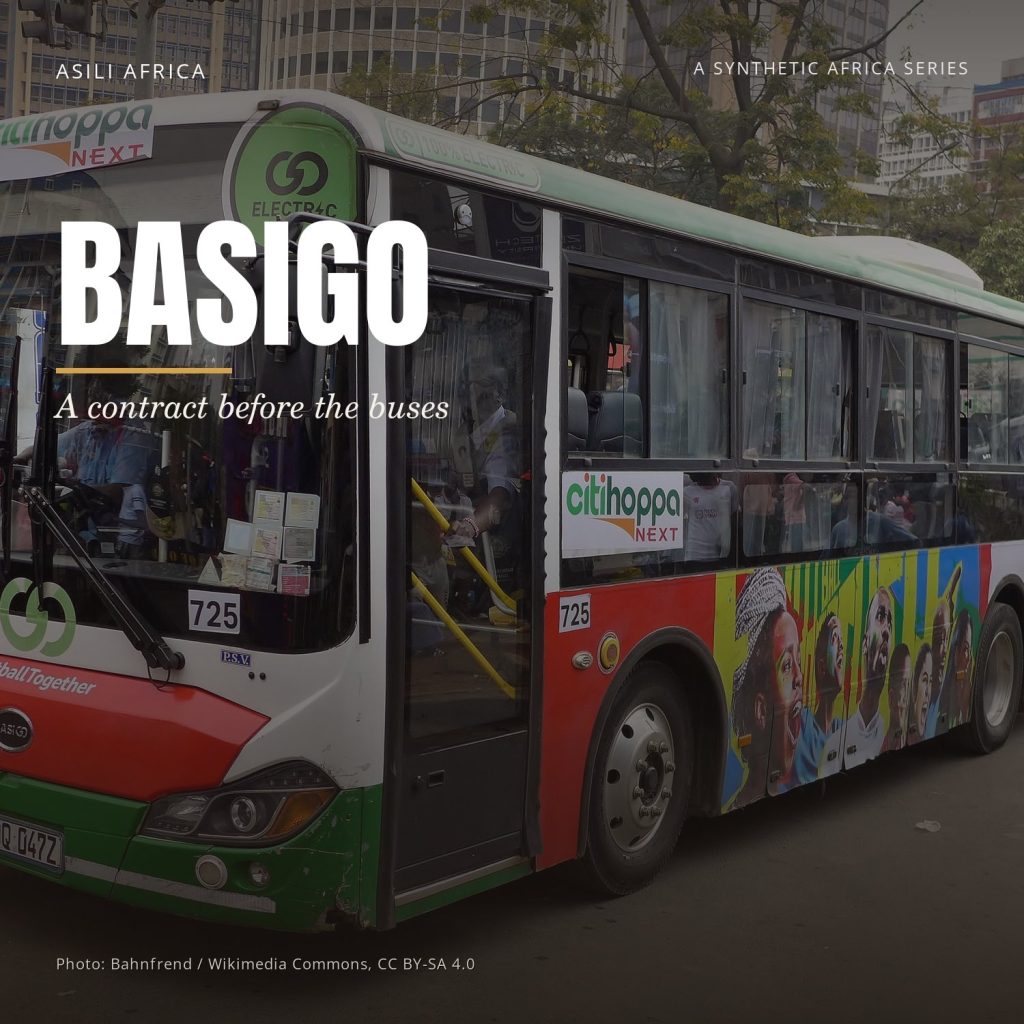
The BasiGo Story: Electric buses on Nairobi’s streets
Sometime in the second week of April, 2020, the people of Nairobi looked up and saw something they had not seen in years.
Kenya was locked down. Public transport had stopped. The matatus — the loud, painted minibuses that move four out of every five Kenyans who travel — were idle in their depots. The diesel buses were parked. And in their absence, the air above the city cleared so completely that, for the first time in living memory, Mount Kenya was visible from the rooftops of the capital. Two hundred kilometres away. A mountain that had been hidden by the city’s own breath.
The photographs went around the country in a day.
One of the people who saw them was a Stanford-trained engineer named Jit Bhattacharya. And what he understood, looking at that mountain, was that the single biggest air-quality lever in urban East Africa was sitting in those diesel depots. It was not a policy problem. It was not an aid project. It was, if you priced it right, a business.
This is the story of BasiGo. A company that does not build buses. Does not own most of its buses. And is, quietly, trying to electrify the way an entire continent moves.
The Idea That the Mountain Made Possible
To understand BasiGo, you have to begin with what was already broken.
By 2020, Nairobi was one of the most polluted capitals in Africa. Roughly two-thirds of Kenya’s energy-sector emissions came from transport. The matatus and the buses that moved most of the country burned imported diesel, ran on tight margins, and could not be regulated out of business because they were also the country’s largest informal employer. Every previous attempt to clean up the fleet had run into the same wall — a diesel matatu cost a certain amount, an electric bus cost roughly twice as much, and no operator with a daily revenue dependency was going to absorb that difference for an ESG outcome they would not see on their balance sheet.
Multiple electric bus pilots had been tried in East Africa before 2020. Almost all of them had the same shape. An NGO or a development agency would fund a single vehicle. A municipality would accept it. The bus would run a demonstration route for a year. Then the battery would degrade, the spare parts would not arrive, the depot would not have a charger, and the bus would be quietly parked. The story was always the same. The technology worked. The economics did not.
The man who would change that was not, on paper, an obvious Nairobi founder.
Jit Bhattacharya was Indian-American. He had a mechanical engineering degree from Stanford and an MBA from the Haas School of Business at the University of California, Berkeley. He had spent the previous decade in Silicon Valley electric-vehicle work — first as chief executive of Mission Motors, a Bay Area electric motorcycle and powertrain company, then inside Apple’s Special Projects Group, the secretive division behind what the world would later learn was the Apple Car. He was, in other words, a climate-tech engineer at the absolute centre of where global EV capital was being deployed.
And by 2020 he had relocated to Kenya.
The reasoning he has repeated, in interview after interview, is structural. The demand side of the global energy transition is largest in the places where the existing fleet is dirtiest and grows fastest — which is to say, the Global South. Silicon Valley was building EVs for people who already had cars. The much bigger market was for people who had never owned a car and never would, but who rode a diesel bus to work every morning and would ride an electric one instead the moment the numbers made sense.
The second founder did not have the same résumé, and that was the point.
Jonathan Green came from East African transport-operator finance. He had spent years close enough to the fleet economics of Kenyan PSV operators to understand, in granular detail, why every previous pilot had failed. The bus was not the problem. The contract was. An operator who could afford KES 9,000 a day in diesel could not afford the upfront capital cost of an electric bus — but if you let the operator pay per kilometre, in the same way they were already paying for diesel, the equation reversed.
What Green designed, with Bhattacharya, was the piece that made the company possible. They called it Pay-As-You-Drive. The operator would put down a deposit comparable to a diesel bus down-payment. The operator would then pay BasiGo twenty Kenyan shillings — about seventeen US cents — for every kilometre the bus drove. That kilometre fee bundled the battery lease, the charging at BasiGo’s own depots, comprehensive maintenance, roadside assistance, and insurance. BasiGo would hold the battery on its own balance sheet. BasiGo would guarantee ninety percent uptime.
The capex problem became an opex problem.
In 2021, with this model on paper and a small pre-seed cheque from a Nairobi venture firm called Novastar Ventures, Jit Bhattacharya and Jonathan Green incorporated BasiGo Kenya Limited. The product, on day one, was a contract. The hardware to attach to that contract — the actual buses — would have to come from somewhere else.
Three Doors That Were All Locked
In 2021, before BasiGo had a single bus on the road, the company had three problems and no clear right to solve any of them.
The first was the operators. Kenya’s PSV industry runs on SACCOs — Savings and Credit Cooperative Organisations that pool the assets of dozens or hundreds of small owners under a single route licence. Matatu and bus SACCOs are not, as a rule, friendly to outsiders. They have been disrupted by promises before. The original pitch to a SACCO chairman in late 2021 was a difficult one. Trust us. We are a startup. We do not yet own a bus. We will sell you a vehicle whose technology you have never operated, on a contract that creates a permanent dependency on us, and we will be around in five years to honour it. Probably.
The second was the electricity. In 2021, Kenya did not have an e-mobility tariff. Charging a bus at standard commercial rates would have made the entire PAYD calculation collapse. The kilometre price was a function of the electricity price, and the electricity price, as it stood, was wrong. BasiGo had to lobby the Energy and Petroleum Regulatory Authority — EPRA — and Kenya Power, for a dedicated tariff that would let buses charge cheaply overnight, when the country’s geothermal and hydro generation was producing power the grid did not otherwise need. That fight took roughly eighteen months. The first months of BasiGo were, in significant part, a regulatory campaign run by engineers.
The third problem was the most quietly fatal. Nobody in Kenya knew how to service a BYD electric bus.
The vehicles themselves were going to be Chinese. BYD — the Shenzhen-based manufacturer that, by 2024, would overtake Tesla as the world’s largest electric-vehicle company — made a 25-seater model called the K6, with a 250-kilometre range and a four-hour recharge cycle. It was the right bus for the route lengths BasiGo had in mind. But Kenyan PSV mechanics had spent their careers under diesel chassis. The skill base for a sealed lithium-iron-phosphate battery pack and a regenerative-braking control unit did not exist outside of Shenzhen. BasiGo would have to internalise every aspect of maintenance itself.
That third problem turned out to be a feature, not a bug. The reason maintenance ended up bundled into Pay-As-You-Drive was not that the founders had read a Harvard Business School case on outcome-based pricing. It was that there was nobody else to do it. The product Jonathan Green had designed on paper became, in execution, the only one BasiGo could have built.
On the ninth of March, 2022, almost exactly two years after Mount Kenya had reappeared over Nairobi, BasiGo launched its first electric public service vehicle. The event was at the Kenya International Conference Centre in the centre of the city. The bus was a single BYD K6, painted in green and white. The pilot partners were two Kenyan operators who had agreed to take the early risk — Citi Hoppa, on the central business district to Jomo Kenyatta International Airport route, and East Shuttle, on the Eastlands routes that carry the city’s lower-income commuters into work each morning.
One bus. Two operators. The smallest possible commercial pilot the company could legitimately run.
In November of the same year, BasiGo closed a six-point-six million dollar seed round. The investors were Novastar Ventures, the Mobility 54 fund affiliated with Toyota Tsusho, the Susquehanna Foundation, Moxxie Ventures, and Trucks VC. The first capital was on the balance sheet. The contract had survived first contact with a customer. The bus was on the road.
Six months later, in May of 2023, EPRA published the e-mobility tariff. Sixteen Kenyan shillings per kilowatt-hour at peak. Eight at off-peak. The economics that PAYD had been promising for two years became, that month, mathematically defensible. BasiGo connected the first dedicated charging station to the new tariff in the same month.
The bus that had launched at KICC the year before was no longer a demonstration. It was the beginning of a fleet.
From Importer to Industrial Policy Artifact
Between the middle of 2023 and the middle of 2024, BasiGo stopped being a pilot and became something the Kenyan state could put on a poster.
In August 2023, the company introduced a second vehicle — the E9 Kubwa, a 36-seater nine-metre bus designed specifically for Kenyan PSV operating conditions. Kubwa is Swahili for “big.” The name was deliberate. The K6 was a starter vehicle. The Kubwa was for the routes where the SACCOs made real money — longer hauls, higher passenger throughput, the spine of the Nairobi commuter system.
In November of the same year, British International Investment — the UK government’s development finance institution — committed an initial seven-and-a-half-million-dollar debt facility. Development finance was, in this period, the only credit window willing to lend against an EV financing platform in East Africa at the rates the unit economics could sustain. Commercial banks would not. The capital stack that BasiGo would carry from this point forward was a hybrid — equity from venture firms, debt from development finance institutions, customer deposits from SACCOs — and that hybrid would shape every subsequent round.
In December 2023, BasiGo crossed its first border.
The Rwanda launch was anchored by three local operators — Kigali Bus Service, Royal Express, and Volcano Express — and seeded with one-and-a-half million dollars earmarked specifically for the rollout. Rwanda was, structurally, a softer entry market than Kenya. The Kigali public transport system was more centralised, the regulatory environment was less fragmented, and the government had explicit climate commitments that made an EV partner politically attractive. The Rwanda business would, in retrospect, become the proof that PAYD travelled — that the contract Jonathan Green had designed for the Kenyan matatu sector was not country-specific.
But the moment that changed how the company was perceived inside Kenya was four months later.
In April 2024, the first dedicated electric bus assembly line in Kenya — and, for that matter, in the East African region — opened at the Kenya Vehicle Manufacturers plant in Thika. KVM had been assembling diesel vehicles since the 1970s. The new line, built under a roughly twenty-seven-million-dollar capital partnership with BasiGo, would receive Complete Knocked Down kits from BYD, ship them by container from Mombasa, and assemble the E9 Kubwa on Kenyan soil with Kenyan workers.
The Cabinet Secretary for Investments, Trade and Industry, Rebecca Miano, inaugurated the line. The first locally assembled Kubwa buses were delivered to Citi Hoppa and to Super Metro — two of the largest PSV operators in Nairobi — within weeks. The press coverage was, by Kenyan standards, enormous. The narrative was no longer that a Silicon Valley engineer had imported a Chinese bus. It was that Kenya had its first electric bus assembly line, that the line was being expanded, and that the partnership had the explicit backing of the Cabinet.
The same month, the company closed a follow-on equity round of three million dollars to bridge to a larger raise. The runway was clear. The Series A was being prepared.
In October 2024, it closed.
Forty-one and a half million dollars. Twenty-four million in equity led by Africa50 — the pan-African infrastructure investor anchored by the African Development Bank — alongside Novastar Ventures, CFAO Kenya, Mobility 54, SBI Investment, the Susquehanna Foundation, Trucks VC, and Moxxie Ventures. Seventeen and a half million in debt — including ten million from the United States International Development Finance Corporation, the DFC, whose participation implied that the company had cleared US-government commercial and ESG diligence at the level normally reserved for sovereign-backed infrastructure.
Total capital raised across all rounds, by the end of 2024, was approaching one hundred million dollars.
The contract Jonathan Green had sketched on a notebook in 2020 was, by the end of 2024, the underwriting case for a hundred-million-dollar climate-tech infrastructure platform.
What the Numbers Will and Will Not Say
By the middle of 2025, the company’s operating story was clean. In August, BasiGo delivered its hundredth electric bus. The fleet was running in Nairobi, in Kigali, and on selected routes in Nyeri, Nakuru, Meru, and Nanyuki. The charging depots — Buruburu, Komarock, Taj Mall, Riruta, and the others that followed — were operating. The off-peak tariff was holding. The unit economics that PAYD had promised were, finally, observable in the field.
The next month, the company announced something that read, at first, as a footnote. KVM in Thika would begin assembling a second vehicle alongside the BYD K6 and the E9 Kubwa — the King Long, a nine-metre electric bus from another major Chinese manufacturer. The line was no longer single-vendor. The supply chain had been deliberately diversified, which was an admission, in the polite vocabulary of corporate communications, that no single Chinese partner could be allowed to become the single point of failure for the East African electric bus industry.
By November 2025, the fleet was 114 buses. By May 2026, it was 134. Roughly twenty thousand Kenyans were riding a BasiGo bus to work each day.
Those are the numbers that the company will quote.
The numbers it will not quote — because they are uncomfortable — are these. The original public target had been one thousand buses on Kenya’s roads by the end of 2025. At the end of 2025, the number was 114. The target has been quietly rolled forward to 2027. The single best piece of journalism on this question — TechCabal’s September 2025 piece by an Accra-based correspondent — established that the bottleneck is not demand. Reservations are over a thousand. The bottleneck is supply, capital, and the time it takes to commission a charging depot.
There are two further honest questions that any episode of this kind has to put on the table.
The first is the China question. The buses are BYD and King Long. The chassis design, the battery chemistry, the motor controllers, the regenerative-braking firmware — these are Chinese intellectual property, assembled in Thika under licence. A sympathetic but unambiguous analysis published in May 2024 by the China-Global South Project framed BasiGo, accurately, as Chinese EV technology in Kenyan mass transport. The Kenyan state would prefer the framing to emphasise local assembly and green-tech jobs. The company would prefer the framing to emphasise that the local value-add is the financing platform, the charging network, and the service contract — none of which exist in Shenzhen. Both framings are defensible. A skeptic would call BasiGo a sophisticated BYD dealer with a software layer. A founder would call it the only feasible path to electrification in a market that does not have its own automotive manufacturing base. Both are correct.
The second question is competition. There is one serious one. A Swedish-Kenyan company called Roam Motors — formerly Opibus — designs and builds its electric buses in Nairobi, rather than importing from China, and targets larger SACCO fleets through a more conventional financing model. Roam is, today, a different product for a different customer. But if “Made in Kenya” becomes the procurement criterion that governments use, Roam’s narrative position is structurally stronger than BasiGo’s, and BasiGo’s response cannot be Chinese hardware. The response will have to be the depth of the service platform, the breadth of the charging network, and the operating data that no competitor has.
By May 2026, BasiGo has 134 buses, around 100 million dollars in capital, around 250 employees, two countries, and a target it has already missed once.
What it does next is the rest of the story.
Three Bets, One Window
The company that Jit Bhattacharya and Jonathan Green will hand over to whoever comes next will be defined, more than by anything else, by three decisions taken in the first six months of 2026.
The first is the matatu. In April 2026, BasiGo began local assembly of an electric van — the Ma3e — at Associated Vehicle Assemblers in Mombasa. The target is 120 units by the end of 2026. The matatu segment is the much larger market. There are roughly twenty thousand PSV buses in Kenya. There are more than one hundred thousand matatus. If PAYD works on the van as well as it has worked on the bus, the addressable market multiplies by five. If it does not — because matatu economics are more fragmented, more cash-flow sensitive, more politically contested — then the company’s growth ceiling is the bus segment, which is smaller than the venture math requires.
The second is intercity. In March 2026, BasiGo opened Rwanda’s first intercity DC fast-charging station, at Muhanga, 240 kilowatts. The company has announced planning for fast-charging buildout along the Nairobi-Mombasa and Nairobi-Nakuru corridors. Intercity is technically harder — the range demands are different, the dwell times are different, the operator economics are different — and it is, at the moment, almost completely unserved by EV infrastructure anywhere in East Africa.
The third is the most strategically delicate. In February 2026, BasiGo began testing scheduled fixed-route commuter service in Nairobi — a BasiGo-branded, BasiGo-operated route, with a published timetable and a designated stop. This is a step from supplying buses to operating them. It changes the unit economics, because the company would capture the fare revenue as well as the kilometre fee. And it puts BasiGo, for the first time, in potential direct competition with the SACCOs that are also its customers. How this experiment is managed will define what kind of company BasiGo is in five years.
Beyond Kenya and Rwanda, the public roadmap names Nigeria and Tanzania as next markets. There are no commercial commitments yet. There is one window — call it three years — in which BasiGo can either prove that PAYD is the dominant model for African public transport electrification, or watch it be replicated, refined, and underpriced by a competitor with a stronger hardware story, a stronger sovereign story, or both.
The mountain came back, in April of 2020, for ten days. The bet of this company is that it does not have to take a lockdown to bring it back permanently.
Every empire has an origin.
BasiGo’s was a photograph of a mountain. Two founders at a kitchen table. A contract written before the buses existed. A bet that Kenya’s matatu owners — written off by global capital as too informal to electrify — would pay for clean transport if you priced it the way they already paid for diesel.
They did.
And the air, for a while now, has been a little easier to breathe.
This is Asili Africa.
Key Takeaways
- The Idea That the Mountain Made Possible. To understand BasiGo, you have to begin with what was already broken.
- From Importer to Industrial Policy Artifact. Between the middle of 2023 and the middle of 2024, BasiGo stopped being a pilot and became something the Kenyan state could put on a poster.
- What the Numbers Will and Will Not Say. By the middle of 2025, the company’s operating story was clean.
- Three Bets, One Window. The company that Jit Bhattacharya and Jonathan Green will hand over to whoever comes next will be defined, more than by anything else, by three decisions taken in the first six months of 2026.
Also available on YouTube — search “Asili Africa” or subscribe to our channel.