
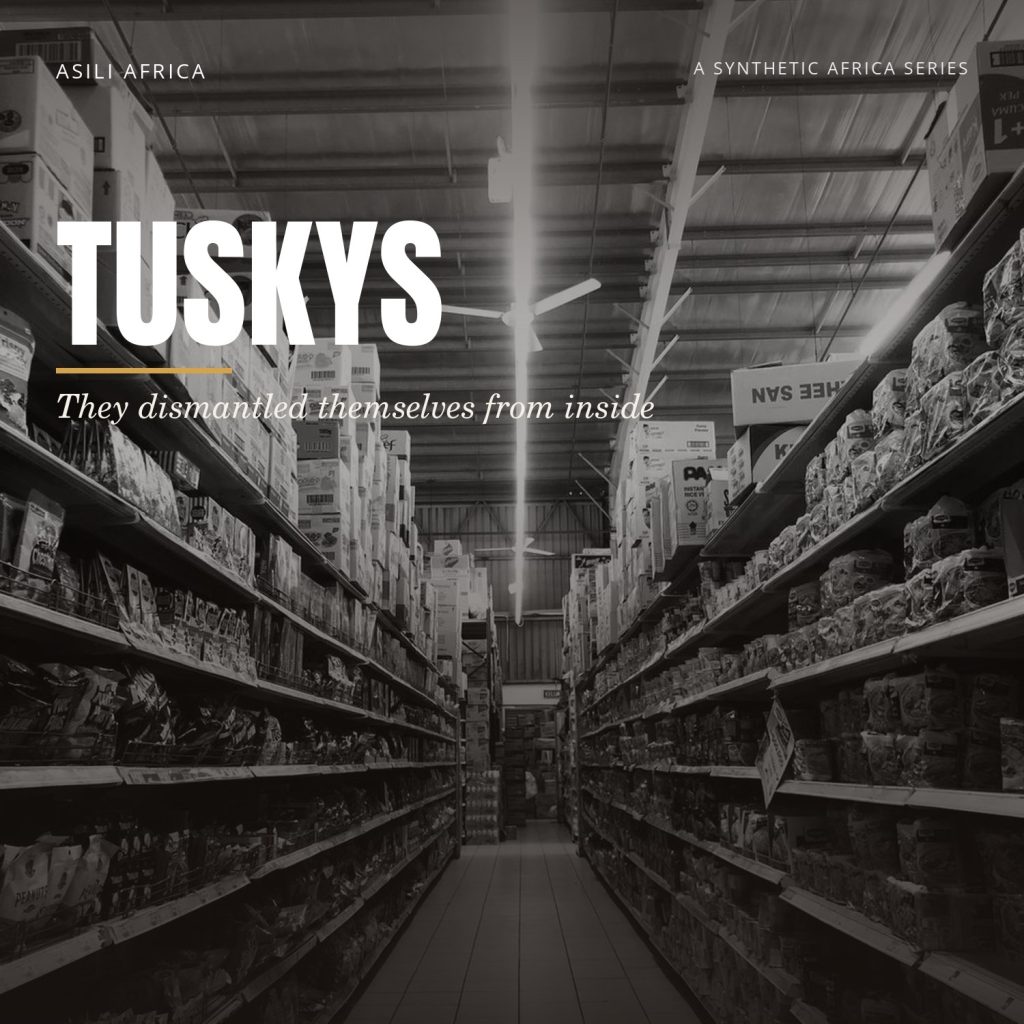
The Tuskys Story: They dismantled themselves from inside
In the second half of twenty twenty, a group of about twenty young men and women arrive at an office building in Embakasi, an industrial district on the eastern edge of Nairobi.
They ride the lift to an upper floor.
They are here for the office of the chief executive of Kenya’s second largest supermarket chain.
He is not a member of their family. He was hired from outside the company five years earlier, specifically to arbitrate a paralysis their parents and aunts and uncles could not resolve on their own.
The young men and women asking him to leave are the grandchildren of the man who founded the company. There are about twenty of them.
They physically escort him from the building.
Their fathers and aunts and uncles, sitting on the board of the company the chief executive is meant to be running, publicly disown the action. The chief executive leaves anyway.
The company is Tuskys. In nineteen eighty eight it opened as a single mattress shop on Mfangano Street in central Nairobi. At its peak thirty years later, it runs about sixty stores across Kenya and Uganda. Six thousand people work in the Kenyan stores. Another hundred and fifty work in three Kampala outlets. In the trade press of the day, it is Kenya’s second largest supermarket chain by branch count.
Three years after the scene in the Embakasi office, on the thirty first of May twenty twenty three, a High Court judge in Nairobi will order the whole company liquidated.
Debts of nineteen point six billion Kenyan shillings against assets of about six billion. Thirty five years after the mattress shop opened.
That court order is the collapse. It is not the beginning of the story. It is not even the middle.
It is the end of a slide that a sitting director of the company had already put on the public record, in a court filing about something else, three years before the first insolvency petition was filed.
This is the story of a company that failed slowly, and in writing, and in front of witnesses. And of the machinery meant to catch that failure, which was owned every step of the way by the people the machinery was meant to catch.
THREE MEN IN NAKURU
To find where Tuskys begins, go to a mid sized town in Kenya’s Rift Valley called Nakuru, in the years before nineteen eighty eight.
There are three men on that street. They are not partners. They are not officially connected.
But the businesses they build over the next thirty years will together become the three largest family owned supermarket chains in Kenya.
The first man is Joram Kamau. He runs a small shop in a town called Rongai, on the road out of Nakuru.
The second is Kamau’s own brother, Peter Mukuha Kago. When Kamau eventually leaves for Nairobi, Kago will inherit the Rongai shop.
The third is Mangalal Shah. Shah runs a shop across the street called Nakuru Mattresses. He sells Kamau near expiry stock on generous credit.
The credit relationship is the founding fact of what comes next. A rival across the street extends the working capital that lets a competitor open a shop of his own in the capital. Not out of charity. Out of the ordinary logic of a trading street where inventory that will not sell on Monday is inventory nobody makes money on by Friday.
In nineteen eighty eight, Joram Kamau uses Shah’s credit line to open his own shop in Nairobi. The name over the door is Tusker Mattresses. The address is Mfangano Street, in the central business district.
Over the first half of the nineteen nineties, the mattress shop broadens into general goods. It becomes a self service store. Then it becomes a chain.
By the end of the decade, the sign above the door in Nairobi is being changed. The shortened name Tuskys goes up.
In two thousand and two, Joram Kamau dies. He leaves what has grown into an eight store chain to his seven surviving children. There is no will that anyone contests. There is no external partner to buy anyone out. There are seven siblings, and eight stores, and a company that has never had anybody but a Kamau on its cap table.
His brother, Peter Mukuha Kago, is still running the Rongai shop the family started with. Under his sons it will grow into another supermarket chain. The name that chain will trade under is Naivas.
Mangalal Shah’s mattress trade will also grow into a supermarket chain. It will call itself Nakumatt.
Three men. One trading circle. One town. The three largest family owned supermarket chains Kenya will ever have all trace back to this one street corner.
Their founding stories interlock, and it is a fact worth knowing before the family Tuskys inherits gets asked to run one.
THE MACHINERY
The seven surviving children of Joram Kamau inherit the eight store chain. On his death in two thousand and two, they begin to run it together, in the arrangement families most often use to run a company nobody has ever asked to be run any other way — informally, by consensus, one of them chairing the board, the other six holding the operations between them.
Four of the sons hold roughly seventeen and a half per cent each. The eldest son, one of the sisters, and the estate of another sister hold roughly ten per cent each. No block has a majority. No block has a controlling stake. Any decision that matters needs a majority of them.
For the first seven years, the arrangement runs. The chairman chairs. The managing director manages. The other siblings hold operating portfolios. The company grows.
In two thousand and nine, the family formalises the arrangement. They form a holding company. They call it Orakam Holdings.
Orakam is the first appearance of what looks like institutional discipline. A named vehicle. A cap table. A structure. A step, on paper, from a family business to a governed one.
On paper, the company now has a governance.
Underneath the holding company, the shareholding does not change. Seven siblings. No outside shareholders. No independent director. No external check. The chairs around the table are the chairs that were around it in two thousand and two. The names on the register are the same names. What has changed is the letterhead.
By the end of the decade, Tuskys is one of the three largest supermarket chains in the country, alongside Nakumatt at the top and, at the mid market end, the state anchored Uchumi.
Turnover is in the billions of shillings a year. The store count is climbing. New branches open at a pace the trade press keeps up with more than it questions.
None of it is audited for public disclosure. The company is one hundred per cent family owned, and it has never been listed on any stock exchange. The people who know what the accounts say are the seven people who own it, and the outside auditor they retain to sign the books.
The shop floor mechanism works. Suppliers deliver. Shelves are stocked. Customers pay at the counter.
Trade runs.
But the mechanism the shop floor runs on is not the mechanism Orakam Holdings was set up to install. Orakam is a governance structure. What it will be asked to do, in the years directly ahead, is arbitrate between the seven people who sit around this table. And it will find that it cannot.
THE STALL
In December, two thousand and eleven, one of the seven siblings — a director named Yusuf Mugweru — accuses two of his brothers of moving one point six billion shillings out of the company.
The two brothers he names are Stephen Mukuha, the managing director, and George Gachwe. The financial director, a man named Frank Kamau, is named alongside them.
The allegation is specific. The money has been moved, he says, through five subsidiary companies registered without a board resolution. Alleged, at that stage. Not proven.
The dispute enters the courts. It stays there for years.
In two thousand and fifteen, the family tries to solve their own paralysis from outside. They hire a chief executive.
His name is Daniel Githua. He comes in from a Kenyan financial services company. He is not a member of the family.
The chairman of the board — John Kago, the eldest son of the founder — unveils the appointment publicly. It is the first outside management the company has ever had.
One of the seven siblings opposes the appointment immediately. Yusuf Mugweru. The same brother who had filed the diversion allegation four years earlier.
In two thousand and sixteen, the one point six billion shilling matter is closed. Not adjudicated. Settled.
The settlement re-characterises the disputed sum. It is no longer described as a diversion. It is described as a shareholder loan, from the company to the two accused brothers.
No criminal conviction is recorded. No money is returned. The brothers accused of moving the money are the brothers who sign the loan.
In the same period, two of the brothers meet in person at the company headquarters to argue over the demand to produce the company’s books.
The meeting ends, per the accusing brother’s own account, in violence. The managing director is charged with assault of his sibling.
Some months later, the founder’s grandchildren arrive at the outside chief executive’s office for the first time. They accuse him of concealing his ownership of an outsourcing firm the company uses to hire staff.
They eject him from the office.
The board investigates. It clears him. Two months later he is reinstated.
By the end of two thousand and sixteen, the company has installed four different mechanisms to catch its own drift. A holding company. An outside chief executive. A civil case over the one point six billion shillings. A criminal complaint over an assault between directors.
Every one of the four mechanisms has, by the end of the same year, been undone by the same family that installed it. The holding company sits over an unchanged seven way shareholding. The outside chief executive has been ejected and reinstated. The civil case has closed by relabelling the money as a loan. The criminal complaint has moved without conviction.
Every mechanism installed. Every one dismantled by the people it was installed to constrain. That is the pattern the next act inherits.
THE SENTENCE
In two thousand and seventeen, Yusuf Mugweru takes the case outside the family for the first time.
He files a formal complaint with ICPAK, the Institute of Certified Public Accountants of Kenya. The accountants’ regulator.
The complaint names the company’s outside auditor. It names Deloitte.
The allegation is that Deloitte concealed the unauthorised registration of five subsidiaries — the same five the accusing brother had named in twenty eleven, the ones the alleged one point six billion had moved through.
ICPAK opens an inquiry. It asks the complainant to supply the supporting documents. This is the external channel — the professional body, the audit oversight, the process that sits outside the boardroom and does not need a family majority to move.
The documents do not come.
The inquiry stalls. The regulator waits. The complainant, who is a sitting director of the company he is complaining about, and who has personal custody of the papers his own case needs, does not file them.
Nothing moves.
In November of the same year, a very different set of talks begins in a Nairobi boardroom.
Tuskys enters merger discussions with the collapsing rival supermarket chain Nakumatt. If the deal closes it will create one of East Africa’s largest retail groups.
It is a rescue. Nakumatt is already visibly failing. And, as this episode has already said, the founding families of the two chains come from the same street corner in Nakuru.
Yusuf Mugweru opposes the merger. Publicly, and in a sworn court filing.
Buried inside that filing, opposing an entirely different transaction, comes a sentence.
Tuskys, the director writes, has not turned a profit since twenty twelve.
The company he sits on the board of, and has sat on the board of throughout, has by his own testimony been unprofitable for five years by the time he writes those words.
The merger falls through. In April of twenty eighteen, Tuskys withdraws from the deal, publicly citing disagreement with the administrator’s creditor proposals. The rescue that had been proposed as a merger is now off the table.
Nothing else changes. The directors continue to draw their salaries. The stores continue to open. New branches are announced in the trade press with the language of a growing chain. The sentence sits on the public record and is, for the next three years, effectively unread.
THE COLLAPSE
By the late two thousand and tens, Tuskys is paying its suppliers late. On some accounts it is paying on terms of a hundred and fifty days, against a market norm of thirty to forty five.
The company is funding its expansion with money it has not earned yet. Money it owes to the manufacturers who supply its shelves.
The pattern has a name. Overtrading. It is the same pattern that killed Nakumatt. In a company that has been unprofitable, by its own director’s testimony, since twenty twelve, it is what the second half of the twenty tens finances.
Suppliers who deliver on Monday are told the invoice will be paid in five months. Some of them stop delivering. Others accept the terms because losing a supermarket account is worse than being paid late.
In May of twenty twenty, salary payments to staff begin to stop.
Some of the staff who are not being paid have worked for the company for years.
Some of them are trusted with cash handling and loss prevention. Some of them, unpaid for months, begin to take cash and stock in order to survive.
Security cameras in some branches are switched off. The company that runs the guarding has itself not been paid, and has stopped.
In some branches the electricity is disconnected over unpaid bills. Generators are wheeled in as a substitute.
In August of twenty twenty, an appliance manufacturer named Hotpoint Appliances files an insolvency petition against Tuskys in the Kenyan courts.
The petition documents debts of two hundred and forty eight million shillings. Some of them date to twenty sixteen. Suppliers, in other words, had been unpaid for four years.
Two more suppliers file petitions of their own. Rositalia Limited. Syndicate Agencies Limited.
In November of twenty twenty, Tuskys is placed under administration. A court appointed administrator takes charge.
The store count begins to fall. Sixty four stores at the moment of collapse.
Then fifty. Then thirty. Then twenty.
By January of twenty twenty one, six months after the first insolvency petition, the count is five. From sixty four to five in half a year.
In February of twenty twenty one, reporting puts the company’s own account balance at about three hundred and seventy four thousand United States dollars. A fraction of one month’s revenue for a business that once turned over billions of shillings a year.
By December, court filings will place the total debt at nineteen point six billion shillings. From an asset base assessed at about six billion. Of the money owed to unsecured creditors, the court concludes at most about a third is recoverable.
Staff have gone months without pay.
Reporting from the same period says the four operating directors are drawing salaries of more than five hundred thousand shillings a month each. And, per the same reporting, dividends. In the same weeks a supermarket cashier is being told, again, that her month’s wages are late.
The cashier takes cash from the till. The stock taker takes stock. The guarding company sends its guards home, because the guarding company has not been paid either.
In the same period, the founder’s grandchildren return to the office of the outside chief executive. There are about twenty of them.
This time, no board investigation reinstates him. The chairman, John Kago, publicly disowns his own children’s action. It does not matter. The outside chief executive leaves. The last mechanism the family had installed to arbitrate itself is now gone.
In February of twenty twenty two, one of the seven siblings — the managing director, Stephen Mukuha — dies in a Nairobi hospital, aged sixty four, after a month in a coma following surgery on a brain tumour.
And on the thirty first of May twenty twenty three, in the High Court in Nairobi, Justice David Majanja orders Tuskys liquidated.
Assets of about six billion shillings. Liabilities of about twenty billion. Debts of nineteen point six billion at the ruling. An asset base that, per the court’s own reading, could never cover a liability pile more than three times its size.
Restructuring efforts had failed. A proposed two point one billion strategic investment. A nine hundred and eleven million shilling property sale. The court found all of it insufficient.
Thirty five years after the mattress shop opened, a formal order.
WHAT REMAINS
The liquidation, ordered in twenty twenty three, does not close the story. It opens a slower one.
The real estate that the sixty odd Tuskys stores had occupied is quickly taken over by other chains.
Naivas takes over the anchor tenancies at Greenspan Mall in Donholm and at Juja City Mall. Quickmart takes T-Mall on Lang’ata Road. Carrefour absorbs others.
The largest single winner is Naivas. The chain founded by Joram Kamau’s own brother, from the same Rongai shop the story started at.
Even after the main liquidation, individual Tuskys properties remain in dispute. Diamond Trust Bank pursues the former Athi River branch under a separate three hundred and twenty million shilling secured loan.
That auction is still being advertised in January of twenty twenty five. The winding up runs piecemeal, one property at a time.
The stores that had carried the Tuskys name are now carrying other names. The physical infrastructure persists. The nameplates change.
New tills. New uniforms. Same catchment. In the trade press, the coverage is of a market consolidating. In the accounts of the incoming chains, it is real estate acquired at a discount to what it would have cost to build.
Six thousand people worked in the Kenyan stores at the peak. Another hundred and fifty worked in three Uganda outlets.
The record does not name them. Not one of the six thousand people who stocked the shelves, ran the tills, guarded the back rooms and swept the floors appears in the sourced accounts of the collapse as an individual, with a name and a story of their own.
They appear as a collective count. As a figure in a court filing. As the group of people the theft-and-guarding paragraphs got written about. What happened to them one by one, after the store they worked in closed, is not in the reporting this research reached.
We looked. That silence is worth naming, and we are not going to fill it with a guess.
Three chains came out of that Nakuru trading circle.
Nakumatt refused outside capital until it was too late, and collapsed in twenty eighteen.
Tuskys refused outside capital twice — the Nakumatt merger, and the outside chief executive, ejected twice by the same family that hired him — and collapsed in twenty twenty three.
Naivas took outside capital in twenty twenty. Majority control passed to a Mauritian conglomerate in twenty twenty three. It is, at the recording of this episode, the largest supermarket chain in the country.
The chain that stayed one hundred per cent family owned right up to the liquidation order is the one that died.
One last date sits on this story. Not a court order. A form.
Former staff of Tuskys have until the thirtieth of September twenty twenty six to file claims against the Tuskys Staff Pension Scheme with the appointed liquidator.
After that date, per the liquidator’s notice, the scheme is to be permanently dissolved. Unclaimed entitlements forfeit. The record does not carry how many people are in that scheme.
In nineteen eighty eight, one mattress shop on Mfangano Street.
In twenty twenty three, a High Court order and a debt of nineteen point six billion shillings.
Between them, thirty five years and a slow, written failure that the machinery meant to catch was owned by the people the machinery was meant to catch. This is Asili Africa. Every empire has an origin. See you on the next one.
Key Takeaways
- THREE MEN IN NAKURU. To find where Tuskys begins, go to a mid sized town in Kenya’s Rift Valley called Nakuru, in the years before nineteen eighty eight.
- THE STALL. In December, two thousand and eleven, one of the seven siblings — a director named Yusuf Mugweru — accuses two of his brothers of moving one point six billion shillings out of the company.
- THE SENTENCE. In two thousand and seventeen, Yusuf Mugweru takes the case outside the family for the first time.
- WHAT REMAINS. The liquidation, ordered in twenty twenty three, does not close the story.
In this series: The Retail Collapse
Who took the shelf space when the chains fell?
Also available on YouTube — search “Asili Africa” or subscribe to our channel.