
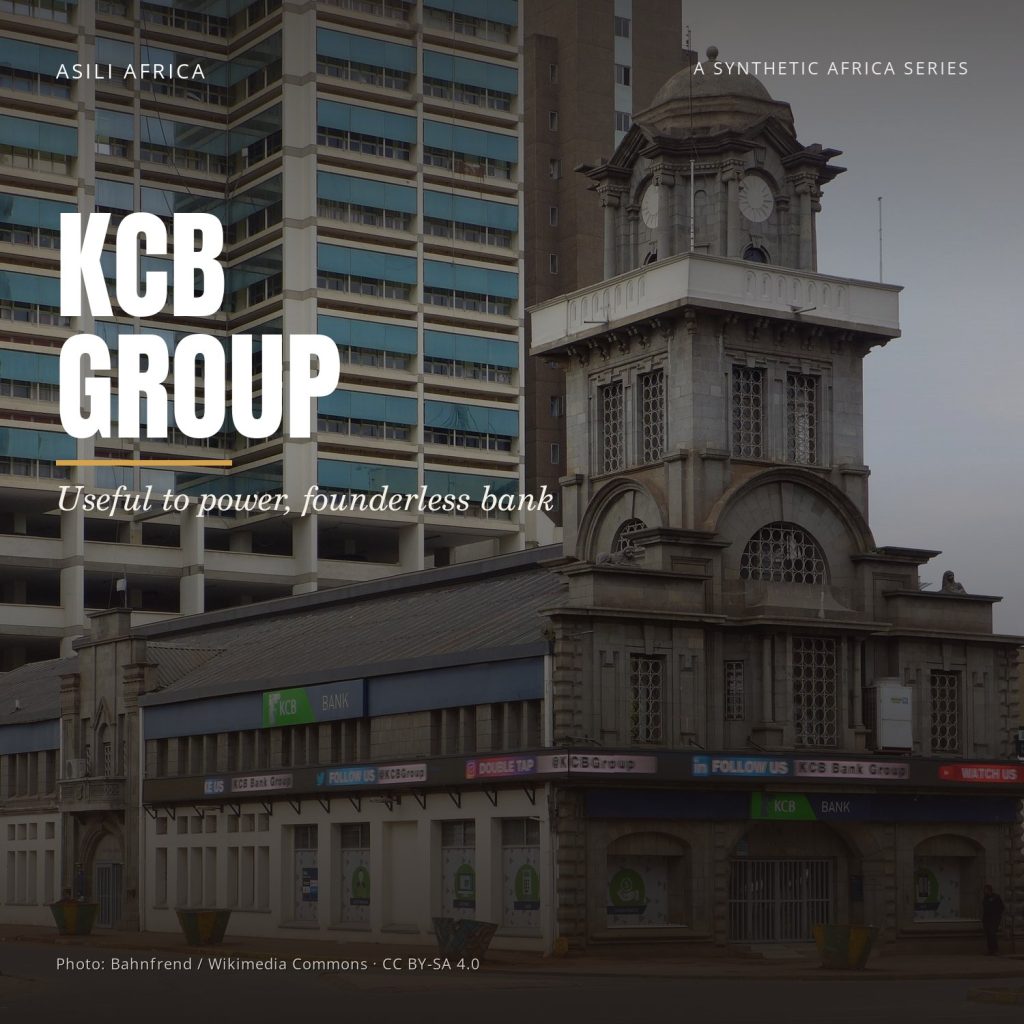
The KCB Group Story: Useful to power, founderless bank
In April, two thousand and three, the chairman of Kenya’s largest bank resigned three days before the annual meeting.
The bank had just posted a loss of more than forty eight million dollars. It was the largest loss in its modern history.
Retrospective accounts describe those losses as coming out of politically directed lending in the final year of the government then in power.
Skip forward, twenty three years.
The same bank has just sold a smaller Kenyan lender it bought in twenty nineteen. The buyer is Nigerian. The price is more than twice what the bank paid six years earlier.
And for the first time in the bank’s one hundred and thirty year history, it pays its shareholders a special dividend.
The largest single shareholder receiving that dividend is the Kenyan state, which is also the state that had put the smaller bank inside this one, six years earlier, in the first place.
This is a bank that has no founder because the state has always played that role. It has grown, for a hundred and thirty years, by being useful to whichever version of the state was in power.
THE BRANCH BEFORE THE COUNTRY
In July, eighteen ninety six, four years before Kenya existed as a British protectorate, a London-headquartered bank called the National Bank of India opened a branch at Moi Avenue in Mombasa.
The reason for the opening was ordinary. The Imperial British East Africa Company had opened up trade routes into the interior. There was a settlement business to be had — imports, wages, shipping bills, cargo receipts — and the bank wanted it.
The Uganda Railway was under construction. It was the largest infrastructure project East Africa had seen, and the freight it would carry needed accounts to sit in.
Eight years later, in nineteen oh four, a second branch opened in a tin shack in Nairobi, driven by the growth of the Indian bazaar and the settler farms beginning to spread across the highlands.
The bank ran on ledgers and clerks. Nairobi in nineteen oh four was still more of a rail depot than a city.
Then, in nineteen oh eight, the National Bank of India signed the agreement that would set the shape of the next century.
It became sole banker to the Uganda Railway. The largest employer and the largest logistical concern in the region banked with one office.
This was the first government relationship in the story. It prefigured everything that came after: a bank whose reason for existing was to be useful to whatever institution ran the country.
Half a century later, in nineteen fifty eight, the National Bank of India merged with Grindlays Bank, a British colonial lender with a heavy Indian and African presence, to form the National and Grindlays Bank.
On the twelfth of December, nineteen sixty three, Kenya became independent. National and Grindlays was the largest commercial bank in the new country.
Nothing about the founding had prepared it for that. It had been a colonial branch office. Independence found it accidentally central.
Seven years later, in nineteen seventy, the newly independent government bought sixty per cent of the bank and split it in two.
The retail and commercial half was renamed. Its new name was Kenya Commercial Bank.
In November, nineteen seventy six, the government bought out the remaining forty per cent from Grindlays of London. Kenya Commercial Bank was fully state-owned.
The rationale, as the Central Bank of Kenya later put it, was to bring banking closer to the majority of Kenyans. The state had inherited a colonial ledger and made it its own.
The bank that had opened to serve the trade the Uganda Railway was about to unlock was now the state’s principal instrument for the settlements, salaries and lending that keep a young country running.
THE STATE’S BANK
For twelve years after nineteen seventy six, Kenya Commercial Bank was fully owned by the government of Kenya. The largest lender in the country was, in effect, an arm of the Treasury.
It handled public sector deposits. It paid civil servant salaries. It made loans the ministries wanted made.
There was no market pricing on any of it, because there was no meaningful private banking sector to compete with.
Then, in nineteen eighty eight, the government did something the country had not done before. It sold twenty per cent of its shareholding in Kenya Commercial Bank on the Nairobi Stock Exchange.
This was the first privatisation Kenya had ever executed through the exchange. Ordinary Kenyans could buy shares in a state bank. Retail investors did.
Two years later, in nineteen ninety, Parliament created the Capital Markets Authority — the regulator for the exchange itself. The KCB share sale had been the demonstration. The regulator followed the demonstration into being.
Meanwhile, some years earlier, a nineteen year old had walked into a Kenya Commercial Bank branch in Nairobi to work as a teller.
The year was nineteen seventy nine. He counted notes, wrote up passbooks, greeted customers. He was there for about a year, and then he left for other things. He does not appear in the corporate record again.
Skip forward, thirteen years.
In two thousand and two, at the end of the twenty four year government of the ruling party, Kenya Commercial Bank posted losses exceeding forty eight million dollars.
Retrospective accounts describe those losses as coming out of politically directed lending in the government’s final year.
The record found does not name the borrowers. It does not name the specific directives. It does not name the executives who approved them.
The single most cited historical fact about the modern bank is not, in the record, specific. What is on the record is that in April, two thousand and three, the chairman, Benjamin Kipkulei, resigned three days before the annual general meeting.
In the same year, the country voted the ruling party out for the first time since independence. A new government arrived at State House.
A new chair of Kenya Commercial Bank was appointed a few weeks later. Her name was Susan Mudhune.
She inherited books that carried the specific losses of the previous era. And she inherited the general problem underneath them: in a country where the state was your largest shareholder, your largest customer and your regulator, the boundary between a commercial decision and a political one had never been a clean line.
The bank’s twelve months from April, two thousand and three began the work of drawing that boundary again.
THE QUIET REPAIR
The bank returned to profit within two years. The books were cleaner. The lending was written to more visible standards. There was no dramatic single event, and none of the reforms took the name of any single reformer.
Under the reformed government, Kenya Commercial Bank began to look outside its own country.
It had, in fact, opened a subsidiary in Tanzania some years earlier — in nineteen ninety seven — but the years after two thousand and three are when the regional footprint became a strategy rather than a single branch.
In two thousand and six, a South Sudan operation was licensed. Later, more than twenty branches were opened there. Also in two thousand and six, an Islamic banking window was launched under the name KCB Sahl, aimed at Muslim customers on the coast and in the north east.
Uganda opened in two thousand and seven. Rwanda in two thousand and nine. Burundi around twenty twelve. The Democratic Republic of the Congo, a decade later.
By the middle of the twenty tens the Group operated across seven East African markets. Every anchor of the East African Community, except Ethiopia.
In twenty thirteen, a new group chief executive was appointed from inside the finance office. His name was Joshua Oigara.
That year, Group net profit was fourteen point three billion shillings. Eight years later, when he handed the role over, it was thirty four point two billion.
In twenty fifteen, the operating bank was placed under a non-operating holding company called KCB Group Plc, listed on the Nairobi Securities Exchange. The bank in Kenya was now one subsidiary among several.
Also in twenty fifteen, a representative office opened in Addis Ababa. Ethiopia was not yet a market a foreign bank could operate in.
Then, in December, twenty fifteen, the government of South Sudan let its pound float. The currency lost more than eighty per cent of its value against the dollar within days.
The Juba subsidiary went from a profit of one point seven eight billion shillings the year before, to a loss of seven hundred and fifty nine million shillings the year of the devaluation.
The Group booked six point one billion shillings of foreign exchange losses that year, largely from South Sudan. It was the largest single market hit in the modern history of the bank.
That is the bank’s loss, measured in shillings. The bank’s South Sudanese customers lost far more. Their losses, in South Sudanese pounds, are not measured in any source we could find.
The Group considered closing the South Sudan branches. It did not. And it did not, in any material way, close the customer side of the accounting either.
Through the same years, the Group was disbursing tens of millions of small mobile loans to millions of customers, through a channel operated with the country’s largest telecom.
What those borrowers paid, how many were listed with the credit reference bureaus, and what recovery looked like for them — none of that is in the public record found for this episode.
At the end of twenty eighteen, the Group had a seven country footprint, a returned-to-profit balance sheet, and one specific silence sitting on top of a very large book of loans.
AN UNDERVALUED BANK
In April, twenty nineteen, KCB Group made a formal offer for National Bank of Kenya.
National Bank of Kenya was a Kenyan bank in its own right. A separate listed lender in which the state was the largest shareholder. It had been distressed for years — problem loans, thin capital, the visible edge of a longer decline.
The offer was structured as a share swap. Ten National Bank of Kenya shares for one KCB share. The implied value came to roughly six billion shillings.
The National Assembly Finance Committee formally opposed the deal.
The committee said the offer undervalued National Bank of Kenya by approximately one third against an independent valuation it had commissioned.
Its preferred remedy was that National Bank of Kenya should be recapitalised through a rights issue instead. That its existing shareholders, including the state, should put fresh money into the bank rather than swap it out at a discount.
The Central Bank of Kenya approved the acquisition anyway.
By the thirtieth of August, twenty nineteen, KCB held eighty seven point seven per cent of National Bank of Kenya by shareholder consent, going to full control shortly after.
Parliament’s objection did not stop the deal. The deal completed on its stated terms. National Bank of Kenya became a subsidiary of KCB, at a price its independent valuer had said was one third too low.
That same year and the next, another matter was working its way toward the courts.
The scandal at the National Youth Service — a state programme through which, over the previous four years, an estimated ten and a half billion shillings had been siphoned through ghost suppliers — had passed, in part, through the country’s commercial banking system.
In March, twenty twenty, the Office of the Director of Public Prosecutions, working with the Central Bank of Kenya, entered into deferred prosecution agreements with five banks.
KCB. Equity. Standard Chartered. Co-operative. Diamond Trust.
The banks were found not to have participated in the underlying theft. They were found to have violated the Proceeds of Crime and Anti-Money Laundering Act — POCAMLA — by failing to detect and report suspicious transactions moving through them.
Total penalties across the five banks: three hundred and eighty five million shillings. KCB’s share was one hundred and forty nine point five million shillings — the largest.
Because the agreement was deferred, no criminal trial of any of the banks followed. This is a documented compliance failure, on the largest single penalty of its class. It is not, in the legal record, a corruption conviction.
In August, twenty twenty one, KCB paid thirty two million dollars in cash for a majority stake in Banque Populaire du Rwanda. Merged with the existing KCB Rwanda operation, the combined bank held eighty seven and a half per cent of the number two lender in that market.
In December, twenty twenty two, KCB completed the acquisition of a Congolese bank called Trust Merchant Bank. One hundred and ten branches across the Democratic Republic of the Congo. A balance sheet of about one and a half billion dollars in assets. KCB paid at a price to book of one point four nine.
The regional map now ran from Dar es Salaam to Kinshasa. And inside Kenya, National Bank of Kenya was still sitting on the balance sheet at the price Parliament had said was wrong.
Then, in May, twenty twenty two, the chief executive who had bought National Bank of Kenya left the role six months before the end of his contract, forfeiting a severance payment reported at one hundred and eighty four and a half million shillings. The reasons were not publicly detailed.
The role passed to Paul Russo, who had, until his appointment, been the managing director of National Bank of Kenya.
He walked into an office in which the bank he had been running was now a subsidiary of the bank he was now running. National Bank of Kenya was still inside KCB. Parliament’s objection to the price was still on the record, and it had not been answered.
THE FLIP
Paul Russo’s first full financial year as chief executive was twenty twenty three. Under him the balance sheet did what the reforms of the previous decade had built for. It grew, quickly, and without a large single event.
Twenty twenty three closed at a net profit of thirty seven and a half billion shillings. Twenty twenty four closed at sixty one point eight billion — up sixty five per cent. Total assets crossed one point nine six trillion shillings. It was the largest single year of profit growth in the Group’s history.
And the regional footprint, four years after Russo took over, was doing what a regional footprint is supposed to do. About a third of the Group’s profits, and a third of its assets, were now coming from outside Kenya.
Then, in March, twenty twenty four, KCB Group and Access Bank Plc of Nigeria signed a binding agreement. Access Bank would acquire one hundred per cent of National Bank of Kenya. From KCB.
Regulators in Kenya and Nigeria both had to clear the transfer. The Kenyan Treasury had to release the state’s shareholding value. The approvals took a year.
On the thirtieth of May, twenty twenty five, the sale closed. Access Bank Plc paid one hundred and nine point six million dollars in cash. Converted to shillings at closing: fourteen point one six billion shillings.
Six years earlier, in twenty nineteen, KCB had paid a share consideration worth roughly six billion shillings for that same bank.
The Nigerian buyer was paying more than two and four tenths times that number.
National Bank of Kenya left the Group balance sheet.
In August, twenty twenty five, the Group’s half year results were released. Net profit for the six months: thirty two point three billion shillings, up eight per cent. Shareholders’ equity: three hundred and six point eight billion, up twenty seven point three per cent.
The board approved a payout of thirteen billion shillings.
Two shillings a share as an interim dividend. Then two shillings a share on top of that, as a special dividend, linked explicitly to the National Bank of Kenya sale.
The first special dividend in the Group’s one hundred and thirty year history.
The National Treasury of Kenya, which holds nineteen point seven six per cent of KCB Group, received its share.
The same Treasury, in twenty nineteen, had controlled the bank that KCB had just been paid a windfall for selling.
The state was on both sides of the trade.
STILL DECIDING
In June, twenty twenty five, one month after the National Bank of Kenya sale closed, KCB opened formal talks with the National Bank of Ethiopia, the regulator, for the right to acquire up to forty per cent of an undisclosed Ethiopian bank.
If it completes, KCB will be the first foreign bank to enter Ethiopia’s newly liberalising banking sector in more than half a century. No foreign lender has been allowed in Ethiopia since the mid-nineteen seventies.
The talks opened. They have not closed.
Then, on an ordinary Sunday in October, twenty twenty five, the bank’s digital systems went down. ATMs. Cards. Mobile banking. Internet banking. USSD. All offline at once, with branches closed for the day.
Complaints filled social media. The Group scheduled recurring maintenance windows and expanded its status page. No public root cause report was published.
The full year results for twenty twenty five landed at sixty eight point four billion shillings of net profit, up eleven per cent. Non-performing loans came down. Total assets crossed the two trillion shilling mark, at two point zero four four trillion. The largest of any bank in East Africa.
On the nineteenth of August, twenty twenty six, the Group launched a Sustainability Bond Framework — a medium term note programme with a headline size of three hundred billion shillings.
One of the largest private sector green finance instruments in East African history. A quarter of the loan book, above the strategic target for the first year, was now classed as green lending. Renewable energy. Clean transport. Climate-smart agriculture.
That is what is recorded. What is not recorded is who this bank actually is, to the people who use it.
KCB has twenty six point eight million customers. In the sources we could find, not one of them is quoted. There are no branch experience reports. No fee schedule analysis. No account of what it is like, in ordinary time, to hold an account there.
The bank employs about twelve thousand people. No cohort of them has a public account either. When National Bank of Kenya was sold in May, twenty twenty five, roughly two thousand employees were moved from a state bank, where they had started, to a listed one, where they had spent the previous six years, and then out to a foreign one. The record does not follow them.
We looked. That silence is worth naming, and we are not going to fill it with a guess.
And one last silence, unhidden. Earlier, in Act Two, a nineteen year old worked as a teller at a Kenya Commercial Bank branch for a year in nineteen seventy nine, and then left for other things.
His name was Uhuru Kenyatta.
Thirty four years later he became president of Kenya. Ten years after that, his Head of Public Service and State House Chief of Staff, Joseph Kinyua, became chairman of KCB Group. A role he still holds.
In a country whose corporate governance debate is largely absent, this pattern goes unremarked. It is worth naming, once, without leading anywhere.
The Ethiopian negotiation is not closed. The Sustainability Bond programme is a framework, not a raise. The customer story is a silence. The employee story is a silence.
A hundred and thirty years after a London-headquartered Indian bank opened a branch office in Mombasa, the institution is still deciding what it wants to be next.
The bank was there before the country. It watched the country arrive. It has been renamed by every government since, and useful to all of them.
A hundred and thirty years in, the largest bank in East Africa is still deciding what it will be for the next government. Ethiopia is open. The twelve thousand people who work there are a headcount, not a story. The twenty six point eight million people who bank there are a number, not a voice. The next chapter is unwritten because the material has run out, and the bank is waiting for whoever comes next to say what needs to be built for.
This is Asili Africa. Every empire has an origin. See you on the next one.
Key Takeaways
- THE BRANCH BEFORE THE COUNTRY. In July, eighteen ninety six, four years before Kenya existed as a British protectorate, a London-headquartered bank called the National Bank of India opened a branch at Moi Avenue in Mombasa.
- THE QUIET REPAIR. The bank returned to profit within two years.
- AN UNDERVALUED BANK. In April, twenty nineteen, KCB Group made a formal offer for National Bank of Kenya.
- STILL DECIDING. In June, twenty twenty five, one month after the National Bank of Kenya sale closed, KCB opened formal talks with the National Bank of Ethiopia, the regulator, for the right to acquire up to forty per cent of an undisclosed Ethiopian bank.
Also available on YouTube — search “Asili Africa” or subscribe to our channel.