
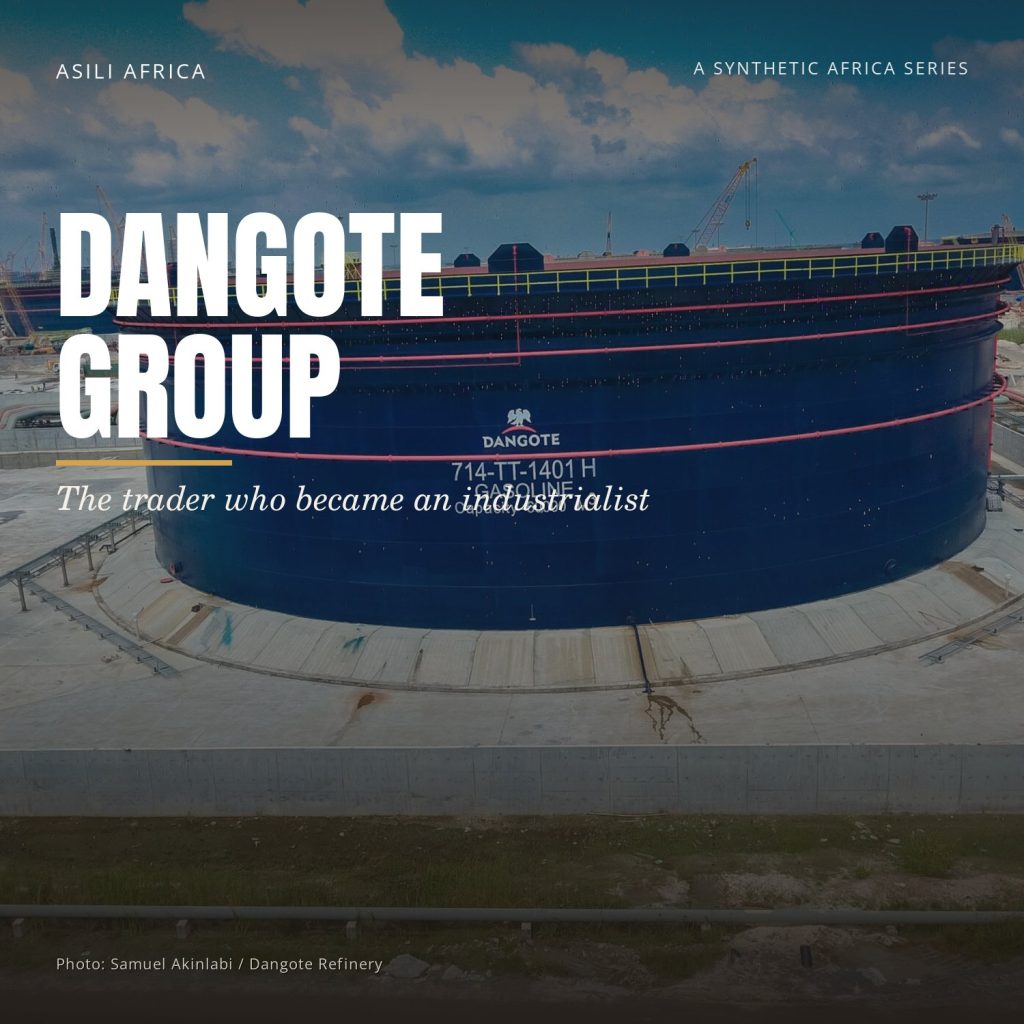
The Dangote Group Story: One man built Africa’s richest fortune from cement
On a humid February night in 2026, on a thirty-five-hundred-hectare patch of coastal Lagos called the Lekki Free Trade Zone, the last unit of the largest single-train oil refinery on Earth came online.
Six hundred and fifty thousand barrels per day. Ten years in the building. Twenty billion US dollars in the spending. And — by the middle of that year — the reason the country it sat in had become a net exporter of petrol for the first time in fifty years.
Nigeria, the nation that for half a century had pumped some of the world’s best crude out of its delta and then bought refined fuel back from Europe at a markup, was now shipping petrol out.
The man who had paid for it was sixty-eight years old. He had been born in Kano, in the north. And he had started, in 1977, with a family loan worth about three thousand US dollars.
This is the story of Dangote Group.
The Boy From Kano
To understand Dangote Group, you have to begin in Kano.
Aliko Dangote was born on the tenth of April, 1957, in Kano — the dust-and-trade capital of Nigeria’s Muslim north. A thousand-year-old caravan city where, long before the British arrived, Hausa merchants had been moving goods between the Atlantic coast and the Sahara.
It is tempting to call Aliko Dangote self-made. It would be technically true, and historically misleading.
His maternal great-grandfather was a man called Alhassan Dantata — a kola-nut, groundnut and cattle trader from the Agalawa clan of long-distance Hausa merchants who, at the time of his death in 1955, was the richest man in West Africa. Alhassan was the first West African trader to use steamships to move goods up and down the coast — Accra, Kumasi, Sekondi, Lagos — which let him cut out the Sahel caravan competition and dominate the soft-commodity trade across what was then British West Africa.
Aliko’s mother, Mariya Sanusi Dantata, was Alhassan’s granddaughter. When she married Mohammed Dangote in the mid-1950s, she did not marry into a story of rags. She united two of northern Nigeria’s most prominent trading houses.
So when, twenty years later, the young Aliko Dangote came home from Cairo with a degree from Al-Azhar University and an idea — and his maternal uncle, Sani Dantata, handed him five hundred thousand naira in seed capital, worth somewhere between three and five thousand US dollars at the time — that loan was not an act of speculation. It was the way the Dantata-Dangote house had always done business with its own. Family capital. Trader to trader. Repaid in three months.
Aliko set up shop in a small warehouse in Kano. He moved rice, sugar, salt and cement out of it, doing what generations of Hausa merchants had done before him. Buying low. Selling high. Watching prices like weather.
But almost immediately, the Nigerian state put weather on his side.
The mid-1970s were Nigeria’s first oil boom. Oil money was flooding into Lagos. The military government of Olusegun Obasanjo was spending it on infrastructure — bridges, ports, military barracks, and the gigantic FESTAC complex in Lagos, built for the Second World Black and African Festival of Arts and Culture in 1977. To feed the construction binge, the government licensed importers — Dangote, and a small number of others — to bring in cement. About sixteen million metric tonnes of it, in what became known as the Cement Armada.
It was the largest single import operation in West African history. Ships waited months in line outside Lagos port for berth space. Some unloaded their cement directly into the lagoon when their charters ran out. And for the importers who had a license, every bag was money.
Dangote had a license.
By the early 1980s — when Dangote Nigeria Limited and a sister company, Blue Star Services, were formally incorporated — the model was clear. Import. Distribute. Dominate. The young Aliko was joined by his brother Sani Dangote, who would be Vice President of the group for the next four decades, and by a tight inner circle of Kano relatives who would run the operation as a single family-disciplined machine.
By the early 1990s, Dangote was Nigeria’s largest sugar trader. He supplied — by his own framing, and most observers’ — somewhere around seventy per cent of every soft-drink bottler in the country, including Coca-Cola Nigeria, and most of the country’s breweries.
It was a quiet, profitable, well-connected empire. Built on a license. Built on a family. And about to meet a decade that would try to take it apart.
The Importer’s Trap
Launching a trading empire is one thing. Keeping one is another. And Dangote spent the second half of the 1980s, and most of the 1990s, discovering exactly how fragile an import-based fortune can be.
The first blow came from inside the Nigerian state itself.
In 1986, under the military government of Ibrahim Babangida, Nigeria entered into the IMF’s Structural Adjustment Programme. The naira was devalued. And then devalued again. And then it was floated. Over the next decade, a currency that had once traded at roughly parity with the US dollar collapsed by a factor of more than twenty.
For Dangote, whose business model was buying goods in dollars overseas and selling them in naira at home, every devaluation was a knife to working capital. Receivables he held in naira lost value while he slept. Invoices priced in dollars came due before his clients had paid. Survival meant rotating inventory faster than the currency could fall, and holding as many hard-currency receivables as he could buy.
He survived it. Many of his competitors did not.
The second blow was political. As a Hausa-Fulani Muslim from Kano operating in a Lagos-dominated commercial economy, Dangote was constantly navigating the unwritten northern-versus-southern faultline of Nigerian business — a faultline made worse by the military coups, civilian transitions and ethnic-regional turbulence of those years. He answered it the only way his family ever had. He built relationships across every regime. Northern. Southern. Civilian. Military. It did not matter. The Dantata-Dangote house had been doing business through warlords, colonisers and central banks for a hundred years before Aliko was born. It would keep doing business through this one.
That posture was not without cost. In 1996, his younger brother Bello Dangote was killed in a private-jet crash near Kano, alongside Ibrahim Abacha, the eldest son of the military dictator Sani Abacha. The family’s proximity to the Abacha regime — the most internationally isolated and notoriously corrupt period of Nigerian rule — would, in later years, become a recurring question raised by critics. No credible evidence has ever tied Aliko personally to Abacha-era looting. But the photograph of those years is the photograph of a family that knew how to be in the room with whoever was in power. That, too, is part of the origin.
The third blow was structural. And it came at the turn of the millennium.
By the late 1990s, the import-license game that had made Dangote rich was running out of road. The trade balance was unsustainable. The political will was shifting. And, in 1999, Olusegun Obasanjo — the same general who had presided over the original Cement Armada twenty-two years earlier — returned, this time as a civilian president, and pulled Dangote into the inner circle of his economic-reform team.
The reform was not, however, going to be friendly to the trader. In 2002, the Obasanjo government launched what it called the Backward Integration Policy — a sweeping ban, over time, on the importation of cement and several other commodities the country could, in theory, produce for itself.
In one stroke, the policy threatened the foundation of the Dangote empire. For twenty-five years, his business had been built on bringing things into Nigeria. Now the government was telling him — and every other importer — that the era of bringing things in was over.
There were two ways to read this announcement. The first was as a catastrophe. The second was as the largest industrial opening in the country’s history.
Dangote read it the second way.
He had, by then, already begun construction on a sugar refinery at Apapa, on the Lagos waterfront — the largest of its kind in sub-Saharan Africa, commissioned in the year 2000. He had begun, in other words, to bet on the manufacturer’s side of the table.
Now the government had just announced that the trader’s side was closing.
The next decade would decide whether he could move fast enough to live on the other side.
The Manufacturer
In 2002, Aliko Dangote made the decision that turned a trading house into an industrial empire. He stopped fighting Backward Integration. He became its biggest beneficiary.
In 2003, Dangote acquired two of the federal government’s struggling cement assets. The first was Benue Cement Company. The second was a partly-built, partly-abandoned plant in Kogi State called Obajana — a project that had stalled under state ownership for years. Dangote bought the controlling interest. The price was a fraction of what it would have cost to build the plant new. And the political timing — a privatisation wave under Obasanjo, an importer turned manufacturer at the front of the policy queue — could not have been better.
Critics would, years later, call this crony capitalism. Defenders would call it the unavoidable shape of African industrialisation. The Kogi State government, under a different governor twenty years on, would attempt to call it something else entirely. But that comes later.
What mattered in 2003 was that Dangote now owned plants. And plants meant he could play a different game.
In 2007, Dangote Sugar Refinery listed on the Nigerian Stock Exchange. The same year, NASCON — Dangote’s salt business — listed too. In 2008, the Obajana plant was commissioned at five million tonnes per annum — at that moment, the largest cement plant anywhere in sub-Saharan Africa.
And on the twenty-sixth of October, 2010, Dangote merged the Obajana, Benue and Gboko plants under a single listed vehicle — Dangote Cement Plc — and floated it on the Nigerian Stock Exchange. Within hours of listing, it became the most valuable stock in Nigeria. It still is. As of 2026, Dangote Cement accounts for roughly one in every eight naira of equity value on the entire Nigerian market.
In 2011, the federal government recognised Aliko Dangote with the GCON — Grand Commander of the Order of the Niger — the country’s second-highest national honour. In 2012, Forbes named him the richest man in Africa, with a net worth of more than thirteen billion US dollars. He was fifty-five years old. The boy from Kano had become a continental figure.
But the company’s defining strategic choice — the choice that would, more than any other, decide whether Dangote Group became a Nigerian giant or something larger — was being made in private at the same time.
In September of 2013, Aliko Dangote stood up in Lagos and announced that his group would build a new project. Not another cement plant. An oil refinery. A single facility on the Lekki coast of Lagos that would, when finished, process six hundred and fifty thousand barrels of crude per day. A nine-billion-dollar bet on the proposition that Nigeria — Africa’s largest oil producer, and one of the world’s most embarrassing fuel importers — could refine its own crude on its own soil at last.
He had three point three billion dollars of initial financing committed. He had no operating experience in oil. He had a deadline of 2016. And he was about to discover that building a refinery in Nigeria is not a project. It is a decade-long argument with reality.
But the pivot was made. He was no longer a trader who happened to manufacture cement. He was an industrialist. And he was about to bet everything cement had built on a single piece of coastal land in Lekki.
Cement to Crude
Between 2014 and 2026, two stories ran in parallel inside Dangote Group. One was the cash-printing empire of cement, fertilizer, sugar and salt — predictable, growing, pan-African. The other was the refinery — a sinkhole into which the cash-printing empire kept pouring everything it earned.
Start with the cash machine.
In 2014, Dangote opened the Ibese cement plant in Ogun State at twelve million tonnes per annum. Over the next three years, he built or acquired cement plants in Senegal, Cameroon, Ethiopia, South Africa, Tanzania, Zambia, Sierra Leone, Ghana, Congo and Benin. By 2017, Dangote Cement was operating in ten countries across the continent, with a combined capacity of more than fifty million tonnes per annum, and a fleet of ten thousand trucks moving product across porous African borders.
In 2019, Dangote sold the group’s flour business to Olam International for about three hundred and sixty million dollars — freeing capital for the bigger bet. In 2021, the Dangote Fertilizer plant came online in Lekki, three million tonnes per annum of urea and ammonia — at commissioning, the largest single-site urea and ammonia complex on the African continent. By 2024, Dangote Fertilizer was the largest urea exporter in sub-Saharan Africa, shipping to Brazil, India and the United States.
That was the cash machine. It worked. It still works.
The refinery did not work for ten years.
Construction began in 2016, after the original Olokola site was abandoned and the project moved east to Lekki. The cost ballooned from nine billion dollars to twenty. The deadline of 2016 slipped to 2019. Then to 2021. Then to 2023. The COVID pandemic shut construction sites. Naira devaluations re-priced every imported component. Dangote Industries reportedly poured 2.7 billion US dollars of its own cement and fertilizer cashflow into the project just to keep it building.
Then, in October 2022, while the refinery was still incomplete, the Kogi State government under Governor Yahaya Bello sent armed security personnel to the Obajana cement plant — Dangote’s largest single industrial asset — and shut it down. Kogi alleged that the 2003 acquisition had violated due process, and that the state was owed five per cent equity. The plant stayed dark for ten days. Estimated losses: four billion naira. The federal government intervened. The plant reopened. The litigation is still going on in 2026. The message was clear. Even Africa’s largest company is exposed to whichever sub-national politician decides to test it.
The refinery came back into focus in May 2023, when outgoing President Muhammadu Buhari personally inaugurated it eight days before leaving office — a ceremonial start with the facility still pre-operational. Real production began in January 2024, with diesel and aviation fuel. Petrol followed in September of that year. And in February of 2026 — fourteen years after the project was announced — the refinery finally hit its full six hundred and fifty thousand barrel-per-day nameplate capacity.
The most valuable single asset Africa had ever built was running. Nigeria became a net exporter of petrol in March. By May, Bloomberg measured Aliko Dangote’s personal net worth at thirty-six point eight billion US dollars — making him, on most measures, the wealthiest Black person in human history.
The Monopoly Question
The refinery’s first full year of operation was also the year Dangote Group went to war with the Nigerian state.
The conflict had been building since 2024. Dangote accuses the Nigerian National Petroleum Company — NNPC — of starving him of crude oil, supplying five cargoes a month against the thirteen needed for full operation, forcing him to buy Nigerian crude on the international spot market in dollars. NNPC, in turn, accuses Dangote of producing sub-standard fuel and of attempting to acquire a private monopoly over Nigeria’s downstream petroleum market.
In April 2025, Dangote Refinery filed suit against the Federal Attorney General to invalidate the fuel-import licenses still being issued to NNPC and to a small number of private marketers — arguing that those licenses violate the Petroleum Industry Act and undercut domestic refining. In May 2026, NNPC filed its court response, calling Dangote’s suit an attempt at monopoly control that would expose Nigeria to supply shocks.
It is, by most accounts, the largest single piece of commercial litigation in Nigerian history. It will decide whether the Petroleum Industry Act actually protects domestic refiners. Whether Nigeria dismantles the eleven-billion-dollar-a-year fuel-import economy that has dominated its trade balance for half a century. And whether the planned September 2026 IPO of Dangote Refinery — the financial event the group has been pointing at for a decade — can proceed at all.
While the case grinds on, Dangote is not waiting. In October 2025, the group announced it would expand the Lekki refinery from six hundred and fifty thousand barrels per day to one point four million — which, if built, would be the largest refinery on Earth by a factor of nearly two. A second six-hundred-and-fifty-thousand-barrel refinery is being scoped for East Africa, with Tanzania and Kenya competing for the site. Steel, telecoms and natural gas have all been hinted at.
At home, succession is quietly being arranged. Aliko’s eldest daughter, Halima Aliko-Dangote — Group Executive Director, Commercial Operations — is widely seen as the heir apparent. Aliko himself, sixty-nine in 2026, is reportedly still working fourteen-hour days through the refinery ramp-up.
The bigger question — the one Africa’s economists and African industrialists are arguing about right now — is whether Aliko Dangote is the model for African industrialisation, or its last great state-shaped exception.
Every empire has an origin.
Dangote’s origin is a Kano warehouse, a family loan worth three thousand dollars, and an import license in a country that needed cement faster than its ports could unload it. The empire it built is, by some measures, the most valuable single industrial fortune in African history. The question it leaves us with is whether the next one can be built without the state.
This is Asili Africa.
Key Takeaways
- The Boy From Kano. To understand Dangote Group, you have to begin in Kano.
- The Manufacturer. In 2002, Aliko Dangote made the decision that turned a trading house into an industrial empire.
- Cement to Crude. Between 2014 and 2026, two stories ran in parallel inside Dangote Group.
- The Monopoly Question. The refinery’s first full year of operation was also the year Dangote Group went to war with the Nigerian state.
Also available on YouTube — search “Asili Africa” or subscribe to our channel.