
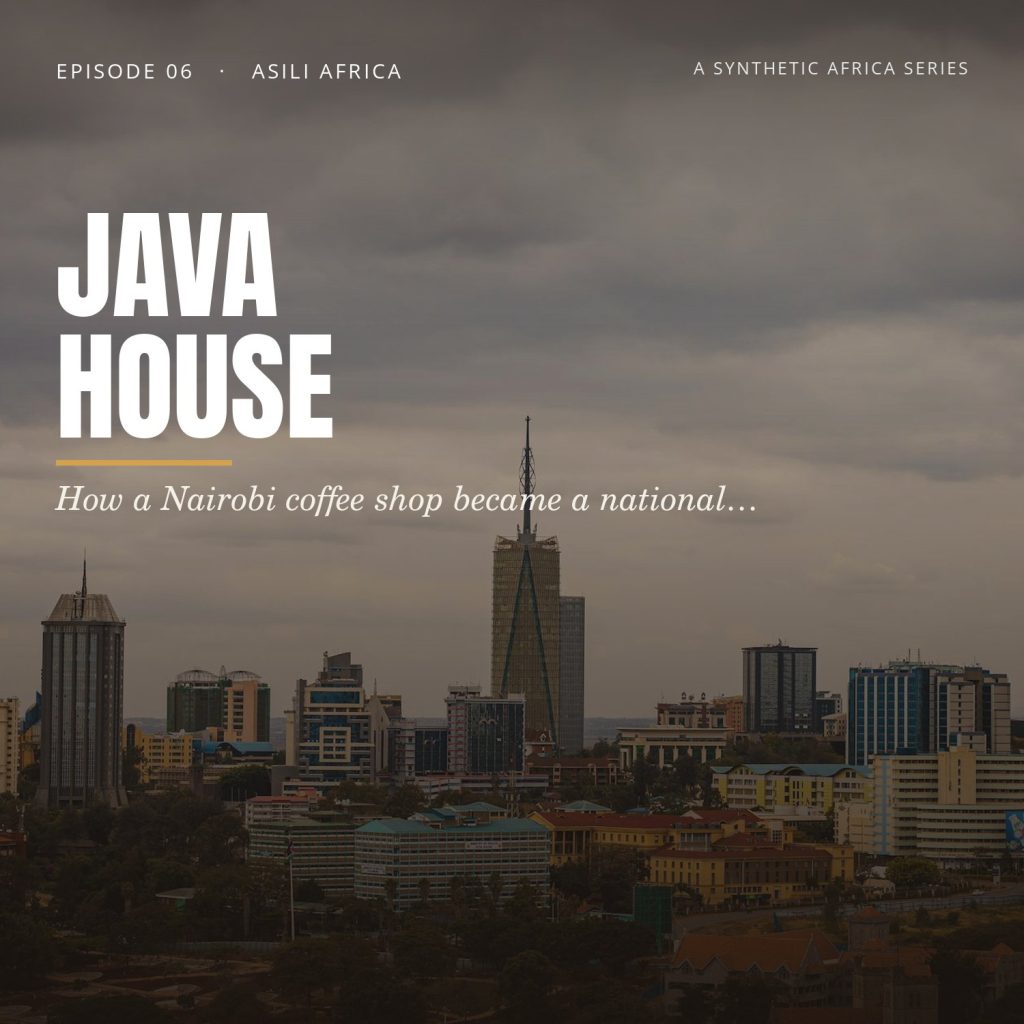
The Java House Story: From a single coffee shop on Adams Arcade to a pan-African chain
June 2018. In an air-conditioned tower in Dubai, the Abraaj Group is dying. Until that moment, it was the largest private-equity firm in the emerging world. Now it is filing for liquidation in the Cayman Islands, owing creditors around one billion US dollars. The biggest private-equity collapse in history.
And caught in the wreckage, thousands of miles away, was a chain of coffee shops in Nairobi.
Java House. Roughly sixty cafés across Kenya, Uganda and Rwanda. Profitable. Beloved. And suddenly an orphan — trapped inside the frozen estate of a financier it had never asked for.
By then, Java had already been sold once. It would be sold again. And again. Four global owners in twelve years, each one buying it to enrich the next.
But how does this happen? How does a single café — opened on a tired little arcade on Ngong Road, by two American aid workers who just missed good coffee — become a prize fought over by some of the most powerful financiers on earth?
To understand the empire, you have to go back to the cup.
The Origin
Kenya, 1999. On the high, cool slopes north of Nairobi, in volcanic red soil washed by the long rains, farmers were growing some of the finest coffee on earth. Kenyan arabica — bright, complex, prized by roasters from Tokyo to Trieste. It went into the blends you’d find in a Hamburg café or a London espresso bar. And almost none of it stayed home.
This was the paradox at the heart of the country. Kenya grew world-class coffee for a century — and Kenyans barely drank it. What people drank was tea. Or kahawa chungu — a bitter little cup of street coffee, sweetened heavy, sold from a flask on a corner for spare change. If you wanted more, there were a handful of hotel coffee shops serving weak, overpriced brew that nobody loved. No espresso bar. No cappuccino. No café where you’d sit for an hour with a laptop or a friend. The whole idea of coffee as something you’d savour, in a place built for it, simply didn’t exist. The beans went out by the shipload. The culture never came back in.
And it was not an easy moment to try something new. Daniel arap Moi was still president, in the long tail of a tired era. The economy was stagnant, the shilling was weak, and disposable income for most families was thin. Nairobi had no modern shopping malls — that whole world of glass atriums and food courts was still years away. If you were going to open a business, you found space in an old stand-alone arcade and you funded it yourself, because there was no venture capital waiting for a single coffee shop in Nairobi.
Into this stepped two Americans who hadn’t come to Kenya for coffee at all. The first was Kevin Ashley. Business degree from Pepperdine, class of 1987. He’d come to East Africa through humanitarian work — joined the World Food Programme in 1993 as a field monitor, then a liaison officer. He spent years out of Lokichogio, the dusty airstrip town in Kenya’s far northwest that was the staging ground for relief flights into the South Sudan war. Aid work led him to aviation: in 1998, with a partner, he co-founded a cargo airline, 748 Air Services, flying supplies into the conflict. He was, in other words, a relief worker who’d become a frontier entrepreneur. The coffee shop was meant to be a side project.
His partner was Jon Wagner, another American expat in Nairobi at the end of the nineties. He’d become the operating partner — the man who’d actually run the place day to day. And between the two of them, they had a thesis that was almost embarrassingly simple.
The beans were already here. The best in the world, grown a hundred kilometres up the road. Nobody was roasting them properly for the people who lived right next to them. So the idea was this: take those local beans, roast them well, and serve them in a café modeled on what the two of them missed from back home — a real American coffee house. A place to sit. A third place, that’s neither work nor home. That was the whole plan.
In August 1999, they opened the doors. Not in a five-star hotel. Not in a glossy mall — there weren’t any. They opened in Adams Arcade, a tired little shopping center on Ngong Road, the kind of place you’d pass without looking twice. They taught themselves the business from the ground up, in a shared kitchen, working out how to roast a bean and bake a pastry. Nairobi Java House. One café. Two founders who weren’t really coffee men. A country that had never asked for any of this.
Now they just had to convince Kenyans to pay a hundred shillings for a cup of coffee — when a cup of tea cost ten. And that would take a great deal longer than anyone expected.
The Struggle
Here is the thing nobody tells you about Java House. It was not an overnight success. It only looks that way now, from a distance, with a hundred outlets on the map. Up close, the first decade was a grind.
Think about what Ashley and Wagner were actually asking Kenyans to do. To pay eighty, ninety, a hundred and twenty shillings for a cup of coffee — where coffee was the thing you grew and shipped to Europe, not the thing you sat down and savored. And in those early years, it showed. Roughly two-thirds of Java’s customers were not ordinary Kenyans at all. They were expatriates — aid workers, diplomats, foreign business people — and affluent Kenyan-Asian families who already knew what a proper espresso was supposed to taste like. The mass market, the middle-class Nairobian who would one day make Java a household name, was not there yet. They had to be won, one cappuccino at a time, over years.
Convincing people to spend on a luxury they had never missed, during years when money was tight — that is not a marketing problem you solve in a quarter. It is a cultural shift, and cultural shifts take a decade.
So they built it the hard way. Remember, Nairobi had no modern malls yet — so the mall-anchored expansion that would later power Java’s explosion simply did not exist. Every new location was a stand-alone hunt: Westlands, ABC Place, Yaya Centre, one careful opening at a time. And there was no investor cavalry coming. No venture capital. No private equity. Ashley and Wagner funded it themselves — out of personal savings, and crucially, out of the cash flow from Ashley’s other business, the cargo airline 748 Air Services. The planes flying aid into South Sudan were, in a very real sense, helping to keep the coffee machines running back home.
And here is the number that tells the whole story. It took roughly a full decade — ten years — to reach about ten branches. One branch a year, give or take. That is the most under-told fact in the entire Java House story. The empire you see today was built at the pace of a small business, because for a long time, that is exactly what it was.
It is in this stretch — the slow middle years, before the sale, before the spotlight — that the story passes through its most difficult chapter, one a documentary cannot honestly skip. In 2008, co-founder Jon Wagner was charged with defiling three underage girls; he was convicted in 2009 and sentenced to fifteen years. In March 2011, the High Court quashed that conviction on appeal, citing flawed investigations and procedural failures by the trial court, and Wagner was freed. He maintained throughout that the case was extortion-driven — that it followed his refusal to pay a bribe. He left the business at the sale that came the following year.
By then, though, the concept had finally proven itself. The middle-class Kenyan customer the founders had bet on a decade earlier was, at last, walking through the door. Java had started to stretch beyond coffee — in 2011 it launched Planet Yogurt, East Africa’s first self-service frozen-yoghurt brand, a sign of a company confident enough to experiment. And the branch count was climbing toward thirteen.
Thirteen stores. A proven idea. A coffee culture that, against every odd, two American aid workers had quietly willed into existence. And something real, in Nairobi, in 2012 — that gets noticed. The investors who had ignored a single café for thirteen years were suddenly very interested in a chain of thirteen. The outside capital was circling. And the next people to own Java House would not be the people who built it.
The Pivot
In 2012, after thirteen years, Java House had finally become something. A brand. A piece of Nairobi’s middle-class daily life. And that is exactly the moment Kevin Ashley and Jon Wagner decided to sell.
The buyer was Emerging Capital Partners — ECP — a private-equity firm headquartered not in Nairobi, not in Lagos, but in Washington, D.C. ECP bought roughly ninety percent of the company. Ashley and Wagner kept a minority slice, and walked away with the rest. Business Daily reported that Ashley alone pocketed around 1.3 billion shillings.
Think about what that means. A coffee shop two American aid workers had started almost as a side project — funded out of an air-cargo business and their own savings — was now worth, by back-of-envelope math, somewhere in the range of ten to fifteen billion shillings. For the men who built it, it was the payday of a lifetime.
But this is the hinge of the whole story. Because the moment Java passed from its founders to a private-equity fund, its purpose quietly changed. Ashley and Wagner had built slowly, for themselves, for keeps. ECP did not buy Java to keep it. Private-equity firms buy to build, and then to sell — usually inside four to six years — to the next owner, at a higher price. From 2012, Java was no longer somebody’s life’s work. It was an asset on a clock.
And on that clock, Java moved fast. Under ECP, the company that had taken ten years to reach ten outlets went from about thirteen stores to roughly sixty in five. The timing was perfect. Kenya was in the middle of a shopping-mall boom — Garden City, Two Rivers, The Hub in Karen, gleaming new retail palaces rising across Nairobi — and Java rode it. A café in every mall. New brands to fill them: in 2013, 360 Degrees Pizza. And for the first time, Java crossed Kenya’s borders — into Uganda in 2014, and into Kigali, Rwanda, in January 2017. The accidental Nairobi café was becoming an East African chain.
It was everything the founders had never managed to do — done in a fraction of the time. But here is the uncomfortable truth underneath the success. All of that scale, all of that speed — it was not being built to last fifty years. It was being built to make Java bigger, shinier, and more valuable for one reason: so that ECP could sell it to somebody else, at a profit.
By 2017, the strategy had worked. Java was sixty stores across ten cities and three countries — and ECP was ready to cash out. The question was who would pay, and how much. The answer would be the biggest number in Java’s history, and it would come from a firm whose name, within a year, would become a byword for the largest collapse private equity had ever seen.
The Scale
In July of that year, the buyer came from Dubai. The Abraaj Group — the largest private-equity firm in the emerging world, run by a financier named Arif Naqvi. Abraaj bought one hundred percent of Java House from ECP for more than a hundred million dollars. It was the headline valuation, the number everyone would remember. Abraaj said it wanted to turn Java into Africa’s leading food-service brand.
It had eleven months.
In early 2018, investors in one of Abraaj’s funds — a health fund, backed by the Gates Foundation — asked a simple question. Where had their money gone? The answer unravelled everything. Hundreds of millions of dollars, allegedly commingled and misappropriated. By June, Abraaj filed for liquidation in the Cayman Islands, owing creditors around a billion dollars — the largest private-equity collapse in history.
And Java House? Java House was fine. The cafés kept opening. The coffee kept pouring. Kenyans queued for breakfast with no idea that the company serving it was now a piece of evidence in the biggest insolvency the industry had ever seen. Operationally healthy — and completely orphaned. An asset frozen inside a dead estate, waiting for someone to come and claim it.
In 2019, someone did. Actis — a London private-equity house with deep roots across African markets — moved in and pulled Java out of the wreckage. Not through a bidding war. There was no auction here. Actis was the buyer of last resort, lifting a healthy company out of a bankrupt owner’s hands. Java’s third private-equity owner in seven years.
That same year, on Kimathi Street in central Nairobi, Java launched something new — Kukito, a grilled-chicken brand, a bet on the fast-food crowd. New owner, new ambitions.
Then came 2020.
COVID emptied the malls Java had spent a decade colonising. Footfall collapsed. The company laid off staff and shut two outlets — the Aero Club at Wilson Airport, and the Express on Peponi Road. By the end of it, around forty-three branches, roughly three billion shillings in revenue. Rumours spread that Java might be leaving Kenya altogether. The company denied it — and then proved it, reopening, rebuilding, and growing again the moment the restrictions lifted.
And in January 2025, the carousel turned one more time.
Alterra Capital, taking the majority, alongside Phatisa, a minority partner, bought one hundred percent of Java House from Actis. The fourth owner in just over twelve years.
And somewhere in all of this, you may have noticed something missing.
The founders. Kevin Ashley and Jon Wagner — the two aid workers who taught a country to drink its own coffee — were gone. Not pushed out in this deal, or the one before it. Long gone, since 2012. Java House had been bought and sold and bought again, built up by each owner only to enrich the next, and the men who started it weren’t in the room for any of it. Their company had become something they never set out to build: not a café, but an asset.
But there was one debt the carousel had left behind. And the taxman had been keeping count.
Today & Tomorrow
So where does that leave Java House today?
In the middle of 2026, the company is bigger than Kevin Ashley and Jon Wagner ever imagined when they were teaching themselves to roast beans in a shared kitchen on Ngong Road. Roughly one hundred outlets, spread across Kenya, Uganda, and Rwanda. More than two thousand three hundred employees. Around five and a half million meals served every single year.
And it’s no longer just cafés. There’s Java Express, the small convenience format. There’s 360 Degrees Pizza. Planet Yogurt. Kukito, the grilled-chicken brand they’re now scaling through franchising. And behind all of it, Foodscape — the central commissary that roasts around twenty-five tonnes of coffee a month, bakes the bread, marinates the meat, and runs the logistics. The single café became a food system.
And running it all, for the first time, is a Kenyan. Priscilla Gathungu took the top job in November 2022 — the first Kenyan, and the first woman, to lead the company. Not an outsider parachuted in by a fund, but a true insider. She’d started as HR Director, moved to Commercial, then ran Foodscape. After twenty-three years of foreign founders and foreign owners, the person at the helm finally came from inside the house.
But hanging over all of it is the reckoning from that 2017 offshore exit. The Kenya Revenue Authority’s three-point-two-one billion shilling assessment ground through the system. The Tax Appeals Tribunal upheld roughly seven hundred and seventy-four million of it in 2023. The High Court threw out the appeal in December 2024. KRA had built a landmark precedent — proof that Kenya could tax a private-equity exit structured offshore. There was only one problem. ECP Kenya was by then an empty shell. Zero assets. Nearly four billion shillings in liabilities. A historic win, against a company with nothing left to take.
So what comes next? The new owners, Alterra and Phatisa, have hinted at the markets Java never reached — Tanzania, Ethiopia, the rest of the region the founders only ever talked about. Maybe they finally break the pattern. Or maybe, in a few years, there’s a fifth owner, and the carousel turns again. The empire on Ngong Road keeps growing. Who it belongs to next — that question is still open.
Two tired men opened one shop on Ngong Road and taught a country to drink the coffee it had always grown. They built it. And then they sold it — and the cup kept changing hands, owner after owner, each one building it to sell again.
What founders make, owners trade. An empire of cups, grown from one tired arcade.
This is Asili Africa. Every empire has an origin.
Key Takeaways
- The Origin. Kenya, 1999.
- The Pivot. In 2012, after thirteen years, Java House had finally become something.
- The Scale. In July of that year, the buyer came from Dubai.
- Today & Tomorrow. So where does that leave Java House today?
Also available on YouTube — search “Asili Africa” or subscribe to our channel.