
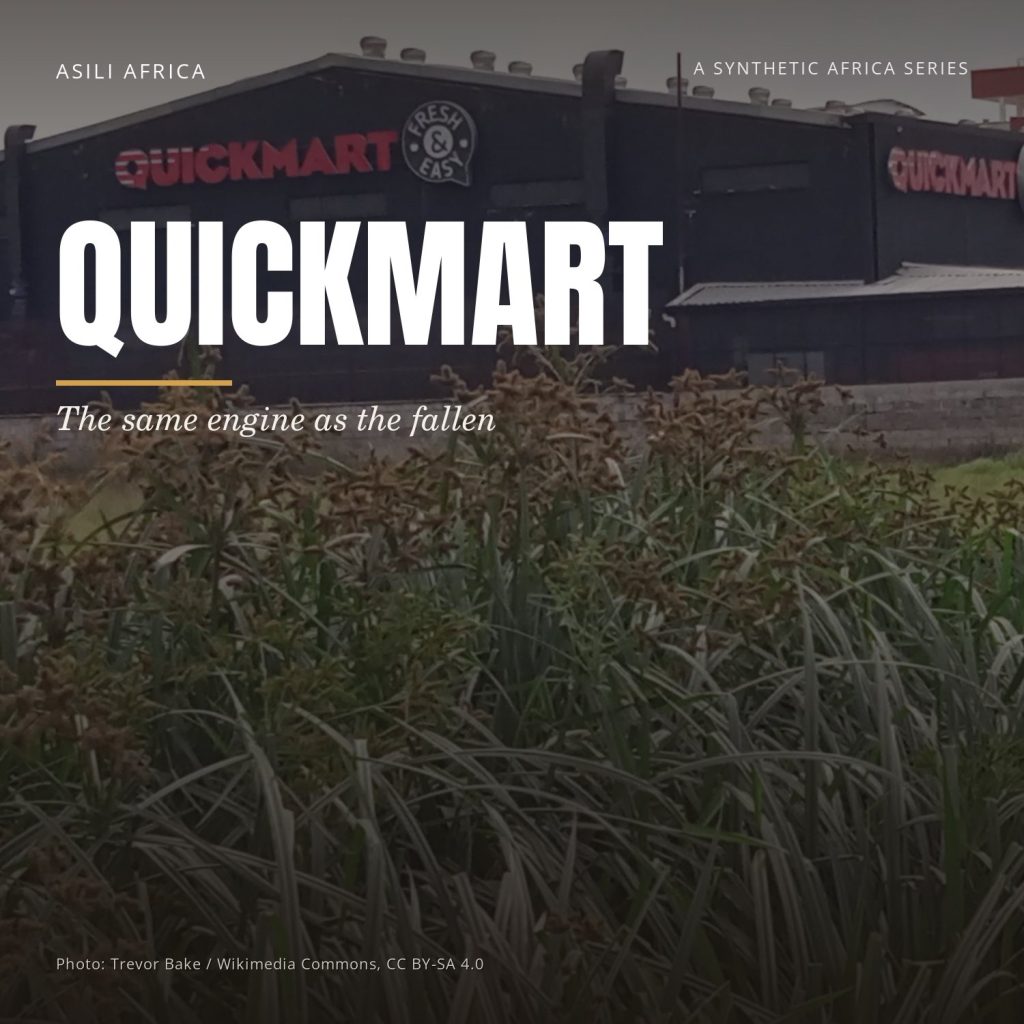
The Quickmart Story: Fast Retail, Bold Future
In September, twenty twenty six, Quickmart, Kenya’s second-largest supermarket chain, announced that half of it would be offered to the public.
It has seventy-two stores, in sixteen counties.
The document it published ahead of the listing puts its borrowings at six point eight million shillings.
Not billion. Million.
The same document gives it negative working capital of about four billion shillings.
One analysis of that document described how the chain pays for its growth. With its own cash, and with supplier credit.
Its suppliers, in effect, finance its stock.
The supermarket chains that collapsed in Kenya over the past decade were financed the same way.
What would tell this one apart is how quickly it pays the people who fill its shelves.
Those terms have not been published.
NAKURU AND EASTLANDS
John and Zipporah Kinuthia married in nineteen seventy six, thirty years before the kiosk. They farmed, and they kept livestock.
Over the years that followed they went into business for themselves. They ran a bar, a butchery and a lodging business. None of it was retail on any scale.
The supermarket was Zipporah’s idea. Years later she described the moment to the Kenyan news site Kenyans dot co dot ke.
“I felt I wanted to do something different,” she said, “so I told my husband, ‘I have a dream. Why don’t we open a supermarket?'”
John was hesitant at first. Then he agreed.
In two thousand and six, in Nakuru, they opened a small kiosk. That is where Quickmart begins.
There are two versions of the founding. In hers, the idea was Zipporah’s. Quickmart’s own listing document, published in September twenty twenty six, tells it differently. It says the chain was founded by the late John Kinuthia and his son, Duncan. The record holds both, and we give both.
Her account stops there. It does not say what the kiosk cost to open, where the money came from, or how hard the first years were. Nothing we have fills that in, and we are not going to guess.
The same year, a second shop opened, in Nairobi’s Eastlands.
Moses Nditika had spent about twenty years as a supermarket attendant, working in stores that belonged to other people.
With his brother and a partner, he opened one of his own. They called it Tumaini Self Service. Tumaini is the Kiswahili word for hope.
It was paid for in two halves. Five million shillings of savings. And a sacco loan of five million more, borrowed from a savings and credit cooperative.
That is how the second founding was financed, and unlike the first, it is on the record.
So there were two shops, opened in one year, by people who were not corporate retailers.
One was opened by a couple who had farmed and run small businesses, on the wife’s idea.
The other was opened by a man who had spent two decades working in other people’s supermarkets, on his savings and a loan.
Nothing in the record says either knew the other existed.
The Kinuthias’ son, Duncan Kinuthia, joined the family business after finishing secondary school and studying accounting.
In twenty ten, he pushed the chain out of Nakuru and into Nairobi.
In twenty sixteen, John Kinuthia died. Duncan became managing director.
By November twenty seventeen, the family chain had eight outlets.
Tumaini, over the same years, grew to thirteen stores, in Nairobi, Kiambu, Kajiado and Kisumu. By then both chains were trading in the capital.
The record gives these years as dates and counts. It does not give scenes, and this episode does not invent them.
Both chains were growing up beside much larger ones. Nobody at the kiosk in Nakuru, or on the shop floor in Eastlands, was yet in that league. And in these same years, the largest supermarket chains in Kenya were expanding on supplier credit, paying their suppliers late, and beginning to fail.
A supplier delivers goods to a supermarket. The supermarket puts them on the shelf and sells them. The supplier’s invoice is paid later.
Between the sale and the payment, the shop is holding money it owes to the supplier. For as long as the invoice waits, the supplier is lending to the shop. Nobody signs a loan agreement. It is a loan all the same.
A chain that grows on that credit can open stores faster than its own cash would allow. Each new store brings new sales, and with them more goods on credit, which help to pay for the store after that. It stays standing as long as the payments keep coming. When they slow, the suppliers carry the difference.
Nakumatt was placed under administration in twenty eighteen and later liquidated. Tuskys followed it down. Uchumi, Kenya’s first supermarket chain, collapsed too.
When the chains fell, their suppliers were unsecured creditors.
An unsecured creditor has no claim on any particular asset. When the business fails, those creditors are paid from whatever remains after others have been paid first. Most of what the suppliers were owed did not come back.
Those losses, the jobs that ended and the invoices that were never paid, are what opened the gap in Kenyan retail.
None of them appear in Quickmart’s record. The story of what filled that gap is told from the winners’ side.
SOKONI
In twenty seventeen, a private equity firm based in Mauritius, Adenia Partners, closed its fourth fund at its hard cap of two hundred and thirty million euros.
A hard cap is the most a fund has agreed to accept from its investors. Adenia raised this one in two stages, with a first close in November twenty sixteen and the final close the following year.
Adenia is reported to manage more than a billion dollars across five funds.
This fund’s stated target was medium sized companies, with a turnover of between five and forty million dollars a year.
That is the criterion on the record. No source gives Adenia’s reasons for choosing Kenyan supermarkets beyond it, and we will not supply one.
Much of the fund’s money came from development finance institutions. These are lenders owned by governments, set up to invest in private business in developing economies.
How much is reported differently. More than forty per cent, according to The Conversationalist. Half, according to Africa Global Funds.
Among the investors that can be confirmed are the European Investment Bank, the International Finance Corporation, Norfund and Proparco.
The fund’s vehicle for Kenyan retail was a company called Sokoni Retail Kenya. In Kiswahili, sokoni means at the market. Sokoni is still the sole shareholder of Quickmart today, and Adenia controls it. It was the buyer then. It is the seller now.
In late twenty eighteen, Sokoni bought Tumaini. Reports differ on the exact date. It was the first of the two purchases.
On the twenty-sixth of August, twenty nineteen, the Competition Authority of Kenya approved Sokoni’s purchase of Quick Mart. The merger was announced in early September.
The price of neither deal has been disclosed.
Business Daily reported that the Kinuthia family “relinquishes control”. Those are the paper’s words, and we will not stretch them further than they go.
What either founding family received has not been published.
The founders, and the man about to run the merged chain, are reported to hold interests through Sokoni. How large those interests are is undisclosed.
No source records what the founders said, then or since, about letting control go. As far as the public record goes, their part in this story largely ends here.
Eleven Quick Mart stores and thirteen Tumaini stores made twenty-four. Business Daily’s report on the merger described the result as a giant retailer.
Peter Kang’iri became group chief executive and managing director. Of everyone in this story, he is the one who runs through every year from here.
The integration took about a year.
In twenty twenty, the two chains began trading under one name. Quickmart.
The name that survived was the Kinuthias’.
Tumaini Self Service, the shop a supermarket attendant opened in Eastlands with his savings and a sacco loan, stopped existing under its own name.
What Moses Nditika does now is not on the record.
SIXTEEN COUNTIES
In twenty twenty one, the chain opened six stores. No other Kenyan chain opened as many that year.
By June twenty twenty two, it had fifty-three, and more than five thousand employees.
By July twenty twenty three, it had fifty-eight, in sixteen counties.
Sixty-four at the end of twenty twenty five. Sixty-eight by the middle of twenty twenty six. Seventy-two in September.
Revenue rose with the stores. Twenty-five point seven billion shillings in the twenty twenty one financial year. Fifty point four billion in twenty twenty five. Close to double, in four years, at about eighteen per cent a year.
Most of it is food. In the first half of twenty twenty six, food and fresh produce made up sixty-five per cent of revenue.
In twenty twenty five the chain kept a gross margin of twenty-two per cent, an operating margin of six point eight per cent, and a net margin of three per cent. Reported profit was one point five one billion shillings.
The first half of twenty twenty six brought twenty-seven point three billion shillings of revenue, and about eight hundred and seventy three million of profit.
It owns none of its stores. Every one is leased, and rent runs at between two and a half and three and a half per cent of sales. The company’s target for all its operating costs is fourteen to fifteen per cent.
Suppliers deliver directly to each store. There are more than seven hundred of them.
More than eight thousand people work for the chain now.
In the rankings it sits second. Naivas takes more than twice Quickmart’s revenue, and in twenty twenty five it grew faster, by more than twenty-one per cent. It also makes more in absolute terms, about two point four five billion shillings of net profit.
But Quickmart keeps more of each shilling it takes. Its net margin of three per cent compares with about two point one at Naivas.
Behind it, Carrefour is closing in. In twenty twenty five, Carrefour’s Kenyan business grew thirteen point seven per cent. Quickmart grew eight.
The gap between them in revenue is now about one point six billion shillings.
In July twenty twenty three, the company set itself a public target. One hundred and five stores by twenty twenty six.
It has seventy-two. The plan now is a hundred or more over the medium term, at ten to fifteen new stores a year, in the cities, the towns around them, the regions and the coast.
Neither the company nor the press has explained the gap between the target and the count. We have no reason to offer, and we will not invent one.
About five million times a month, someone pays at a Quickmart till.
Five million transactions. From two shops in two thousand and six to seventy-two stores, and profitable while it grew.
The chain works.
THE LOAD-BEARING WALL
In September twenty twenty six, ahead of the listing, Quickmart published an intention to float. The figures that follow are from that document.
Borrowings, six point eight million shillings.
Net cash of about seven hundred million shillings, not counting leases.
No new equity raised to pay for the growth.
And negative working capital of about four billion shillings.
Working capital is, roughly, what a business holds for the short term, its stock and the money owed to it, set against what it owes over the same period. When the figure is negative, it owes more in the short run than it holds.
For a supermarket, a large part of what it owes in the short run is usually owed to the people who supplied its goods.
The Rio Times put the model plainly. Quickmart’s growth is funded by internally generated cash, plus supplier credit.
Tumaini opened on savings and a sacco loan. The chain it became borrows almost nothing from banks. Its shelves are stocked, in effect, on its suppliers’ credit.
The document calls its inventory turnover rapid. It does not show how long Quickmart takes to pay for its goods.
Nor is a bank loan the only fixed commitment. Every store is leased, and the company’s net finance charges came to one point two eight billion shillings in twenty twenty five.
This is how the fallen chains were financed too. On supplier credit.
It is not, by itself, a sign of trouble. A supermarket that sells its stock before the invoice falls due, and then pays the invoice when it falls due, is using credit its suppliers agreed to give.
The difference between that and what happened to the fallen chains is whether the payments stay on time.
If Quickmart pays on the terms its suppliers agreed to, the four billion is the ordinary credit of the trade. If payments were ever to slip, the suppliers would be carrying the chain, the way suppliers carried the ones that fell. The public record cannot say which of those describes Quickmart.
Quickmart’s own document says its negative working capital reflects rapid inventory turnover and, in its words, “favourable supplier payment terms”. It does not say what those terms are. The Rio Times called them the model’s load-bearing wall. It is the one part of the building nobody outside can see.
More than seven hundred suppliers finance these shelves.
No source we found reports the terms they are on. Not how many days a Quickmart invoice stays outstanding. Not whether suppliers pay listing or promotion fees. And not a single supplier’s own account of doing business with the chain.
That is the central open question in this story. The record does not answer it in either direction.
The Competition Authority of Kenya has cited three practices as abuses of buyer power among the country’s major retailers. Delaying payment to suppliers. Dropping them suddenly. And pushing the cost of promotions onto them.
Whether any of those findings was made against Quickmart specifically is not established in the sources we have. It is a finding about the sector, and we are keeping it there.
In July twenty twenty three, according to a Harvard Business School case study, Peter Kang’iri feared that Quickmart could repeat the failures of retailers that had stalled at around sixty-five stores.
It has seventy-two.
This is not a company in trouble. It is profitable. It has net cash. And no bank can call in a loan it does not have.
OFFER FOR SALE
Over four financial years, from twenty twenty two to twenty twenty five, Quickmart reported profits totalling three point three seven billion shillings. Over the same years it paid three point seven four billion in dividends.
That is one hundred and eleven per cent of reported profit.
In twenty twenty five alone, the dividend was one point six five billion shillings, against reported profit of one point five one billion. One hundred and nine per cent.
In twenty twenty two, the dividend had been one hundred and six million shillings.
The policy from here is to pay out at least eighty per cent of profit, in two payments a year. The first dividend after listing is expected in the first half of twenty twenty seven.
Analysts reading the float have flagged a strain in that. The chain plans to open ten to fifteen stores a year and to pay for them from its own cash. A payout of eighty per cent or more leaves less of that cash to do it with.
On the twenty-third of September, twenty twenty six, the listing was announced. Sokoni will sell two billion existing shares, half the company, on the Nairobi Securities Exchange.
Up to fifteen per cent more may be sold if demand allows. If all of it goes, Sokoni’s stake falls to about forty-two and a half per cent.
It is an offer for sale. The shares already exist, and the money paid for them goes to whoever is selling. No new money goes to Quickmart. It all goes to Sokoni.
So the listing is not a company raising money to grow. It is an owner selling half of what it owns, at a time the owner chose. Those are different things, and the difference decides what the public is buying into.
Martha Osier, a partner at Adenia, called the listing “a natural next step”.
Peter Kang’iri said that listing gives Kenyans the chance to own a share of a business they already shop in.
Who receives the money is less clear. Quickmart’s own document says the sale is a partial exit, in proportion, by Sokoni’s shareholders. Those are funds managed by Adenia, the founders of Quickmart, the founders of Tumaini and the group chief executive.
The shares held through Sokoni by the Kinuthia family, by Moses Nditika and by Peter Kang’iri, and what each of them will receive, are undisclosed.
As of the twenty-eighth of September, no approval from the Capital Markets Authority or the Nairobi Securities Exchange had been announced, and no price had been published. The offer was expected to open around the thirtieth.
We are not going to guess at the price, or at how the offer will be received.
In July twenty twenty six, the Competition Authority opened an investigation into supermarket pricing. It is examining gaps between shelf prices and till prices, and inflated former prices on discounted goods, at Naivas, Carrefour, Quickmart and Magunas.
Quickmart was reported in connection with sticker prices and cooking gas refills.
No penalty has been announced, and the reports say the inquiries remain ongoing. Our research found no response from the company.
More than eight thousand people work for Quickmart, and thirty-five of its stores never close.
No source we found describes their wages, their contracts, whether a union is recognised, or what the night shifts are like.
Staff costs run at about six per cent of sales. Nobody in the record is on the other end of that figure.
Once it is listed, Quickmart will have to publish its accounts twice a year.
Those accounts may show how long it takes to pay its suppliers. That is the number no owner has yet published.
In two thousand and six, in Nakuru, there was a kiosk with a few shelves, and a woman who had told her husband she had a dream.
The same year, in Eastlands, a supermarket attendant opened a shop of his own.
The chain those two shops became is now being offered to the public.
If the listing goes ahead, its accounts will be public twice a year. Whether they show how fast it pays the people who stock its shelves, the one thing that would set it apart from the chains that fell, is a question still open. This is Asili Africa. Every empire has an origin. See you on the next one.
Key Takeaways
- NAKURU AND EASTLANDS. John and Zipporah Kinuthia married in nineteen seventy six, thirty years before the kiosk.
- SIXTEEN COUNTIES. In twenty twenty one, the chain opened six stores.
- THE LOAD-BEARING WALL. In September twenty twenty six, ahead of the listing, Quickmart published an intention to float.
- OFFER FOR SALE. Over four financial years, from twenty twenty two to twenty twenty five, Quickmart reported profits totalling three point three seven billion shillings.
In this series: The Retail Collapse
Who took the shelf space when the chains fell?
- Uchumi
- Nakumatt
- Tuskys
- Naivas
- Quickmart (this episode)
- Chandarana Foodplus
Also available on YouTube — search “Asili Africa” or subscribe to our channel.