
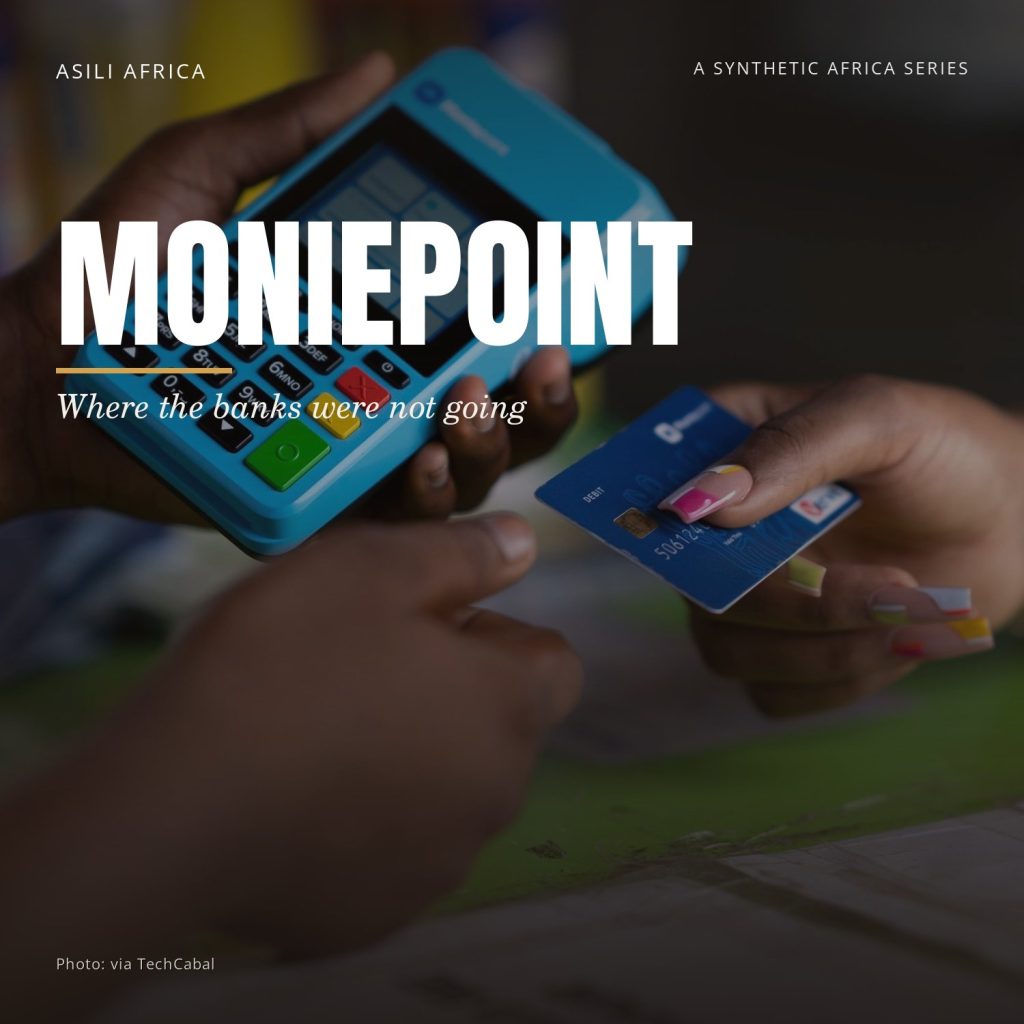
The Moniepoint Story: It started as boring back-end software for banks, then noticed millions
In February of twenty twenty three, the Central Bank of Nigeria decided to redesign the country’s currency.
The plan was to swap out the old high denomination Naira notes for new ones, on a short, hard deadline. The stated goal was to fight inflation, fight illicit cash flows, and force more transactions into the formal banking system.
The execution failed.
Within weeks, the largest economy in Africa ran out of cash. A T Ms went dark. Banking apps crashed. Branches closed their doors. Long queues formed at the few bureaux de change that were still open. Petrol stations turned customers away. Market traders refused to sell anything they could not immediately reinvest.
Two hundred and twenty million Nigerians, in the largest cash economy on the continent, suddenly had no way to move money.
Almost no way.
Across the country, on hundreds of thousands of street corners, in petrol stations, in barber shops, in tailoring stalls, in the front rooms of small kiosks, a different network was quietly carrying the load. Small blue plastic boxes the size of a paperback book, manned by young men and women in bright blue branded T shirts. The fishmonger could not get cash out of her bank. She could get cash from a stranger in a blue shirt who could see her bank account on a phone.
The blue boxes belonged to a company most of those Nigerians had never heard of before twenty twenty three. A company that had spent the previous seven years selling invisible back end software to the banks that were now closed.
This is the story of Moniepoint. The boring software company that walked up the stack until it became one of Africa’s most important consumer banks.
This is Asili Africa.
The Engineers Who Left Interswitch
Tosin Eniolorunda grew up in Nigeria and trained as a software engineer. By his late twenties he was working at Interswitch, the company that, by the late two thousands, was the dominant payments processor in the country. If a Nigerian swiped a card, made an interbank transfer, or used a P O S terminal, the transaction almost certainly travelled across Interswitch rails.
Tosin spent six years there. He worked as a product manager. He worked as a software architect. He learned the plumbing of Nigerian payments from the inside.
One floor away, in the same building, another engineer was doing similar work. Felix Ike had graduated from the University of Lagos with first class honours in Computer Science. By the early twenty tens he was Lead Software Engineer at Interswitch. He was, by most accounts, one of the strongest engineers in the building.
The two of them became friends. And in the way that friendships between engineers at dominant companies often do, the conversation drifted, slowly, toward the same question.
What if we built it better?
Interswitch was, in the early twenty tens, the only meaningful payments processor for most Nigerian banks. The banks paid for that monopoly. The systems were creaky. The fees were high. The procurement cycles were long. And the banks themselves, which had grown into giants on the back of oil money and consumer credit, were running on back end software that was, by global standards, behind.
Tosin and Felix had a thesis. The thesis was that two engineers who knew the plumbing of Nigerian banking could write better plumbing, cheaper, and sell it to the same banks that were already paying Interswitch a premium. The thesis was simple. The thesis was almost certainly going to be lonely.
In June of twenty fifteen, the two of them walked out of Interswitch. They took five other engineers with them. Together the seven of them founded a company called TeamApt.
They did not raise money first. They bootstrapped. They did not have a marketing department. They had a Lagos banking ecosystem small enough that a good piece of work could travel by word of mouth in a quarter. They got to work.
The first products were unglamorous. There was Moneytor, a digital banking platform that let financial institutions track and reconcile transactions across their systems. There was Monnify, a payments and small business management suite that early Nigerian fintechs, Piggyvest, Cowrywise, and FairMoney, picked up as a back end. There was AptPay, a push payments infrastructure layer.
Each product solved an unglamorous, expensive problem inside a bank’s middle office. Each product was the kind of work no consumer would ever see.
The breakthrough moment came somewhere around twenty seventeen. Fidelity Bank, one of Nigeria’s mid tier commercial banks, ran a tender for a piece of payments infrastructure. The bank had every reason to give the work to Interswitch. The bank picked TeamApt.
Inside the Lagos banking community, that single choice was a signal. A small startup founded by two ex Interswitch engineers had beaten the incumbent on the incumbent’s home turf. The other banks paid attention.
By the end of twenty eighteen, by the company’s own count, twenty six of Nigeria’s thirty banks were running at least one TeamApt product somewhere in their stack. Three years after walking out of Interswitch, Tosin and Felix had become the quiet engineers whose code was running, invisibly, behind the screens of almost every banking app in the country.
The thesis had survived. The company was profitable. The seven co-founders had a real business.
And the founders had begun to notice something about their customers that was, in a way they could not yet say out loud, troubling.
The Banks Would Not Go
By twenty eighteen, TeamApt had a problem that very few profitable back end software companies ever admit to having.
The customers were the problem.
The banks paid TeamApt on time. The banks renewed contracts. The banks were polite. But the banks, Tosin and Felix were beginning to see, were not actually using TeamApt’s software to do the thing both founders had quietly hoped they would do.
The banks were not going where the customers were.
Nigeria, in the late twenty tens, was a country of more than two hundred million people. The formal banking sector served, by the most generous estimates, around forty percent of the adult population. The other sixty percent — the market traders, the artisans, the small manufacturers, the boda boda riders, the informal services economy — was running on cash. Not because it wanted to. Because the formal banking system, the same system whose back end TeamApt was now powering, had decided that serving these customers was not worth the cost.
Branches were expensive. Compliance was expensive. The customer was too small. The transactions were too small. The risk model was, by twentieth century standards, broken.
Tosin and Felix had built the best back end software in Nigeria. The banks had taken that software, made themselves more efficient, and used the savings to lend more aggressively to the customers they already had. The informal economy stayed exactly where it had been.
For roughly a year, between twenty eighteen and twenty nineteen, the two founders sat with the problem.
They could keep selling back end software. They could keep being a profitable, quiet middleware company that powered other people’s payment products. That was the safe path. That was the path most of the industry expected them to take.
Or they could walk up the stack themselves. They could decide that if the banks would not go where the customers were, then a software company that already knew how every Nigerian bank’s payments engine worked could simply go there itself.
The decision was not theoretical. It was structural. It meant turning a polite middleware business that the banks viewed as a partner into a direct competitor that the banks would view, eventually, as a threat. It meant building a sales force, an operations team, an agent network, a brand. It meant raising real capital. It meant changing what kind of company TeamApt was.
In March of twenty nineteen, the company closed a five point five million U S dollar Series A round led by Quantum Capital Partners. It was the first time TeamApt had taken any meaningful outside money, after four years of bootstrapping.
Tosin and Felix did not raise that money to keep doing middleware better. They raised it because they had decided to launch a new product, under a new brand name, aimed directly at the customers their bank clients refused to serve. The brand name was already written on the back of an early product spec.
Moniepoint.
The product was a P O S terminal. Specifically, a small blue plastic P O S terminal that a person could carry under one arm. The plan was to distribute the terminals through a network of agents, small business owners and entrepreneurs, who would set up small banking points on street corners, in shops, in fuel stations. Anyone within walking distance of an agent could withdraw cash, deposit cash, send money, and pay bills, without ever entering a bank branch.
Nigeria already had a name for this kind of business. The C B N called it agency banking. The model existed. It had just never been pushed at the scale or speed Tosin and Felix were now about to push it.
Because the founders had seen something the banks had missed. The P O S terminal, they realised, was not a payment accessory. It was something else entirely.
The P O S terminal was a data rail.
The Blue Box and the Data Rails
The first Moniepoint P O S terminals deployed in twenty nineteen. The plan was simple. Recruit agents. Hand them blue boxes. Give them a small float of working capital. Pay them a thin margin on every transaction. Let them set up wherever there were customers a bank would not serve.
The agents did not need to be banks. They did not need to be financial professionals. They needed to be present. They needed to be trustworthy in their own neighbourhoods. They needed to want to make a small business out of being the place on the street where cash could come in and out.
The economics of agency banking, by themselves, were not new. Other banks ran agent networks. Other fintechs were trying. What Tosin and Felix added was the back end. Every transaction at every blue box flowed through the same TeamApt payments engine the banks had already adopted. That meant that, from Lagos, the company could see, in something close to real time, exactly what was happening across the entire network. How many transactions per agent. How much cash. How often a particular merchant repeated. How fast a float turned. How concentrated risk was.
Inside Moniepoint, the team began to understand that the blue P O S terminal was not just a payment accessory. It was a data rail. Every swipe was a data point about a business. Every series of swipes was an income statement. Every pattern of swipes, over months, was an underwriting file.
A traditional Nigerian bank could not lend to a small market trader because the bank had no idea what the trader earned. A Moniepoint agent processing tens of thousands of naira a day through a Moniepoint terminal was, without realising it, building exactly the credit profile the bank had spent decades not knowing how to build.
The implication was profound. Moniepoint was not just disbursing payments. Moniepoint was, over time, going to be able to lend on the back of its own transaction graph.
The funding climbed. The pure software Series B closed in twenty twenty one, led by Novastar Ventures, with F M O, Global Ventures, B I I, Oui Capital, Kepple Africa, Soma Capital, and Endeavor Catalyst all writing alongside. The amount was undisclosed. The signal was not. Moniepoint was being treated as a development finance story now. Not just a fintech.
By the end of twenty twenty one, the platform had crossed one hundred and twenty thousand active merchants and roughly eighteen million unique end users. Monthly transaction volume passed four billion U S dollars.
In mid twenty twenty two, Q E D Investors, the U S firm best known for backing fintech infrastructure in mature markets, led a fifty million U S dollar pre Series C round. Lightrock joined. The valuation came in at around four hundred million U S dollars. The headcount, which had started the year at roughly fifty people, was on its way to passing one thousand.
The company was no longer a side project for two engineers. It was, by any reasonable measure, becoming an infrastructure company at national scale.
What it needed next was a name that matched.
In January of twenty twenty three, the parent company TeamApt Inc. quietly retired. In its place stood a single global brand. Moniepoint Inc.
The back end business kept running. The banks kept paying. But the company now stood, publicly, on its consumer product. The boring middleware firm had finished walking up the stack.
One month after the rebrand, the entire country of Nigeria ran out of cash.
From Software Company to Unicorn
The Naira redesign of February twenty twenty three was, on paper, a monetary policy decision. In practice, it was the single largest unintended marketing campaign in the history of Nigerian fintech.
Within days of the launch of the new notes, the cash supply collapsed. Banks could not load A T Ms. Banking apps overloaded and crashed. Bureaux de change rationed access. The world’s largest cash economy went, almost overnight, into a forced digital experiment.
Moniepoint’s blue box network became the country’s de facto cash infrastructure. Agents who had been processing modest daily volumes saw queues that did not move all day. Cash came in from one customer, went out to another, then back in again, sometimes within the same hour. The same agents started running out of float. Moniepoint operations spent the cash crunch months frantically rebalancing liquidity across regions, propping agents up with bridge floats so the network would not break.
The network did not break.
By the time the cash supply normalised later in twenty twenty three, two things had quietly changed. Millions of Nigerians who had never used a fintech now knew the colour blue meant cash. And Moniepoint had data on a scale almost no consumer brand in the country had ever seen.
In August of twenty twenty three, the company launched personal banking. A consumer app. A debit card. The same green and grey identity. The same simple proposition. The fishmonger who had used a Moniepoint agent during the cash crunch now had her own Moniepoint account. The blue box on the corner had a sibling in her pocket.
The strategy was suddenly clear, all the way up. Moniepoint was no longer an agency banking company with a back end software side. It was a vertically integrated, full stack Nigerian bank. P O S terminals at the front. Merchant banking in the middle. Personal banking on top. Lending wrapped around everything, underwritten on the company’s own transaction graph.
Over the course of twenty twenty three, Moniepoint processed more than five point two billion transactions. The total value passed one hundred and fifty billion U S dollars. The agent network passed three hundred thousand. Inside Nigerian fintech, the company was now spoken about in the same breath as OPay and PalmPay, even though much of the country still did not know exactly what it was.
Then came the corrective.
In Q two of twenty twenty four, the Central Bank of Nigeria fined Moniepoint one billion naira for K Y C non compliance. The C B N had spent the previous year tightening fintech onboarding rules after a wave of fraud and concerns that anonymous accounts were being used for F X speculation during the Naira crisis. OPay was hit with an identical one billion naira fine. The message was clear. The C B N considered the consumer fintechs systemic, and was going to regulate them as such.
Moniepoint paid the fine. The company tightened K Y C. Onboarding slowed. The regulator was now, formally, a partner, and a watchdog.
Six months later, on the twenty ninth of October, twenty twenty four, came the round that changed the public conversation about the company entirely. Development Partners International led a one hundred and ten million U S dollar Series C, with Google’s Africa Investment Fund, Verod Capital, and Lightrock writing alongside. The valuation came in at more than one billion U S dollars.
Moniepoint had become Africa’s eighth unicorn.
In the press releases, the company described itself, for the first time, as one of the most important banks for small businesses in Africa. In the Nigerian banking community, the same banks Tosin and Felix had quietly been selling software to a decade earlier suddenly noticed that the back end company they had been paying for years had grown into something they now had to compete with.
The Bank They Used To Sell To
In June of twenty twenty five, Moniepoint announced its first major African expansion. The original plan had been to acquire the Kenyan merchant payments startup KopoKopo, a deal that had received Competition Authority of Kenya approval. About five months in, the deal collapsed. Neither side disclosed the reason. Within weeks, Moniepoint pivoted to acquiring seventy eight percent of Sumac Microfinance Bank, a regulated deposit taking institution in Kenya. The agency banking playbook now had a foothold in East Africa.
In July of twenty twenty five, the company acquired Bancom Europe Limited, an Electronic Money Institution in the United Kingdom with passporting rights across the European Economic Area. The strategic logic was straightforward. Nigeria received roughly twenty billion U S dollars in remittances in twenty twenty five, most of it through Western Union and informal channels. Moniepoint wanted that flow on its own rails.
In October of twenty twenty five, D P I and LeapFrog led a ninety million U S dollar closing tranche of the Series C. Google, Visa, the International Finance Corporation, Proparco, Swedfund, Verod, and Alder Tree wrote alongside. Total Series C capital reached two hundred million U S dollars. Capital runway extended well into twenty twenty seven.
In January of twenty twenty six, the C B N upgraded Moniepoint, along with OPay, PalmPay, Kuda, and Paga, from regional to national microfinance bank status, at a five billion naira capital requirement. The companies could now operate freely across all thirty six Nigerian states.
Underneath the headlines, harder questions remained.
Hallmark News reported in twenty twenty five that Moniepoint was carrying around seven billion naira in non performing loans, the product of an aggressive S M E lending push the company had ridden through twenty twenty four. The data driven underwriting that worked beautifully in calm conditions was being tested by the F X volatility, inflation, and fuel subsidy removal of the Nigerian macroeconomic story.
A Nigerian businessman escalated a seven hundred million naira account restriction to the C B N and the E F C C, joining a broader pattern of agency banking and S M E customers reporting frozen funds during fraud reviews. In early twenty twenty six, Tosin Eniolorunda publicly stated that the company had around five hundred open vacancies it could not fill domestically, framing the issue as a Nigerian talent gap. The Nigerian tech community was sharply divided. He clarified the remarks days later.
Above all of it sits the ambition the company has not yet been granted. Moniepoint has publicly applied for a commercial banking license. That license would let it take corporate deposits, broaden F X services, and structurally compete with the same Nigerian commercial banks whose back office software it once quietly built.
The same banks Tosin and Felix walked out of Interswitch to sell to. Then quietly competed with. And now want to be one of.
The story of Moniepoint is the story of two engineers who looked at the boring back end of Nigerian banking and decided the boring back end was the front door.
They sold software to the banks. The banks would not go where the customers were. So the engineers built a blue box, handed it to a stranger on a street corner, and let the country decide what to do with it.
Every empire has an origin. This one began with a back end software company that quietly noticed the bank branches were never coming.
This is Asili Africa. Every empire has an origin.
Key Takeaways
- The Engineers Who Left Interswitch. Tosin Eniolorunda grew up in Nigeria and trained as a software engineer.
- The Blue Box and the Data Rails. The first Moniepoint P O S terminals deployed in twenty nineteen.
- From Software Company to Unicorn. The Naira redesign of February twenty twenty three was, on paper, a monetary policy decision.
- The Bank They Used To Sell To. In June of twenty twenty five, Moniepoint announced its first major African expansion.
Listen
Also available on YouTube — search “Asili Africa” or subscribe to our channel.