
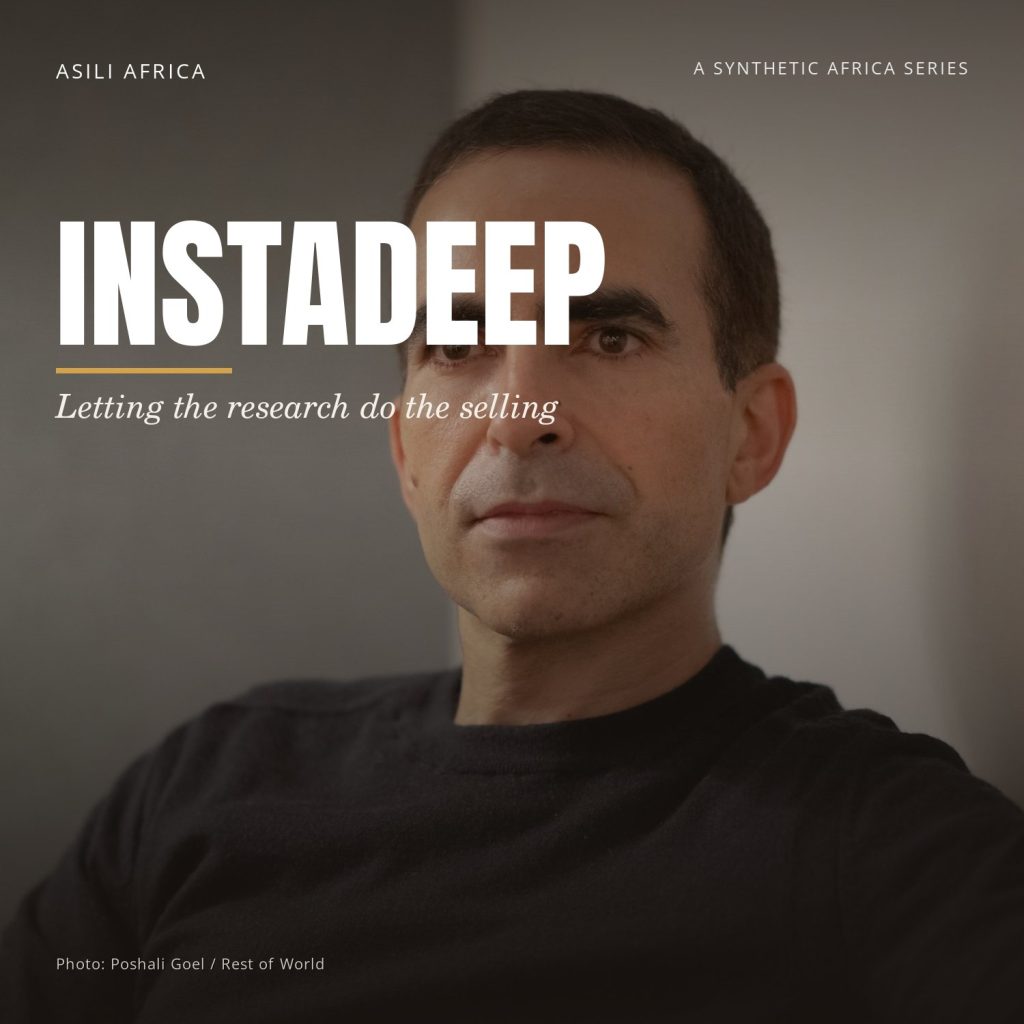
The InstaDeep Story: Karim Beguir and Zohra Slim started an AI company in Tunis with two laptops
On the twenty fourth of November, twenty twenty one, a new viral sequence was uploaded to a public health database in Geneva. Within twenty four hours, an artificial intelligence built in an office in Tunis had read it, scored it, and flagged it as high risk.
Two months later, the World Health Organization gave that sequence a name.
Omicron.
The W H O was two months late. The A I in Tunis had been right the day the sequence appeared.
Two weeks after the W H O caught up, the company that built that A I closed a one hundred million dollar funding round, one of the largest pure A I rounds ever raised in Africa to that date. Fourteen months later, a German biotech company called BioNTech, the same company that had built one of the world’s first COVID vaccines, announced it would buy the whole thing for up to six hundred and eighty million dollars.
The largest technology acquisition in African history.
The company was called InstaDeep. It was seven years old.
And before any of this, before BioNTech, before the variant scoring, before the venture capital, it had started in a town on the edge of the Sahara desert that the global technology industry had literally never heard of.
Two friends. Two laptops. Two thousand dollars. And a bet on mathematics that the rest of the world said could not be made from there.
This is the story of InstaDeep.
This is Asili Africa.
Two Laptops
The town’s name is Tataouine. It sits on the edge of the Sahara desert in southern Tunisia, about six hours by road from the closest major airport. It has roughly seventy five thousand people. Most of the world has never heard of it. The world that has heard of it, has heard of it because George Lucas filmed Star Wars there in the nineteen seventies, and borrowed the town’s name for Luke Skywalker’s home planet.
One of the things Tataouine has produced is a young doctor named Abdallah Beguir. In the nineteen seventies, Doctor Beguir went to France for medical school. He could have stayed. Many of his classmates did. France was richer, the hospitals were better equipped, the career was easier. Instead, after qualifying, he packed up his family and moved back to Tataouine. His son Karim later asked him why. His father’s answer was simple. It was the place where patients needed care most.
Karim Beguir was born in Échirolles, France, in November of nineteen seventy six. He grew up in Tataouine. He grew up watching his father do hard work where it was most needed, instead of where it was most lucrative. That single moral example, he would say decades later, was the architecture of his entire life.
Karim was a serious student. In nineteen ninety seven, he passed the entrance examination to the École Polytechnique, the most demanding engineering school in France. From there, he went to New York University’s Courant Institute of Mathematical Sciences as a Program Fellow. And from there, into the engine room of global finance.
For roughly ten years, Karim Beguir built risk and pricing models for J P Morgan and Bank of America, in New York and in London. It was the dream job of the dream career. It was also, at some point in his mid thirties, no longer the right job. He quit the bank, and he went home.
The other half of the story is a woman named Zohra Slim. She and Karim had been childhood friends in Tunisia. By the time he came back, she had taken a very different path through technology. No formal computer science degree. Self taught. She had picked up the entire stack by building things. She had gone to India to lead a team of developers. She had returned to Tunisia and started a digital communication agency.
When a mutual friend introduced them back in Tunis, the two of them discovered they shared a stubborn conviction. Frontier artificial intelligence research could be done in Africa, if you were willing to ignore everyone who said it could not.
In twenty fourteen, in Beguir’s family home in Tataouine, they incorporated a company. They called it InstaDeep. The starting capital was two thousand dollars, and two personal laptops. No office. No salaries. No outside investors. No co-founders beyond the two of them.
The first paying work was small and unglamorous. They built websites for Tunisian clients. They built a computer vision tool that, with a phone camera, could verify whether a luxury handbag was authentic or counterfeit. They eventually sold that tool to a buyer in London. It paid a few bills.
When Karim told people that this two person operation in Tataouine was going to do what Google and Meta and DeepMind were doing, the answer was always the same.
People laughed.
So they kept their heads down and built.
Nobody Believes
The first hard wall was a regulatory one. Tunisia has a foreign exchange code that goes back to the early decades of independence. Article fourteen of that code restricts how hard currency can move in and out of the country. For a small business it was manageable. For an artificial intelligence company that would one day need to raise tens of millions of dollars from venture capitalists in London and Silicon Valley, it was, in practical terms, fatal.
So in twenty fifteen and twenty sixteen, Beguir made a quiet decision. The InstaDeep holding company moved its registration to London. The engineering team stayed in Tunis. Zohra Slim stayed in Tunis. The work, the research, the engineers, all of it remained on Tunisian soil. The piece of paper that the world’s investors needed in order to write a cheque, that moved to London. It was, in his own framing, the only way to keep the company alive long enough to do what it was built to do.
The second wall was the local market. Tunisia, in the middle of the twenty tens, was not buying artificial intelligence. Beguir would later say they only managed to make a few thousand dollars in local sales in those years. There simply was not a Tunisian customer for what they were trying to sell. Everything they earned, they earned from clients in Europe and the United States.
That commercial reality forced a strategic choice that would turn out to be the most important decision Karim Beguir ever made. He decided that InstaDeep was not going to be a custom A I consultancy. There were already a dozen of those, in better markets, with better connections. Instead, InstaDeep was going to publish original research, at the most prestigious machine learning conferences in the world.
The bet was that scientific credibility, the kind verifiable in a peer reviewed paper, would do the company’s sales for it. The customers worth having were the ones who could read the paper, understand the work, and recognise that it was real.
It took years to pay off. While they wrote and rewrote and submitted and got rejected, they kept paying the bills with consulting projects.
In twenty seventeen, the first signal came. Karim was invited to Silicon Valley. He was introduced, at Facebook’s Menlo Park campus, to Mark Zuckerberg. Later that same year, Google certified him as a Developer Expert in Machine Learning. These were small things, but they were the first international validations that what InstaDeep was working on was real.
Then, in December of twenty eighteen, the global accelerator network Endeavor selected Karim Beguir as an Endeavor Entrepreneur. Endeavor had been picking high impact founders around the world for nearly twenty years. Beguir was one of the very first they had ever chosen from Tunisia.
And then, the big one. Later that same year, InstaDeep got original research accepted at NeurIPS, the most important machine learning conference in the world. To this day, InstaDeep is one of the very first African founded companies ever to publish there. The paper itself mattered less than what it signalled. From inside the global research community, this Tunisian company was now visible.
Four years in. No institutional capital yet. The founders were paying themselves the bare minimum. They had been laughed at at home, ignored by the regulators, and forced to move their registration to a different continent.
And they were, finally, on the map.
The Tender
Once the world was paying attention, the world wrote cheques.
On the third of May, twenty nineteen, InstaDeep closed its first institutional funding round. Seven million dollars in Series A capital. The lead investor was AfricInvest, one of the largest private equity firms based in Tunis. Alongside them came Endeavor Catalyst, the investment arm of the network that had selected Beguir six months earlier. It was the first Tunisian investment Endeavor Catalyst had ever made. Five years after incorporation, on its founder’s bet that mathematics could speak for itself, InstaDeep had finally raised institutional money.
Five months later, the bigger break came.
In October of twenty nineteen, Deutsche Bahn, the German national railway company, ran an open international tender for an artificial intelligence partner. The tender was to build a deep reinforcement learning system that could optimise rail traffic across Germany, scheduling trains in real time across one of the most complex transport networks in the world. Some of the largest A I labs in the world bid on the contract.
InstaDeep won.
A Tunisian founded company, five years into its life, had beaten the world’s largest A I labs on a competitive bid to build the brain of the German national rail system. The contract would run for seven years. And it would put InstaDeep, all at once, into the conversations that mattered in European industrial A I.
That same year, twenty nineteen, a much quieter conversation began. A small German biotech company based in the city of Mainz, working on a class of vaccines built around messenger R N A, started talking to InstaDeep about a research collaboration. The biotech’s name was BioNTech. At the time, almost no one outside of European oncology had heard of it. It had not yet made its COVID vaccine, because there was not yet a COVID. The two companies started working together on what would become a platform called DeepChain, applying InstaDeep’s deep learning methods to the problem of designing proteins and messenger R N A sequences.
A year later, in November of twenty twenty, BioNTech and InstaDeep formalised that collaboration. They announced a joint A I Innovation Lab, spanning London and Mainz, dedicated to applying artificial intelligence to drug discovery, supply chain optimisation, and messenger R N A design. By that point, BioNTech had become one of the most important biotech companies in the world. Its COVID vaccine, developed with Pfizer, had just begun reaching arms.
And buried inside that vaccine partnership was a very small, very ambitious Tunisian A I company that BioNTech had quietly decided was worth keeping close.
InstaDeep had spent five years working in the dark. It was about to step into the light at the worst possible global moment, and the best possible one for what it was about to do next.
Up To Six Hundred And Eighty Million
COVID changed everything for BioNTech. And everything BioNTech did, InstaDeep was in the room for.
The two companies’ joint A I lab quietly began applying machine learning to the most urgent biology problem on earth. They wanted to predict, in advance, which mutations of the COVID virus were likely to become dangerous variants. The W H O was reading every new sequence by hand, after the fact. InstaDeep and BioNTech wanted to read them automatically, at scale, in hours.
On the twelfth of January, twenty twenty two, they revealed what they had built. An A I early warning system, free to the public, that scored every new viral sequence that hit the public databases. The system had been quietly running for months. The numbers told the story. It had correctly flagged more than ninety percent of the variants that the W H O would later designate as variants of concern, on average about two months ahead of the W H O’s designation. It had ranked Omicron as high risk the same day Omicron’s sequence appeared in the public databases.
A small Tunisian founded A I company had built the early warning system the world’s public health authorities had needed, and had not built.
Two weeks after that announcement, on the twenty fifth of January, twenty twenty two, InstaDeep closed a Series B funding round of one hundred million dollars. It was, at the time, one of the largest pure A I rounds ever raised by an African founded company. The lead investors were a Taiwanese firm called C D I B Capital, and an Asian European fund called Alpha Intelligence Capital. The participating investors were a different kind of signal. Google. BioNTech itself. The Emirati artificial intelligence firm G four two. Chimera Abu Dhabi. Deutsche Bahn’s own digital venture arm. The Tunisian firm Synergie.
Eight years after two friends in Tataouine put two laptops on a kitchen table, InstaDeep had raised, in total, one hundred and seven million dollars in venture capital. And BioNTech had quietly become a shareholder.
Then, on the tenth of January, twenty twenty three, the announcement came. BioNTech would acquire one hundred percent of InstaDeep. The headline price was up to five hundred and sixty two million pounds, around six hundred and eighty million dollars. Three hundred and sixty two million pounds would be paid up front, in a mixture of cash and BioNTech shares. Up to two hundred million pounds more would follow over time, tied to performance milestones.
It was the largest technology acquisition in African history. It is, as of this episode, still the record.
The acquisition closed on the fourth of July, twenty twenty three. Two hundred and ninety InstaDeep employees, across London, Tunis, Paris, Berlin, and four continents, became employees of a German biotech company. They kept doing what they had been doing. The brand stayed. The leadership stayed. Karim Beguir stayed. Zohra Slim stayed in Tunis.
Khaled Ben Jilani, the partner at AfricInvest who had led the seven million dollar Series A four years earlier, told the press the same week that it had been a conservative ten times return.
Two friends. Two laptops. Two thousand dollars. Up to six hundred and eighty million dollars.
And the question that came next was the one that mattered most.
Ten InstaDeeps In Ten Years
Was InstaDeep still an African company?
The criticism arrived almost immediately. The holding company was registered in London. The acquirer was German. The Series B lead investors had been Asian and Middle Eastern, not African. Some of the cash from the exit went to investors outside the continent. African writers, fairly, asked whether this counted as an African win.
Karim Beguir’s defence was the one he had been giving for years. The single largest engineering site at InstaDeep is still Tunis, and it always has been. The company has opened offices in Cape Town, Lagos, and Kigali. In September of twenty twenty three, with a Tunisian education company called Gomycode, InstaDeep opened a school for artificial intelligence in Tataouine, the founder’s hometown, the place where the company began. A starting point for the next generation of engineers, in the same desert town his father came back to seventy years ago, for the same reason.
In February of twenty twenty four, Karim Beguir was honoured with the TIME one hundred Impact Award in artificial intelligence. In his acceptance speech, he closed with the line his father had given him through example. Human values must be at the core of any project.
The work has not slowed. InstaDeep is now the artificial intelligence engine of BioNTech’s drug discovery roadmap. It built the Bayesian Flow Network, a generative model for designing proteins. It operates a near exascale supercomputer for BioNTech, called Kyber. It built an internal A I assistant for biologists called Laila, on top of Meta’s Llama three model. It open sourced a family of foundation models for genomics, the Nucleotide Transformer family. In September of twenty twenty four it launched DeepPCB Pro, an A I assistant for designing computer chips, on Google Cloud.
It is still in eleven offices, on four continents, with around three hundred and fifty employees. And it still has Tunis. It still has Tataouine.
The open question is whether ten more InstaDeeps follow. Beguir himself has put it this way. If we manage to channel this living force into high level innovation, we will have ten InstaDeeps in ten years. That is the bet. That an unlikely deep tech exit out of a Saharan town can be the first one of many, instead of the only one.
Time will tell.
The story of InstaDeep is the story of a stubborn idea. That frontier artificial intelligence research could be done from Africa. That you do not have to be in Silicon Valley to read the global research, or to write it. That a kitchen table in Tataouine and a friend you trust are sometimes the only two ingredients required.
Two laptops. Two thousand dollars. The largest technology acquisition the continent has ever produced.
Now the question is whether the next one comes faster, and from where.
This is Asili Africa. Every empire has an origin.
Key Takeaways
- Two Laptops. The town’s name is Tataouine.
- The Tender. Once the world was paying attention, the world wrote cheques.
- Up To Six Hundred And Eighty Million. COVID changed everything for BioNTech.
- Ten InstaDeeps In Ten Years. Was InstaDeep still an African company?
Also available on YouTube — search “Asili Africa” or subscribe to our channel.