
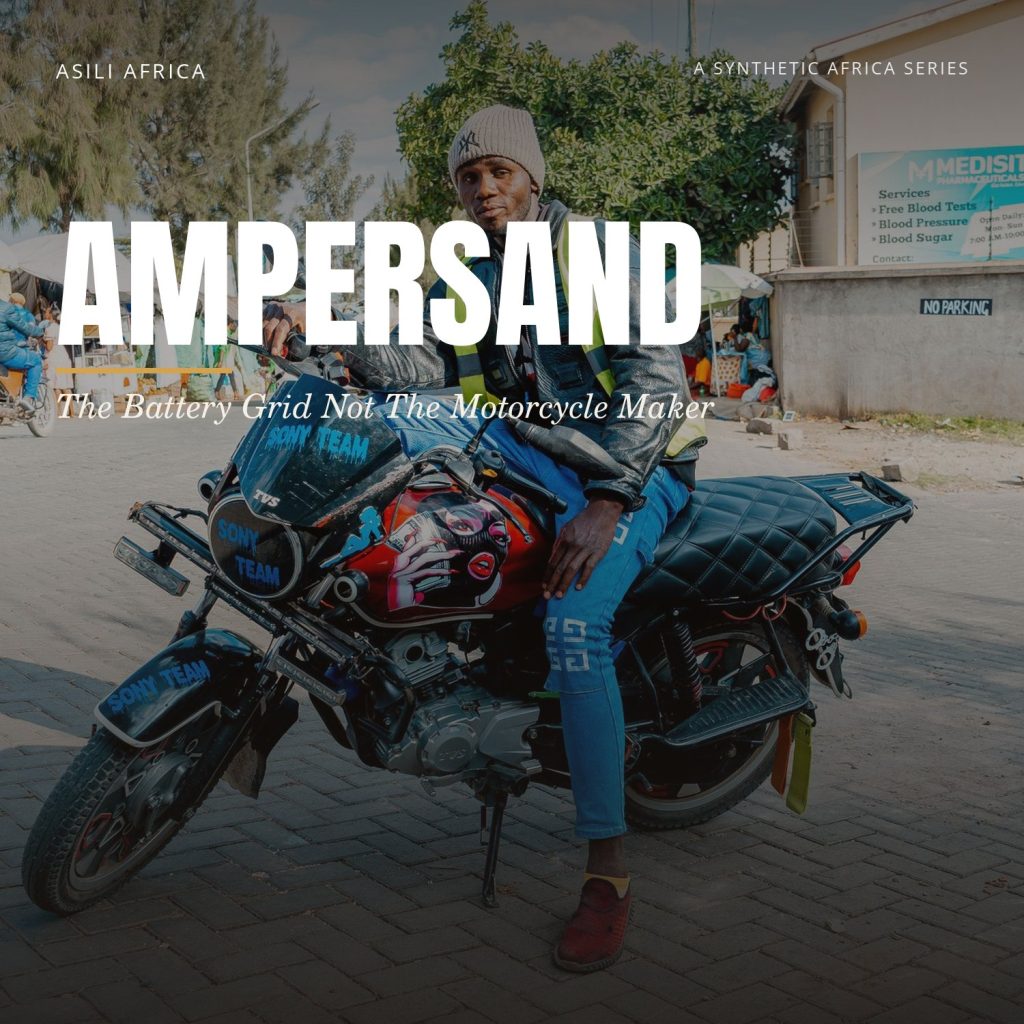
The Ampersand Story: The Battery Grid Not The Motorcycle Maker
Kigali. November of twenty twenty five.
Five agencies of the Rwandan government moved, jointly, on a single company. MINICOM. RICA. RSB. RURA. MININFRA. The company was Spiro — a pan African electric motorcycle operator, backed by Africa Fifty, with more than one hundred and fifty million dollars raised, and by that month more than twenty thousand motorcycles on Rwandan roads.
The complaints were brake failures leading to accidents, spare parts nobody could get, and an after sales service that had, in rider language, simply collapsed.
Fifteen months before, Spiro had overtaken the pioneer in Rwanda by fleet size, by a factor of roughly eight.
The pioneer was Ampersand. Ampersand did not declare victory.
By November of twenty twenty five, Ampersand had spent the year answering a different question. In May, it had renamed its motorcycle Alpha, so the parent brand could stand for something else. In December, it would open its battery swap network to any manufacturer that wanted to plug in.
By the time the government moved on Spiro, Ampersand was pulling back to the layer of the stack it had always known.
Not the vehicle. The battery.
TWO CURVES CROSSING
Twenty sixteen. Four people converged on Kigali who did not, between them, share a country.
Josh Whale was British, an intellectual property lawyer whose previous decade had been spent in China, representing international clients. From that seat he had watched, all through the twenty tens, the price of a lithium ion cell fall through the floor. Cheap, then cheaper, then cheap enough. Emmanuel Hakizimana was Rwandan, a mechanical engineer, the domestic operational leg of the four — the founder who would eventually be the country manager for Rwanda. Olaf Lange was German. He was the fourth co-founder. His current role at Ampersand is not on the public record; his biography is not on the public record either. Three of the four are visible in the searchable material. Lange is the fourth. And Alp Tilev — Turkish and Danish, computer scientist, ex-Microsoft in New York, then at a Norwegian search company called Fast Search — was already in Rwanda, working for a company called Great Lakes Energy.
The founding thesis was arithmetic between two curves.
Curve one: the global cost of a lithium ion battery, collapsing every year of the twenty tens as Chinese supply chains matured. Curve two: what a boda boda rider paid, every week, to keep a petrol tank full. About six thousand Rwandan francs a week on fuel and consumables. A driver in Kigali was taking home the change on either side of that number.
Somewhere in the middle of the decade, those two curves crossed. Not on paper. On a road. Batteries were now cheap enough that an electric motorcycle could, in principle, cost a Kigali rider about the same up front as a petrol equivalent, and less to run every day for the rest of its life. Nobody on the continent had built the physical stack — cells, packs, chargers, stations, telematics — to make that a real product for a real driver.
The four of them decided to be the ones who did. They incorporated in Kigali that year.
Before any of that — before the whiteboards in Kigali, before the first prototype, before a single motorcycle — Alp Tilev already had a job. He was an engineer at Great Lakes Energy in Rwanda, and his job was to keep the lights on at rural health clinics. Solar panels on the roofs. Lithium ion batteries under the panels. Remote telematics, over patchy networks, so an engineer sitting somewhere else could see which battery on which clinic on which hill was starting to fail.
Alp Tilev did not come to Rwanda to build motorcycles. He came to keep lithium batteries running on the rooftops of rural health clinics.
BATTERY AS A SERVICE, BORN OF NECESSITY
From twenty sixteen to twenty eighteen, in a workshop in Kigali, the four founders and a small team built motorcycle prototypes and battery prototypes from scratch.
There was no template on the continent. Nowhere in Africa had a commercial electric motorcycle already been running, and nowhere had a commercial battery swap service either. The team was writing both, in parallel, in a country whose regulator had never seen a lithium swap station and whose electrical grid was not designed to charge one at scale. Every design choice was first of a kind.
But the binding constraint through those first years was not engineering. It was money.
The number that mattered was what a boda boda rider could put down at the start of a day. A motorcycle in Kigali was already a real financial stretch. A rider borrowed to buy the bike and earned the loan payment back one fare at a time. A lithium ion battery big enough to move that motorcycle was, at those cell prices, most of the cost of the vehicle. If Ampersand tried to sell the rider a bike and a battery together, the sticker price was double a petrol equivalent, and the deal was dead.
So they separated the two.
The rider would buy or finance the motorcycle at rough parity to a petrol motorcycle. Ampersand would keep the battery, on its own balance sheet, and lease its use. The rider would ride into a station, slide the empty battery out, slide a full one in, and ride out again. Under two minutes. Roughly one dollar sixty per swap.
They called it battery as a service. It was not a financing trick. It was the same architecture as an off grid solar business — the customer pays for the service, the operator owns the asset — moved from a stationary roof to something that moves. The chemistry Alp Tilev had been monitoring on Rwandan clinic rooftops for years now sat under a motorcycle seat. The telematics that had once told him which panel on which hill needed attention now told a Kigali dispatcher which battery had how much range left, and where. Necessity gave them the model. The model was the moat.
Three years of prototypes. No revenue. Then, in May of twenty nineteen, Ampersand put twenty motorcycles on Kigali streets under a commercial lease.
Twenty was not scale. On a normal reading, twenty was a modest pilot. Twenty was also the first commercial electric motorcycles operating anywhere in Africa. Not the first prototype. The first commercial fleet. Every rider on those twenty bikes was, technically, a customer of a company that had, three years earlier, been an idea between four people in a workshop.
The lock in was already there — quietly, from day one. It was not designed as a competitive weapon. It was born as the answer to a credit problem the pilot could not have launched without. What Ampersand would eventually defend against a much larger competitor was built here.
THE PIONEER’S PLAYBOOK
Twenty twenty. Ampersand’s waiting list stood at seven thousand riders. Boda boda drivers, most of them in Kigali, wanting a bike the company could not yet build fast enough to give them.
Twenty twenty one. Rwanda enacted comprehensive e mobility incentives. No import duty, no VAT, no excise on electric vehicles, batteries, charging equipment or spare parts. A preferential fifteen percent corporate income tax rate for e mobility businesses. The regulator was building the market the company was trying to sell into.
Twenty twenty two. Named a World Economic Forum Technology Pioneer. A partnership with TotalEnergies to site swap stations on the fuel company’s forecourts. Late in the year, commercial entry into Kenya. By December, eight hundred motorcycles in service, sixty thousand swaps a month, swap stations in Kigali and Nairobi.
Twenty twenty four. In January, a Series A close of nineteen and a half million dollars, in equity and debt. In June, a memorandum of understanding with BYD, the Chinese lithium giant, for LFP cells sufficient for roughly forty thousand vehicles by the end of twenty twenty six. In October, a twenty one thousand square metre factory opened in Nairobi. Capacity sixty motorcycles a day.
The retention economics compounded through those five years. Ninety nine percent of batteries still active at eighteen months, on the company’s own data. Rider take home, on the company’s data, up about forty five percent when a driver switched from petrol to Ampersand. By late twenty twenty four, roughly twenty thousand battery swaps were happening across the two country network every day, and about nine hundred thousand kilometres were being covered daily by Ampersand powered motorcycles. Six thousand riders, across Rwanda and Kenya.
The forty five percent take home figure is the company’s, and it has never been independently audited. What an Ampersand ride feels like from the driver’s chair, at scale, is not on the public record. Two riders — one anonymous, in a World Economic Forum piece; one named, Patrick Sakwa, in a Kenyan feature — are the entire searchable record of what it is to earn a living on one of these motorcycles. Ampersand powers six thousand of them.
Ampersand does not carry the rider credit risk directly. Four lenders do — Bboxx, Watu, M-Kopa and Jali Finance. Between them they underwrite the vehicle purchase side of every rider deal. What their default rates are on Ampersand financed bikes, how they price the loans, what happens to a rider who falls a payment behind — none of that is on the public record. If Ampersand’s growth is credit driven and one of those partners tightens, the story changes.
A BETTER CAPITALISED COPY
In July of twenty twenty four, in Rwanda, Ampersand was overtaken by Spiro in fleet size.
Spiro was not a startup insurgent. It was an Africa Fifty backed pan African e motorcycle operator, running in Rwanda, Kenya, Uganda, Nigeria, Benin, and Togo. By late twenty twenty five, Spiro had raised more than one hundred and fifty million dollars — a one hundred million dollar round in October of that year, followed a few months later by a fifty million dollar debt facility. Ampersand’s cumulative disclosed equity and debt across ten years sat somewhere between thirty five and forty eight million dollars. The public trackers disagree by ten to fifteen million and the reconciliation is not achievable from the record. Call it, roughly, one third of what Spiro had raised.
The gap in vehicles was wider than the gap in capital.
In Rwanda alone, by late twenty twenty five, Spiro had roughly twenty five thousand motorcycles on the road and up to six hundred and fifty swap stations. Ampersand had roughly two thousand seven hundred vehicles in Rwanda, and eleven swap stations in Kigali. Three to four times the capital. Eight times the fleet.
Ampersand’s counter claim, when it came, was narrow and specific. On new sales in Kigali — new motorcycles bought that year, not the cumulative fleet on the road — Alpha outsold competitors nine to one. In Nairobi, four to one. These are the company’s own numbers. Spiro has not publicly contested them. Spiro’s own fleet size figures are also company supplied. No third party audits the numbers on either side.
Both sets of claims can be true simultaneously. A company deploying at speed can carry a much larger cumulative fleet and still, in a given quarter, lose the per unit sales race among newly buying riders. Or the nine to one figure is narrow — one metric, one segment, one month. Neither reading resolves from the public data. Both stand as claims.
Fifteen months after the July overtake, five Rwandan agencies moved on Spiro over brake failures, spare parts shortages and after sales collapse.
None of those data points shows that Spiro built a better vehicle. They show that Spiro deployed vehicles faster than its service network could catch up with. The competition between the two companies, through twenty twenty four and twenty twenty five, was on the speed of deployment, which is capital intensive. It was not, on the visible evidence, on the quality of the unit.
That left Ampersand with a strategic question. If the pioneer had been out deployed at the vehicle layer, what game was Ampersand actually in?
WHAT AMPERSAND ALWAYS WAS
In May of twenty twenty five, Ampersand renamed its motorcycle Alpha.
Publicly, that was a product story. About fifty engineering upgrades, a hill park device, a regenerative braking button, a reinforced rear wheel. But the frame was the story. If the motorcycle had its own name, the parent brand could stand behind it as something else — an energy platform sitting above a fleet of vehicles, rather than a motorcycle manufacturer. Alpha was one product on top of the stack. Ampersand was the stack.
Five months before the rebrand, the Kigali ICE registration ban had come into force. No petrol motorcycle could now be newly registered for public transport in the city. That is state policy, not company achievement. Ampersand did not deliver it, and if a future Rwandan government softens it, the moat weakens. But from January of twenty twenty five onwards, every new commercial motorcycle registered in Kigali had to be electric. In July, Rwanda published a national e mobility strategy, targeting thirty percent of motorcycles electric by twenty thirty. In August, the government mandated that ride hailing platforms include electric options. The state was building the market.
In November of twenty twenty five, the five agencies moved on Spiro. Brake failures. Spare parts shortages. After sales collapse. Spiro publicly responded, admitted faults, said it was upgrading.
Every headline about electric motorcycle problems in Rwanda hurts the whole category. Vindication for the pioneer and contagion for the sector are the same event, and there is no clean way to be pleased about it.
In December of twenty twenty five, Ampersand opened its swap network to any third party motorcycle manufacturer that wanted to plug in.
The bet: batteries and swap stations are the natural monopoly — physical infrastructure that takes years and hundreds of millions of dollars to build, and cannot be cloned in a quarter with capital. Vehicles are the commodity. Any manufacturer that can put a compatible battery pack on a motorcycle can, from the moment the network opens, ride into a Kigali station and swap.
Three of the four risks that matter next are exogenous to Ampersand. Whether the Kigali ICE registration ban stays enforced, and whether it spreads to Kenya. Whether BYD keeps supplying cells at agreed terms through twenty twenty six and beyond. Whether Spiro’s problems tar the whole category. And, on the platform side, whether third party manufacturers actually plug in.
After ten years, Ampersand has never disclosed revenue. The only profitability claim is Kenya, in August of twenty twenty five. Rwanda — the larger and older market — is not on the public record. Nor are the people. Of the roughly three hundred employees across the Kigali and Nairobi plants, no press profile has yet talked to an assembly line worker, a swap station attendant, or a Nairobi manager. Seven anonymous reviews on one venue are not a substitute for that reporting. Neither is silence.
As of the December announcement, one third party manufacturer had plugged in.
Wylex Mobility. One partner.
Ampersand’s answer to a better capitalised copy was to become again what its engineering team had always known how to build. Whether the world moves toward a fleet of interoperable batteries and commoditised motorcycles is, by the pioneer’s own admission, no longer up to Ampersand.
Ten years ago, four people from four countries came to Kigali with a thesis about lithium cost curves and rural infrastructure. They built a battery. Then they built a motorcycle around it. Then, when a much larger competitor came for the motorcycle, they let it — and doubled down on the battery. Whether the market plugs in behind them is a question the pioneer can only ask, and wait to be answered. This is Asili Africa. Every empire has an origin. See you on the next one.
Key Takeaways
- TWO CURVES CROSSING. Twenty sixteen.
- THE PIONEER’S PLAYBOOK. Twenty twenty.
- A BETTER CAPITALISED COPY. In July of twenty twenty four, in Rwanda, Ampersand was overtaken by Spiro in fleet size.
- WHAT AMPERSAND ALWAYS WAS. In May of twenty twenty five, Ampersand renamed its motorcycle Alpha.
Also available on YouTube — search “Asili Africa” or subscribe to our channel.